SLIDE 1
Middle School Study
SLIDE 2
PRE NELMS
SLIDE 3 The Process
- 1. During the 2016 - 2017 school year, the Middle School
Steering Team Worked with the entire middle school faculty and staff to create a Self-Study (2016-2017). The team created a survey regarding areas of strength, areas of challenge, and areas of immediate need, which they distributed to the faculty. Members of Middle School Steering Team: Kerri Sandler, Catherine Duggan, Holly Sullivan, Eileen Weisslinger, Jeff Knight, Joan McTigue, Paula Jewell, Gail St.Peter, Donna Melia, Erin Ryan, Catherine Nelligan, Bob Erlandsen, and Kathy Sanges
SLIDE 4 The Process
Last Year’s Findings Regarding Areas of Strength, Areas of Challenge & Areas of Immediate Need:
- A. Areas of strength: teacher-student relationships and a highly
qualified faculty
- B. Areas of challenge: special education schedule, executive
functioning for students, some class size concerns, student anxiety, and the need for more “fun”
- C. Areas of immediate need: middle school identity, middle
school office to facilitate communication, and some facility issues
SLIDE 5 The Process (continued)
- 2. Also in 2016-2017, the Middle School Steering Team created
six subcommittees (2016-2017) in order to address the needs identified in the self-study. Culture, Grading Practices, Curriculum, Student Supports, Schedule and Structure These committees met once a month from December to April to identify areas within their subcommittee, which they thought should be a focus
SLIDE 6
CHANGES THAT WERE PUT IN PLACE THIS YEAR
SLIDE 7
Skipper Creed
SLIDE 8
Skipper Creed
SLIDE 9
Skipper Creed Awards Ceremony
SLIDE 10
Skipper Creed
SLIDE 11
Skipper Creed
SLIDE 12
Fun and Learning: Learning Opportunities for Students
SLIDE 13
Fun and Learning: Middle School Teacher Book Club
SLIDE 14
Fun and Learning: Middle School Spirit Days
SLIDE 15
Middle School Bumper Magnets (Branding)
SLIDE 16
Office Hours in the Middle School
SLIDE 17
Executive Function Classes at the Middle School
SLIDE 18
BRYT Program Tiered Support
SLIDE 19
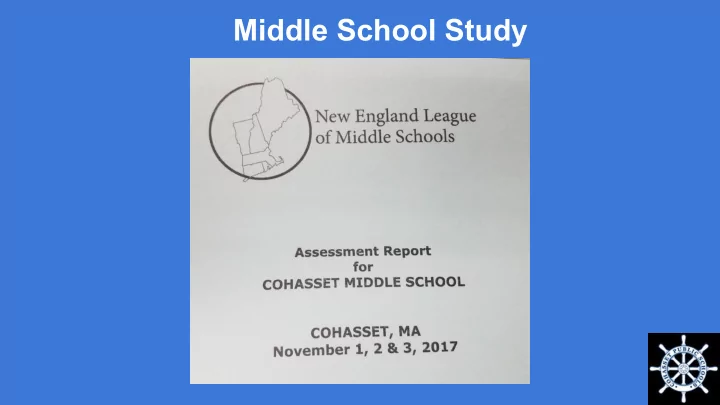
The NELMS Part of the Process
SLIDE 20 The Process (continued)
- 4. The Steering Team worked to bring New England League of Middle
Schools (NELMS) to CMS to complete a middle school study and to help steer the next steps in the process.
Visiting Team Members: William Downey, Team Leader Jerry Frew, Executive Director of NELMS Cynthia Bresnahan, Middle School Special Education, Norton, MA Alexander Hoyt, Middle School Teacher, Hudson, MA Kathryn Small, Middle School Teacher, Wolfeboro, NH
SLIDE 21
WHY NELMS?
The NELMS Assessment... Is Research-Based: It is based on the research in Turning Points 2000, and it incorporates AMLE's This We Believe-Successful Schools for Young Adults. Is Flexible - NELMS tailors the plan to individual school needs Provides for follow-up services
SLIDE 22 WHY NELMS? (continued)
Seven Areas are analyzed:
- Relevant, standards-based
curriculum
- Instructional strategies appropriate
for young adolescents
- Opportunities for middle level
professionals
- Organization of students and
teachers
- Building governance
- School climate
- Parent and community involvement
SLIDE 23 The Process (continued)
- 5. NELMS created and distributed surveys to collect information
Surveys were distributed to: Student Surveys: Grades 6-9 Faculty & Staff Surveys: Grades 6 – 8 (including support staff) Parent Surveys: Parents of all current middle school students The results of the surveys helped inform the assessment.
SLIDE 24 The Process (continued)
- 6. The Visiting Team members conducted a school visit on
November 1, 2, & 3. During the visit the team: Toured school and talked to Student Council Representatives Visited all classrooms Interviewed staff Interviewed school committee Interviewed parents Interviewed administration Worked with steering committee Viewed learning products
SLIDE 25 The Process (continued)
- 7. The Visiting Team members created a
comprehensive assessment report, which was shared with the steering team. This included results from the surveys and from the visit.
- 8. Results were shared with steering team who
worked to analyze the data and to create a list of next steps.
SLIDE 26
Identified Strengths and Recommendations from the NELMS Team
SLIDE 27 Some of the Strengths Noted in The NELMS Assessment
- Curriculum meets high academic expectations
- Varied formative assessments
- Students are respectful and academically driven to
succeed
- Teacher-student interactions are positive
- Facilities are bright and positive
SLIDE 28 Some of the Strengths Noted in The NELMS Assessment (continued)
- Active and positive PSO
- Exceptionally dedicated staff
- Highly qualified staff
- The NELMS visiting team praised the work of the
steering committee
SLIDE 29
Recommendations from the NELMS Assessment
The Steering Team organized the important recommendations into five categories:
Communication Culture Curriculum / Assessment / Instruction Staff Development Other
SLIDE 30
Recommendations: Curriculum/Assessment/Inst.
Investigate flexible scheduling models and planning time to promote and support initiatives (PBL, SEL, etc.) Revisit curriculum so that it fits the middle school model of student development (social emotional, physical and academic development of adolescents) Explore standards-based reporting of grades Continue to develop a more robust Tier II intervention strategy (with support from professional development)
SLIDE 31
Recommendations: Staff Development
Develop highly effective instructional teams Develop interdisciplinary curricula and/or projects Investigate effective Advisory models for implementation Expand Co-teaching (professional development to support our co-teaching initiative)
SLIDE 32
Recommendations: Communication
Showcase more of our Middle School achievements and identity Explore creative ways to conference with parents Identify further opportunities to bring parents and community into CMS
SLIDE 33
Recommendations: Culture
CREATE MORE OF A “MIDDLE SCHOOL” IDENTITY Find more ways to celebrate students achievement (socially and academically) Promote social-emotional learning skills on the part of our students
SLIDE 34
Recommendations: Action Planning Team
“There is a need for an Action Planning Team with broad-based representation comprised of faculty, staff, parents, students and community representatives. This group should analyze the NELMS report and last year’s work to create an action plan. This team should be an ongoing group, which meets regularly to help implement best middle school practices and to advocate for professional development that helps the middle school.”
SLIDE 35
NEXT STEPS
SLIDE 36
Next Steps
Have faculty, parent and student conversations about the report to gain a better understanding of what is wanted/needed
SLIDE 37
Next Steps
Develop larger Action Planning Team: Reach out beyond the school to involve SC member, parents and community in our action plan. With the larger committee, develop the plan with concrete info and realistic timeline and clearly articulated steps ■ Goal, Action Steps, Resources, Responsible Party, Timeline, School visits WORK WITH THE ACTION PLANNING TEAM TO CREATE A MIDDLE SCHOOL MISSION & VISION
SLIDE 38
Next Steps (continued)
Present the agreed upon Action Plan to the School Committee and Faculty
SLIDE 39
THANK YOU!
Thank you to the Steering Team, to the NELMS Visiting Team, to the Cohasset School Committee, to the CMS PSO and parents who were interviewed by the visiting team, and to the students, faculty and staff of Cohasset Middle School.
SLIDE 40
We Are CMS!