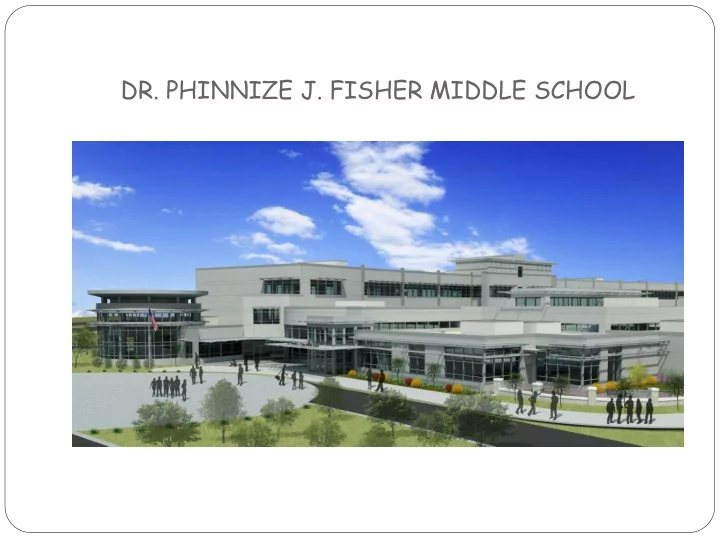
DR. PHINNIZE J. FISHER MIDDLE SCHOOL DR. PHINNIZE J. FISHER MIDDLE - - PowerPoint PPT Presentation

dr phinnize j fisher middle school
SMART_READER_LITE
LIVE PREVIEW

DR. PHINNIZE J. FISHER MIDDLE SCHOOL DR. PHINNIZE J. FISHER MIDDLE - - PowerPoint PPT Presentation

DR. PHINNIZE J. FISHER MIDDLE SCHOOL DR. PHINNIZE J. FISHER MIDDLE SCHOOL South Carolina Standardized Testing 2015 ACT Aspire SC PASS DR. PHINNIZE J. FISHER MIDDLE SCHOOL Fisher Middle School for the 2015 testing cycle will administer all


slide-1
SLIDE 1
  • DR. PHINNIZE J. FISHER MIDDLE SCHOOL
slide-2
SLIDE 2
  • DR. PHINNIZE J. FISHER MIDDLE SCHOOL

South Carolina Standardized Testing 2015 ACT Aspire SC PASS

slide-3
SLIDE 3
  • DR. PHINNIZE J. FISHER MIDDLE SCHOOL

 Fisher Middle School for the 2015 testing

cycle will administer all as paper tests.

 Students in 6th grade will take a new test, the

ACT Aspire. Students will take ELA (English, reading and writing) and math tests.

 Additionally, all students in 6th grade will take

the SCPASS science and social studies tests.

slide-4
SLIDE 4
  • DR. PHINNIZE J.FISHER MIDDLE SCHOOL

 ACT Aspire, which is a timed test, will

require students to answer multiple choice questions and complete a writing sample.

 SCPASS, which is an untimed test, will

require students to answer multiple choice questions.

 Both tests are aligned to the state

standards that are being taught in your child’s classroom.

slide-5
SLIDE 5
  • DR. PHINNIZE J. FISHER MIDDLE SCHOOL

ACT ASPIRE

  • WRITING

30 MIN TUESDAY, APRIL 28

  • ENGLISH

35 MIN TUESDAY, APRIL 28

ACT ASPIRE

  • READING

60 MIN WEDNESDAY, APRIL 29

  • MATH

55 MIN THURSDAY, APRIL 30

SCPASS

  • SCIENCE UNTIMED

THURSDAY, MAY 7

  • SOC STU UNTIMED

FRIDAY, MAY 8

slide-6
SLIDE 6
  • DR. PHINNIZE J. FISHER MIDDLE SCHOOL

Math Department Head

  • Mrs. Kim Skipper
slide-7
SLIDE 7

ACT Aspire Math

 Multiple Choice and Constructed Response  Heavy Emphasis on Geometry

slide-8
SLIDE 8

ACT Aspire Math Continued

 Questions requiring Formulas will provide them  DOK Breakdown:

 Level 1 -

7-15%

 Level 2 – 39-41%  Level 3 – 48-57%

 Justification: Explain correct/incorrect  Can use Calculator for simple operations

 +, -, ÷, X

slide-9
SLIDE 9

Depth of Knowledge Samples

Level 1 Level 2 Level 3

  • Can you

identify____?

  • What is ____?
  • How would you

write?

  • What is the

formula for_____?

  • Can you explain

how ____ affected _____?

  • How are _____

alike and different?

  • How can you

classify_____?

  • How would you

estimate____?

  • How is ____

related to___?

  • What conclusions

can you draw?

  • What would

happen if____?

  • Can you formulate

a theory for ____?

slide-10
SLIDE 10

How to Prepare

In class:

Time limits on bell ringers/starters Time awareness/limits

At home:

Complete unit review as test Watch time on homework completion

Most importantly: DO NOT STRESS

slide-11
SLIDE 11
  • DR. PHINNIZE J. FISHER MIDDLE SCHOOL

ELA Department Head

  • Mr. Gage McAngus
slide-12
SLIDE 12

Tools and paper

 No tools allowed (dictionaries,

thesaurus)

 Scratch paper for planning is allowed  Pages for final draft contained in test

booklet

 Grade 6: 3 pages of wide-ruled paper

slide-13
SLIDE 13

How is writing assessed?

Competent student writing entails:

  • Generating ideas
  • Developing ideas
  • Sustaining ideas
  • Organizing ideas
  • Communicating ideas (includes

grammar conventions, style and tone)

slide-14
SLIDE 14

Writing rubric domains

  • 1. Development (scored 1-6)
  • 2. Organization (scored 1-6)
  • 3. Language Usage (scored 1-6)
  • 4. Ideas and Analysis (Mode Specific

criteria for Narrative, Informational,

  • r Argument) (scored 1-6)

Each domain has a six point scale - 4 is considered “adequate”

slide-15
SLIDE 15

Supporting timed writing

1. Provide sufficient explicit instruction in writing

  • 2. Begin experimenting with timed writing only

after explicit instruction has been given

  • 3. Offer oral prompting strategies for managing

time

  • 4. Wean them off the oral prompting several

weeks before the exam.

slide-16
SLIDE 16

Timed Writing Plan

 Start timed writing practice in mid-March  Weekly  Structure the time for them in the

beginning and give oral prompts to move process along (i.e., 5 minutes for brainstorming, 5 minutes to organize, 15 minutes to draft, five minutes to edit)

 Wean them off the oral prompting by mid-

April

 Emphasize that timed writing is scored

differently from untimed writing and that small errors are overlooked.

slide-17
SLIDE 17

English test

Three main areas for assessment through evaluation of passages:

  • Conventions of Standard

English

  • Production of writing
  • Rhetorical purpose
slide-18
SLIDE 18

Conventions

  • Punctuation conventions
  • Usage conventions
  • Sentence structure and

formation (understanding of the relationships between and among clauses, placement of modifiers, and shifts in construction)

slide-19
SLIDE 19

Production/Rhetorical Purpose

Test-takers will apply their understanding of :

  • Topic development (purpose and audience)
  • Organization, unity, and cohesion
  • Knowledge of language (precise, concise, and

stylistically consistent)

slide-20
SLIDE 20

Reading test

The ACT Aspire reading assessments measure students’ ability to derive meaning from, and reason logically about, text

  • passages. Assessed through MC and CR.
  • Key ideas and details
  • Craft and Structure
  • Integration of knowledge
slide-21
SLIDE 21

Constructed Response (CR)

Constructed-response tasks in the ACT Aspire reading assessments include:

  • Formulate a conclusion by making connections within a passage and

provide support using specific details from the text.

  • Formulate a conclusion by making connections between a pair of

passages and provide support using specific details from both texts.

  • Identify cause and effect relationships within a passage and

provide support using specific details from the text.

  • Identify similarities and differences between the key ideas of

paired passages and provide support using specific details from both texts.

slide-22
SLIDE 22

Sample CR question

The passage states that the gray cub “had early discovered that one wall of his world was different from the rest” (line 20). Explain how the gray cub feels about this discovery. Use two details from the passage to support your answer.

slide-23
SLIDE 23

CR Scoring

  • Constructed-response tasks are scored

according to rubrics that give students varying amounts of credit for responses that are correct or partially correct, enabling differentiation between multiple skill levels.

  • Each rubric is unique to the question

stem

slide-24
SLIDE 24
  • DR. PHINNIZE J. FISHER MIDDLE SCHOOL

 TEST TAKING TIPS  Students should pay close attention to

directions and should note and highlight words that may assist in answering the questions.

 In the reading comprehension section, test-

takers should start by previewing the questions prior to reading the passage to help know what to look for.

slide-25
SLIDE 25
  • DR. PHINNIZE J. FISHER MIDDLE SCHOOL

 In multiple choice questions, test-takers

should rule out answers they know are

  • incorrect. It will then be easier to figure out

the correct answer.

 Pay attention to the time. Introduce your

child to the concept of time management.

slide-26
SLIDE 26
  • DR. PHINNIZE J. FISHER MIDDLE SCHOOL

 Minimize Anxiety!  Encourage your child to relax and to view the

test as a chance to show what they know. Reassure them it is natural to feel nervous and the most important thing is to try their BEST!

slide-27
SLIDE 27
  • DR. PHINNIZE J. FISHER MIDDLE SCHOOL
slide-28
SLIDE 28
  • DR. PHINNIZE J. FISHER MIDDLE SCHOOL

 THE DAY BEFORE: Make sure your child

gets a good night’s sleep. Test scores can be greatly affected when a child has not gotten enough rest.

 TEST Day: A good breakfast the morning

  • f the test is a terrific brain booster.

Nutrients help stimulate the brain!

slide-29
SLIDE 29