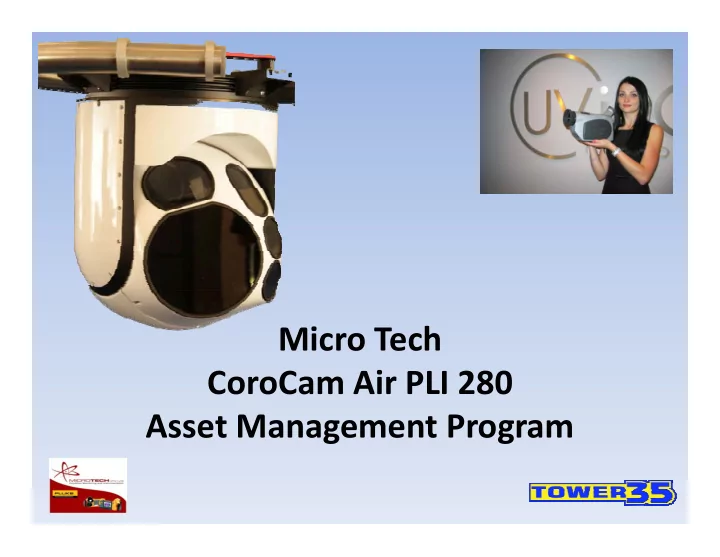
Micro Tech CoroCam Air PLI 280 CoroCam Air PLI 280 Asset Management - - PowerPoint PPT Presentation
Micro Tech CoroCam Air PLI 280 CoroCam Air PLI 280 Asset Management Program Airborne Power Line Inspection Airborne Power Line Inspection CoroCam Air (PLI280) Prepared by: Pieter van Jaarsveld Jacques Theron October 2010 Scenario:
Airborne Power Line Inspection Airborne Power Line Inspection CoroCam Air (PLI280)
- Prepared by: Pieter van Jaarsveld
Jacques Theron
- October 2010
Scenario:
- Power lines and their associated servitudes are long distance
features that requires structured and repeatable management approaches
- A key component in this process is collection of condition data in a
cost effective and repeatable manner
- This condition data consist of a complex arrangement of
information, spread over large distances
- The information needs to be collected, stored and managed in an
accessible and repeatable manner
- Examples of relevant data is video imagery, high resolution still
imagery, UV imagery, infra red imagery and spatial data
- With the source data available, reporting is required to reduce this
data to an accessible and manageable format
Approach:
- Airborne to cover distances at speed and without terrain limitation
- Stabilized and steerable and protected sensor suite to improve view and
Stabilized and steerable and protected sensor suite to improve view and remove airframe dynamics from the sensor line of sight
- Sensors in order of importance is HD color video, high resolution
h t t i till UV d th l i photogrammetric still, UV and thermal imager
- Image information excluding still is fused as a single display, providing overview
- f all information to the operator
- Information is recorded with spatial information (position, orientation and
time) embedded
- Post processing automatically links information to spatial position, to form the
backdrop for reporting
- Reports are thus linked to spatial position, with all the supporting imagery
interactively available
Implementation:
Simple architecture consisting of:
- Gimbal with sensors
- Laptop gimbal and sensor controller
- High definition display
- High definition recorder
- Post processing and reporting PC and software.
Features: Features:
- 4 axis light weight, non ITAR, purpose designed, stabilized payload system
- Highly transportable and easy to mount
- High resolution photogrammetric color stills
- HD video imagery
UV ti
- UV sensor option
- Radiometric infrared sensor option
- Multi‐spectral image fusion
- Spatial referencing on all imagery
Spatial referencing on all imagery
- Interactive imagery / position display and reporting environment
Operational Approach:
- The system is configured to supply maximum information, with minimum operator
input
- All sensors, except the HD day are focused at infinity, to simplify
- All sensor information (except still) is fused into a single image, to provide maximum
id tifi ti bilit identification capability
- Information is recorded with integrated spatial information, making it possible to
automatically relate imagery to position and time
- The operator will steer the line of sight to view objects of interest. On the HD day
image the filtered UV and filtered IR information is super imposed
- This queues the operator towards possible problem areas. The HD zoom camera can
then be controlled to look at detail
- The photogrammetric still camera provides overview and servitude information
- Object positions can be determined through still imagery
Airborne Hardware
Monitor M lti S Gi b l Multi Sensor Gimbal Laptop Controller Recorder
Specifications Specifications
Day
Sony FCB-H11 1920 x 1080 pixels 16 : 9 aspect ratio Spatial resolution 1 2 mm @ 30 m
Still
Canon EOS 550D 18 mega pixel 5184 x 3456 pixels 35 mm lens
Ultra Violet
Uvirco CoroCAM 504 core 8 x 5.5 0 field of view 20 m minimum focus distance
Infra Red
Thermoteknix Miricle 307 8 - 12 μm micro bolometer 640 x 480 pixels 50 mm focal length
Sensors
Spatial resolution 1.2 mm @ 30 m 5.1 to 51 mm zoom 4.4 x 2.5 0 Narrow 42 x 24 0 Wide 35 mm lens 35 x 24 0 field of view Spatial resolution 3.6 mm @ 30 m 18 m minimum focus distance 50 mm focal length 18.2 x 13.7 0 field of view Spatial resolution 15 mm @ 30 m
Gimbal
Gimbal
280 mm diameter < 22 kg mass + 10 0 to - 140 0 elevation freedom 360 0 continuous azimuth freedom < 15 μrad rms stabilization
Laptop Controller
Converted to HD-SDI 1080 50i Contains spacial information
Monitor
JVC BT-LH1710 16:9 aspect ratio HD-SDI input
Recorder
Client furnished
System
μ Optical serial digital output Onboard digital excitation and control 150 knots maximum speed
- 10 to + 45 0 C operating temperature
Conclusion: Conclusion:
- The complexity, data quantity and reporting requirements
demands a purpose specific implementation, mechanizing repeatable data collection and reporting, from a airborne platform
- The PLI280 provides an operational cost‐effective solution,
through high levels of integration, combined with small size and low mass
Corona Detection & P.D.
- Broken or damaged strands
- Damaged insulator discs
g
- Spark gaps on loose clamp
- Pollution,conductors,insulators
- Missing or damaged rings
g g g
- Incorrect arc horns
- Flash‐over paths
- Sharp hardware protrusions
Sharp hardware protrusions
- Corroded conductors
- Power loss
- Environmental Pollution
Environmental Pollution