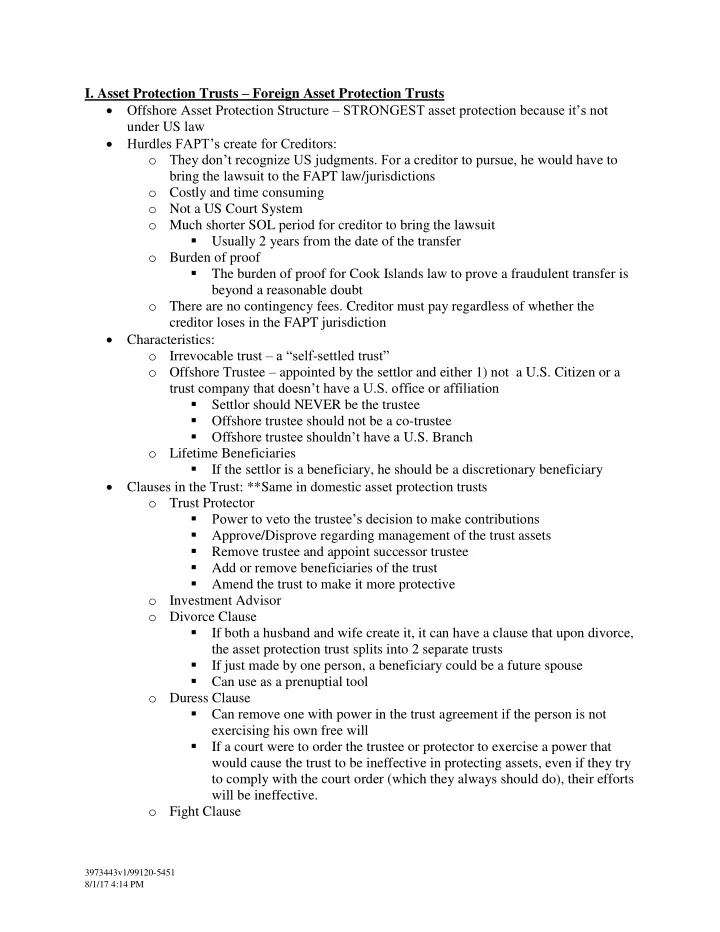
I. Asset Protection Trusts Foreign Asset Protection Trusts Offshore - - PDF document

i asset protection trusts foreign asset protection trusts
SMART_READER_LITE
LIVE PREVIEW

I. Asset Protection Trusts Foreign Asset Protection Trusts Offshore - - PDF document

I. Asset Protection Trusts Foreign Asset Protection Trusts Offshore Asset Protection Structure STRONGEST asset protection because its not under US law Hurdles FAPTs create for Creditors: o They dont recognize US judgments.


slide-1
SLIDE 1

3973443v1/99120-5451 8/1/17 4:14 PM

  • I. Asset Protection Trusts – Foreign Asset Protection Trusts

 Offshore Asset Protection Structure – STRONGEST asset protection because it’s not under US law  Hurdles FAPT’s create for Creditors:

  • They don’t recognize US judgments. For a creditor to pursue, he would have to

bring the lawsuit to the FAPT law/jurisdictions

  • Costly and time consuming
  • Not a US Court System
  • Much shorter SOL period for creditor to bring the lawsuit
  • Usually 2 years from the date of the transfer
  • Burden of proof
  • The burden of proof for Cook Islands law to prove a fraudulent transfer is

beyond a reasonable doubt

  • There are no contingency fees. Creditor must pay regardless of whether the

creditor loses in the FAPT jurisdiction  Characteristics:

  • Irrevocable trust – a “self-settled trust”
  • Offshore Trustee – appointed by the settlor and either 1) not a U.S. Citizen or a

trust company that doesn’t have a U.S. office or affiliation

  • Settlor should NEVER be the trustee
  • Offshore trustee should not be a co-trustee
  • Offshore trustee shouldn’t have a U.S. Branch
  • Lifetime Beneficiaries
  • If the settlor is a beneficiary, he should be a discretionary beneficiary

 Clauses in the Trust: **Same in domestic asset protection trusts

  • Trust Protector
  • Power to veto the trustee’s decision to make contributions
  • Approve/Disprove regarding management of the trust assets
  • Remove trustee and appoint successor trustee
  • Add or remove beneficiaries of the trust
  • Amend the trust to make it more protective
  • Investment Advisor
  • Divorce Clause
  • If both a husband and wife create it, it can have a clause that upon divorce,

the asset protection trust splits into 2 separate trusts

  • If just made by one person, a beneficiary could be a future spouse
  • Can use as a prenuptial tool
  • Duress Clause
  • Can remove one with power in the trust agreement if the person is not

exercising his own free will

  • If a court were to order the trustee or protector to exercise a power that

would cause the trust to be ineffective in protecting assets, even if they try to comply with the court order (which they always should do), their efforts will be ineffective.

  • Fight Clause
slide-2
SLIDE 2

2

  • Allows a trustee or the trust protector to change the jurisdiction of the

FAPT/DAPT. This can be trigged upon the FAPT/DAPT laws of the state being held invalid  Downsides:

  • Settlor should NOT retain control over the appointment of the offshore trustee, or

if the trust protectors or trust advisors have the power to remove and replace the

  • ffshore trustee, several courts around the U.S. have forced either of these parties

to dissolve the trust.

  • **Judges have held the debtor, his trust adviser, or trust protector, in

contempt of court and have put them in jail until they comply with the court’s order.

  • An offshore trust will be most effective if the debtor/settlor is willing to

relinquish all control over the offshore trust and the offshore trustee and if all parties to the trust other than the settlor are outside the jurisdiction of the United States.

  • Judges have thrown the settlor in jail for contempt of court
  • Advice: transfer the assets before the asset protection is needed, eliminate the

possibility of contempt of court

  • Tax Reporting – higher reporting requirements
  • May be uncomfortable for the client
  • Vulnerable in bankruptcy
  • If settlor files for bankruptcy, the bankruptcy courts have worldwide

jurisdiction – but the enforcement of bringing debtor’s property outside the US is into the bankruptcy estate is difficult

  • Settlor still must pay taxes on the money

 Foreign Jurisdictions:  Critics:

  • “It’s the idea of being outside the rule of law: that you can put money into a trust,

do something wrong and not have to worry about answering in court for your

  • actions. It’s a way of making that money disappear. It’s not nice and it’s not

right” Jack A. Blum – Chairman of Tax Justice Network USA  Supporters:

  • Lawyers who arrange Cook trusts see them as a negotiating tool: If litigation

arises, many creditors will settle for cents on the dollar, rather than face the expense of a long and difficult lawsuit halfway across the Pacific

  • II. Breaking Down

 Under Local Law for Domestic Asset Protection Trusts

  • Child support obligations
  • Delaware & Rhode Island: trust assets are not protected against child

support claims period

  • Alaska & Utah: trust assets aren’t protected from child support claims if at

the time of the transfer the settlor was in default by 30 days or more in making those payments.

  • Nevada: no spendthrift trust exception for child support
  • Fraudulent conveyances statutes
slide-3
SLIDE 3

3

  • Asset protection trust statutes do NOT override the state’s fraudulent

conveyance statutes, but differs on how the fraudulent conveyance statute is applied

  • Delaware & Wyoming – the burden of proof for fraudulent conveyance

regarding an asset protection trust is clear and convincing evidence

  • Nevada – only a 2 year SOL period from the time of the transfer or 6

months after the transfer reasonably should’ve been discovered

  • Spousal claims
  • Delaware, Rhode Island, & Utah: exempts marital property divisions or

distributions from protection

  • Tort claims from injuries occurring on or before the date of transfer of the trust
  • Delaware: doesn’t insulate trust property from a person who suffers tort

injuries (death, personal injury, or property damage) on or before the date

  • f the transfer to the trust – in cases where the injury or damage is caused

in whole or in part by an act or omission of the transferor or by someone from whom the transferor is or was vicariously liable

  • Alaska: doesn’t have this provision at all.
  • Sham or alter-ego transaction
  • Applicability: when the settlor has retained excessive control in the trust

document or through inappropriate trust administration and a failure to adhere to trust formalities

  • Result: trust assets are subject to levy
  • The transfer is against public policy
  • Applicability: applies to states where self-settled trusts are not recognized

– the trust can be disregarded for public police reasons. State public policy provides an exception to the choice of law language in the trust instrument to prevent the other court from having jurisdiction

  • Process:

 1) establish that the court has jurisdiction  2) determine whether the law designated in the trust or the law of the court with jurisdiction should govern

  • Factors: Settlor residency, trust asset location, creditor

residency, operation of business, trust administration, and location of legal professionals  11 U.S.C. 548 – Fraudulent Transfers under federal bankruptcy law

  • TIP/DIP can use this in conjunction with state law remedies because of § 544(b)

that gives the DIP/TIP the power of a hypothetical lien creditor under state law

  • § 548(a)(1): TIP/DIP can bring the action as long as the transfer was made 2 years

before the filing of the petition

  • § 548(e): 10 year look back period applies to asset protection trusts if the trust

was created with an actual intent to hinder, delay, or defraud creditors, the amount

  • f the exemptions will be reduced.
  • It can be proven by actual fraud or constructive fraud if the debtor was insolvent
  • n the date of the transfer or because of the transfer the debtor became insolvent

AND the debtor received less than reasonable equivalent value in exchange for the transfer

slide-4
SLIDE 4

4  Contempt Powers – civil contempt orders

  • Applicability: once the U.S. court gets jurisdiction over the person of the debtor,

the courts will consider using civil contempt orders to induce the trustee of the foreign trust to repatriate the assets to the U.S. in satisfaction of the judgment

  • Compel repatriation of foreign assets or contempt of court for failing to comply

with the repatriation order

  • Repatriation order – settlor is ordered to appoint a US trustee for the
  • ffshore accounts OR repatriate the assets held in those trusts to satisfy the

judgment, as long as the settlor makes a significant effort to repatriate the funds to the US – Grant

  • Held: The settlor had sufficient power to repatriate the corpus of the
  • ffshore trusts such that once those funds are in the U.S. they must be

applied to her tax debt. She had control over the offshore trusts by having $221,000 in trust funds deposited into her children’s accounts.  Embargo Orders

  • Some Americans have gone around US embargo orders and placed the proceeds

into offshore accounts

  • Example: Marc Rich traded with Iran and placed the $100 million he made

into an offshore account in the Cook Islands  Treaties

  • US & Bermuda – Bermuda Income Tax Treaty 1986
  • Purpose: exchange of info and assistance in collection issues against non-

Bermuda residents for criminal & civil cases

  • US & Bermuda – FATCA: Foreign Account Tax Compliance Act
  • Purpose: mutual assistance in tax matters & desire to conclude an

agreement to improve their cooperation in combating international tax evasion

  • Applicability: applies to Reporting Bermuda Financial Institutions that

registers with the IRS must report on the holdings of U.S. taxpayers to the IRS or face penalties

  • US & Bahamas
  • Entered into mutual assistance agreements regarding disclosure of info in

connection w/ suspected criminal activities – including a tax info exchange

  • FATCA – Foreign Account Tax Compliance Act
  • Purpose: to target non-compliance by U.S. taxpayers using foreign

accounts

  • Applicability: requires foreign financial institutions (FFIs) to report to the

IRS information about financial accounts held by U.S. taxpayers, or by foreign entities in which U.S. taxpayers hold a substantial ownership

  • interest. FFIs are encouraged to either directly register with the IRS to

comply with the FATCA regulations (and FFI agreement, if applicable) or comply with the FATCA Intergovernmental Agreements (IGA) treated as in effect in their jurisdictions

  • In force by Bermuda & the Bahamas from the above list of popular

foreign states for FAPT

slide-5
SLIDE 5

5

  • AML (Anti-Money Laundering) Compliance
  • Purpose: to end global tax evasion – giving the US IRS an increased

ability to detect US tax evaders concealing their assets in foreign accounts and investments under the FATCA - 26 USC Ch. 4) in 2010

  • How: done by encouraging non-US entities to comply with a new set of

tax information reporting and withholding rules or suffer the consequences

  • f non-compliance, primarily being subject to withholding tax on income

from US sources.  Ultimately the consequence of non-compliance will include withholding on gross proceeds from the sale of US securities and income from non-US sources.

  • III. Forces of Evil

 Foreign Judges

  • “I serve my jurisdiction only and don’t give 2 hoots about cooperating with

Judges in U.S.” – Judge Bannister (ret.), BVI

  • The Supreme Court of Liechtenstein affirmed the decision of the appellate court,

effectively dismissing the creditor’s challenge against the trust for his $1 million

  • judgment. The settlor’s $1.2 million trust remained safe and the creditor had to

pay $100,000 in legal costs to the settlor.

  • Reasoning: distributions to the settlor were discretionary by the

Liechtenstein trustee.  Foreign laws, policy (revenue)

  • Cook Islands: Cook Islands Act
  • Benefits:

 Does NOT recognize treaties or statutes to enforce foreign judgments against settlors, donors, trustees, protectors, or beneficiaries.  The creditor MUST bring an action in the Cook Islands to set aside the trust

  • If unsuccessful, the credit may have to pay the legal costs
  • f the trusts if the court mandates it

 Fraudulent transfers: the creditor must prove that the settlor did it with an intent to defraud him and that the transfer rendered the settlor insolvent or without assets that the creditor’s claim could have satisfied  Burden of proof on the creditor to deem the trust invalid is beyond a reasonable doubt  Settlor retains various powers  The settlor can also be a beneficiary of the trust – as well as the sole beneficiary  SOL: 2 years from the date the trust was created  It’s an offense for a person to disclose any information re the establishment, constitution, or business undertaking or affairs of the trust – fine: $10,000 or prison up to a year

slide-6
SLIDE 6

6

  • UNLESS authorized to by the High Court of Cook Islands
  • r for administrative purposes when the trustee needs to

seek advice of legal counsel

  • 2,619 trusts in 2013
  • Popular for the wealthy in

 Palm Beach, FL  New York  Hollywood

  • Trust owners:

 Those convicted of Medicaid Fraud  Ponzi Schemes  Bilking employee pension funds  Doctors worried of getting sued for malpractice

  • Drawbacks:

 Must be registered with the Registrar of International Trusts within 45 days after it’s established

  • Bahamas: Trustee Act of 1998
  • Benefits:

 The trust cannot be void, voidable, or liable to be set aside under foreign law  No settlor or trustee or any beneficiary can be subject to liability based on laws of any foreign jurisdiction that doesn’t recognize the trust, the trust avoids rights from someone with a personal relationship with the settlor or by heirship rights, or if the trust contravenes a rule of foreign law, judicial, or administrative order

  • r action

 SOL: 2 years for the creditor to bring a fraudulent conveyance action and the creditor must prove fraudulent intent  The settlor retains various powers  Settlor can be a beneficiary of the trust

  • BUT the settlor cannot benefit from a spendthrift provision

in the trust  Non-Bahamian trust beneficiaries are exempt from taxes – income tax, capital gains tax, estate tax, or inheritance tax  Trusts or other deeds executed by the trustees, settlors, beneficiaries, or protectors are exempt from registration under Bahamian law

  • Drawbacks:

 Trust – do NOT include duties incident to property subject to a mortgage, but it does extend to implied, constructive, and resulting trusts  The Rule of Perpetuities applies, or in the alternative, the trust cannot exceed 150 years

  • Nevis: Nevis International Exempt Trust Ordinance, 1994
  • Benefits:
slide-7
SLIDE 7

7  Does NOT recognize foreign judgments  The settlor or the trustee of the trust can also be a beneficiary – and settlor can be the only beneficiary  Settlor retains various powers  Creditor must prove the fraudulent transfer beyond a reasonable doubt by proving actual fraud against this credit & the settlor’s insolvency (same as Cook Islands)  The creditor must post a bond to pursue any action against the trust property  It provides secrecy laws to protect the confidentiality of the info related to a trust registered under the act  SOL: 2 years

  • Drawbacks:

 Must be registered under Nevis’ laws within 45 days  Settlor and beneficiaries must be a nonresident  The trust cannot own any land in Nevis and St. Kitts

  • Belize: Trusts Amendment Act of 2007

 It will NOT recognize any claim against the assets of the trust, or the order of a court of another jurisdiction respecting the trust, with regard to marriage, divorce, forced heirship, and creditor claims in the event of a settlor's insolvency.  Settlor can also be a beneficiary  Rule against Perpetuities does not apply  It’s exempt from taxes and duties of Belizean laws  Trusts are NOT open for public inspection

  • except the trustee or trust agent may authorize, in writing, a

person to inspect the entry of that trust on the register

  • Drawbacks:

 Non-charitable trusts can only last for 120 years from the date of its creation  It has its own fraudulent transfers law that applies if actual intent is proven & its own law for invalidating international trusts

  • Bermuda: Several acts cover FAPT
  • Benefits:

 Does NOT recognize foreign judgments

  • Does NOT recognize actions based on law from a

jurisdiction that prohibits the trust;

  • Actions that the trust avoids rights, claims, or interests

brought by a personal with a personal relationship to the settlor or any beneficiary or by way of heirship rights; or

  • Actions that the trust avoids rights, claims, or interests

brought by a creditor in matters of insolvency  Trustee can be a beneficiary

  • Drawbacks:
slide-8
SLIDE 8

8  The trust must be created for a certain purpose either non- charitable purpose or purses provided that:

  • sufficiently certain to allow the trust to be carried out;
  • lawful; and
  • not contrary to public policy.
  • The Rule Against Perpetuities applies – but ONLY to the extent that the

property is land in Bermuda  U.S. Asset Protection Attorneys

  • “We help our clients protect their hard-earned assets from lawyers, malpractice

claims, creditors, foreclosure deficiencies, former or current spouses, children, relatives, and greedy lawsuit-obsessed citizens…You must think and act defensively to protect your wealth in today's dangerously predatory and lawsuit crazy world; your wealth isn't safe, unless you protect it! Utilize proven strategies to shelter your assets; tools and tactics that we use as asset protection attorneys to successfully shield the wealth of thousands of individuals, families, and companies.” – The Presser Law Firm, P.A.

  • “YES, YOU CAN LOSE EVERYTHING!” The Presser Law Firm, P.A.
  • “Litigation is America’s fastest growing business, and why not? Plaintiffs

have everything to gain and nothing but a few hours’ time to lose”  Top FAPT/DAPT Atty – Hillel L Presser

  • “The set up and maintenance of Offshore bank accounts for US persons has

become increasingly difficult because of the IRS’s aggressive position with respect to tax evasion and the US position relative to terrorism and money laundering.” – J.R. Matson – California

  • “You can have your cake and eat it to.” – Howard D. Rosen of Coral Gabes, FL of

Donlevy-Rosen & Rosen, P.A.

  • “Utilizing this strategy, the valuable equity in the real estate has

effectively been transferred offshore – beyond the reach of any U.S. court. From a creditor’s perspective, the property has been rendered “not worth going after.’” – Howard D. Rosen

  • Attorney Lance Wayne Shinder of Shinder Law, Boca Raton, FL helped represent

the defendant in a matter in which the court held the defendant would not be held in civil contempt:

  • Branch Banking & Trust Co. v. Hamilton Greens, LLC, et. al – 2014 WL

1603759  Facts: Branch Banking & Trust Co. (Plaintiff) brought a Motion for Order to Show Cause for why the defendant should not be held in contempt of court.  Held: Refused to order the defendant in civil contempt and denied Plaintiff’s motion  Reasoning: Plaintiff did not presented sufficient evidence to establish that the defendant should be held in contempt of court for failing to pay the civil judgment entered against him in this breach

  • f contract case. The defendant has established that he is unable to

pay the final judgment and the inability to pay was not self- inflicted

slide-9
SLIDE 9

9

  • Attorneys from Rubinstein Rubinstein, LLP of NY, NY helped protected a

settlor’s foreign asset protection trust where the Supreme Court of Liechtenstein affirmed the dismissal of the creditor’s claim

  • Held: The Supreme Court of Liechtenstein affirmed the decision of the

appellate court, effectively dismissing the creditor’s challenge against the trust for his $1 million judgment. The settlor’s $1.2 million trust remained safe and the creditor had to pay $100,000 in legal costs to the settlor.

  • Reasoning: because distributions to the settlor were discretionary by the

Liechtenstein trustee.  U.S. v. Grant

  • U.S. v. Grant (2008):
  • Facts: The Plaintiff (the “U.S.”) brought a civil action against the

defendants (one of which is now deceased) for unpaid federal income tax

  • liabilities. The U.S. previously won an entry of default against the

defendants and at that time the court invoked a Repatriation Order.

  • Held: The magistrate judge issued a repatriation order, requiring Mrs.

Grant to either repatriate the assets or fire the foreign trustees and appoint a U.S. resident trustee to administer the trusts, thus bringing the trust assets within U.S. jurisdiction, and available to creditors based on Mrs. Grant power to fire and replace trustees, and the power to effect distributions from the trusts to herself.

  • Reasoning: Mrs. Grant attempted to fire the foreign trustees but they

refused stating that their relinquishment of the trust assets to her would be a breach of the trustee’s obligations to future trust beneficiaries (the Grant’s children). Based on Mrs. Grant’s efforts, the magistrate judge refused to put her in contempt.

  • U.S. v. Grant (2013):
  • Facts: In 2011 Mrs. Grant ordered the foreign trustees to make periodic

cash transfers to her.

  • Held: Defendant violated the Repatriation Order and failed to show cause.

The defendant is now in civil contempt. The U.S.’s injunction is granted, allowing the U.S. to enforce internal revenue laws and in doing so prohibit the defendant from continuing to receive trust assets without turning them

  • ver to the U.S.
  • Reasoning: The settlor had sufficient power to repatriate the corpus of the
  • ffshore trusts such that once those funds are in the U.S. they must be

applied to her tax debt. She had control over the offshore trusts by having $221,000 in trust funds deposited into her children’s accounts.