Memory'Stack 1 Stacks - - PDF document

memory stack
SMART_READER_LITE
LIVE PREVIEW

Memory'Stack 1 Stacks - - PDF document

Memory'Stack 1 Stacks A%stack%is%an%area%of%memory%which%grows%as%new% data%is%pushed%onto%the%top%of%it,%and%shrinks%as% data%is%popped%off%the%top%< LIFO%Queue


slide-1
SLIDE 1

1

Memory'Stack

2

Stacks

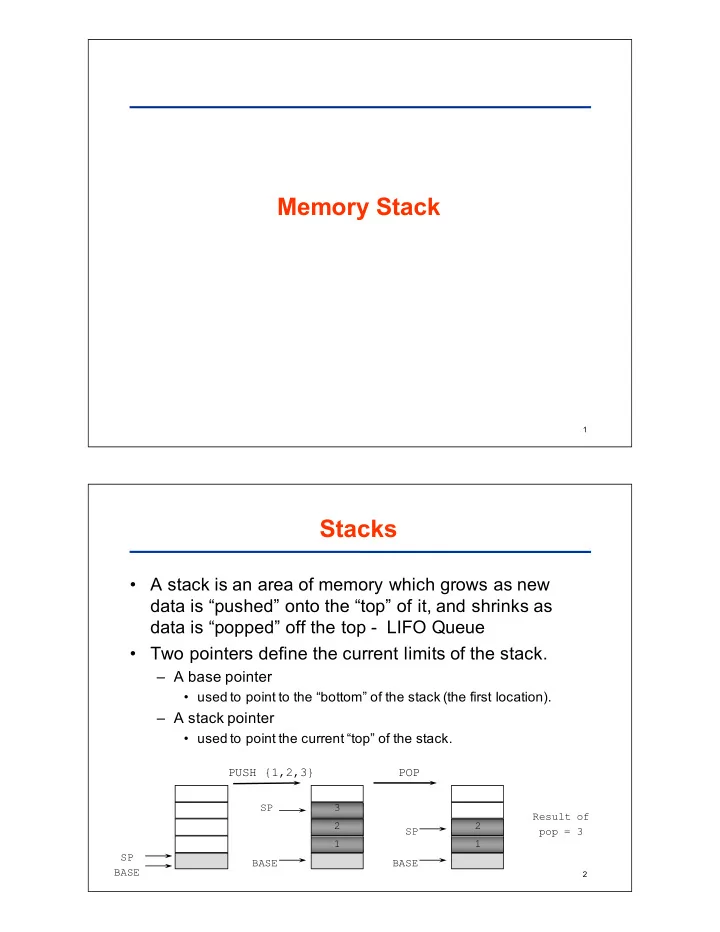
  • A%stack%is%an%area%of%memory%which%grows%as%new%

data%is%“pushed”%onto%the%“top”%of%it,%and%shrinks%as% data%is%“popped”%off%the%top%< LIFO%Queue

  • Two%pointers%define%the%current%limits%of%the%stack.

– A%base%pointer%

  • used%to%point%to%the%“bottom”%of%the%stack%(the%first%location).

– A%stack%pointer

  • used%to%point%the%current%“top”%of%the%stack.%

SP BASE

PUSH {1,2,3}

1 2 3 BASE SP

POP

1 2 Result of pop = 3 BASE SP

slide-2
SLIDE 2

3

Stack'Operation'

Multiple<register%transfer%instructions%are%particularly%useful%for%% stack%operation. Stack%is%used%to%save%multiple<register%content%that%may%be%affected% when%performing%a%subroutine%call.%% Using%one%STM instruction%can%save%several%registers%onto%the% stack. Example:% To%save%multiple<register%content%on%a%stack% STMDB sp!, {r4-r8} This%instruction%‘pushes’%the%four<register%content%to%the%stack. The%corresponding%instruction%to%‘pop’%the%content%from%the%stack%is% LDMIA sp!, {r4-r8}

4

Stack'Implementations'

The%option%of%using%‘DB’%or%‘DA’%for%push%operation%(&% ‘IA’%or%‘IB’%for%corresponding%pop%operation)%depends%

  • n%the%way%a%stack%is%implemented.
  • Full%stack:%address%pointed%by%sp%is%already%used%%
  • Empty%stack:%address%pointed%by%sp%is%still%empty
  • Descending:%stack%grows%down%in%memory%address
  • Ascending:%stack%grows%up%in%memory%address

Discussion:% The%earlier%example%uses%STMDB and%LDMIA to% manipulate%the%stack%content.%What%type%of%stack%is%this?

slide-3
SLIDE 3

5

Stack4Specific'Instructions'

To%avoid%using%the%wrong%type%of%STM and%LDM instructions%when%dealing%with%stack%operation

  • special%suffixes%are%used%instead%to%match%the%different%

stack%implementation

  • FD:%for%Fully%Descending%stack
  • FA:%for%Fully%Ascending%stack
  • ED:%for%Empty%Descending%stack
  • EA:%for%Empty%Ascending%stack

Example:% For%the%ARM%processor%that%uses%a%fully%descending% stack,%the%pair%of%stack%instructions%is%STMFD and%LDMFD.

6

Stack'Operation

  • Stack%Usually%Grows%Down%in%Memory

– last%“pushed”%value%is%at%the%lowest%address

  • ARM%also%supports%ascending%stacks%

– stack%structure%grows%up%through%memory.%

  • The%value%of%the%stack%pointer%can%either:

– Point%to%the%last%occupied%address%(Full%stack)

  • needs%pre<decrementing%(ie%before%the%push)

– Point%to%the%next%occupied%address%(Empty%stack)

  • needs%post<decrementing%(ie%after%the%push)
slide-4
SLIDE 4

7

Stack'Operation

  • Stack%Type%to%be%used%is%given%by%the%postfix%

to%the%instruction:

– STMFD /%LDMFD :%Full%Descending%stack – STMFA /%LDMFA :%Full%Ascending%stack. – STMED /%LDMED :%Empty%Descending%stack – STMEA /%LDMEA :%Empty%Ascending%stack

  • ARM%Compiler%will%always%use%a%Full%

descending%stack

8

Stack'Examples

STMFD sp!{r0,r1,r3-r5}

r5 r4 r3 r1 r0

SP

Old%SP STMED sp!,{r0,r1,r3-r5}

r5 r4 r3 r1 r0

SP

Old%SP

r5 r4 r3 r1 r0

STMFA sp!,{r0,r1,r3-r5}

SP

Old%SP

0x400 0x418 0x3e8

STMEA sp!,{r0,r1,r3-r5}

r5 r4 r3 r1 r0

SP

Old%SP

slide-5
SLIDE 5

9

Stacks'and'Subroutines

  • Stacks%can%be%Used%to%create%temporary%register%

workspace%for%subroutines.%

  • Any%registers%that%are%needed%can%be%pushed%onto%

the%stack%at%the%start%of%the%subroutine%and%popped%off% again%at%the

STMFD sp!,{r0-r12, lr} ; stack all registers ........ ; and the return address ........ LDMFD sp!,{r0-r12, pc} ; load all the registers ; and return automatically

10

Functionality'of'Block'Data'Transfer

  • When%LDM /%STM are%not%being%used%to%implement%

stacks,%it%is%clearer%to%specify%exactly%what% functionality%of%the%instruction%is:

– i.e.%specify%whether%to%increment%/%decrement%the%base% pointer,%before%or%after%the%memory%access.

  • In%order%to%do%this,%LDM /%STM support%a%further%syntax%

in%addition%to%the%stack%one:%

– STMIA /%LDMIA :%Increment%After – STMIB /%LDMIB :%Increment%Before – STMDA /%LDMDA :%Decrement%After – STMDB /%LDMDB :%Decrement%Before

slide-6
SLIDE 6

11

Example:'Block'Copy

– Copy%a%block%of%memory,%which%is%an%exact%multiple%of%12%words% long%from%the%location%pointed%to%by%r12%to%the%location%pointed% to%by%r13.%r14%points%to%the%end%of%block%to%be%copied.

; r12 points to the start of the source data ; r14 points to the end of the source data ; r13 points to the start of the destination data loop LDMIA r12!, {r0-r11} ; load 48 bytes STMIA r13!, {r0-r11} ; and store them CMP r12, r14 ; check for the end BNE loop ; and loop until done

– This%loop%transfers%48%bytes%in%31%cycles – Over%50%Mbytes/sec%at%33%MHz

r13 r14 r12 Increasing Memory

12

Load'and'Stores'4 User'Mode'Privilege

  • When%using%post<indexed%addressing,%there%is%a%further%

form%of%Load/Store%Word/Byte:

<LDR|STR>{<cond>}{B}T Rd, <post_indexed_address>

  • When%used%in%a%privileged%mode,%this%does%the%

load/store%with%user%mode%privilege.

– Normally%used%by%an%exception%handler%that%is%emulating%a% memory%access%instruction%that%would%normally%execute%in%user% mode.

slide-7
SLIDE 7

13

Pointer%to% start%of%array

Example'Usage'of'Addressing'Modes

  • Imagine%an%array,%the%first%element%of%which%is%pointed%to%by%the%

contents%of%r0.

  • If%we%want%to%access%a%particular%element,

then%we%can%use%pre<indexed%addressing:

– r1 is%element%we%want. – LDR r2, [r0, r1, LSL #2]

  • If%we%want%to%step%through%every

element%of%the%array,%for%instance to%produce%sum%of%elements%in%the array,%then%we%can%use%post<indexed%addressing%within%a%loop:

– r1 is%address%of%current%element%(initially%equal%to%r0). – LDR r2, [r1], #4

Use%a%further%register%to%store%the%address%of%final%element, so%that%the%loop%can%be%correctly%terminated.

1 2 3 element 4 8 12 Memory% Offset

r0

14

Offsets'for'Halfword'and'Signed' Halfword'/'Byte'Access

  • The%Load%and%Store%Halfword%and%Load%

Signed%Byte%or%Halfword%instructions%can% make%use%of%pre< and%post<indexed% addressing%in%much%the%same%way%as%the% basic%load%and%store%instructions.

  • However%the%actual%offset%formats%are%more%

constrained:

– The%immediate%value%is%limited%to%8%bits%(rather% than%12%bits)%giving%an%offset%of%0<255%bytes. – The%register%form%cannot have%a%shift%applied%to%it.

slide-8
SLIDE 8

15

Block'Data'Transfer

Cond 1 0 0 P U S W L Rn Register list

Condition field Base register

Load/Store bit

0 = Store to memory 1 = Load from memory

Write- back bit

0 = no write-back 1 = write address into base

PSR and force user bit

0 = don’t load PSR or force user mode 1 = load PSR or force user mode

Up/Down bit

0 = Down; subtract offset from base 1 = Up ; add offset to base

Pre/Post indexing bit

0 = Post; add offset after transfer, 1 = Pre ; add offset before transfer 28 31 22 16 23 21 15 27 20 19 24

Each bit corresponds to a particular

  • register. For example:
  • Bit 0 set causes r0 to be transferred.
  • Bit 0 unset causes r0 not to be transferred.

At least one register must be transferred as the list cannot be empty.

  • The%Load%and%Store%Multiple%instructions%(LDM/STM)%allow%

between%1%and%16%registers%to%be%transferred%to%or%from%memory.

  • The%transferred%registers%can%be%either:

– Any%subset%of%the%current%bank%of%registers%(default). – Any%subset%of%the%user%mode%bank%of%registers%when%in%a%privileged% mode%(postfix%instruction%with%a%‘^’).

16

Block'Data'Transfer

  • Base%register%used%to%determine%where%memory%

access%should%occur.

– 4%different%addressing%modes%allow%increment%and% decrement%inclusive%or%exclusive%of%the%base%register% location. – Base%register%can%be%optionally%updated%following%the% transfer%(by%appending%it%with%an%‘!’. – Lowest%register%number%is%always%transferred%to/from%lowest% memory%location%accessed.

  • These%instructions%are%very%efficient%for

– Saving%and%restoring%context

  • For%this%useful%to%view%memory%as%a%stack.

– Moving%large%blocks%of%data%around%memory

  • For%this%useful%to%directly%represent%functionality%of%the%

instructions.
slide-9
SLIDE 9

17

  • Atomic%operation%of%a%memory%read%followed%by%a%memory%write%

which%moves%byte%or%word%quantities%between%registers%and% memory.%

  • Syntax:

SWP{<cond>}{B} Rd, Rm, [Rn]

  • Thus%to%implement%an%actual%swap%of%contents%make%Rd%=%Rm.
  • The%compiler%cannot%produce%this%instruction.

Swap'and'Swap'Byte'Instructions

Rm Rd

Rn

3

2 1

temp

Memory

18

Data'Movement'Instructions

ARM%can%only%manipulate%data%within%registers.

  • so%data%has%to%be%loaded%from%memory%into%

register(s)%for%data%operation

  • with%results%eventually%stored%back%into%memory

A%lot%of%instructions%in%a%running%program%involve%data% movement.

  • important%to%have%efficient%addressing%mode%and%data%

loading%and%storing%instructions

  • to%optimize%processor%performance
slide-10
SLIDE 10

19

MOV'Format

General%Form: Form%with%Immediate%Operand: 8<bit%Immediate%Means%[0,255]%Only%!!!!!

20

Condition'Codes

All%ARM%Instructions%utilize%condition%codes:

Cond Instruction Bitmap No Cond Code Executes if 0000xxxx xxxxxxxx xxxxxxxx xxxxxxxx 0 EQ(Equal) Z 0001xxxx xxxxxxxx xxxxxxxx xxxxxxxx 1 NE(Not Equal) ~Z 0010xxxx xxxxxxxx xxxxxxxx xxxxxxxx 2 CS(Carry Set) C 0011xxxx xxxxxxxx xxxxxxxx xxxxxxxx 3 CC(Carry Clear) ~C 0100xxxx xxxxxxxx xxxxxxxx xxxxxxxx 4 MI(MInus) N 0101xxxx xxxxxxxx xxxxxxxx xxxxxxxx 5 PL(PLus) ~N 0110xxxx xxxxxxxx xxxxxxxx xxxxxxxx 6 VS(oVerflow Set) V 0111xxxx xxxxxxxx xxxxxxxx xxxxxxxx 7 VC(oVerflow Clear) ~V 1000xxxx xxxxxxxx xxxxxxxx xxxxxxxx 8 HI(HIgher) C and ~Z 1001xxxx xxxxxxxx xxxxxxxx xxxxxxxx 9 LS(Lower or Same) ~C and Z 1010xxxx xxxxxxxx xxxxxxxx xxxxxxxx A GE(Greater or equal) N = V 1011xxxx xxxxxxxx xxxxxxxx xxxxxxxx B LT(Less Than) N = ~V 1100xxxx xxxxxxxx xxxxxxxx xxxxxxxx C GT(Greater Than) (N= V)and~Z 1101xxxx xxxxxxxx xxxxxxxx xxxxxxxx D LE(Less or equal) (N =~V)orZ 1110xxxx xxxxxxxx xxxxxxxx xxxxxxxx E AL(Always) True 1111xxxx xxxxxxxx xxxxxxxx xxxxxxxx F NV(Never) False

slide-11
SLIDE 11

21

Data'Movement

  • Operations%are:

– MOV Rd%<< operand2 – MVN Rd%<< NOT%operand2

  • Syntax:

– <Operation>{<cond>}{S} Rd, Operand2

  • Examples:

– MOV r0, r1 ;r0 <- r1 – MOVS r2, #10 ;r0 <- #10 – MVNEQ r1, #0 ;if(Z==0) r1 <-0xFFFFFFFF

22

Loading'full'32'bit'constants

  • If%Instructions%are%32%bits%long%(16%

for%thumb),%how%are%32<bit% immediate%values%encoded%into%an% Instruction?

–USES%LITERAL%POOLS

MVNEQ r1, #0 Instruction*useful*since*allows*0xFFFFFFFF to*be*used as*324bit*"immediate"*in*324bit*Instruction

slide-12
SLIDE 12

23

Literal'Pools

  • Literals%Pools%– Constant%Data%Areas%Embedded%in%

the%Code

– At%end%of%modules,%between%functions

  • Although%the%MOV/MVN mechanism%in%combination%

with%shifts%will%load%a%large%range%of%constants%into%a% register,%sometimes%this%mechanism%will%not%generate% the%required%constant.

  • Therefore,%the%assembler%also%provides%a%method%

which%will%load%ANY 32%bit%constant:

– LDR rd, =numeric constant

24

Literal'Pools

  • If%the%constant%can%be%constructed%using%either%a%MOV or%

MVN then%this%will%be%the%instruction%actually%generated%by% the%assembler

  • Otherwise,%the%assembler%will%produce%an%LDR instruction%

with%a%PC(r15)<relative%address%to%read%the%constant%from% a%literal%pool

  • Pseudo<instructions

– LDR r0,=0x42 ;generates MOV r0,#0x42 – LDR r0,=0x55555555 ;generate LDR r0,[pc,

  • ffset

to lit pool]

  • As%this%mechanism%will%always%generate%the%best%

instruction%for%a%given%case,%it'is'the'recommended'way'

  • f'loading'constants.
slide-13
SLIDE 13

25

  • To%allow%larger%constants%to%be%loaded,%the%assembler%offers%a%pseudo<

instruction: – LDR rd, =const

  • This%will%either:

– Produce%a%%MOV or%%MVN instruction%to%generate%the%value%(if%possible).

  • r

– Generate%a%LDR instruction%with%a%PC<relative%address%to%read%the% constant%from%a%literal*pool (Constant%data%area%embedded%in%the% code).

  • For%example

– LDR r0,=0xFF => MOV r0,#0xFF – LDR r0,=0x55555555 => LDR r0,[PC,#Imm12] … … DCD 0x55555555

  • This%is%the%recommended%way%of%loading%constants%into%a%register

Loading'32'bit'constants

26

MOV'Format

Assume%this%is%0xE3A004FF Last%12%bits%of%machine%code%are%0x4FF Rotation%Value%is%ALWAYS%Multiplied%by%2%in%Machine%Code:% (4*2=8)%So%Can%Only%Rotate%by%EVEN%Values,%ODD%Value causes%Next%Lower%Even%Rotate%to%Occur 8<bit%Immediate%is%0xFF Can%Only%Use%0x01 thru 0xFF Value%8%Causes%Immendiate%to%be%Rotated%to%Right%by%8%Bits mov r0, #0xFF, 8 ;r0 <- 0xFF000000

slide-14
SLIDE 14

27

MOV'with'Rotate'Right'Operand

mov r0, #0xFF, <n> n Value%%%%%%%%%%%%%Operation 30 ;r0 <- 0x000003FC 28 ;r0 <- 0x00000FF0 26 ;r0 <- 0x00003FC0 24 ;r0 <- 0x0000FF00 22 ;r0 <- 0x0003FC00 ..... 8 ;r0 <- 0xFF000000 6 ;r0 <- 0xFC000003 4 ;r0 <- 0xF000000F 2 ;r0 <- 0xC000003F

28

Register,%optionally%with%shift%operation – Shift%value%can%be%either%be:

  • 5%bit%unsigned%integer
  • Specified%in%bottom%byte%of%

another%register.

– Used%for%multiplication%by% constant Immediate%value – 8%bit%number,%with%a%range%of%0< 255.

  • Rotated%right%through%number%of%

positions%

– Allows%increased%range%of%32<bit% constants%to%be%loaded%directly% into%registers

Result

Operand'1

Barrel Shifter

Operand'2

ALU

Using'a'Barrel'Shifter:The'2nd'Operand

slide-15
SLIDE 15

29

Barrel'Shifter

30

  • No%ARM%instruction%can%contain%a%32%bit%immediate%constant

– All%ARM%instructions%are%fixed%as%32%bits%long

  • The%data%processing%instruction%format%has%12%bits%available%

for%operand2

  • 4%bit%rotate%value%(0<15)%is%multiplied%by%two%to%give%range%0<

30%(in%steps%of%2%in%Machine%Code)

7 11 8 immed_8

Shifter ROR

rot x2

Immediate'constants'

ARM’s%scheme has%in<line%ROR

slide-16
SLIDE 16

31

  • Many%Constants%can%be%Generated%by%Using%the%In<Line%Shifter
  • Not%ALL%Constants%can%However
  • For%those%that%Can’t%be%Generated%using%the%Shifter:

– Literal%Pools%with%MOV Translated%to%LDR

  • Examples:

mov r0, #0xff ;r0 <- 255 mov r0, #0xff, 30 ;r0 <- 1020 mov r0, #0xff, 26 ;r0 <- 4096 add r0, r2, #0xff000000 ;r0 <- r2 + 0xff000000 sub r2, r3, #0x8000 ;r2 <- r3 – 0x8000 rsb r8, r9, #0x8000 ;r8 <- 0x8000 – r9 ; (reverse sub)

Immediate'constants'

32

  • Want%to%generate%constant%4080%using%byte%rotation
  • (4080)10=(1111%1111%0000)2

mov r0, #0xff, 28 ;r0 <- 4080

Example

  • Want%to%shift%FF%4<bits%to%Left
  • ARM%Only%has%Right%Rotator
  • Rotate%Right%by%28%is%Equal%to%Left%Shift%by%4:

(32%– 4)%=%28

slide-17
SLIDE 17

33

MVN Instruction

  • Moves%One’s%Complement%Value%into%Register
  • One’s%Complement%is%bit<by<bit%Complement
  • Examples:

mvn r0, #0 ;What is in r0? mvn r0, #0xFF, 8 ;What is in r0?

34

MVN Instruction

  • Moves%One’s%Complement%Value%into%Register
  • One’s%Complement%is%bit<by<bit%Complement
  • Examples:

mvn r0, #0 ;What is in r0? ;r0 <- 0xFFFFFFFF mvn r0, #0xFF, 8 ;What is in r0? ;r0 <- 0x00FFFFFF

slide-18
SLIDE 18

35

Pseudo4instruction'Instruction

  • Safest%Way:%You%Don’t%have%to%Think%too%hard
  • Examples:

ldr <Rd>, =numeric_constant

  • Many%Times%Constants%Loaded%at%Top%of%Code

SRAM_BASE EQU 0x04000000 AREA example, CODE, READONLY ;Initialization section ENTRY mov r0, #SRAM_BASE mov r1, #0xFF000000

What*if*SRAM_BASE*Changes*to*value*that*can’t*be* generated*with*rotation*scheme?

36

Pseudo4instruction'Instruction

  • Many%Times%Constants%Loaded%at%Top%of%Code

SRAM_BASE EQU 0x04000000 AREA example, CODE, READONLY ;Initialization section ENTRY ; mov r0, #SRAM_BASE ldr r0, =SRAM_BASE ;This will always work ldr r1, =0xFF000000

Assembler*will*try*to*use*a*mov with*rotate*if*it*can If*it*cannot,*it*will*create*a*literal*pool*and*use*a*ldr Default*is*Literal*Pools*Loaded*after*END Directive Can*Force*Other*Location*with*LTORG Directive