Call Stack Stack Bottom Memory region managed with stack discipline - - PowerPoint PPT Presentation

call stack
SMART_READER_LITE
LIVE PREVIEW

Call Stack Stack Bottom Memory region managed with stack discipline - - PowerPoint PPT Presentation

Call Stack Stack Bottom Memory region managed with stack discipline Procedures and the Call Stack higher %rsp holds lowest stack address addresses (address of "top" element) Topics stack grows Procedures toward lower


slide-1
SLIDE 1

Procedures and the Call Stack

Topics

  • Procedures
  • Call stack
  • Procedure/stack instructions
  • Calling conventions
  • Register-saving conventions

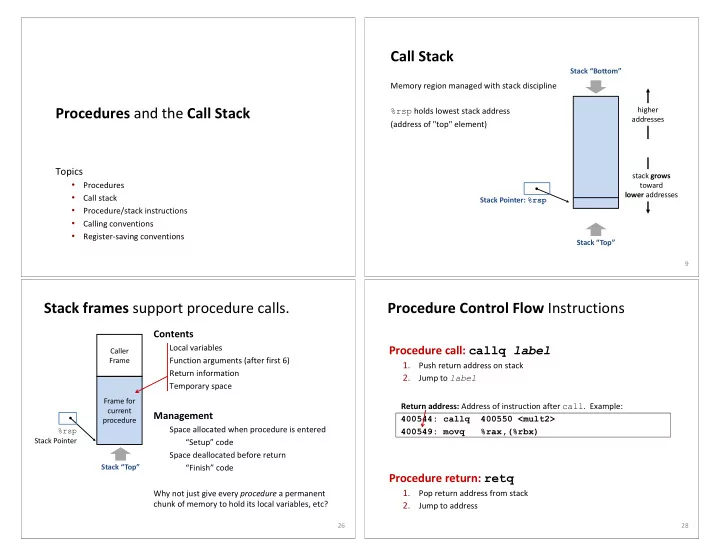
Call Stack

Memory region managed with stack discipline %rsp holds lowest stack address (address of "top" element)

Stack Pointer: %rsp stack grows toward lower addresses higher addresses Stack “Top” Stack “Bottom”

9

Stack frames support procedure calls.

Contents

Local variables Function arguments (after first 6) Return information Temporary space

Management

Space allocated when procedure is entered “Setup” code Space deallocated before return “Finish” code Why not just give every procedure a permanent chunk of memory to hold its local variables, etc?

26

%rsp Stack Pointer Caller Frame Stack “Top” Frame for current procedure

Procedure Control Flow Instructions

Procedure call: callq label

1.

Push return address on stack

2.

Jump to label Return address: Address of instruction after call. Example: 400544: callq 400550 <mult2> 400549: movq %rax,(%rbx)

Procedure return: retq

1.

Pop return address from stack

2.

Jump to address

28

slide-2
SLIDE 2

Call Example (step 1)

0000000000400550 <mult2>: 400550: mov %rdi,%rax

  • 400557: retq

0000000000400540 <multstore>:

  • 400544: callq

400550 <mult2> 400549: mov %rax,(%rbx)

  • 0x400544

0x120

  • %rsp

0x120 0x128 0x130 %rip

29

0000000000400550 <mult2>: 400550: mov %rdi,%rax

  • 400557: retq

0000000000400540 <multstore>:

  • 400544: callq

400550 <mult2> 400549: mov %rax,(%rbx)

  • 0x400557

0x118 0x400549

  • %rsp

0x120 0x128 0x130 0x118 %rip

Return Example (step 1)

31

Procedure Data Flow

Only allocate stack space when needed

%rdi %rsi %rdx %rcx %r8 %r9 %rax Arg 7

  • • •

Arg 8 Arg n

  • • •

High Addresses Low Addresses

Diane’s Silk Dress Costs $8 9

First 6 arguments passed in registers Return value

Arg 1 Arg 6

Remaining arguments passed

  • n stack (in memory)

Stack Frame

35

Return Address Saved Registers + Local Variables Extra Arguments for next call … Extra Arguments to callee Caller Frame Stack pointer %rsp Callee Frame

slide-3
SLIDE 3

Example: increment

long increment(long* p, long val) { long x = *p; long y = x + val; *p = y; return x; } increment: movq (%rdi), %rax addq %rax, %rsi movq %rsi, (%rdi) ret Register Use(s) %rdi Argument p %rsi Argument val, y %rax x, Return value

37

Procedure Call Example (initial state)

38

call_incr: subq $16, %rsp movq $240, 8(%rsp) movl $61, %esi leaq 8(%rsp), %rdi call increment addq 8(%rsp), %rax addq $16, %rsp ret long call_incr() { long v1 = 240; long v2 = increment(&v1, 61); return v1+v2; }

Initial Stack Structure

  • • •

Return addr <main+8>

%rsp %rsi %rdi %rax

Procedure Call Example (step 4)

42 call_incr: subq $16, %rsp movq $240, 8(%rsp) movl $61, %esi leaq 8(%rsp), %rdi call increment addq 8(%rsp), %rax addq $16, %rsp ret long call_incr() { long v1 = 240; long v2 = increment(&v1, 61); return v1+v2; }

Stack Structure

increment: movq (%rdi), %rax # x = *p addq %rax, %rsi # y = x+61 movq %rsi, (%rdi) # *p = y ret

  • • •

Return addr <main+8>

301

Unused Return addr <call_incr+?>

%rsp %rsi 301 %rdi &v1 %rax 240

long increment(long* p, long val) { long x = *p; long y = x + val; *p = y; return x; }

v1 in call_incr à

Procedure Call Example (step 6)

Stack Structure

44

long call_incr() { long v1 = 240; long v2 = increment(&v1, 61); return v1+v2; } call_incr: subq $16, %rsp movq $240, 8(%rsp) movl $61, %esi leaq 8(%rsp), %rdi call increment addq 8(%rsp), %rax addq $16, %rsp ret

  • • •

Return addr <main+8>

301

Unused

Update %rax: v1+v2

%rsp %rsi 301 %rdi &v1 %rax 541 v1 in call_incr à

slide-4
SLIDE 4

A Puzzle

*p = d; return x - c; movsbl %dl,%edx movl %edx,(%rsi) movswl %di,%edi subl %edi,%ecx movl %ecx,%eax Write the C function header, types, and

  • rder of parameters.

C function body: assembly: movsbl = move sign-extending a byte to a long (4-byte) movswl = move sign-extending a word (2-byte) to a long (4-byte)

Register Saving Conventions

yoo calls who:

Caller Callee Will register contents still be there after a procedure call?

Conventions:

Caller Save Callee Save

yoo:

  • • •

movq $12345, %rbx call who addq %rbx, %rax

  • • •

ret who:

  • • •

addq %rdi, %rbx

  • • •

ret

49

?

x86-64 64-bit Register Conventions

51

%rax %rbx %rcx %rdx %rsi %rdi %rsp %rbp %r8 %r9 %r10 %r11 %r12 %r13 %r14 %r15 Callee saved Callee saved Callee saved Callee saved Callee saved Caller saved Callee saved Stack pointer Caller Saved Return value – Caller saved Argument #4 – Caller saved Argument #1 – Caller saved Argument #3 – Caller saved Argument #2 – Caller saved Argument #6 – Caller saved Argument #5 – Caller saved

Callee-Saved Example

call_incr2: pushq %rbx subq $16, %rsp movq %rdi, %rbx movq $240, 8(%rsp) movl $61, %esi leaq 8(%rsp), %rdi call increment addq %rbx, %rax addq $16, %rsp popq %rbx ret long call_incr2(long x) { long v1 = 240; long v2 = increment(&v1, 61); return x+v2; }

Begin/End Stack Structure

%rsp . . . Rtn address

Stack Structure in call_incr2

240 Unused %rsp . . . Rtn address %rsp+8 Saved %rbx

52

slide-5
SLIDE 5

/* Recursive popcount */ long pcount_r(unsigned long x) { if (x == 0) { return 0; } else { return (x & 1) + pcount_r(x >> 1); } }

Recursive Function

pcount_r: movl $0, %eax testq %rdi, %rdi je .L6 pushq %rbx movq %rdi, %rbx andl $1, %ebx shrq %rdi call pcount_r addq %rbx, %rax popq %rbx .L6: rep; ret

54

x86-64 stack storage example (1)

61

long int call_proc() { long x1 = 1; int x2 = 2; short x3 = 3; char x4 = 4; proc(x1, &x1, x2, &x2, x3, &x3, x4, &x4); return (x1+x2)*(x3-x4); } call_proc: subq $32,%rsp movq $1,16(%rsp) # x1 movl $2,24(%rsp) # x2 movw $3,28(%rsp) # x3 movb $4,31(%rsp) # x4

  • • •

Return address to caller of call_proc ←%rsp

Procedure Summary

call, ret, push, pop Stack discipline fits procedure call / return.*

If P calls Q: Q (and calls by Q) returns before P

Conventions support arbitrary function calls.

Register-save conventions. Stack frame saves extra args or local variables. Result returned in %rax

*Take 251 to learn about languages where it doesn't.

66

Return Address Saved Registers + Local Variables Extra Arguments for next call … Extra Arguments to callee Caller Frame Stack pointer %rsp Callee Frame 128-byte red zone

%rax %rbx %rcx %rdx %rsi %rdi %rsp %rbp %r8 %r9 %r10 %r11 %r12 %r13 %r14 %r15 Callee saved Callee saved Callee saved Callee saved Callee saved Caller saved Callee saved Stack pointer Caller Saved Return value – Caller saved Argument #4 – Caller saved Argument #1 – Caller saved Argument #3 – Caller saved Argument #2 – Caller saved Argument #6 – Caller saved Argument #5 – Caller saved