ADT Stack 1 Stacks of Coins and Plates 2 Stacks of Rocks and - - PDF document

adt stack
SMART_READER_LITE
LIVE PREVIEW

ADT Stack 1 Stacks of Coins and Plates 2 Stacks of Rocks and - - PDF document

ADT Stack 1 Stacks of Coins and Plates 2 Stacks of Rocks and Books TOP OF THE STACK TOP OF THE STACK Add, remove rock and book from the top, or else 3 Stack at logical level A stack is an ADT in which elements add added and


slide-1
SLIDE 1

1

ADT Stack

2
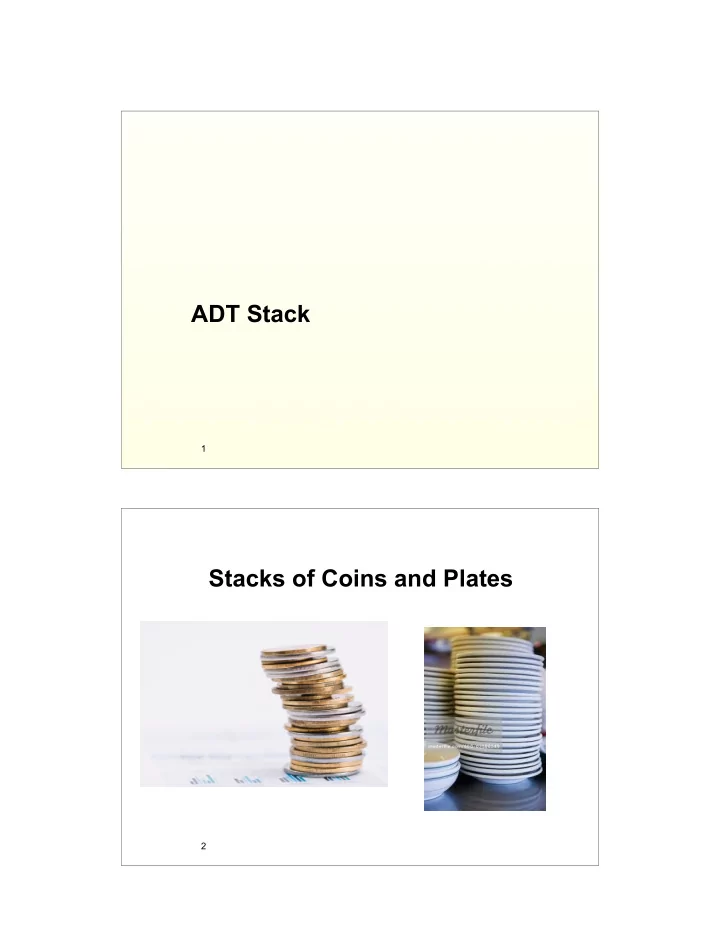
Stacks of Coins and Plates

slide-2
SLIDE 2

3

Stacks of Rocks and Books

TOP OF THE STACK TOP OF THE STACK

Add, remove rock and book from the top,

  • r else…

4

Stack at logical level

  • A stack is an ADT in which

elements add added and removed from only one end (i.e.,at the top of the stack).

  • A stack is a LIFO “last in,

first out” structure.

slide-3
SLIDE 3

5

Stack at Logical Level

  • What operations would be appropriate for a

stack?

6

Stack Operations

Transformers

  • Push
  • Pop

Observers

  • Top
  • IsEmpty
  • IsFull

change state

  • bserve state
slide-4
SLIDE 4

7

Stack at Application Level

  • For what types of problems would be stack be

useful for?

  • LIFO: good for reversing data
  • If we push a, b, c, d into a stack, and then

pop all elements out, we get d, c, b, a

  • In OS/language: function call stack
  • Finding Palindromes
  • Expression evaluation and Syntax Parsing

8

Function call stack

  • For what types of problems

would be stack be useful for?

  • LIFO: good for reversing data
  • If we push a, b, c, d into a

stack, and then pop all elements out, we get d, c, b, a

  • In OS/language: function call

stack

  • Finding Palindromes
  • Expression evaluation and

Syntax Parsing

slide-5
SLIDE 5

9

Use stack to reverse

  • Sometimes you need to output in reverse orders

Convert decimal to binary: DisplayInBinary (int num) while (num>0) digit = num % 2 print digit num = num / 2

  • The binary representation is printed backward
  • Trace it with num=21, output?
  • Solution: push each digit onto a stack in the loop, after

the loop, pop digits out one by one and display it.

10

Use stack to backtrack

  • In maze-walking algorithm, we can use stack to store

all nodes that we led us to current node, so that we can backtrack when needed.

  • Goal: find a path via white

blocks from (0,0) to (5,5)

  • Need to explore: try diff.

next step

  • and backtrack (when reach

dead-end): i.e., reverse back to previous node

slide-6
SLIDE 6

11

Stack of ItemTypes

class StackType { public: StackType( ); bool IsFull () const; bool IsEmpty() const; void Push( ItemType item ); void Pop(); ItemType Top() const; };

What are the pre and post conditions?

12

Stack Implementation

  • array-based implementation: static or dynamic

array

  • linked-structure implementation
slide-7
SLIDE 7

13

class StackType { public: StackType( ); bool IsFull () const;

bool IsEmpty() const; void Push( ItemType item ); void Pop(); ItemType Top(); private: int top; ItemType items[MAX_ITEMS]; };

2 ‘c’ ‘b’ ‘a’ Stack items unused slots/garbage

14

Class Interface Diagram


(Memory reversed to better illustrate concept)

StackType class

StackType Pop Push IsFull IsEmpty

Private data: top

[MAX_ITEMS-1]

. . .

[ 2 ] [ 1 ]

items [ 0 ]

Top

slide-8
SLIDE 8

15

How to initialize data member top? 0 or -1 Depends on what top stores: * initialized to 0: If it’s the next open slot * initialized to -1: if it’s the index of stack top element Need to be consistent in all member functions, Top(), Push(), Pop(), isfull, isEmpty()…

Below we use second option:

StackType::StackType( ) { top = -1; //index of top element in stack }

Initialize stack

16

// pre: the stack has been initialized // post: return true if the stack is empty, false ow bool StackType::IsEmpty() const { return(top == -1); } //pre: //post: bool StackType::IsFull() const { return (top = = MAX_ITEMS-1); }

slide-9
SLIDE 9

17

void StackType::Push(ItemType newItem) { if( IsFull() ) throw FullStack(): top++; items[top] = newItem; } void StackType::Pop() { if( IsEmpty() ) throw EmptyStack(); top--; } ItemType StackType::Top() { if (IsEmpty()) throw EmptyStack(); return items[top]; }

18

Tracing Client Code

char letter = ‘V’; StackType charStack; charStack.Push(letter); charStack.Push(‘C’); charStack.Push(‘S’); if ( !charStack.IsEmpty( )) charStack.Pop( ); charStack.Push(‘K’); while (!charStack.IsEmpty( )) { letter = charStack.Top(); charStack.Pop(0)} Private data: top [MAX_ITEMS-1]

. .

[ 2 ] [ 1 ] items [ 0 ] letter

‘V’

slide-10
SLIDE 10

19

Stack Implementation: linked structure

  • One advantage of an ADT is that the implementation

can be changed without the program using it knowing about it.

  • in-object array implementation: has a fixed max. size
  • dynamically allocated array (as in lab2?): can be

grown when needed, but lots of copy!

  • Linked structure: dynamically allocate the space for

each element as it is pushed onto stack.

20

ItemType is char

class StackType

StackType Top Pop Push IsFull IsEmpty

Private data: topPtr

~StackType ‘C’ ‘V’

slide-11
SLIDE 11

21

// DYNAMICALLY LINKED IMPLEMENTATION OF STACK struct NodeType; //Forward declaration class StackType { public: //Identical to previous implementation /* Add: copy-constructor, destructor, assignment

  • perator: since dynamic memory is used! */

private: NodeType* topPtr; }; . . . struct NodeType { ItemType info; NodeType* next; };

22

Implementing Push

void StackType::Push ( ItemType newItem ) // Adds newItem to the top of the stack. { NodeType* location; location = new NodeType; location->info = newItem; location->next = topPtr; topPtr = location; }

slide-12
SLIDE 12

23

Deleting top element from the stack

NodeType* tempPtr; item = topPtr->info; tempPtr = topPtr; topPtr = topPtr->next; delete tempPtr;

topPtr

‘B’ ‘X’ ‘C’ ‘L’

tempPtr

item

24

Deleting top element from the stack

NodeType* tempPtr; item = topPtr->info; tempPtr = topPtr; topPtr = topPtr->next; delete tempPtr;

topPtr item

‘B’ ‘X’ ‘C’ ‘L’

tempPtr

‘B’

slide-13
SLIDE 13

25

Deleting item from the stack

NodeType* tempPtr; item = topPtr->info; tempPtr = topPtr; topPtr = topPtr->next; delete tempPtr;

topPtr item

‘B’ ‘X’ ‘C’ ‘L’

tempPtr

‘B’

26

Deleting item from the stack

NodeType* tempPtr; item = topPtr->info; tempPtr = topPtr; topPtr = topPtr->next; delete tempPtr;

topPtr item

‘B’ ‘X’ ‘C’ ‘L’

tempPtr

‘B’

slide-14
SLIDE 14

27

Deleting item from the stack

NodeType<ItemType>* tempPtr; item = topPtr->info; tempPtr = topPtr; topPtr = topPtr->next; delete tempPtr;

topPtr item

‘X’ ‘C’ ‘L’

tempPtr

‘B’

28

Implementing Pop

void StackType::Pop() // Remove top item from Stack. { if (IsEmpty()) throw EmptyStack(); else { NodeType* tempPtr; tempPtr = topPtr; topPtr = topPtr ->next; delete tempPtr; } }

slide-15
SLIDE 15

29

Implementing Top

ItemType StackType::Top() // Returns a copy of the top item in the stack. { if (IsEmpty()) throw EmptyStack(); else return topPtr->info; }

30

Implementing IsFull

bool StackType::IsFull() const // Returns true if there is no room for another // ItemType on the free store; false otherwise { NodeType* location; try { location = new NodeType; delete location; return false; } catch(std::bad_alloc exception) { return true; } }

slide-16
SLIDE 16

31

Array vs Linked Structure

  • Drawback of array-based implementation:
  • at any point of time, array is either filled or

not

  • memory is either not enough,
  • r wasted
  • Linked Structure: allocate on demand
  • Drawback: need to store lots of addresses

(in pointer field of node)

  • if ItemType is small compared to pointer,

then it’s not memory efficient

32

Efficiency comparison

slide-17
SLIDE 17

33

C++ Standard Template Library

  • a set of C++ class templates that provides

common programming data structures and functions

  • lists, stacks, queues, hash table, many

more…

  • all data structures/container are implemented as

class template, which can be parameterized:

  • vector<int>, vector<double> …
  • stack<int>, stack<char>
  • the type in <> is type parameter, specifying

the type of items that the stack stores…

34

Sample code using STL stack

slide-18
SLIDE 18

35

Sample code using STL stack

More info on stack

36

Exercises

  • use C++ STL stack to finish the code that

displays a number in binary

slide-19
SLIDE 19

37

Problem Solving using Stack

  • check for balanced parenthesis (, ), {, }, [, ].
  • Balanced parentheses: means that each
  • pening symbol has a corresponding closing

symbol and the pairs of parentheses are properly nested.

  • examples: are the following balanced?
  • ( ) ( ) ]
  • { [ ( ) ( } )
  • [ () ]{ }
  • { [ ( )( ) ] { } }
  • How to write a function/program to check?