Outline and Reading Singly linked list Lists and Sequences - - PDF document

outline and reading
SMART_READER_LITE
LIVE PREVIEW

Outline and Reading Singly linked list Lists and Sequences - - PDF document

Outline and Reading Singly linked list Lists and Sequences Position ADT and List ADT (2.2.2) Doubly linked list ( 2.2.2) Sequence ADT ( 2.2.3) Implementations of the sequence ADT ( 2.2.3) Iterators (2.2.3) 6/8/2002 2:15 PM


slide-1
SLIDE 1

6/8/2002 2:15 PM Sequences 1

Lists and Sequences

6/8/2002 2:15 PM Sequences 2

Outline and Reading

Singly linked list Position ADT and List ADT (§2.2.2) Doubly linked list (§ 2.2.2) Sequence ADT (§ 2.2.3) Implementations of the sequence ADT (§ 2.2.3) Iterators (2.2.3)

6/8/2002 2:15 PM Sequences 3

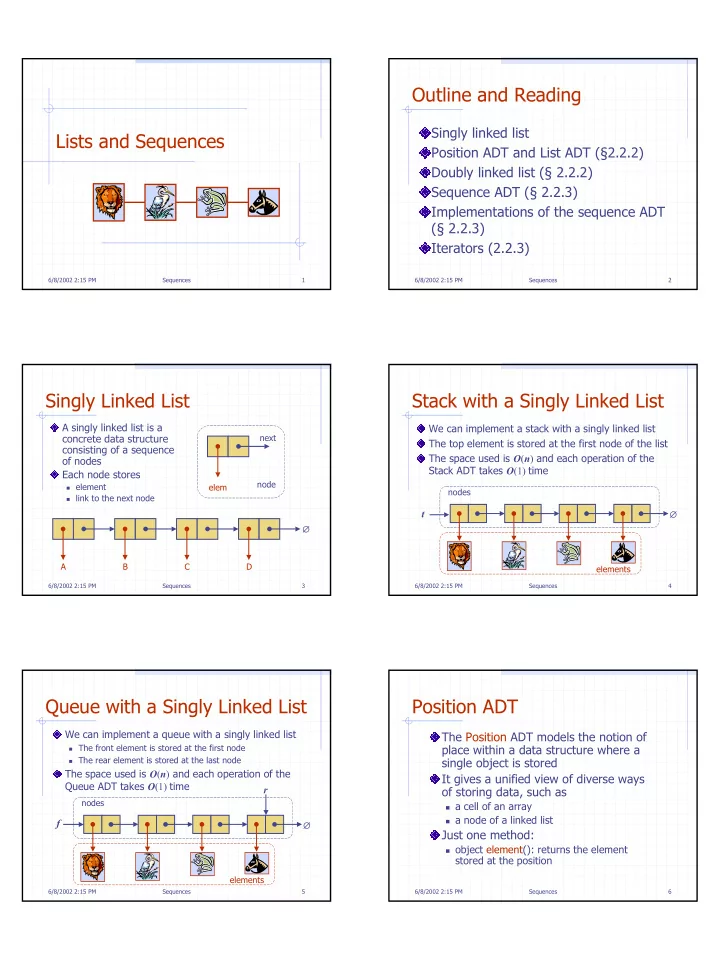
Singly Linked List

A singly linked list is a concrete data structure consisting of a sequence

  • f nodes

Each node stores

element link to the next node

next elem node A B C D ∅

6/8/2002 2:15 PM Sequences 4

Stack with a Singly Linked List

We can implement a stack with a singly linked list The top element is stored at the first node of the list The space used is O(n) and each operation of the Stack ADT takes O(1) time

t

nodes elements

6/8/2002 2:15 PM Sequences 5

Queue with a Singly Linked List

We can implement a queue with a singly linked list

The front element is stored at the first node The rear element is stored at the last node

The space used is O(n) and each operation of the Queue ADT takes O(1) time f r

∅ nodes elements

6/8/2002 2:15 PM Sequences 6

Position ADT

The Position ADT models the notion of place within a data structure where a single object is stored It gives a unified view of diverse ways

  • f storing data, such as

a cell of an array a node of a linked list

Just one method:

  • bject element(): returns the element

stored at the position

slide-2
SLIDE 2

6/8/2002 2:15 PM Sequences 7

List ADT

The List ADT models a sequence of positions storing arbitrary objects It establishes a before/after relation between positions Generic methods:

size(), isEmpty()

Query methods:

isFirst(p), isLast(p)

Accessor methods:

first(), last() before(p), after(p)

Update methods:

replaceElement(p, o),

swapElements(p, q)

insertBefore(p, o),

insertAfter(p, o),

insertFirst(o),

insertLast(o)

remove(p)

6/8/2002 2:15 PM Sequences 8

Doubly Linked List

A doubly linked list provides a natural implementation of the List ADT Nodes implement Position and store:

element link to the previous node link to the next node

Special trailer and header nodes prev next elem trailer header nodes/positions elements node

6/8/2002 2:15 PM Sequences 9

Insertion

We visualize operation insertAfter(p, X), which returns position q

A B X C A B C p A B C p X q p q

6/8/2002 2:15 PM Sequences 10

Deletion

We visualize remove(p), where p = last()

A B C D p A B C D p A B C

6/8/2002 2:15 PM Sequences 11

Performance

In the implementation of the List ADT by means of a doubly linked list

The space used by a list with n elements is

O(n)

The space used by each position of the list

is O(1)

All the operations of the List ADT run in

O(1) time

Operation element() of the

Position ADT runs in O(1) time

6/8/2002 2:15 PM Sequences 12

Sequence ADT

The Sequence ADT is the union of the Vector and List ADTs Elements accessed by

Rank, or Position

Generic methods:

size(), isEmpty()

Vector-based methods:

elemAtRank(r),

replaceAtRank(r, o), insertAtRank(r, o), removeAtRank(r)

List-based methods:

first(), last(),

before(p), after(p), replaceElement(p, o), swapElements(p, q), insertBefore(p, o), insertAfter(p, o), insertFirst(o), insertLast(o), remove(p)

Bridge methods:

atRank(r), rankOf(p)

slide-3
SLIDE 3

6/8/2002 2:15 PM Sequences 13

Applications of Sequences

The Sequence ADT is a basic, general- purpose, data structure for storing an ordered collection of elements Direct applications:

Generic replacement for stack, queue, vector, or

list

small database (e.g., address book)

Indirect applications:

Building block of more complex data structures 6/8/2002 2:15 PM Sequences 14

Array-based Implementation

We use a circular array storing positions A position

  • bject stores:

Element Rank

Indices f and l keep track of first and last positions 1 2 3

positions elements

S l f

6/8/2002 2:15 PM Sequences 15

Sequence Implementations

n n insertAtRank, removeAtRank 1 1 insertFirst, insertLast 1 n insertAfter, insertBefore n 1 replaceAtRank 1 1 replaceElement, swapElements n 1 atRank, rankOf, elemAtRank 1 1 size, isEmpty 1 n remove 1 1 first, last, before, after List Array Operation

6/8/2002 2:15 PM Sequences 16

Iterators

An iterator abstracts the process of scanning through a collection of elements Methods of the ObjectIterator ADT:

  • bject object()

boolean hasNext()

  • bject nextObject()

reset()

Extends the concept of Position by adding a traversal capability Implementation with an array

  • r singly linked list

An iterator is typically associated with an another data structure We can augment the Stack, Queue, Vector, List and Sequence ADTs with method:

ObjectIterator elements()

Two notions of iterator:

snapshot: freezes the

contents of the data structure at a given time

dynamic: follows changes to

the data structure