Outline and Reading The Stack ADT (2.1.1) Stacks Applications of - - PDF document

outline and reading
SMART_READER_LITE
LIVE PREVIEW

Outline and Reading The Stack ADT (2.1.1) Stacks Applications of - - PDF document

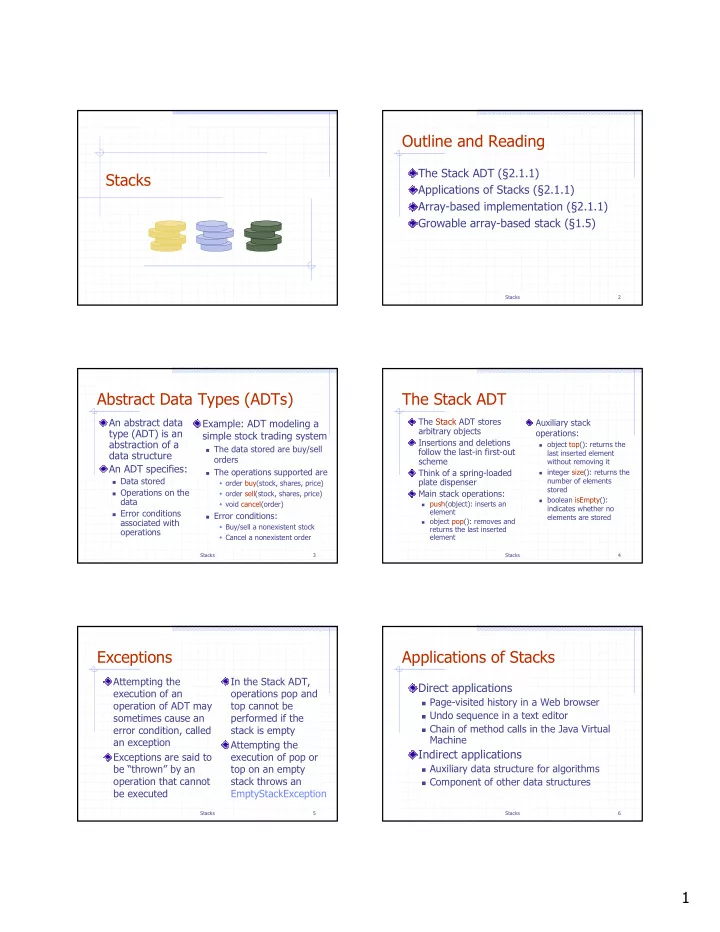
Outline and Reading The Stack ADT (2.1.1) Stacks Applications of Stacks (2.1.1) Array-based implementation (2.1.1) Growable array-based stack (1.5) Stacks 2 Abstract Data Types (ADTs) The Stack ADT An abstract data The Stack ADT


slide-1
SLIDE 1

1

Stacks

Stacks 2

Outline and Reading

The Stack ADT (§2.1.1) Applications of Stacks (§2.1.1) Array-based implementation (§2.1.1) Growable array-based stack (§1.5)

Stacks 3

Abstract Data Types (ADTs)

An abstract data type (ADT) is an abstraction of a data structure An ADT specifies:

Data stored Operations on the

data

Error conditions

associated with

  • perations

Example: ADT modeling a simple stock trading system

The data stored are buy/sell

  • rders

The operations supported are

  • rder buy(stock, shares, price)
  • rder sell(stock, shares, price)

void cancel(order)

Error conditions:

Buy/sell a nonexistent stock Cancel a nonexistent order

Stacks 4

The Stack ADT

The Stack ADT stores arbitrary objects Insertions and deletions follow the last-in first-out scheme Think of a spring-loaded plate dispenser Main stack operations:

push(object): inserts an

element

  • bject pop(): removes and

returns the last inserted element

Auxiliary stack

  • perations:
  • bject top(): returns the

last inserted element without removing it

integer size(): returns the

number of elements stored

boolean isEmpty():

indicates whether no elements are stored

Stacks 5

Exceptions

Attempting the execution of an

  • peration of ADT may

sometimes cause an error condition, called an exception Exceptions are said to be “thrown” by an

  • peration that cannot

be executed In the Stack ADT,

  • perations pop and

top cannot be performed if the stack is empty Attempting the execution of pop or top on an empty stack throws an EmptyStackException

Stacks 6

Applications of Stacks

Direct applications

Page-visited history in a Web browser Undo sequence in a text editor Chain of method calls in the Java Virtual

Machine

Indirect applications

Auxiliary data structure for algorithms Component of other data structures

slide-2
SLIDE 2

2

Stacks 7

Method Stack in the JVM

The Java Virtual Machine (JVM) keeps track of the chain of active methods with a stack When a method is called, the JVM pushes on the stack a frame containing

Local variables and return value Program counter, keeping track of

the statement being executed

When a method ends, its frame is popped from the stack and control is passed to the method

  • n top of the stack

main() { int i = 5; foo(i); } foo(int j) { int k; k = j+1; bar(k); } bar(int m) { … }

bar PC = 1 m = 6 foo PC = 3 j = 5 k = 6 main PC = 2 i = 5

Stacks 8

Array-based Stack

A simple way of implementing the Stack ADT uses an array We add elements from left to right A variable keeps track of the index of the top element S 1 2 t … Algorithm size() return t + 1 Algorithm pop() if isEmpty() then throw EmptyStackException else t ← t − 1 return S[t + 1]

Stacks 9

Array-based Stack (cont.)

The array storing the stack elements may become full A push operation will then throw a FullStackException

Limitation of the array-

based implementation

Not intrinsic to the

Stack ADT

S 1 2 t … Algorithm push(o) if t = S.length − 1 then throw FullStackException else t ← t + 1 S[t] ← o

Stacks 10

Performance and Limitations

Performance

Let n be the number of elements in the stack The space used is O(n) Each operation runs in time O(1)

Limitations

The maximum size of the stack must be defined a

priori and cannot be changed

Trying to push a new element into a full stack

causes an implementation-specific exception

Stacks 11

Computing Spans

We show how to use a stack as an auxiliary data structure in an algorithm Given an an array X, the span S[i] of X[i] is the maximum number of consecutive elements X[j] immediately preceding X[i] and such that X[j] ≤ X[i] Spans have applications to financial analysis

E.g., stock at 52-week high

1 3 2 1 1 2 5 4 3 6 X S 1 2 3 4 5 6 7 1 2 3 4

Stacks 12

Quadratic Algorithm

Algorithm spans1(X, n) Input array X of n integers Output array S of spans of X

#

S ← new array of n integers n for i ← 0 to n − 1 do n s ← 1 n while s ≤ i ∧ X[i − s] ≤ X[i] 1 + 2 + …+ (n − 1) s ← s + 1 1 + 2 + …+ (n − 1) S[i] ← s n return S 1 Algorithm spans1 runs in O(n2) time

slide-3
SLIDE 3

3

Stacks 13

Computing Spans with a Stack

We keep in a stack the indices of the elements visible when “looking back” We scan the array from left to right

Let i be the current index We pop indices from the

stack until we find index j such that X[i] < X[j]

We set S[i] ← i − j We push x onto the stack

1 2 3 4 5 6 7 0 1 2 3 4 5 6 7

Stacks 14

Linear Algorithm

Algorithm spans2(X, n) # S ← new array of n integers n A ← new empty stack 1 for i ← 0 to n − 1 do n while (¬A.isEmpty() ∧ X[A.top()] ≤ X[i]) do n A.pop() n if A.isEmpty() then n S[i] ← i + 1 n else S[i] ← i − A.top() n A.push(i) n return S 1

Each index of the array

Is pushed into the

stack exactly one

Is popped from

the stack at most

  • nce

The statements in the while-loop are executed at most n times Algorithm spans2 runs in O(n) time

Stacks 15

Growable Array-based Stack

In a push operation, when the array is full, instead of throwing an exception, we can replace the array with a larger one How large should the new array be?

incremental strategy:

increase the size by a constant c

doubling strategy: double

the size Algorithm push(o) if t = S.length − 1 then A ← new array of size … for i ← 0 to t do A[i] ← S[i] S ← A t ← t + 1 S[t] ← o

Stacks 16

Comparison of the Strategies

We compare the incremental strategy and the doubling strategy by analyzing the total time T(n) needed to perform a series of n push operations We assume that we start with an empty stack represented by an array of size 1 We call amortized time of a push operation the average time taken by a push over the series of operations, i.e., T(n)/n

Stacks 17

Incremental Strategy Analysis

We replace the array k = n/c times The total time T(n) of a series of n push

  • perations is proportional to

n + c + 2c + 3c + 4c + … + kc = n + c(1 + 2 + 3 + … + k) = n + ck(k + 1)/2 Since c is a constant, T(n) is O(n + k2), i.e., O(n2) The amortized time of a push operation is O(n)

Stacks 18

Doubling Strategy Analysis

We replace the array k = log2 n times The total time T(n) of a series

  • f n push operations is

proportional to n + 1 + 2 + 4 + 8 + …+ 2k = n + 2k + 1 −1 = 2n −1 T(n) is O(n) The amortized time of a push

  • peration is O(1)

geometric series 1 2 1 4 8

slide-4
SLIDE 4

4

Stacks 19

Stack Interface in Java

Java interface corresponding to

  • ur Stack ADT

Requires the definition of class EmptyStackException Different from the built-in Java class java.util.Stack

public interface Stack { public int size(); public boolean isEmpty(); public Object top() throws EmptyStackException; public void push(Object o); public Object pop() throws EmptyStackException; }

Stacks 20

Array-based Stack in Java

public class ArrayStack implements Stack { // holds the stack elements private Object S[ ]; // index to top element private int top = -1; // constructor public ArrayStack(int capacity) { S = new Object[capacity]); } public Object pop() throws EmptyStackException { if isEmpty() throw new EmptyStackException (“Empty stack: cannot pop”); Object temp = S[top]; // facilitates garbage collection S[top] = null; top = top – 1; return temp; }