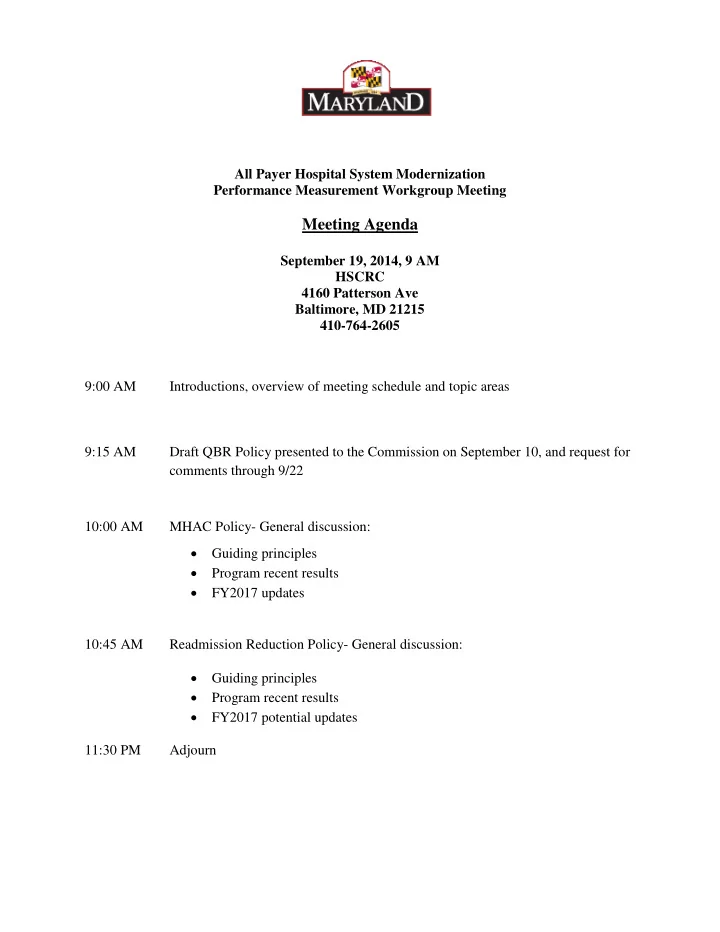
Meeting Agenda September 19, 2014, 9 AM HSCRC 4160 Patterson Ave - - PDF document

meeting agenda
SMART_READER_LITE
LIVE PREVIEW

Meeting Agenda September 19, 2014, 9 AM HSCRC 4160 Patterson Ave - - PDF document

All Payer Hospital System Modernization Performance Measurement Workgroup Meeting Meeting Agenda September 19, 2014, 9 AM HSCRC 4160 Patterson Ave Baltimore, MD 21215 410-764-2605 9:00 AM Introductions, overview of meeting schedule and


slide-1
SLIDE 1

All Payer Hospital System Modernization Performance Measurement Workgroup Meeting

Meeting Agenda

September 19, 2014, 9 AM HSCRC 4160 Patterson Ave Baltimore, MD 21215 410-764-2605 9:00 AM Introductions, overview of meeting schedule and topic areas 9:15 AM Draft QBR Policy presented to the Commission on September 10, and request for comments through 9/22 10:00 AM MHAC Policy- General discussion:

  • Guiding principles
  • Program recent results
  • FY2017 updates

10:45 AM Readmission Reduction Policy- General discussion:

  • Guiding principles
  • Program recent results
  • FY2017 potential updates

11:30 PM Adjourn

slide-2
SLIDE 2

HSCRC Performance Measurement Work Group

Albert Wu, MD, PhD

Director, Center for Health Services and Outcomes Research Johns Hopkins Bloomberg School of Public Health

Barbara Epke

Vice President LifeBridge Health

Beverly A. Collins, MD, MBA, MS Traci LaValle

Vice President, Financial Policy & Advocacy Maryland Hospital Association

Daniel Cochran

Vice President, CFO Shady Grove Adventist Hospital

Daniel Winn, MD

Vice President and Senior Medical Director Carefirst

Ed Beranek

Director of Regulatory Compliance Johns Hopkins Health System

Farzaneh L. Sabi, MD

Kaiser Mid-Atlantic Permanente Medical Group

  • Dr. Joseph Territo

Associate Medical Director for Quality Kaiser Mid-Atlantic Permanente Medical Group

Jeff Richardson, MBA, LCSW-C

Executive Director Mosaic Community Services

Justin Deibel

Senior Vice President, CFO Mercy Medical Center

Karen Matsuoka, PhD

Director, Health System and Infrastructure Administration Maryland Department of Health and Mental Hygiene

Linda Costa, PhD, RN, NEA-BC

Assistant Professor, OSAH University of Maryland School of Nursing

Madeline Shea, PhD

Vice President, Population Health Center Delmarva Foundation for Medical Care, Inc.

Tricia Roddy

Director, Office of Planning Maryland Department of Health and Mental Hygiene

Stan Dorn

Urban Institute

Sean Tunis, MD, MSC

President and CEO Center for Medical Technology Policy

Theressa Lee

Chief of Hospital Quality and Performance Maryland Health Care Commission

Performance Measurement Roster Update September 2014

slide-3
SLIDE 3

HSCRC Performance Measurement Workgroup Proposed Work Plan – Phase 2

Updated 7/23/14 Meeting Date Meeting Goals Commission Meeting Date: September 10, 2014 (Draft QBR FY2017 Policy) September 19, 2014 9:00 – 11:30 Room 100

  • 1. Overview of Meeting Schedule/Agendas
  • 2. Draft QBR Policy -(Draft policy shared w/workgroup for comment in August)
  • 3. MHAC: General discussion of FY2017 Updates
  • 4. Readmission : General discussion of FY2017 Updates

Commission Meeting Date: October 15, 2014 (Final QBR FY2017 Policy) October 17, 2014 9:00 – 11:30 Room 100

  • 1. MHAC: Progress report
  • 2. POA Audits/Possible presentation
  • 3. Readmission : Socio Economic Adjustments

November 5, 2014 9:00 – 11:30 Room 100

  • 1. MHAC: Draft MHAC policy (including benchmarks and targets)
  • 2. Readmissions : MD vs. National trend modeling

Commission Meeting Date: November 12, 2014 (Draft MHAC FY2017 Policy) November 21, 2014 9:00 – 11:30 Room 100

  • 1. Readmission: Draft FY 2017 policy review
  • 2. MHAC: Final FY 2017 policy review

Commission Meeting Date: December 10, 2014 (Final MHAC FY2017 Policy; Draft Readmission FY2017 Policy) December 19,2014 (tentative) 9:00 – 11:30 Room 100

  • 1. Readmission: Final FY 2017 readmission policy review
  • 2. Potentially Avoidable Utilization Measurement
  • 3. Patient Centered Performance Measurement Strategy
  • 4. Other Topics – TBD

January 6, 2015 9:00 – 11:30 Room 100

  • 1. Potentially Avoidable Utilization Measurement
  • 2. Topics TBD based on future work group plans

Commission Meeting Date: Jan 14, 2014 (Final Readmission FY2017 Policy) Note: This is a preliminary work plan. It is possible that meetings or conference calls could be added or that some materials may be reviewed via email.

slide-4
SLIDE 4

Draft Recommendation for Updating the Quality Based Reimbursement (QBR) Program

Draft Recommendation for Updating the Quality Based Reimbursement Program for FY 2017

Health Services Cost Review Commission 4160 Patterson Avenue Baltimore, MD 21215 (410) 764‐2605 September 10, 2014

This document contains the draft staff recommendations for updating the Quality Based Reimbursement (QBR) Program for FY 2017 for consideration at the September 10, 2014 Public Commission Meeting. Public comments should be sent to Dianne Feeney at the above address or by e-mail at Dianne.Feeney@Maryland.gov. For full consideration, comments must be received by September 22, 2014. 1

slide-5
SLIDE 5

Draft Recommendation for Updating the Quality Based Reimbursement (QBR) Program

  • A. Introduction

The HSCRC quality-based measurement initiatives, including the scaling methodologies and magnitudes of revenue “at risk” for these programs, are important policy tools for providing strong incentives for hospitals to improve their quality performance over time. For HCSRC’s Quality-based Reimbursement (“QBR”) Program, current Commission policy calls for measurement of hospital performance scores across clinical process of care, outcome and patient experience of care domains, and revenue neutral scaling of hospitals in allocating rewards and penalties based on performance. “Scaling” for QBR refers to the differential allocation of a pre-determined portion of base regulated hospital inpatient revenue based on assessment of the relative quality of hospital

  • performance. The rewards (positive scaled amounts) or penalties (negative scaled amounts) are

then applied to each hospital’s update factor for the rate year; these scaled amounts are applied

  • n a “one-time” basis (and not considered permanent revenue), and are computed on a

“revenue neutral” basis for the system so that the net increases in rates for better performing hospitals are funded entirely by net decreases in rates for poorer performing hospitals. For the QBR program for State FY 2016 rates, as approved by the Commission, the HSCRC will weight the clinical outcomes domain more heavily than the previous year, and scale a maximum penalty of 1% of approved base hospital inpatient revenue. Staff recommends adjusting the weights of the measurement domains so that outcome domains account for a greater proportion of the hospital’s overall performance scores going forward, as well as updating the amount of total hospital revenue at risk for scaling for the QBR program.

  • B. Background
  • 1. Centers for Medicare & Medicaid Services (CMS) Value Based Purchasing (VBP)

Program The Patient Protection and Affordable Care Act of 2010 requires CMS to fund the aggregate Hospital VBP incentive payments by reducing the base operating diagnosis-related group (DRG) payment amounts that determine the Medicare payment for each hospital inpatient

  • discharge. The law set the reduction at one percent in FY 2013, rising incrementally to 2 percent

by FY 2017. CMS implemented the VBP program with hospital payment adjustments beginning in October

  • 2013. For the federal FY 2016 (October 1, 2015 to September 30, 2016) Hospital VBP program,

CMS measures include four domains of hospital performance: clinical process of care; patient experience of care (HCAHPS survey measure); outcomes; and efficiency/Medicare spending per beneficiary. Results are weighted by CMS as listed below, with 1.75% of Medicare hospital payments “at risk” for 2016. Figure 1. CMS VBP Domain Weights, FY 2016 Clinical/Process Patient Experience Outcome Efficiency/Medicare spending/beneficiary FFY 2016 10% 25% 40% 25% 2

slide-6
SLIDE 6

Draft Recommendation for Updating the Quality Based Reimbursement (QBR) Program

CMS indicated its future emphasis will increasingly lean toward outcomes in the VBP program. In addition, staff notes that for the CMS VBP program for FY 2016, CMS added additional

  • utcome measures, including the Agency for Healthcare Research and Quality (“AHRQ”)

Patient Safety Indicator (“PSI”) 90 Composite measure and the Centers for Disease Control National Health Safety Network (“CDC-NHSN”) Central Line Associated Blood Stream Infection (CLABSI) and Catheter Associated Urinary Tract Infection (CAUTI) measure.

  • 2. QBR Measures, Domain Weighting and Magnitude at Risk to Date

HSCRC implemented the first hospital payment adjustments for QBR program performance in July 2009. For rate year 2016 (July 1, 2015-June 30, 2016), the QBR program scales 1% of revenue at risk and uses the CMS/Joint Commission core process measures—e.g., aspirin upon arrival for the patient diagnosed with heart attack—, “patient experience of care” or Hospital Consumer Assessment of Healthcare Providers and Systems (“HCAHPS”) measures, and three

  • utcome measures, which include AHRQ PSI 90, the CDC-NHSC CLABSI measure, and all-

cause inpatient mortality using the 3M Risk of Mortality classifications. The weighting for each domain compared with the CMS VBP Program are illustrated below in Figure 2. Figure 2. Maryland QBR Compared with CMS VBP Domain Weights, FY 2016 Staff convened several meetings of the QBR Update Workgroup in October and November of 2013 and the Performance Measurement Workgroup, which began meeting in January 2014, where there was agreement to add measures to be consistent with the VBP Program where feasible, and to align the list of process of care measures, threshold and benchmark values, and time lag periods with those used by CMS, 1 allowing HSCRC to use the data submitted directly to CMS. This alignment must include the measures used, data sources and magnitude of revenue “at risk” for the program. Maryland has not, to date, developed and implemented an efficiency measure as part of the QBR program. As part of the implementation of New All- Payer Model; there was agreement among Workgroup members and staff that a new efficiency measure is needed to incorporate population-based outcomes.

  • 3. Value Based Purchasing Exemption Provisions

Pursuant to 1886(o)(1)(C)(iv) of the Social Security Act, “the Secretary may exempt such hospitals from the application of this subsection if the State which is paid under such section submits an annual report to the Secretary describing how a similar program in the State for a participating hospital or hospitals achieves or surpasses the measured results in terms of patient health outcomes and cost savings established under this subsection.” VBP exemptions have been requested and granted for FYs 2013, 2014 and 2015.

1 HSCRC has used core measures data submitted to MHCC and applied state-based benchmarks and thresholds to

calculate hospitals’ QBR scores up to the period used for State FY 2015 performance.

FY 2016 Clinical/ Process Patient Experience Outcome Efficiency CMS VBP 10% 25% 40% 25% Maryland QBR 30% 40% 30% N/A 3

slide-7
SLIDE 7

Draft Recommendation for Updating the Quality Based Reimbursement (QBR) Program

The CMS FY 2015 Inpatient Prospective Payment final rule states that, in order to implement the Maryland All-Payer Model, CMS has waived certain provisions of the [Social Security] Act, and the corresponding implementing regulations, as set forth in the agreement between CMS and Maryland and subject to Maryland’s compliance with the terms of the agreement. The final rule continues that, in other words, although the exemption from the Hospital VBP Program no longer applies, Maryland hospitals will not be participating in the Hospital VBP Program because section 1886(o) of the Act and its implementing regulations have been waived for purposes of the model, subject to the terms of the agreement The section of Maryland All-Payer Model Agreement between CMS and the State addressing the VBP program is excerpted below. …4. Medicare Payment Waivers. Under the Model, CMS will waive the requirements of the following provisions of the Act as applied solely to Regulated Maryland Hospitals: …e. Medicare Hospital Value Based Purchasing. Section 1886(o) of the Act, and implementing regulations at 42 CFR 412.160 - 412.167, only insofar as the State submits an annual report to the Secretary that provides satisfactory evidence that a similar program in the State for Regulated Maryland Hospitals achieves or surpasses the measured results in terms of patient health outcomes and cost savings established under 1886(o) of the Act…. Staff will work out requirements and timelines with CMS for submitting an annual report on comparable programs to the VBP program in the State.

  • C. Assessment

Staff analyzed changes in performance on the QBR and VBP measures used for FY 2015 performance for Maryland versus the US for October 2012 through September 2013 compared with the immediately prior 12 month period. Figure 3 below lists each of the measures used for the VBP and QBR programs. The data indicate that Maryland improved at a slightly higher rate and/or performed slightly better for all but one of the process of care measures. Maryland also performed significantly better than the US on the CLABSI measure for both time periods and also improved. For HCAHPS, Maryland declined slightly in performance for almost half (4 out

  • f 10) of the measures, and performed below the US on all measures with the exception of

“Patient given information about recovery at home” where Maryland improved significantly and now performs the same as the US. 4

slide-8
SLIDE 8

Draft Recommendation for Updating the Quality Based Reimbursement (QBR) Program

Figure 3. QBR Measures Change for Maryland Versus US Staff examined measures finalized for the CMS VBP Program for FY 2017 in the 2015 CMS Inpatient Prospective Payment System (IPPS) Final Rule and those in the potential pool for the QBR program for 2017. Figure 4 below details the measures by domain and the available published performance standards for each measure, and indicates the measures that will be included in the VBP and QBR programs.

MD Base Period MD Most Current Performance US Base Period US Most Current Performance Q308-Q211 Q309-Q212 Difference Q308-Q211 Q309-Q212 Difference Combined CHF, AMI, Pneumonia 30 day mortality 11.56 11.38

  • 0.18

12.34 12.31

  • 0.03

Maryland Base Period MD Performance Period US Base Period US Performance Period Oct 11-Sep12 Oct12-Sep13 Difference Oct11-Sep12 Oct12-Sep13 Difference AMI 8a Primary PCI within 90 minutes 89.96 94.68 4.72 95.22 96.25 1.03 HF 1 Discharge instructions 92.94 94.28 1.34 92.59 93.9 1.31 IMM 1 Pneumococcal vaccination* 91.59 94 2.41 88.28 92 3.72 Imm 2 Influenza vaccination* 90.19 94 3.81 84.16 90 5.84 PN 3b Blood culture before first antibiotic 96.53 97.03 0.5 96.93 97.4 0.47 PN 6 Initial antibiotic selection 95.82 97.29 1.47 94.63 95.19 0.56 SCIP INF 1 Antibiotic givin within 1 hour 97.79 97.7

  • 0.09

97.96 98.3 0.34 SCIP INF 4 Cardiac surgery patients with controlled 6am postop serum glucose 94.23 96.51 2.28 95.88 96.47 0.59 SCIP INF 9 Urinary catheter removed postop day 1

  • r 2

93.69 97.74 4.05 94.98 96.84 1.86 Clinical Process Average Total Score 93.64 95.91 2.28 93.40 95.15 1.75 HCAHPS Doctors always communicated well 77.51 78 0.49 81.34 82 0.66 HCAHPS Nurses always communicated well 74.84 75 0.16 78.18 79 0.82 HCAHPS Patients always received help as soon as they wanted 59.19 58

  • 1.19

66.63 68 1.37 HCAHPS Staff explained about medication 59.02 58

  • 1.02

63.47 64 0.53 HCAHPS Pain was always controlled 67.67 67

  • 0.67

70.63 71 0.37 HCAHPS Patient room always kept quiet 56.05 57 0.95 60.35 65 4.65 HCAHPS Patient room always kept clean 65.21 64

  • 1.21

72.78 73 0.22 HCAHPS Patient given information about recovery at home 82.93 85 2.07 84.21 85 0.79 HCAHPS Patient would definitely recommend hospital to friends and family 66.88 67 0.12 70.76 71 0.24 HCAHPS Average Total Score 67.70 67.67

  • 0.03

72.04 73.11 1.07 MD Base Period MD Most current performance Difference US Base Peroid US Most current performance Difference CLABSI 0.55 0.53

  • 0.02

1 1 N/A CAUTI 1.59 1.78 0.19 1 1 N/A MRSA N/A 1.83 N/A N/A 1 N/A C-diff N/A 1.16 N/A N/A 1 N/A SSI Colon N/A 0.95 N/A N/A 1 N/A SSI Hysterectomy N/A 1.51 N/A N/A 1 N/A PSI 90 Data Unavailable Data Unavailable *Data collection periods for Immunization measures differ than those for other measures.

CLINICAL OUTCOME Mortality CLINICAL PROCESS PATIENT EXPERIENCE (HCAHPS) SAFETY**

**For the Safety measures are ratios where a decrease indicates improvement. An average score for the saferty domain was not calculated due to incomplete data.

5

slide-9
SLIDE 9

Draft Recommendation for Updating the Quality Based Reimbursement (QBR) Program

Figure 4. Measures and Performance Standards for the FY 2017 CMS Hospital VBP Program Compared with Maryland QBR Program

Measure ID (Applicable Programs) Description Achievement Threshold Benchmark Safety Measures CAUTI (VBP and New QBR) Catheter-Associated Urinary Tract Infection 0.845 0.000 CLABS (VBP and QBR) Central Line-Associated Blood Stream Infection 0.457 0.000

  • C. difficile

(New VBP and QBR TBD- MD data collection began in July 2013.) Clostridium difficile Infection 0.750 0.000 MRSA Bacteremia (New VBP and QBR TBD- MD data collection began in July 2013) Methicillin-Resistant Staphylococcus aureus Bacteremia 0.799 0.000 PSI-90 (VBP and QBR) Complication/patient safety for selected indicators (composite) 0.577321* (*VBP MEDICARE ONLY;QBR All-PAYER THRESHOLD TBD) 0.397051* (*VBP MEDICARE ONLY;QBR All-PAYER BENCHMARK TBD) SSI (VBP and New QBR) Surgical Site Infection

  • Colon
  • Abdominal Hysterectomy
  • 0.751
  • 0.698
  • 0.000
  • 0.000

Clinical Care – Outcomes Measures MORT-30-AMI (VBP ONLY) Acute Myocardial Infarction (AMI) 30-day mortality rate 0.851458 0.871669 MORT-30-HF (VBP ONLY) Heart Failure (HF) 30-day mortality rate 0.881794 0.903985 MORT-30-PN (VBP ONLY) Pneumonia (PN) 30-day mortality rate 0.882986 0.908124 Mortality (QBR ONLY) All-cause inpatient using 3M risk of mortality TBD TBD Clinical Care – Process Measures AMI-7a (VBP and QBR) Fibrinolytic Therapy Received Within 30 Minutes of Hospital Arrival 0.954545 1.000000 IMM-2 (VBP and QBR) Influenza Immunization 0.951607 0.997739

6

slide-10
SLIDE 10

Draft Recommendation for Updating the Quality Based Reimbursement (QBR) Program

Measure ID (Applicable Programs) Description Achievement Threshold Benchmark PC-01 (New VBP and QBR TBD- MD data collection began in January 2014) Elective Delivery Prior to 39 Completed Weeks Gestation 0.031250 0.000000 Efficiency and Cost Reduction Measure MSPB-1 (VBP ONLY) Medicare Spending per Beneficiary Median Medicare Spending per Beneficiary ratio across all hospitals during the performance period Mean of the lowest decile Medicare Spending per Beneficiary ratios across all hospitals during the performance period Patient and Caregiver-Centered Experience of Care/Care Coordination Domain HCAHPS Survey Dimension (VBP and QBR) Floor (percent) Achievement Threshold (percent) Benchmark (percent) Communication with Nurses 58.14 78.19 86.61 Communication with Doctors 63.58 80.51 88.80 Responsiveness of Hospital Staff 37.29 65.05 80.01 Pain Management 49.53 70.28 78.33 Communication about Medicines 41.42 62.88 73.36 Hospital Cleanliness & Quietness 44.32 65.30 79.39 Discharge Information 64.09 85.91 91.23 Overall Rating of Hospital 35.99 70.02 84.60

Staff is proposing updated measure domain weights based on the VBP measures domain weights published in the CMS IPPS Final Rule, Maryland’s need to improve on the HCAHPS measures, and the measures and domains available for adoption in the QBR rate year FY 2017; Figure 4 below illustrates the VBP final domain weights and the QBR proposed domain weights. Staff circulated the draft recommendation via email to the members of the Performance Measurement Workgroup as in person meetings were not feasible due to summer schedules. The draft recommendation will be discussed at the September 19 in person meeting and issues raised in the discussions will be incorporated into the final recommendation. Figure 4. Final Measure Domain Weights for the Hospital VBP Program and Proposed Domain Weights for the QBR Program FY 2017

Clinical

  • Outcomes

(Mortality)

  • Process

Patient Experience Safety Efficiency

7

slide-11
SLIDE 11

Draft Recommendation for Updating the Quality Based Reimbursement (QBR) Program

Staff notes again that the established revenue “at risk” magnitude for the CMS VBP Program is set at 2% for 2017. To determine the potential impact of increasing the amount of revenue at risk for the QBR program to 1.5% versus 2%, staff used the most recent scaling results (October 1, 2012 to September 30, 2013 performance period) that apply to hospitals for rate year FY 2015 for modeling purposes. The results, to be considered for altering the magnitude of revenue to be scaled for rate year FY 2017, detailed in Appendix I, reveal that a total range of $7.7M to $10.3M is redistributed under the revenue neutral scaling methodology. A memo summarizing the updates to the QBR methodology with the required benchmark data will be sent to the hospitals after final Commission approval of the QBR program updates for FY 2017.

  • D. Recommendations

For the QBR program, staff provides the following recommendation:

  • 1. Allocate 2% of hospital approved inpatient revenue for QBR relative performance in FY

2017.

  • 2. Adjust measurement domain weights to include 5% for process, 15% for outcomes

(mortality), 35% for safety, and 45% patient experience of care.

CMS VBP

  • 25 percent
  • 5 percent

25% 20% 25% Proposed Maryland QBR

  • 15 percent
  • 5 percent

45% 35% N/A

8

slide-12
SLIDE 12

Draft Recommendation for Updating the Quality Based Reimbursement (QBR) Program

Appendix I. QBR Continuous Linear Scaling- Modeling Maximum Penalty of 1.5% Versus 2% of Hospital Inpatient Revenue Using Data Results for RY 2015

HOSPID HOSPITAL NAME INPATIENT REVENUE QBR FINAL POINTS SCALING BASIS 1.5% SCALING BASIS 2% REVENUE IMPACT OF SCALING 1.5% REVENUE IMPACT OF SCALING 2% REVENUE NEUTRAL ADJUSTED REVENUE IMPACT OF SCALING 1.5% REVENUE NEUTRAL ADJUSTED REVENUE IMPACT OF SCALING 2% REVENUE NEUTRAL ADJUSTED GROSS REVENUE 1.5% REVENUE NEUTRAL ADJUSTED GROSS REVENUE 2% REVENUE NEUTRAL ADJUSTED PERCENT 1.5% REVENUE NEUTRAL ADJUSTED PERCENT 2% A B C D E F G H I J K L M N

210062 Southern Maryland Hospital Center 159,227,525 $ 0.050

  • 1.500%
  • 2.000%
  • $2,388,413
  • $3,184,551
  • $2,388,413
  • $3,184,551

$156,839,112 $156,042,975

  • 1.500%
  • 2.000%

210003 Prince Georges Hospital Center 172,920,161 $ 0.110

  • 1.253%
  • 1.671%
  • $2,167,170
  • $2,889,561
  • $2,167,170
  • $2,889,561

$170,752,991 $170,030,601

  • 1.253%
  • 1.671%

210048 Howard County General Hospital 163,303,899 $ 0.230

  • 0.760%
  • 1.013%
  • $1,240,839
  • $1,654,452
  • $1,240,839
  • $1,654,452

$162,063,061 $161,649,448

  • 0.760%
  • 1.013%

210013 Bon Secours Hospital 76,305,158 $ 0.251

  • 0.675%
  • 0.900%
  • $514,792
  • $686,390
  • $514,792
  • $686,390

$75,790,366 $75,618,769

  • 0.675%
  • 0.900%

210019 Peninsula Regional Medical Center 228,027,801 $ 0.269

  • 0.600%
  • 0.800%
  • $1,367,997
  • $1,823,995
  • $1,367,997
  • $1,823,995

$226,659,805 $226,203,806

  • 0.600%
  • 0.800%

210044 Greater Baltimore Medical Center 196,617,898 $ 0.279

  • 0.560%
  • 0.747%
  • $1,101,266
  • $1,468,354
  • $1,101,266
  • $1,468,354

$195,516,632 $195,149,544

  • 0.560%
  • 0.747%

210029 Johns Hopkins Bayview Medical Center 347,704,294 $ 0.285

  • 0.534%
  • 0.712%
  • $1,855,601
  • $2,474,135
  • $1,855,601
  • $2,474,135

$345,848,693 $345,230,159

  • 0.534%
  • 0.712%

210055 Laurel Regional Hospital 75,611,683 $ 0.294

  • 0.495%
  • 0.661%
  • $374,653
  • $499,537
  • $374,653
  • $499,537

$75,237,030 $75,112,146

  • 0.495%
  • 0.661%

210060 Fort Washington Medical Center 17,342,569 $ 0.295

  • 0.493%
  • 0.657%
  • $85,421
  • $113,895
  • $85,421
  • $113,895

$17,257,148 $17,228,674

  • 0.493%
  • 0.657%

210022 Suburban Hospital 176,985,550 $ 0.310

  • 0.431%
  • 0.574%
  • $762,580
  • $1,016,774
  • $762,580
  • $1,016,774

$176,222,969 $175,968,776

  • 0.431%
  • 0.574%

210001 Meritus Hospital 182,862,924 $ 0.310

  • 0.431%
  • 0.574%
  • $787,904
  • $1,050,539
  • $787,904
  • $1,050,539

$182,075,019 $181,812,385

  • 0.431%
  • 0.574%

210040 Northwest Hospital Center 138,718,749 $ 0.316

  • 0.407%
  • 0.543%
  • $565,094
  • $753,459
  • $565,094
  • $753,459

$138,153,654 $137,965,289

  • 0.407%
  • 0.543%

210057 Shady Grove Adventist Hospital 223,152,951 $ 0.320

  • 0.390%
  • 0.520%
  • $869,741
  • $1,159,655
  • $869,741
  • $1,159,655

$222,283,210 $221,993,296

  • 0.390%
  • 0.520%

210018 Montgomery General Hospital 85,514,349 $ 0.335

  • 0.328%
  • 0.437%
  • $280,547
  • $374,063
  • $280,547
  • $374,063

$85,233,802 $85,140,286

  • 0.328%
  • 0.437%

210011

  • St. Agnes Hospital

233,289,323 $ 0.335

  • 0.328%
  • 0.437%
  • $765,354
  • $1,020,472
  • $765,354
  • $1,020,472

$232,523,969 $232,268,851

  • 0.328%
  • 0.437%

210015 Franklin Square Hospital Center 278,723,093 $ 0.345

  • 0.287%
  • 0.383%
  • $799,797
  • $1,066,396
  • $799,797
  • $1,066,396

$277,923,296 $277,656,697

  • 0.287%
  • 0.383%

210037 Memorial Hospital at Easton 92,515,251 $ 0.364

  • 0.208%
  • 0.277%
  • $192,111
  • $256,149
  • $192,111
  • $256,149

$92,323,139 $92,259,102

  • 0.208%
  • 0.277%

210016 Washington Adventist Hospital 157,754,799 $ 0.367

  • 0.196%
  • 0.261%
  • $308,512
  • $411,350
  • $308,512
  • $411,350

$157,446,287 $157,343,450

  • 0.196%
  • 0.261%

210024 Union Memorial Hospital 236,590,732 $ 0.374

  • 0.166%
  • 0.221%
  • $392,446
  • $523,262
  • $392,446
  • $523,262

$236,198,286 $236,067,471

  • 0.166%
  • 0.221%

210033 Carroll Hospital Center 134,838,320 $ 0.380

  • 0.143%
  • 0.191%
  • $192,858
  • $257,144
  • $192,858
  • $257,144

$134,645,462 $134,581,176

  • 0.143%
  • 0.191%

210004 Holy Cross Hospital 311,801,309 $ 0.400

  • 0.061%
  • 0.081%
  • $189,539
  • $252,719
  • $189,539
  • $252,719

$311,611,770 $311,548,590

  • 0.061%
  • 0.081%

210056 Good Samaritan Hospital 176,449,767 $ 0.405

  • 0.040%
  • 0.054%
  • $70,983
  • $94,644
  • $70,983
  • $94,644

$176,378,785 $176,355,124

  • 0.040%
  • 0.054%

210061 Atlantic General Hospital 37,698,304 $ 0.426 0.048% 0.064% $18,052 $24,069 $12,462 $16,616 $37,710,766 $37,714,920 0.033% 0.044% 210012 Sinai Hospital 418,687,491 $ 0.446 0.127% 0.169% $529,804 $706,406 $365,751 $487,668 $419,053,243 $419,175,160 0.087% 0.116% 210038 Maryland General Hospital 130,524,694 $ 0.451 0.148% 0.197% $192,860 $257,147 $133,141 $177,522 $130,657,835 $130,702,215 0.102% 0.136% 210035 Civista Medical Center 74,476,146 $ 0.455 0.165% 0.220% $123,164 $164,218 $85,026 $113,368 $74,561,172 $74,589,514 0.114% 0.152% 210034 Harbor Hospital Center 120,977,775 $ 0.469 0.221% 0.295% $267,581 $356,775 $184,725 $246,300 $121,162,500 $121,224,075 0.153% 0.204% 210032 Union of Cecil 66,197,257 $ 0.482 0.277% 0.369% $183,360 $244,480 $126,583 $168,777 $66,323,840 $66,366,034 0.191% 0.255% 210002 University of Maryland Hospital 842,774,096 $ 0.484 0.284% 0.379% $2,394,842 $3,193,122 $1,653,283 $2,204,377 $844,427,379 $844,978,473 0.196% 0.262% 210039 Calvert Memorial Hospital 65,741,743 $ 0.491 0.315% 0.420% $207,196 $276,261 $143,038 $190,717 $65,884,781 $65,932,461 0.218% 0.290% 210049 Upper Chesapeake Medical Center 145,284,971 $ 0.495 0.330% 0.440% $479,229 $638,972 $330,837 $441,116 $145,615,808 $145,726,087 0.228% 0.304% 210043 Baltimore Washington Medical Center 217,712,318 $ 0.495 0.330% 0.440% $718,134 $957,512 $495,765 $661,020 $218,208,083 $218,373,338 0.228% 0.304% 210005 Frederick Memorial Hospital 184,859,281 $ 0.500 0.350% 0.467% $647,774 $863,699 $447,192 $596,256 $185,306,473 $185,455,537 0.242% 0.323% 210030 Chester River Hospital Center 28,699,194 $ 0.539 0.509% 0.679% $146,086 $194,781 $100,851 $134,467 $28,800,045 $28,833,662 0.351% 0.469% 210051 Doctors Community Hospital 132,902,820 $ 0.540 0.515% 0.687% $684,311 $912,415 $472,416 $629,887 $133,375,236 $133,532,708 0.355% 0.474% 210010 Dorchester General Hospital 24,515,059 $ 0.552 0.563% 0.751% $137,989 $183,986 $95,261 $127,015 $24,610,320 $24,642,073 0.389% 0.518% 210027 Western MD Regional Medical Center 179,984,650 $ 0.589 0.718% 0.957% $1,291,486 $1,721,982 $891,580 $1,188,773 $180,876,229 $181,173,423 0.495% 0.660% 210008 Mercy Medical Center 227,476,677 $ 0.609 0.799% 1.065% $1,816,689 $2,422,252 $1,254,154 $1,672,206 $228,730,831 $229,148,882 0.551% 0.735% 210017 Garrett County Memorial Hospital 18,267,389 $ 0.611 0.806% 1.074% $147,177 $196,236 $101,604 $135,472 $18,368,993 $18,402,861 0.556% 0.742% 210023 Anne Arundel Medical Center 302,553,244 $ 0.615 0.823% 1.098% $2,490,917 $3,321,222 $1,719,608 $2,292,811 $304,272,852 $304,846,055 0.568% 0.758% 210006 Harford Memorial Hospital 45,941,091 $ 0.632 0.894% 1.192% $410,619 $547,492 $283,472 $377,962 $46,224,563 $46,319,053 0.617% 0.823% 210009 Johns Hopkins Hospital 1,260,991,141 $ 0.634 0.900% 1.200% $11,344,725 $15,126,300 $7,831,850 $10,442,466 $1,268,822,991 $1,271,433,607 0.621% 0.828% 210028

  • St. Mary's Hospital

67,824,688 $ 0.698 1.164% 1.552% $789,483 $1,052,644 $545,021 $726,694 $68,369,709 $68,551,383 0.804% 1.071% Statewide Total $8,460,348,137 $7,747,859 $10,330,478 (0.0) $ (0.0) $ 8,460,348,137 $ 8,460,348,137 $

  • 0.1%
  • 0.1%

9

slide-13
SLIDE 13

1

New All-Payer Model for Maryland Performance Measurement Workgroup Meeting 9/19/2014 Rate Year 2017 Draft Quality Based Reimbursement Recommendation

slide-14
SLIDE 14

2

Presentation Contents

 Program Overview and Guiding Principles  Brief Summary of Current Methodology and Results for

2014 YTD

 Rate

Year 2017 Potential Updates

 Next Steps

slide-15
SLIDE 15

3

Quality Based Reimbursement (QBR) Program

 Maryland was an early adopter and aspires to be a leader in

hospital performance reporting and payment reform

 The QBR program, implemented in 2010, is analogous to the

CMS Value Based Purchasing program, implemented in 2013.

 Revenue at risk:

  • For the QBR program it was initially 0.5% and is now 1% of

approved inpatient revenue (applies to FY 2016 hospital rates)

  • For the

VBP program it was initially1% of base DRG revenue and is now 1.75% (applies to FY 2016 hospital rates); increasing to 2% for FY 2017.

 Under Maryland’s previous waiver, Maryland was required to

seek, and did receive, exemptions from the VBP program by demonstrating cost and quality outcomes equal to or better than the VBP program

slide-16
SLIDE 16

4

Guiding Principles

 Measurement used for performance linked with payment must

include all patients regardless of payer.

 Measurement must be fair to hospitals and allow the ability to

track progress.

 Measures and targets(benchmarks and thresholds) used

should be consistent with those used by the CMS VBP program to the extent possible.

 Emphasis on outcomes should increase going forward.  The new Model contract requires participation in all Inpatient

and Outpatient Quality Reporting requirements, and reporting to CMMI to maintain exemption from the VBP program.

slide-17
SLIDE 17

5

Maryland QBR Compared with US Measure Weighting FY 2016

Clinical/ Process Patient Experience Outcome (For QBR: Mortality, CLABSI, PSI 90) Efficiency CMS VBP 10% 25% 40% 25% Maryland QBR 30% 40% 30% N/A

slide-18
SLIDE 18

6

Maryland QBR Most Currently Available Performance Results Compared with US

(Outcome)

slide-19
SLIDE 19

7

Maryland QBR Most Currently Available Performance Results Compared with US

(Outcome)

slide-20
SLIDE 20

8

Maryland QBR Measures for FY 2017 Compared with US

slide-21
SLIDE 21

9

Maryland QBR Measures for FY 2017 Compared with US

Patient Experience

slide-22
SLIDE 22

10

Rate Year 2017 Base and Performance Periods

HSCRC Quality Program Measurement, Performance and Impact Periods 09/15/2014

Rate Year (Maryland Fiscal Year) FY13-Q2 FY13-Q3 FY13-Q4 FY14-Q1 FY14-Q2 FY14-Q3 FY14-Q4 FY15-Q1 FY15-Q2 FY15-Q3 FY15-Q4 FY16-Q1 FY16-Q2 FY16- Q3 FY16- Q4 FY17- Q1 FY17- Q2 FY17- Q3 FY17- Q4 Calendar Year CY12- Q4 CY13- Q1 CY13- Q2 CY13- Q3 CY13- Q4 CY14- Q1 CY14- Q2 CY14- Q3 CY14- Q4 CY15- Q1 CY15- Q2 CY15- Q3 CY15- Q4 CY16- Q1 CY16- Q2 CY16- Q3 CY16- Q4 CY17- Q1 CY17- Q2 Quality Programs that Impact Rate Year 2017

MHAC

PPC Grouper V. 32 Rate Year Impacted by MHAC Results MHAC Base Period MHAC Performance

QBR

Federal Standards Maryland QBR Core and HCAHPS SAFETY Base Period Rate Year Impacted by QBR Results Federal Base Core_HCAHPS QBR Core and HCAHPS Safety Performance Period Maryland Mortality, PSI Base Period Maryland Mortality, PSI Performance Period

Readmission Reduction Incentive

Readmission Reduction Base Period Rate Year Impacted by Readmission Reduction Results Readmission Reduction Performance Period

slide-23
SLIDE 23

11

Measure Domain Weighting Recommended for FY 2017

Clinical

  • Outcomes

(Mortality)

  • Process

Patient Experience Safety Efficiency CMS VBP

  • 25 percent
  • 5 percent

25% 20% 25% Proposed Maryland QBR

  • 15 percent
  • 5 percent

45% 35% N/A

slide-24
SLIDE 24

12

Revenue at Risk of 2% Recommended for QBR FY 2017

 The established revenue “at risk” magnitude for the CMS

VBP Program is set at 2% for 2017.

 Staff modeled 1.5% versus 2%, of revenue at risk using the

most recent scaling results (October 1, 2012 to September 30, 2013 performance period) that apply to hospitals for rate year FY 2015

 The results reveal that a total range of $7.7M to $10.3M is

redistributed under the revenue neutral scaling methodology.

slide-25
SLIDE 25

13

Discussion

slide-26
SLIDE 26

1

New All-Payer Model for Maryland Performance Measurement Workgroup Meeting 9/19/2014 Draft MHAC Rate Year 2017 Program Potential Updates

slide-27
SLIDE 27

2

Presentation Contents

 Program Overview and Guiding Principles  Brief Summary of Current Methodology and Results for

2014 YTD

 Rate

Year 2017 Potential Updates

 Next Steps

slide-28
SLIDE 28

3

MHAC Program

 Uses list of 65 Potentially Preventable Complications (PPCs)

developed by 3M.

 PPCs are defined as harmful events (accidental laceration during a

procedure) or negative outcomes (hospital acquired pneumonia) that may result from the process of care and treatment rather than from a natural progression of underlying disease.

 Relies on Present on Admission (POA) Indicators  Links hospital payment to hospital performance by comparing the

  • bserved number of PPCs to the expected number of PPCs.
slide-29
SLIDE 29

4

Guiding Principles

 Achieve the new All-payer model goal of a 30% reduction in

all 65 PPCs by the end of 2018.

 Breadth and impact of the program must meet or exceed the

Medicare national program in terms of measures and revenue at risk.

 Improve care for all patients, regardless of payer  Prioritize PPCs that are high volume, high cost, have opportunity for

improvement and are areas of national focus.

 Predetermined performance targets and financial impact  Encourage cooperation and sharing of best practices  Hold harmless for lack of improvement if attainment is highly

favorable.

 Ability to track progress

slide-30
SLIDE 30

5

MHAC Methodology

Dimension MHAC Program RY2016 Performance Metric Observed/Expected Ratio Weights Three tiers; high cost/high prevalence weighted more heavily (50% of total score) Case Mix Adjustment APR-DRG/Severity of Illness with limited case + small cell size exclusions (at risk<10, expected <1) Attainment/ Improvement Better of attainment or improvement Performance Standards

  • Threshold (0 Points): State average
  • Benchmark (Full Points): Ratio of cases from top 25% best

hospitals

  • Serious Reportable Events:0

Scaling

  • Point-based preset scaling, may not be revenue neutral
  • Statewide performance impacts the scaling results
slide-31
SLIDE 31

6

Results: Risk-Adjusted PPC Rates YTD

0.40 0.60 0.80 1.00 1.20 1.40 1.60 1.80 2.00

All-Payer Medicare FFS

Note: Based on final data for January 2013 - June 2014 and preliminary data for July 2014. New Waiver Start Date

Risk Adjusted PPC Rate All-Payer Medicare FFS July 13 YTD 1.30 1.53 July 14 YTD 0.99 1.08 Percent Change

  • 24.27%
  • 29.40%

17% reduction in one month

slide-32
SLIDE 32

7

Improvements in All-Payer Risk-Adjusted PPC Rates YTD by Hospital

  • 100%
  • 80%
  • 60%
  • 40%
  • 20%

0% 20% 40% 60%

See handouts for details on hospital specific scores and improvement results

slide-33
SLIDE 33

8

Rate Year 2017 Base and Performance Periods

 Base Period = FY2014  Performance Period = CY2015

slide-34
SLIDE 34

9

RY2017 Update Considerations

 Basic Approach: Keep the changes to minimum necessary  Statewide minimum improvement target  Maximum at risk amounts  Scaling methodology

 Current policy would have preset scale based on FY2014 scores

 Other Potential changes

 Tiering of PPCs/Serious Reportable Events  Case level and small hospital exclusions  3M PPC Clinical Definitions

 Version 32 changes  Submit any additional clinical recommendations/concerns

slide-35
SLIDE 35

10

Discussion

slide-36
SLIDE 36

1

New All-Payer Model for Maryland Performance Measurement Workgroup Meeting 9/19/2014 Draft Rate Year 2017 Readmission Reduction Incentive Program Potential Updates

slide-37
SLIDE 37

2

Presentation Contents

 Program Overview and Guiding Principles  Brief Summary of Current Methodology and Results for

2014 YTD

 Rate

Year 2017 Potential Updates

 Next Steps

slide-38
SLIDE 38

3

Readmission Reduction Incentive Program

 Maryland’s readmission rates are high compared to the nation.  The CMMI all-payer model demonstration contract

established a readmission reduction target that requires Maryland Medicare rates to be equal or below National Medicare rates by 2018.

 For RY2015 any hospital who meets or exceeds a 6.76%

readmission reduction target, will be eligible for up to a 0.5% provided that the update factor is favorable.

slide-39
SLIDE 39

4

Guiding Principles

 Measurement used for performance linked with payment must

include all patients regardless of payer.

 Measurement must be fair to hospitals.  Annual targets must be established to reasonably support the

  • verall goal of equal or less than the National Medicare

readmission rate by CY 2018.

 Measure used should be consistent with the CMS Measure of

Readmissions.

 Ability to track progress.

slide-40
SLIDE 40

5

RY2015 Performance Metric

  • Risk-Adjusted Readmission Rate
  • 30-Day
  • All-Payer
  • All-Cause
  • All-Hospital (both intra and inter hospital)
  • Exclusions:
  • Planned readmissions (CMS Planned Admission + all deliveries)
  • Deaths
  • Same-day transfers
  • Rehabilitation Hospitals
slide-41
SLIDE 41

6

Results: Risk-Adjusted Readmission Rates YTD

5% 6% 7% 8% 9% 10% 11% 12% 13% 14%

All-Payer Medicare FFS

Note: Based on final data for January 2013 - June 2014 and preliminary data for July 2014. New Waiver Start Date

Risk Adjusted Readmission Rate All-Payer Medicare FFS June 13 YTD 12.4% 13.12% June 14 YTD 12.1% 13.06% Percent Change

  • 2.8%
  • 0.45%
slide-42
SLIDE 42

7

Improvement in All-Payer Risk-Adjusted Readmission Rates YTD by Hospital

  • 40%
  • 30%
  • 20%
  • 10%

0% 10% 20%

Goal of 6.76% Reduction See handout for details on hospital specific rates and improvement results

slide-43
SLIDE 43

8

Rate Year 2017 Base and Performance Periods

 Base Period = FY2014  Performance Period = CY2015

slide-44
SLIDE 44

9

RY2017 Update Considerations

 Statewide and hospital-specific target  Payment incentive structure and amount  Exclusions/Adjustments

 CMS planned admission algorithm update  Exclusions: Multiple-births

 With proper adjustments, consider addition of

attainment to the model

 Out-of-State readmissions  Risk-adjustment beyond APR-DRG SOI

slide-45
SLIDE 45

10

Discussion