Mediterranean Sea Research the new frontier Mediterranean sea Zvi - - PowerPoint PPT Presentation

mediterranean sea research
SMART_READER_LITE
LIVE PREVIEW

Mediterranean Sea Research the new frontier Mediterranean sea Zvi - - PowerPoint PPT Presentation

Mediterranean Sea Research the new frontier Mediterranean sea Zvi Ben-Avraham Head, MERCI - Mediterranean Sea Research Center of Israel Opportunity and need The southeastern Mediterranean is a unique oceanographic system - a natural


slide-1
SLIDE 1

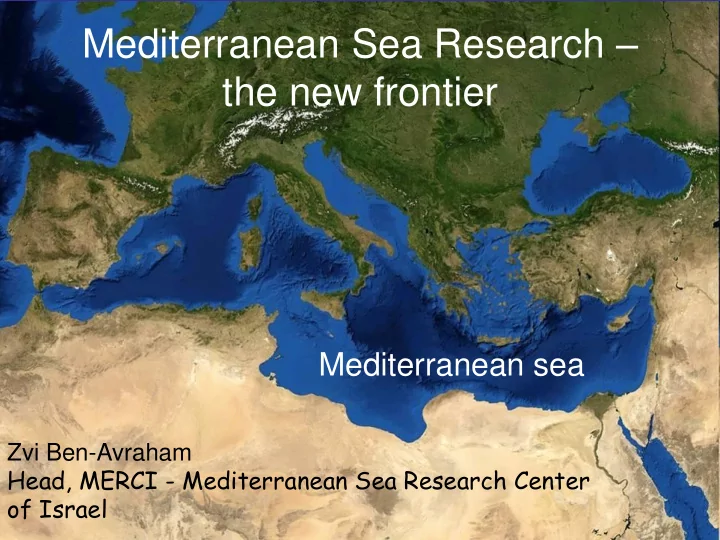
Mediterranean Sea Research – the new frontier

Mediterranean sea

Zvi Ben-Avraham Head, MERCI - Mediterranean Sea Research Center

  • f Israel
slide-2
SLIDE 2

Opportunity and need

 The southeastern Mediterranean is a unique oceanographic system - a natural laboratory providing opportunities for new, globally important and exciting science.  Rising pressure from its heavily populated coasts and

  • ffshore exploit raise urgent environmental worries, and

the need for scientifically driven sustainable resource management.  Yet, due to poor local resources and political cooperation it is one of the poorly studied regions in the world!

slide-3
SLIDE 3

The Eastern Mediterranean

DTM – John K. Hall, 2006

slide-4
SLIDE 4

a b

Crustal Transition Zone

Ben-Avraham et al., 2002

slide-5
SLIDE 5

Ben-Avraham et al., 2002

slide-6
SLIDE 6

50 100 km

Galilee-Lebanon Judea-Samaria Negev Eratosthenes Cyprus

Hall, 2003

slide-7
SLIDE 7

Ben-Avraham et al., 2002

Crustal Provinces

Ben-Avraham and Ginzburg, 1990

slide-8
SLIDE 8

One of the most active and variable regions globally, the Mediterranean is an ocean at the last seconds (geologically) of its existence.

Messinian salt

Nile delta

slide-9
SLIDE 9

10 km

Messinian Salinity crisis (5.96 -5.33 Ma)

M N 3 1 2 TWT (sec)

slide-10
SLIDE 10

Biomass & N:P ratio Total Sea Surface Temperature change 1982-2003

Located at a climatic junction and isolated from the global ocean circulation, the ultra

  • ligotrophic (a marine desert) Southeastern

Mediterranean is a sensitive gauge of natural and anthropogenic changes.

IODP Leg-160 “Sapropel” layers

slide-11
SLIDE 11

Suez Canal 1869

Ferdinand de Lesseps

Mediterranean Sea

Gulf of Suez

  • One-way invasion: Red Sea to

Eastern Mediterranean

  • ~10% of all living species in

eastern Mediterranean are of an Erythrean origin (Por, 1970)

  • Among Fish 90% are

invaders

slide-12
SLIDE 12

System Level- Evolution and ecology; Biological oceanography Organism Level- Biology of marine organisms; Behavior and sensory systems

  • f marine animals

Cellular and Molecular Level- Physiology of marine life; Developmental biology and immunology of marine life

Research of invading species

slide-13
SLIDE 13

The biological system of the southeastern Mediterranean is changing drastically:  Invading species are taking the place

  • f locals.

 The coastal ecosystem is diminishing.

The major beach platform building Vermatid (Dendrapoma Petraeum)

Fish caught by trawling

1990-4 2008-11

slide-14
SLIDE 14

The center of human culture evolved around the eastern Mediterranean, now bearing priceless remains of our history and heritage as affected by environmental events and changes.

slide-15
SLIDE 15

Ecosystem stress in the eastern Mediterranean

  • Pollution
  • Fishing
  • Water desalinization
  • Climate change effects
  • Migration of organisms
  • Tourism and recreation
  • Exploitation – gas (oil?)
  • Earthquake and tsunami
  • Expansion – artificial islands
  • Sand shortage – Aswan Dam

Our challenge

slide-16
SLIDE 16

Man, Sea & Society Israel Oceanograp hic & Limnological Research Ltd. Faculty of Natural Sciences Faculty of Humanities Faculties of Law & Social Sciences Marine GeoSciences Dr M Strauss Marine Biology Maritime Civilizations

The Leon H. Charney School of Marine Sciences

Recanati Institute

  • f Marine

Studies Israel Center of Mediterrane an Marine Research Charney School of Marine Sciences School Head Zvi Ben Avraham

slide-17
SLIDE 17

Tamar Mari-B Treatment Facility

Unprecedented offshore development:

 Global technical challenges  Environmental concerns

Confirmed reservoirs Planned 3D seismic surveys Wells to be drilled in the coming year

Hadera desalination plant בתנ" ג2020

slide-18
SLIDE 18

The BP Horizon spill in the Gulf of Mexico serves as a global warning sign A similar spill in the southeastern Mediterranean may have catastrophic consequences

slide-19
SLIDE 19
slide-20
SLIDE 20

Noa-2

Mari-B Pinnacles Noa-2 Submarine slide scars

New discoveries and development projects emphasize the critical need and potential of modern deep sea research

  • f the Mediterranean offshore of Israel.
slide-21
SLIDE 21

The current situation

  • Institutional acknowledgement of the needs for

high quality modern marine research is poor.

  • Limited and outdated marine research

infrastructure (e.g. the national research vessel

  • f Israel is the 50-year old R/V Shiqmona).
  • A poorly funded marine monitoring program.
  • Meager national research grants are insufficiently funded for modern and

seagoing research. Lack of specific marine engineering curriculums.

  • Large scale offshore development is managed primarily by foreign

consultants, for lack of a strong Israeli alternative. Several academic initiatives focusing on Mediterranean research and teaching are presently active in Israel, led primarily by our consortium members.

slide-22
SLIDE 22
slide-23
SLIDE 23

Aims and vision

  • To provide an interdisciplinary scientific framework and common

resource base at the national level for Mediterranean marine research in Israel.

  • To pool the broad marine sciences knowledge base and capabilities,

currently distributed in six universities and two governmental research institutes, towards excellent collaborative science. Only together we can match a serious marine research facility abroad.

  • To address the challenges facing Israel in sustainable development of

its Mediterranean offshore, and promote a global scientific leadership in marine sciences. The current proposal aims to setup the basic framework and provide seed money for realizing the full scope of our vision.

slide-24
SLIDE 24

Biology Geology & Geophysics Maritime Law Political Sciences Economics Environmental Resources Management Archaeology & History Remote sensing Physical & chemical Oceanography Engineering & Technology

A wide scope of interdisciplinary and a broad base of expertise

(90% of the leading marine scientists in Israel)

slide-25
SLIDE 25

Primary scientific research objectives

  • 1. Marine energy resources of the Israeli EEZ: potential, technology,

environmental impacts and a balanced management policy.

  • 2. The basic oceanographic workings of the southeastern Mediterranean

water mass.

  • 3. Biology of the Levantine basin and potential anthropogenic impacts.
  • 4. Regional to global environmental impacts of climatic and anthropogenic

changes.

  • 5. Marine natural hazards – controls, risks, alerts and mitigation.
  • 6. Coastal preservation and development.
  • 7. Marine bio-resources in the Israeli Mediterranean.
  • 8. Innovative development of research technologies.
slide-26
SLIDE 26

Infrastructure

  • 1. Research vessels to address both coastal and deep water needs. `
  • 2. Seagoing instrumentation including onboard facilities, robotic

underwater vehicles (AUV & ROV), broad sampling equipment.

  • 3. Coastal facilities and national marine services including running sea

water based systems, diving facilities and coastal measurement devices.

  • 4. Monitoring stations and underwater observation network (e.g. following

the ESOMIN model).

  • 5. Analytical laboratories (within the founder university and associated

institutes) .

slide-27
SLIDE 27

SLOCUM glider

Photos taken from Rutgers COOL room website

slide-28
SLIDE 28

Photo is taken from Blufin web site

AUV (Blufin 12S)

slide-29
SLIDE 29

Interuniversity Graduate Program in Marine Sciences

slide-30
SLIDE 30

Objective

  • Pool the resources of all partners to create a shared graduate

program for advanced studies in marine sciences.

  • Admission of 10-12 excellent students per year
  • Direct PhD with solid background in physical, chemical,

geological, and biological oceanography, and with some field experience.

  • This program will supplement existing programs at the various

universities.