Measurement and verification experience of compressed Air - - PowerPoint PPT Presentation

measurement and verification experience of compressed air
SMART_READER_LITE
LIVE PREVIEW

Measurement and verification experience of compressed Air - - PowerPoint PPT Presentation

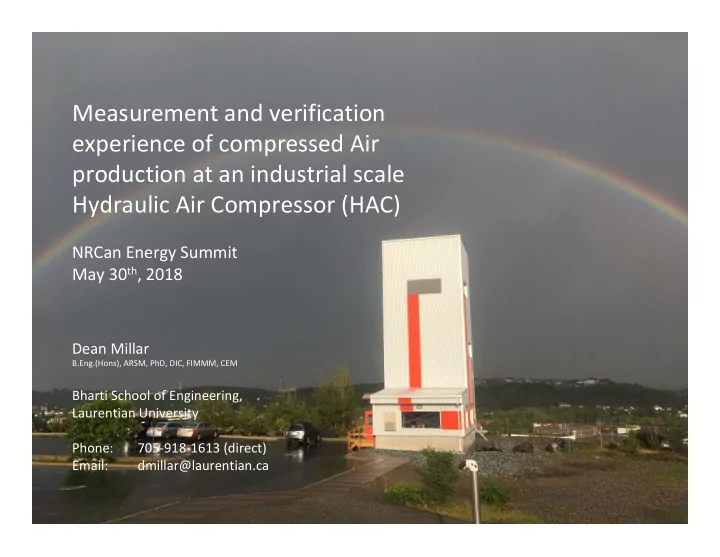
Measurement and verification experience of compressed Air production at an industrial scale Hydraulic Air Compressor (HAC) NRCan Energy Summit May 30 th , 2018 Dean Millar B.Eng.(Hons), ARSM, PhD, DIC, FIMMM, CEM Bharti School of Engineering,


slide-1
SLIDE 1

Measurement and verification experience of compressed Air production at an industrial scale Hydraulic Air Compressor (HAC)

NRCan Energy Summit May 30th, 2018

Dean Millar

B.Eng.(Hons), ARSM, PhD, DIC, FIMMM, CEM

Bharti School of Engineering, Laurentian University Phone: 705-918-1613 (direct) Email: dmillar@laurentian.ca

slide-2
SLIDE 2

Outline

  • Introduction
  • Commissioning, Measurement & Verification
  • Performance tests
  • Troubleshooting & debugging
  • Transitioning to commercial scale
slide-3
SLIDE 3

The HAC Pack

9

Find out more: www.electrale.com 705-918-1613 dmillar@mirarco.org

slide-4
SLIDE 4

What does it do? How does it work?

slide-5
SLIDE 5
  • Q. What will be demonstrated?
  • A. Isothermal compressors that are easy to maintain will be cheaper to run

Shaded area = (Minimum) compression work

12% 12% 76% Equipment and installation Maintenance Electricity

US DOE: OFFICE OF INDUSTRIAL TECHNOLOGIES*

https://www.energystar.gov/ia/business/industry/compressed_air1.pdf

*50 kWe motor on the compressor, 2 shifts per day, 5 days per week, $0.05/kWh, 10 years

slide-6
SLIDE 6

Definition of project success: agreement between modelled and measured HAC performance …

21.9 m (71.9 ft) 5.0 m (16.4 ft) Water: 0.400 m3/s (6300 gpm) Air: 0.115 Sm3/s (244 scfm) 2.1 bar(g) (31 psi(g)) 250 cfm

Source: Young, S., Hutchison, A., Sengupta, S., Clifford, T., Pavese, V., Noula, C., Myre, M., Vitone, D., Chiasson, J.P., and Millar, D.L., 2015. Conceptual design of a modern-day hydraulic air compressor. ECOS 2015, Pau, France, June 2015.

Target: 73% efficiency

slide-7
SLIDE 7

…but first the demonstrator had to be built

7

November 2016 February 2017 March 2017 June 2017

slide-8
SLIDE 8

Some technical risk was mitigated through adoption

  • f Charles Taylor’s 1905 design for the air water mixer
slide-9
SLIDE 9

Y-piece attached + Larry Mk I Starting up with: Taylor air-water mixing head; forebay tank lid open

slide-10
SLIDE 10

Commissioning, Measurement & Verification

Simplified P&ID

slide-11
SLIDE 11

An efficient HAC needs efficient pumps

Freeflow System: Riventa Canada Inc. www.riventa.com

slide-12
SLIDE 12

Commissioning operations proved that the measured compression process was close to isothermal…

2 4 6 8 10 12 0.1 0.15 0.2 0.25 0.3 0.35 0.4 0.45 0.5 Water discharge (m3/s) Temperature increase in downcomer (mK)

dT - BM38A dT - Pavese at al.

2 4 6 8 10 12 0.1 0.15 0.2 0.25 0.3 0.35 0.4 0.45 0.5 Water discharge (m3/s) Temperature increase in downcomer (mK)

dT - BM36A dT - Pavese at al.

t

For more info on “nearly isothermal gas compression” see: Pavese, V., Millar, D., Verda, V., 2016. Mechanical efficiency of hydraulic air compressors. ASME J. of Energy Res Tech, (138) / 062005, 11p

slide-13
SLIDE 13

… but revealed significant differences between modelled and measured performance

10 20 30 40 50 60 70 80 50 100 150 200 250 300 0.2 0.25 0.3 0.35 0.4 0.45 0.5 Efficiency (%) Free Air Delivery (Scfm) Water discharge (m3/s) BMT34 FAD HAC Mk14 Model FAD BMT 34 Eff HAC Mk14 Model Eff

Source: Millar, D.L. & Muller, E., 2017. Hydraulic Air Compressor demonstrator project. Presentation made at the ACEEE Summer Study on Energy Efficiency in Industry, Denver, August 15-18, 2017

slide-14
SLIDE 14

With the Taylor head, the HAC Demonstrator had an efficiency ‘sweet spot’ at around 4.0 m of head and 0.225 m3/s water flow

slide-15
SLIDE 15

A bubble detrainment, water free fall and bubble re-entrainment zone becomes evident from the downcomer pressure profiling measurements

9 Bubbles expand due to lowering of pressure (convergent duct, Bernoulli) Larger bubbles coalesce more readily Void formed from coalesced bubbles Water jet free falls through the void and accelerates Water jet impacts upon a bubble depleted zone ‘New’ bubbles are re-entrained below impact zone Water velocity now sufficient to transport (drag) bubbles downward HAC compression process starts Bubbles become smaller as water potential energy is lost and pressure increases Void fraction (gas holdup) reduces as bubbles are compressed Frequency of bubble interactions (break-up & coalescence) reduce Flow becomes more ‘water dominated’ Water velocity reduces due to its incompressibility

~0.9 m

Venturi inductor geometry draws air in through manifold

slide-16
SLIDE 16

Head loss due to bubble detrainment, free fall and re- entrainment amounted to a ~0.9m head loss across all tests, but brought the measured & predicted performance together

25 50 75 100 125 150 175 200 225 250 275 300 0.1 0.15 0.2 0.25 0.3 0.35 0.4 0.45 0.5 Water discharge (m3/s) Free Air Delivery (Scfm) 5 10 15 20 25 30 35 40 45 50 55 60 65 70 75 80 Efficiency (%)

BM36A & BM38A FAD HAC Mk 14 FAD BM36A & BM38A Eff (%) HAC Mk 14 Eff (%)

25 50 75 100 125 150 175 200 225 250 275 300 0.1 0.15 0.2 0.25 0.3 0.35 0.4 0.45 0.5 Water discharge (m3/s) Free Air Delivery (Scfm) 5 10 15 20 25 30 35 40 45 50 55 60 65 70 75 80 Efficiency (%)

slide-17
SLIDE 17

Detrainment loss depended on the air-water mixing head geometry

Geometry tested Forebay water levels with given geometry

Removing air manifold for hydrofoil grille test

slide-18
SLIDE 18

Y-piece attached “Larry Mk I” From pump 1 From pump 2

Fitting the Y-piece in the forebay tank permitted testing of a ‘closed loop’ configuration with an ‘in-line’ air-water mixer

slide-19
SLIDE 19

No manifold (hydrofoil grille).

No head 2 pumps. No head 1 pump. Y Config + Grill Y Config Larry Mk I

Alex Hutchison’s PhD studies produced an air water mixing head that added ~10% to the Dynamic Earth HAC efficiency (71% against a target of 73%)

In the best case, the HAC Demonstrator returned 10.9 kW/acfm after all losses are taken into account. This appears impressive, but the HAC Demonstrator delivery pressure is far less than normal service air pressure.

slide-20
SLIDE 20

… but bubbles in water with previously dissolved co-solutes can have lower diameter

Without co-solute With co-solute

Credit: Valeria Pavese

slide-21
SLIDE 21

Adding NaCl as a co-solute, increases the water surface tension. This makes bubbles smaller and ‘tougher’; smaller bubbles are dragged to underflow in the HAC separator

Graph source: Chaplin, M. 2017. Explanation for the physical anomalies

  • f water. Online: http://www1.lsbu.ac.uk/water/physical_anomalies.html

Some co-solutes increase surface tension Some co-solutes reduce surface tension

slide-22
SLIDE 22

We are now exploring HAC designs for commercial mine installation …

www.electrale.com +1-705-918-1613

  • Energy efficient
  • Safe
  • Cooler and drier air
  • Reliable
  • Long operating life
  • Scalable
  • Same or lower CAPEX

“All the air at half the cost”

slide-23
SLIDE 23

Compressed Air and Gas Institute (CAGI) data can be used to compare the performance of conventional, incumbent, compressors, with that of a HAC (using the model checked against HAC Demonstrator data for the latter!)

0.150 0.170 0.190 0.210 0.230 0.250 0.270 0.290 500 1000 1500 2000 2500 3000 3500 4000 4500 FAD (acfm) Efficiency (kW/acfm) CAGI 2 No.TS32SC-400HHAC/150psi HAC 4000/150psi

Curve for HAC rises at low flow rates, due to 14kW ventilation fans running continuously to ‘dispose

  • f’ compression heat

How much money is saved actually depends on the demand profile, and whether the machines have been sized properly to meet this demand, but the flatter turn down curve of the HAC, should offer advantage

slide-24
SLIDE 24