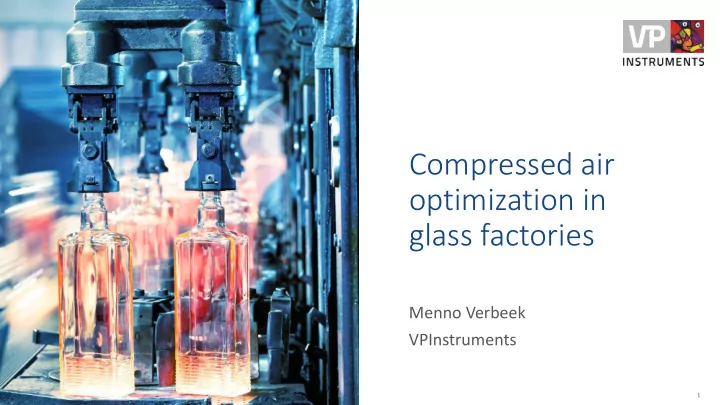
Compressed air optimization in glass factories Menno Verbeek - - PowerPoint PPT Presentation

compressed air
SMART_READER_LITE
LIVE PREVIEW

Compressed air optimization in glass factories Menno Verbeek - - PowerPoint PPT Presentation

Compressed air optimization in glass factories Menno Verbeek VPInstruments 1 Example project: Food Added Value: Leakage management Maintenance management Compressed air: Cost allocation Measures ~ 4..5 % of global electricity


slide-1
SLIDE 1

1

Compressed air

  • ptimization in

glass factories

Menno Verbeek VPInstruments

slide-2
SLIDE 2

2

Example project: Food

Added Value:

  • Leakage management
  • Maintenance management
  • Cost allocation

Measures

  • VPVision with 20 flowmeters
  • Supply and demand side
  • Combined with existing energy

management system ROI: 1 year

Compressed air:

~ 4..5 % of global electricity consumption One of the largest industrial energy savings opportunities

slide-3
SLIDE 3

3

Why save compressed air

  • 8 to 10 times the cost of Electricity
  • Compressed air is 10% - 30 % of the

electricity bill of an average industrial company

  • Relatively easy to save money ”low

hanging fruit”

slide-4
SLIDE 4

4

Why is compressed air important

In the glass industry

  • Up to 30% of the electricity bill
  • In container glass crucial for high quality glass

In the US electricity use for forming is glass is estimated to be 105 kWh/t, of which largest part is for compressed air

slide-5
SLIDE 5

5

Examples of compressed air use

In Glass Industry

  • Production process
  • Forming of containers and specialty glass
  • Lifting of plate glass
  • Cutting, blowing, moving
  • Packaging
  • Conveyors
  • Pneumatic tools
slide-6
SLIDE 6

6

Compressed air: Where does it all go?

Electricity

Heat 85%

$$$

Leaks Artificial demand Inappropriate use Production

50% wasted 50% Air 15%

slide-7
SLIDE 7

7

Fact: Compressed Air Energy Costs

Equipment Maintenance Energy More than 75% of the compressor total cost of ownership over 10 years: energy costs.

slide-8
SLIDE 8

8

Artificial demand Inappropriate use Leaks Production

30% 10% 10% 50%

Compressed air Savings potential

slide-9
SLIDE 9

9

How to save?

Recovering waste heat Adjustable speed drives Optimize control Overall system design Optimize buffer size Reduce the pressure Reduce air leaks Eliminate pressure loss

slide-10
SLIDE 10

10

Glass container industry

Savings opportunities

  • Compressor control/ configuration
  • Reducing leakages
  • Pressure reduction/ stabilization
  • Drier /condensate issues
  • Drying low- and high-pressure air
  • Filter management/ maintenance
  • Alternative energy source
  • Other
slide-11
SLIDE 11

11

Glass container industry

Challenges with any project:

  • Different stakeholders
  • Capex/ Opex budget separated
  • Changing behavior
  • Internal Politics
  • Capacity (maintenance crew)
  • Budget / ROI
slide-12
SLIDE 12

12

Drain management

  • The low hanging fruit
  • A form of leakage and a quality issue
  • Often neglected or dealt with in a wrong

way

  • ROI 3…6 months when properly

implemented

slide-13
SLIDE 13

13

slide-14
SLIDE 14

14

Filter management

  • Inlet filters of Centrifugal machines
  • Decrease of inlet pressure: decrease
  • f output flow & decrease of

efficiency for same discharge pressure.

  • Beware out environment: dusty

roads, trucks etc: Intake location & conditions.

  • Downstream filters
  • Proper sizing
  • Preventive maintenance
slide-15
SLIDE 15

15

Replace compressed air

  • Alternatives for cooling of molds
  • Blowers
  • Nozzles
slide-16
SLIDE 16

16

Glass container industry

  • High- and low-pressure compressors

1.5 to >2 Megawatt in total

  • Multiple compressor rooms in one plant
  • Blowers for furnace and for cooling

purposes

  • Vacuum pumps
slide-17
SLIDE 17

17

Measure to Discover and Save

Why measure & monitor?

  • Predictive maintenance (condition monitoring, leakage)
  • Make founded investment decisions based on consumption

data & costs

  • Monitoring efficiency of compressors and production

equipment

  • Know your baseline
  • ISO 50001 compliance
slide-18
SLIDE 18

18

Measure to Discover and Save

Power

  • Correlation with electricity bill

4-in-1 flow meters: flow, pressure, temperature, total flow

  • Flow consumption
  • Pressure and temperature level
  • Total flow

Dew point sensors:

  • Safeguard your equipment and production process

Monitoring systems

  • Combine all data in one system with alarms and reports
  • Permanent monitoring is key to energy savings
slide-19
SLIDE 19

19

Where to start?

Efficiency monitoring Air audits/ Leakage management Cost allocation

slide-20
SLIDE 20

20

Where to start?

Point of use measurement Auditing Pressure loss

slide-21
SLIDE 21

21

Permanent monitoring vs audits

slide-22
SLIDE 22

22

Dutch glass factory ~ 2007

Solution

  • Monitoring system with 20 flow meters
  • Supply and demand side
  • Combined with existing energy management system

Savings:

  • Leakage in machines
  • Optimization of oven cooling
  • Compressor inlet filter maintenance

ROI:

  • 1 year
  • Total > 200,000 Euro / year

‘Thanks to individual efficiency monitoring on each turbo compressor, we can optimize our maintenance schedule’.

slide-23
SLIDE 23

23

Dutch glass factory

Supply side optimization project

  • Control system optimization
  • Lay out
  • New Master Controller
  • Flow meters as input for optimized

control

  • Total savings > 300 K/ year
  • ROI < 12 months
slide-24
SLIDE 24

24

Step-by-step

Step-by-Step € € € € € € € € € € € € € € €

slide-25
SLIDE 25

25

Conclusions

  • Compressed air savings is your low hanging fruit
  • Compressed air savings increases competitiveness
  • Measurements leads to the right optimization decision
  • Measurements provides proof of realized savings
  • Step-by-step approach
  • Permanent monitoring is key to optimum energy savings
slide-26
SLIDE 26

26

www.facebook.com/vpinstruments/ www.linkedin.com/company/vpinstruments

THANK YOU!

VPInstruments info@vpinstruments.com www.vpinstruments.com