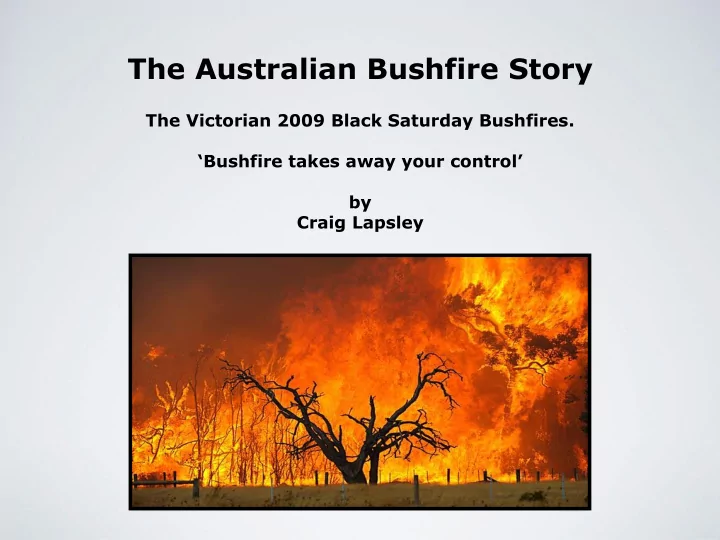
The Australian Bushfire Story The Victorian 2009 Black Saturday - - PowerPoint PPT Presentation
The Australian Bushfire Story The Victorian 2009 Black Saturday Bushfires. Bushfire takes away your control by Craig Lapsley Victoria State is one of the most Bushfire Prone Areas in the world. Victorian summers have: extreme
Victorian summers have:
- extreme temperatures,
- low relative humidity,
- strong, hot and dry
winds. On ‘Bad’ fire days:
- winds will change
direction from North West to South West,
- fires grow significantly
in size after the wind change.
- Significant death and
destruction occurs after the SW wind change.
Victoria State is one of the most Bushfire Prone Area’s in the world.
History of death in bushfires
Bushfire fatalities 825 bushfire fatalities over 110 years across Australia.
- Victoria State has the highest with 506.
- The majority of the 506 in Victoria occurred on 8 days.
- The highest death rate occurred on 7 February 2009 (173)
Locations of death in Bushfires The closer your home is to the bush, the more at risk you are.
- 50% of deaths happened within 30 feet (10 metres) of the bush.
Climate and weather 7th February 2009
Australia had experienced a 10+ year drought. Victoria experienced:
- a very hotter summer.
- a heatwave that killed 374.
- bushfires killed 173.
It was a very intense period. Weather conditions on Saturday 7th February 2009
- Temperature - 118 degrees F (48 C)
- Relative Humidity - 2%
- Wind Speed - 88 mph (142 kmph)
Saturday 7th February 2009 - Black Saturday
400+ bushfires reported 15 major bushfires:
- caused by deliberate &
electrical power lines. Fire behaviour was:
- unpredictable,
- erratic,
- extremely fast moving,
- all consuming,
- embers spotting 20 miles,
- wind change late in the
afternoon / evening. Totally uncontrollable fires burnt farmland, bushland, forests, buildings and infrastructure.
Towns burnt with buildings burning and igniting the neighbouring buildings. House to house ignition occurred from ember attack, from gas cylinders venting and wooden fences burning. Towns and houses burnt
‘The Impact’
- Animals - 1m animals killed,
- Livestock- 12,758 killed,
- Farm land- 1.2m acres burnt,
- Plantations- 28,000 acres burnt,
- Fencing- 7,500 miles destroyed.
- 90 community buildings destroyed
- Hundreds of vehicles destroyed
- 2700 agricultural structures burnt
173 people died, 400+ physical injuries, 2059 homes destroyed, 78 towns impacted, 5000+ people displaced/homeless. …we lost so much, some lost everything….
Death and injury - young, old, individuals and families died or injured. Destruction - everything burnt - homes and complete towns gone. Displacement - nowhere to live, many requiring temporary housing. Dispersal - community members spread all over Victoria and beyond.
‘The Consequence’
Move from victims to survivors….. Survivors had to deal with:
- grieving and funerals,
- personal and family trauma,
- mental, medical and physical health.
Loss of:
- Identity and personal papers,
- Belongings - sentimental and material,
- Place of belonging - home, community.
Issues to deal with:
- Community become welfare dependent,
- Connecting to family and friends,
- School disruption,
- Employment disruption,
- Economic instability.
People are different and have different needs:
- Children
- Youth
- Women
- Men
- Individuals
- Families
- Neighbourhood
- Community
The Victorian Government established a Royal Commission to review all aspects of the 2009 Victorian Bushfires. The key themes:
- Victoria’s Bushfire Safety Policy,
- Emergency and Incident Management,
- Fireground Response,
- Electricity - caused fire,
- Deliberately lit fires,
- Planning and Building,
- Land and Fuel management,
- Organisational structure,
- Research and Evaluation,
- Monitoring Implemenetaion,
- Reflections.
The key themes supported by 67 recommendations.
“SOME THINGS NEED TO BE DONE DIFFERENTLY AND FOR OTHER PROBLEMS, WE NEED TO FIND COMPLETELY NEW WAYS OF WORKING” - 2009 VICTORIAN BUSHFIRES ROYAL COMMISSION
The Royal Commission observed:
- systematic failure,
- a lack of standards,
- first responder agencies working alone,
- traditional methods failure,
- a lack of real time information,
- a lack of key decision making,
- communications processes & systems ineffective,
- communities unable to act effectively.
… things had to change… and they did…
The Royal Commission … said….
What went wrong ??? !!!
What changed?
New:
- Commissioner role established and appointed,
- Legislation,
- Bushfire Safety Policy,
- State Emergency Management Strategic Priorities,
- Operational arrangements focused on interoperability,
- Fuel Management targets,
- Fire Danger Rating system,
- Information and Warnings system,
- Land Use Planning guidelines,
- Building standards and guidelines,
- Deliberate and arson programs,
- Electric line clearance, maintenance and auto management systems
established,
- Systems to support evidence based decision making,
- Approach to connect with community.
.. we work as one ….. established that defines ‘WE’ as everyone.
Awareness and Education State wide bushfire campaign Household bushfire assessments Local community education Programs to vulnerable people Bushfire Safety options Leave early Community Fire Refuges Private shelters Neighbourhood Safer Places Evacuation Fire Danger Information & Warnings National Alert System Technology Community Alert sirens Local Community Fire Planning Community plans Bushfire simulation Support vulnerable people Relocation and Evacuation planning Community capability building Community FireGuard groups Fire Learning Networks Community Grants program Community Fire Drills
BUSHFIRE SAFETY POLICY
Comprehensive policy with 5 policy themes.
New National Fire Danger Rating System
New Australia wide national system that converts Fire Danger Index to a Community focused Fire Danger Rating (FDR). It replaced a decades old system that the highest category was replaced with Severe, Extreme & Code Red providing clarity of risk.
Fire Danger Rating System:
Six Rating levels
- key to personal decision
making. Rating description
- Fire weather / behaviour
- Home siting / construction
- Personal capability
Land Controls
- Fuel reduction
- Land use planning
- Building controls
- Community education
- Personal fire plans
Bushfire Attack Level (BAL)
(increase protection of homes from bushfire) Bushfire spread factors:
- Ember attack
- Radiant heat
- Direct Flame contact
Victorian Building Authority
Other factors:
- Proximity of your home to vegetation
- Construction type
- Radiant heat performance
- Proximity of outbuildings
- Slope of the land
- Vegetation type
- Fire shielding
BAL science is based on heat flux exposure thresholds
Bushfire Risk Reducing the risk of bushfires comprises a number of processes and tasks includes:
- Building materials & construction type,
- Managing site vegetation,
- Creating defendable space,
- Managing the property - house keeping,
Water Supply - fire fighting on private property
All new developments must incorporate a dedicated static water supply for fire fighting purposes for:
- Personal fire fighting, and/or
- Fire Authority.
And be:
- minimum 4,000 gallons (10,000 litres)
for fire fighting,
- accessible to fire authority,
- clearly marked,
- Fire Authority approved fittings.
State Emergency Management Strategic Priorities
- Protection and preservation of life is paramount – (Primacy of Life).
- Issuing Community information and warnings to assist community
members to make decisions about their safety.
- Protection of critical infrastructure and community assets.
- Protection of residential property.
- Protection of assets supporting individual livelihoods and economic
production.
- Protection of environmental and conservation assets that considers
the cultural, biodiversity and social values of the environment. Reset the strategic priorities to assist reshape planning, preparedness, readiness, response, relief, recovery and decision making at every level.
New Strategic Intent - before, during & after, at all levels
INFORMATION and DECISION MAKING - Is the key to success! Information must be timely, tailored and relevant to assist decision making. …. bushfire safety is a shared responsibility, shared obligation ….
Emergency Management Victoria
National Warnings and Emergency Information system
- Built for bushfire, evolved to all emergencies.
- Relies on local knowledge and local awareness.
Public must have more than 1 source of accessing information.
Emergency Management Victoria
Control
Command
Coordination Consequence
Communication
Community
The 6C’s
Rebuild and provide a broader more inclusive approach planning, preparedness, readiness, response, relief, recovery and improve communications and community centre of the decision making.
A new focus - Community Connection
A move from response focus and the traditional 3C’s. To a broader more inclusive approach.
Achieved through Emergency Management Teams at Local, Region and State levels.
Community Connection Community
- people,
- business,
- services,
- environment.
Connection
- trusted networks,
- trusted leaders,
- social capital & cohesion
Trusted networks are local:
- medical and health services,
- veterinary and animal welfare services,
- agriculture and land management,
- welfare groups,
- faith based groups,
- service clubs,
- emergency Management agencies,
- community and sporting groups,
Trusted leaders are local community members that contribute and influence community
- utcomes and are often in community
positions of significance, but not always.
Liveability
Services and systems to enable a community to function - the life lines.
- essential services,
- critical infrastructure,
- community infrastructure.
Community Connection
Community systems and networks are connected, understood, informed and work together to participate in planning and leading to achieve short, medium and long term community outcomes.
Wellbeing
The safety, security, mental, medical and physical health of all individuals, families, neighbourhood and the community.
Sustainability
The establishment and integration of local social and economic systems and networks.
- micro economics-
Viability
The social and economic systems and networks of communities providing
- pportunities for growth and
innovation.
- macro economics-
Community Connection Model
Emergency Management Victoria
Single agency
Hazard focused - Fire, Flood, Storm
Multi agency
Networked Emergency Services
Sector approach
Collaboration & inclusive Community Centric Emergency Management Public Safety
The Journey of Emergency Management / Public Safety
The future is community centric, collaborative, inclusive and joined up.
Collaborative and inclusive approaches. Community centric. Consequence focused. Connected communities. Resilient communities.