SLIDE 1
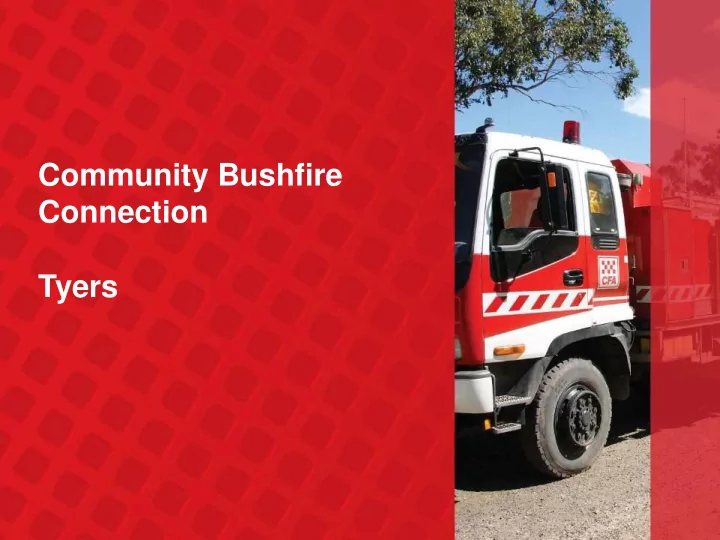
Community Bushfire Connection Tyers
SLIDE 2 2
Today
- Why have bushfire planning and building
requirements?
- Development in bushfire areas
- Factors Contributing to House Loss
- Bushfire Construction Considerations
SLIDE 3
What are we planning for?
SLIDE 4 20 40 60 80 100 120 140 160 180
1901 1904 1907 1910 1913 1916 1919 1922 1925 1928 1931 1934 1937 1940 1943 1946 1949 1952 1955 1958 1961 1964 1967 1970 1973 1976 1979 1982 1985 1988 1991 1994 1997 2000 2003 2006 2009
Aggregated Fatalities Male Female
Victorian bushfires 2009 (VIC) Canberra 2003 (ACT) Black Friday 1939 (VIC) Hobart 1967 (TAS) Black Tuesday 1926 (VIC) Western district 1944 (VIC) Ash Wednesday 1983 (VIC & SA)
Life loss
SLIDE 5 5
What are we planning for?
Bushfire fatalities between 1901 - 2011
SLIDE 6 6
What are we planning for?
Bushfire house loss between 1939 - 2009
SLIDE 7 7
What are we planning for?
20 40 60 80 100 120 140 0-11 12-24 25-49 50-74 75-99 100+
Number of fatalities FFDI Class inside structure inside vehicle
Unknown
SLIDE 8
Development in bushfire areas
SLIDE 9 9
Bushfire Management Overlay
SLIDE 10 10
Victoria’s Bushfire Planning Policy
- Overarching objectives of the bushfire planning
provisions
- Prioritise life
- Apply the precautionary principle to planning
decision
- The Bushfire Management Overlay requires new
development to:
- Build to current bushfire construction standards
- Locate buildings away from the bushfire hazard
- Manage vegetation and fuel loads
- Install a water tank and provide fire truck access
- Refer the planning permit application to fire
authorities, if required.
SLIDE 11 Environment Weather Fuel Topography Fire Forest Grass Heath Fire impacts Flame length Radiant heat
Calculating a Bushfire Attack Level
11
AS 3959-2009 Construction of buildings in bushfire areas
SLIDE 12 Bushfire Attack Levels (BAL)
12 Flame Radiant Heat Embers
SLIDE 13 Radiant heat exposure
13
SLIDE 14 Bushfire Attack Levels (BAL)
BAL 12.5
- Basic ember protection- building must be sarked, steel mesh over all vents and weepholes
- Standards glass in windows steel screens on openable
BAL 19
- Basic ember protection- building must be sarked, steel mesh over all vents and weepholes
- Standards glass in windows steel screens on openable
BAL 29
- Basic ember protection- as above
- Restrictions on the type of timber used
- Windows must be a minimum of 5mm toughened glass with screens on openable windows
BAL 40
- Basic ember protection- as above
- Generally non-combustible external materials
- Windows 6mm toughened glass fully screened or a tested bushfire shutter
BAL FZ
- Basic ember protection- as above
- Building elements generally need to be tested to AS 1530.8.2 or meet 30/30/30 FRL
SLIDE 15
Factors Contributing to House Loss
SLIDE 16 Level of exposure
Building Vulnerability
- Design
- Landscaping
- Human intervention
House Loss
SLIDE 17 Modes of bushfire attack
- Direct Flame
- Radiant Heat
- Ember Attack
17
(Image- Rudolf & Ramsey 2003)
SLIDE 18 18
- Research shows that 80% of house loss is due to
ember attack
House Loss (Embers)
SLIDE 19
House Loss (Embers)
SLIDE 20 House Loss (Radiant Heat)
20
SLIDE 21
House Loss (Direct Flame)
SLIDE 22
Construction Considerations
SLIDE 23
Underfloor Spaces
SLIDE 24
Think non-combustible
SLIDE 25
Think non-combustible
One layer of protection Two layers of protection
SLIDE 26
- Are there areas where debris will accumulate?
(Images- Rudolf & Ramsey 2003)
Simple design
SLIDE 27
Avoid heavy fuel near the building
SLIDE 28 Retrofitting options
28
SLIDE 29
Questions