LCCMR ID: 076-B3 Project Title: Combined CO2-Sequestration and - - PDF document

lccmr id 076 b3
SMART_READER_LITE
LIVE PREVIEW

LCCMR ID: 076-B3 Project Title: Combined CO2-Sequestration and - - PDF document

Environment and Natural Resources Trust Fund 2010 Request for Proposals (RFP) LCCMR ID: 076-B3 Project Title: Combined CO2-Sequestration and Geothermal Electricity Generation in Minnesota LCCMR 2010 Funding Priority: B. Renewable Energy


slide-1
SLIDE 1

Environment and Natural Resources Trust Fund 2010 Request for Proposals (RFP)

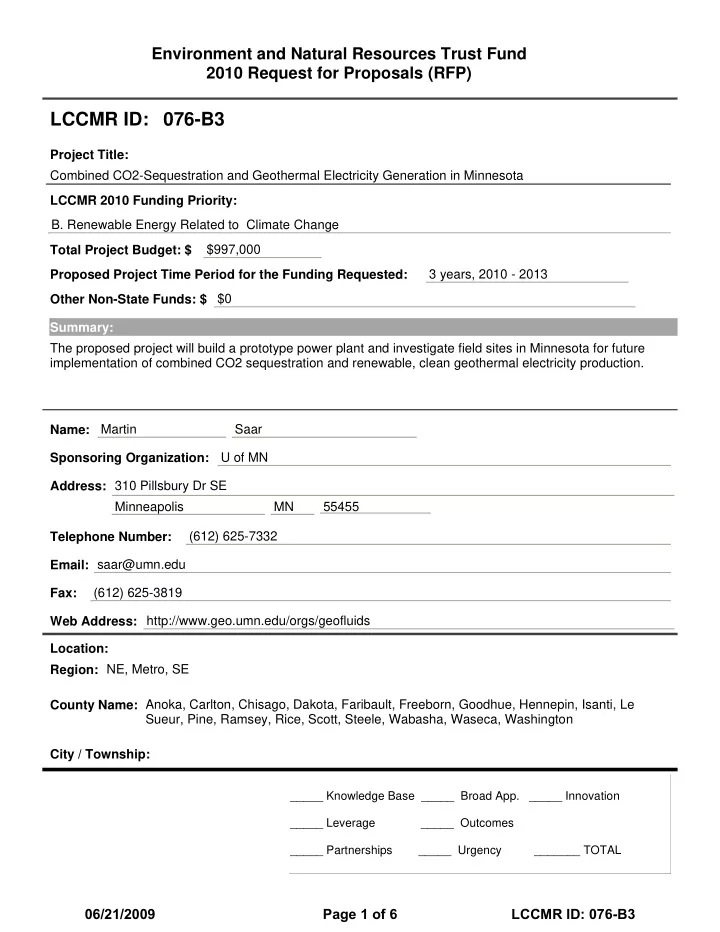
Combined CO2-Sequestration and Geothermal Electricity Generation in Minnesota $997,000 3 years, 2010 - 2013 $0 Martin Saar U of MN 310 Pillsbury Dr SE Minneapolis MN 55455 (612) 625-7332 (612) 625-3819 saar@umn.edu http://www.geo.umn.edu/orgs/geofluids Anoka, Carlton, Chisago, Dakota, Faribault, Freeborn, Goodhue, Hennepin, Isanti, Le Sueur, Pine, Ramsey, Rice, Scott, Steele, Wabasha, Waseca, Washington The proposed project will build a prototype power plant and investigate field sites in Minnesota for future implementation of combined CO2 sequestration and renewable, clean geothermal electricity production. Project Title: Total Project Budget: $ Proposed Project Time Period for the Funding Requested: Other Non-State Funds: $ Name: Sponsoring Organization: Address: Telephone Number: Email: Fax: Web Address: County Name: City / Township: Region: Summary: NE, Metro, SE

LCCMR ID: 076-B3

LCCMR 2010 Funding Priority:

  • B. Renewable Energy Related to Climate Change

Location:

_____ Knowledge Base _____ Broad App. _____ Innovation _____ Leverage _____ Outcomes _____ Partnerships _____ Urgency _______ TOTAL

06/21/2009 Page 1 of 6 LCCMR ID: 076-B3

slide-2
SLIDE 2

Main Proposal

PROJECT TITLE: Combined CO2-sequestration and geothermal electricity generation in Minnesota and worldwide (funding priority: B. Renewable Energy Related to Climate Change)

PROJECT STATEMENT: A revolutionary concept, that will not only address global warming by sequestering carbon dioxide (CO2) but also provide renewable energy, is being developed by a research team at the University of Minnesota (UMN): Combining CO2 sequestration with geothermal electricity

  • generation. Here we propose to address two critical aspects of the concept: 1) construction and testing of

a prototype power plant and 2) characterization of field sites in Minnesota for a future pilot plant system. Geothermal energy is a clean, renewable, and consistent energy source that has the capability to provide much of the nation’s and world’s electric power and space heating needs. Geothermal power plants are scalable to meet local or large-scale energy requirements and can supply base-load power or power to help meet peak demands. Three conditions must be met to use geothermal heat for electricity production: 1) Subsurface temperatures and geothermal heat flow rates need to be sufficiently high; 2) Large amounts of geothermally heated fluid (a liquid or gas, often water) must be present; 3) The subsurface geothermal reservoir must have sufficiently high porosity and permeability to allow easy flow and heating of the (liquid or gaseous) working fluid. Minnesota and most regions worldwide have low geothermal heat flow rates compared to geologically active regions such as the western US, traditionally excluding them from utilizing geothermal heat as a renewable energy alternative to fossil fuels. However, MN’s heat flow rates are likely underestimated (see concurrent LCCMR proposal by Hauck). Accurate measurements of subsurface temperatures and heat flow rates are thus critical to evaluate the state’s potential for geothermal electricity production, no matter what working fluid is used. CO2 , however, has advantages over water as a geothermal working fluid: 1) The thermal properties of CO2 allow lower temperatures, and thus shallower depths, to be used for geothermal electricity production. Power plant drilling and operation costs are reduced when shallower geologic units can be utilized as geothermal reservoirs. Thus, employing CO2 2) Water resources are often protected or needed for consumption/irrigation and thus unavailable for geothermal electricity production. Conversely, society needs to dispose the greenhouse gas, CO could make geothermal electricity production economical in MN, which was not previously the case.

2

3) CO .

2 does not freeze at 32o

F, improving power plant efficiency during Minnesota winters. In a combined CO2 sequestration (i.e., permanent storage) and geothermal energy production system, CO2 from a fossil fuel power plant or industry (e.g., ethanol plant) is injected into deep geologic traps (Figure 1). A fraction of the injected and geothermally heated CO2 is brought back to the surface to drive a turbine and electricity generator, before being returned to the subsurface. The heat is replenished by the Earth’s natural heat flow, while the CO2 is trapped within a geologic structure at great depth (0.6 to 3 miles). In this request, we propose to study two key aspects of the concept: 1) Design, construction, and testing of a prototype power plant utilizing waste heat from a UMN steam plant as a temporary substitute for deep geothermal heating of CO2 2) Characterization of field sites in Minnesota to determine their CO .

2

storage and geothermal heating potential for a later, separately funded, larger-scale pilot plant system in the field. Initial research is supported ($600,000) by the Initiative for Renewable Energy and the Environment (IREE) and a provisional patent (both by Saar et al., 2009). Here, we propose to expand on IREE funding, which is used to explore plant design alternatives and theoretically examine geothermal reservoirs. As part of the IREE study, we will also determine the economic feasibility of the proposed system and place the system into a policy framework relevant to MN. However, IREE funds do not cover implementation

  • f a prototype power plant or CO2 trap characterization of specific field sites in MN, which are critical

and will require several years of study. Simultaneous investigation of both research avenues (results 1 and 2) would ensure the most rapid progress toward implementing a geothermal power plant in MN.

06/21/2009 Page 2 of 6 LCCMR ID: 076-B3

slide-3
SLIDE 3

PROJECT TITLE: Combined CO2-sequestration and geothermal electricity generation in Minnesota and worldwide

DESCRIPTION OF PROJECT RESULTS AND DELIVERABLES Result 1: The design, construction, and preliminary test data for a prototype CO2 Budget: $732,000. (equipment + Kuehn group expenses) Completion Date: June, 2013 power plant. Description: In the prototype 50-500kW plant, CO2 will be heated by waste heat from a UMN steam plant rather than by geothermal heating. This will provide a closed-loop CO2 power plant decoupled from a geothermal reservoir, permitting geology-independent investigations of power plant design and

  • perational aspects such as CO2 inlet temperature and pressure, flow rate, and effects of CO2
  • water
  • mixtures. The facility will allow controlled reproductions of field site conditions, permitting modification

and optimization prior to design of a pilot-scale geothermal facility for a field site. By utilizing waste heat from the steam plant, the research-focused power plant will generate some extra electricity (• 500kW). Deliverables: A functioning prototype power plant including a turbine, generator, cooling tower, and control system capable of operating with high temperature/pressure CO2 . Result 2: Updated maps and numerical models of the Mid-continent Rift System (MRS) and Mt Simon traps to determine their promise for CO2 Budget: $265,000. (geology/geophysics/modeling expenses) Completion Date: June, 2013

  • based geothermal reservoir development

Description: The MRS, which passes through MN and the Mt. Simon formations in southern MN will be

  • studied. Previous research by Thorleifson et al. (2008) indicated that the MRS may not be promising for

CO2 sequestration by standard assumptions, but the deep, large, dual permeability basins of the MRS may be ideally suited as CO2-based geothermal energy reservoirs. Further, a Mt. Simon dome in MN has been used since 1968 for natural gas storage and similar traps may be viable as geothermal reservoirs. We will numerically simulate CO2 injection and geothermal heat recovery at these sites as a precursor to eventual field testing of the prototype plant. Existing data will be compiled, and additional data (e.g., permeability)

  • acquired. A concurrent LCCMR proposal by Hauck will determine geothermal heat flow in these areas.

Deliverables: 1a) A compilation of potential structural traps in the Mt. Simon formations, including data from a currently used natural gas storage formation and 1b) updated MRS data. 2) A computer program for numerical modeling of CO2 injection, storage, and heat recovery in geologic traps at these sites. PROJECT STRATEGY A) Team: Partners: Tom Kuehn (Mechanical Engineering, UMN); Scott Alexander (Geology & Geophysics, UMN); Harvey Thorleifson (Minnesota Geological Survey, UMN, plus survey scientists). Program Manager (PM): Martin Saar (Geology & Geophysics, UMN); Additional collaborations: 1) Jerome Malmquist, Director of UMN Energy Management, will provide space for the prototype plant in a UMN steam heating facility and integrate the plant with UMN systems. 2) IREE is providing partial/seed funding for complimentary work (see above), 3) A concurrent LCCMR proposal by Hauck will provide subsurface temperature and heat flow data for the study sites. B) Timeline (3 years): Prototype power plant: One year is required to complete detailed plant design and bid documents, select a contractor, and initiate construction. A second year is needed to complete construction, commission the plant, and begin testing, while a third year is required to conduct research. Geologic and numerical studies: One to two years are needed to compile existing and collect new field site data. Numerical simulations of fluid and heat flow for both study sites require two additional years. C) Long-Term Strategy: If the prototype power plant works as expected, it could be moved to a field site as a pilot plant using geothermally heated CO2 or it could be installed permanently at UMN. If problems arise with the prototype plant, the design of a future field pilot plant will be modified according-

  • ly. By studying the CO2 turbine power plant and geothermal reservoirs separately, we can correct issues

with the components before developing larger-scale systems. We will pursue funding for a field pilot plant through the Dept. of Energy’s geothermal technologies and ARPA-E programs and through Xcel Energy which voiced interest in the field pilot plant stage (communication: Saar, PM, and Stevens, Xcel).

06/21/2009 Page 3 of 6 LCCMR ID: 076-B3

slide-4
SLIDE 4

BUDGET ITEM Personnel: Project Manager: Martin Saar (UMN Dept. of Geology and Geophysics for fluid and heat flow modeling for power plant testing and for field work and other simulations). One month summer salary of a 9-month appointment (1/9=11% FTE) for three years, July 2010 to June 2013. 77% towards salary, 23% towards benefits. A graduate student (55% towards salary, 10% towards fringe, 35% towards tuition) and/or postdoc (73% towards salary, 27% towards benefits) (UMN Dept. of Geology and Geophysics, Saar research group to assist with activities listed in Saar's budget row related to coupled fluid and heat flow modeling to test power plant and to do field work.). (grad. student: 66% FTE, postdoc: 30% FTE) July 2010 -- June 2013. Research Scientist: Scott Alexander (UMN Department of Geology and Geophysics). (25% FTE) July 2010 -- June 2013. 75% towards salary, 25% towards benefits. Mechanical engineer and heat power system specialist: Thomas Kuehn (UMN, Mechanical Engineering for prototype power plant design, construction, and testing). One month summer salary of a 9-month appointment (1/9=11% FTE) for three years; July 2010 -- June

  • 2013. 77% towards salary, 23% towards benefits

A graduate student (55% towards salary, 10% towards fringe, 35% towards tuition) and/or postdoc (73% towards salary, 27% towards benefits) (UMN Dept. of Mechanical Engineering, Thomas Kuehn research group for prototype power plant design, construction, and testing). (grad. student: 66% FTE, postdoc: 30% FTE) July 2010 -- June 2013. Geologist: Harvey Thorleifson (Director of the Minnesota Geological Survey for supervision

  • f MGS staff + help compiling MRS and Mt. Simon data). 3 weeks total (2% FTE), July

2010 -- June 2013. 76% towards salary, 24% towards benefits Principle geologist for compilation of data regarding Mt Simon/Hinckley formation traps: Tony Runkel (Minnesota Geological Survey). Three months total during July 2010 -- June 2013 (8% FTE). 73% towards salary, 27% towards benefits. Principle geophysicist for modeling of Midcontinent Rift System (MRS): Val Chandler (Minnesota Geological Survey, MGS). Eight weeks total during July 2010 -- June 2013 (5% FTE). 73% towards salary, 27% towards benefits. Assistant geophysicist for modeling of MRS: Rich Lively (MGS). Four weeks total, July 2010

  • - June 2013 (2.5% FTE). 73% towards salary, 27% towards benefits.

Contracts: Contractor for construction of prototype power plant. Design, bidding, engineering, and construction of a facility with power turbine (50-500kW), electric generator (50-500kW), condenser to transfer heat from high pressure CO2 to glycol solution, dry cooling tower to transfer heat from glycol solution to air, pump for high pressure liquid CO2, heat exchanger for steam CO2 (CO2 boiler operated by steam), steam piping from steam plant to heat exchanger, steam condensate return piping to steam plant, sensors to monitor plant performace (CO2 pressure, temperature, flow rate, electrical power production), data acquisition and control system. Equipment and supplies: High-end specialized computational hardware and software, required for this specific type of multiphase, multicomponent groundwater, CO2, and heat flow modeling (will be added to pre-existing resources. Software (Geosoft/Montaj) for three dimensional geophysics modeling and investigation of the MRS (this is also specialized and necessary software). Travel: Travel to conduct field work (permeability, geophysics tests etc.) Travel to out-of-state seismic vendor and to seismic data processing shop (this is proprietary data necessitating out-of-state travel to specific vendor) Additional Budget Items: Acquisition and re-processing of seismic data for MRS. TOTAL PROJECT BUDGET REQUEST TO LCCMR SOURCE OF FUNDS AMOUNT Status In-kind Services During Project Period: Martin Saar will devote 6% of his time during the academic year toward this project. This is in addition to summer support. 16,442 $ N/A

  • V. OTHER FUNDS

32,000 17,000 84,000 84,000 6,000 8,000 997,000 27,000 6,000 4,500 2,000 600,000 8,500

Project Budget

TITLE: Combined CO2-sequestration and geothermal electricity generation in Minnesota

  • IV. TOTAL PROJECT REQUEST BUDGET (3 years)

22,000 AMOUNT ($) 48,000 48,000

06/21/2009 Page 4 of 6 LCCMR ID: 076-B3

slide-5
SLIDE 5

PROJECT TITLE: Combined CO2-sequestration and geothermal electricity generation in Minnesota and worldwide

Figure 1: Concept of the CO2-sequestering geothermal power plant. CO2 from an emitter (e.g., a coal- fired power plant, ethanol plant) is pumped deep into the subsurface into a geothermal reservoir. At the depths considered (0.6 to 3 miles), the reservoir would typically contain salty groundwater that is extremely unlikely to ever being used for drinking or irrigation purposes (particularly in MN). The reservoir is located underneath at least one, and possibly many, very low-permeability caprock (trap) that prevent the CO2 from rising to the surface (similar to natural gas caprocks/traps). In addition, the great depth of the reservoir to be used will also reduce the likelihood of CO2 rising, because multiple other low-permeability layers are more likely present. The CO2 in the reservoir is heated by Earth’s natural geothermal heat flow which constantly replenishes the heat being transmitted to the initially cold CO2. While usage of CO2 reduces minimum temperatures (and thus depths) required for geothermal electricity production, the reservoir still needs to be located sufficiently deep to reach subsurface temperatures high enough even for CO2-based electricity production. The majority of the sequestered CO2 is permanently stored (sequestered) in the subsurface while a small portion of the heated CO2 is brought back to drive a turbine and electricity generator in a closed-loop system so that no CO2 is released to the atmosphere. In fact, the majority of the CO2 is permanently geologically sequestered. Using CO2, rather than water, has the advantage that 1) thermal properties of CO2 allow lower subsurface temperatures to be used for electricity production which could be critical in MN, 2) the working fluid is permanently stored (trapped) in the reservoir which is desired for the greenhouse gas CO2 but not for usable drinking or irrigation water, 3) CO2 sequestration provides revenue resources in addition to electricity sales in a carbon cap and trade market further enhancing the economic competitiveness of the plant, and 4) CO2 does not freeze at atmospheric (heat sink) temperatures below those of water, thereby further increasing power plant efficiency during cold winters/nights in MN.

06/21/2009 Page 5 of 6 LCCMR ID: 076-B3

slide-6
SLIDE 6

Project Manager Qualifications and Organization Description

TITLE: Combined CO2-sequestration and geothermal electricity generation in Minnesota

  • Dr. Martin O. Saar

E-mail: saar@umn.edu Department of Geology and Geophysics Office: +1 612-625-7332 University of Minnesota – Twin Cities Lab: +1 612-625-3928 310 Pillsbury Dr. SE Web: www.geo.umn.edu/orgs/geofluids Minneapolis, MN 55455, USA Wiki: sokar.geo.umn.edu/twiki/bin/view/Geofluids CURRENT POSITIONS AT THE UNIVERSITY OF MINNESOTA (UMN): 05/2008-date Affiliated Member of the Graduate Faculty, Computer Science and Engineering, UMN 08/2006-date Member of the Graduate Faculty, Water Resources Sciences (WRS), UMN 01/2005-date Assistant Professor of Geology and Geophysics, Dept. of Geology & Geophysics, UMN 01/2005-date George and Orpha Gibson Chair of Hydrogeology and Geofluids, UMN EDUCATION: 2003 Ph.D. in Earth and Planetary Sciences, University of California – Berkeley, 1998 M.S. in Geology, University of Oregon – Eugene, OR, United States 1995 Vordiplom (~B.S.) in Geology, Albert-Ludwigs University, Freiburg, Germany SELECTED HONORS, AWARDS, PATENTS: 2009 Provisional patent application submitted by the UMN for Saar, Randolph, and Kuehn on March 13, for a new method to generate electricity in low geothermal heat-flow regions. 2009 McKnight Land-Grant Professor, 2009-2011, University of Minnesota 2005 Endowed Gibson Chair of Hydrogeology and Geofluids, University of Minnesota 2003 Turner Postdoctoral Research Associate Fellowship, University of Michigan QUALIFICATIONS: Martin Saar and scientists in his Geofluids research group have extensive experience investigating coupled heat and groundwater flow, CO2 flow, and multiphase-multicomponent flow employing field, laboratory, and computational methods. In particular, the team has studied the geothermal system of Long Valley Caldera, CA, which houses a geothermal power plant. Furthermore, together with his graduate student, Jimmy Randolph, and a colleague from mechanical engineering, Dr. Kuehn, Saar has developed the concept of combined CO2 sequestration and geothermal energy extraction that was submitted for patenting by the University of Minnesota (see above). Related research was also funded by the Initiative for Renewable Energy and the Environment (IREE) which serves as a complimentary/seed grant to this LCCMR proposal but is much smaller in scope ($600,000 for Saar as lead-PI and 10 co-PIs from geosciences, engineering, public policy, and economics). RESPONSIBILITIES: Dr. Saar will supervise graduate students and scientists on field work, simulations, and calculations to help (Dr. Kuehn and his group) design and implement the prototype power plant. This requires testing and evaluating field conditions related to geothermal heat flow rates and CO2 sequestration potentials. Furthermore, Saar will supervise numerical modeling to evaluate migration and geothermal heat recovery of CO2 injected into the subsurface at the proposed field sites. ORGANIZATION DESCRIPTION: The University of Minnesota is dedicated to research and discovery, teaching and learning, as well as outreach and public service. Within this framework, all institutions involved in this project are ideally positioned to carry out the proposed research. The size and diversity of the University of Minnesota guarantees that a wide range of resources, both human expertise and equipment, can be devoted to the project. This includes the Initiative for Renewable Energy and the Environment, Dr. Saar’s Geofluids Research Group, the Department of Geology and Geophysics, the Department of Mechanical Engineering, the Department of Applied Economics, the Humphrey Institute

  • f Public Affairs, the Natural Resources Research Institute (NRRI), and even the university’s steam plant

and its engineers. All of these institutions have already been brought together by Saar as part of the IREE seed grant. Thus, the collaborative framework for an in-depth study is now well established.

06/21/2009 Page 6 of 6 LCCMR ID: 076-B3