LCCMR ID: 159-E2 Project Title: Conservation Planning for Hornyhead - - PDF document

lccmr id 159 e2
SMART_READER_LITE
LIVE PREVIEW

LCCMR ID: 159-E2 Project Title: Conservation Planning for Hornyhead - - PDF document

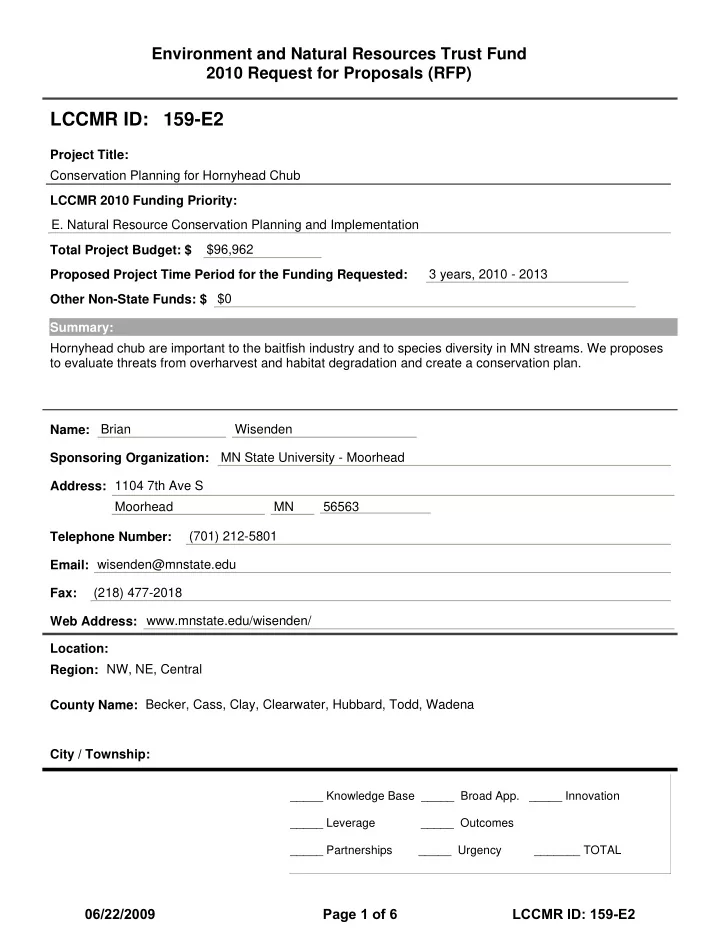
Environment and Natural Resources Trust Fund 2010 Request for Proposals (RFP) LCCMR ID: 159-E2 Project Title: Conservation Planning for Hornyhead Chub LCCMR 2010 Funding Priority: E. Natural Resource Conservation Planning and Implementation


slide-1
SLIDE 1

Environment and Natural Resources Trust Fund 2010 Request for Proposals (RFP)

Conservation Planning for Hornyhead Chub $96,962 3 years, 2010 - 2013 $0 Brian Wisenden MN State University - Moorhead 1104 7th Ave S Moorhead MN 56563 (701) 212-5801 (218) 477-2018 wisenden@mnstate.edu www.mnstate.edu/wisenden/ Becker, Cass, Clay, Clearwater, Hubbard, Todd, Wadena Hornyhead chub are important to the baitfish industry and to species diversity in MN streams. We proposes to evaluate threats from overharvest and habitat degradation and create a conservation plan. Project Title: Total Project Budget: $ Proposed Project Time Period for the Funding Requested: Other Non-State Funds: $ Name: Sponsoring Organization: Address: Telephone Number: Email: Fax: Web Address: County Name: City / Township: Region: Summary: NW, NE, Central

LCCMR ID: 159-E2

LCCMR 2010 Funding Priority:

  • E. Natural Resource Conservation Planning and Implementation

Location:

_____ Knowledge Base _____ Broad App. _____ Innovation _____ Leverage _____ Outcomes _____ Partnerships _____ Urgency _______ TOTAL

06/22/2009 Page 1 of 6 LCCMR ID: 159-E2

slide-2
SLIDE 2

1 Project Title: Conservation planning for hornyhead chub

  • I. Project Statement
  • 1. Minnesota has the largest baitfish industry of the north central states and the industry is

growing rapidly. In 2005 baitfish farms earned over $4 million in sales, and for most baitfish, demand exceeds supply. A prime example of this in MN is the popular hornyhead chub, also known as the redtail chub. This species is “critically imperiled” in WY, KS and PA, and “vulnerable” in ND and SD. The status of this fish in MN is under review, but already there are clear signs that populations are in serious decline. Unfortunately, there is little information regarding the status of chub populations in MN, or the relative impact of wild harvest by the baitfish industry and by habitat degradation. The pebble nests constructed by male hornyhead chub (left) are used by other stream fishes for

  • breeding. Thus, many fishes in stream

ecosystems share their fate with hornyhead chub. Conservation of the hornyhead chub is important because they need silt-free gravel and natural water flow patterns. Thus, we must conserve high quality stream habitat to conserve this species.

  • 2. The overall goal of this project is to develop an integrated, community-based conservation

plan for the hornyhead chub that will ensure ecological integrity of MN streams and long term economic sustainability of the hornyhead chub baitfish industry.

  • 3. This goal will be achieved by these activities:

(1) describe and compare structure of harvested to un-harvested populations of hornyhead chub to understand the impact of baitfish harvest on natural populations (2) describe habitat requirements, particularly for spawning, to understand the habitat needs of hornyhead chub necessary for their conservation (3) describe ecological interactions between hornyhead chub nests and other species of fish that also rely on these nests for reproduction

  • II. Description of Project Results

Result 1. Assessment of baitfish harvest on natural populations Budget: $22,181 Description : We will sample hornyhead chub populations under harvest and not under harvest and compare age and size structure. Results will be used to inform the conservation plan.

  • 1. Effect of baitfish harvest on hornyhead chub populations.

2011

Nests comprise thousands of individually placed

  • pebbles. Eggs are oxygenated by percolating
  • currents. Several fish species depend on these nests.

06/22/2009 Page 2 of 6 LCCMR ID: 159-E2

slide-3
SLIDE 3

2 Result 2. Description of habitat quality needed for nesting Budget: $64, 640 Description : We will sample gravel from established nests at three locations to determine gravel size, water flow and depth, water temperature and nutrient levels. We will quantify the degree of shoreline vegetation, overhead shade and distance to roads. We will use underwater viewing systems to record spawning behavior of hornyhead chub, and use of these nests by other

  • species. Use by other species is important information to get because although multispecies

associations are known to exist, the extent of these associations has never been measured. We need this information to assess the ecological role of this species. Result 3. Development of Conservation Plan Budget: $10, 140 Description: Use data collected in field and lab research to inform a conservation plan for hornyhead chub in the NW, NE and Central regions in Minnesota. This plan will outline how to minimize and mitigate the impact of baitfish harvest on populations and will include recommendations for the MN community of baitfish harvesters. Ultimately, the conservation plan will integrate habitat conservation with education and the baitfish industry.

  • 1. Meet with community members to present draft of conservation plan, complete

plan and share with managers in the NW, NE and Central regions. 2013

  • III. Project strategy
  • A. Project team and partners:

The project goals will be achieved through collaboration between Professors Brian Wisenden and Linda Fuselier at the Biosciences Department at Minnesota State University Moorhead, in consultatory partnership with Jeff Gunderson (MN Seagrant) and Barry Thoele (Baitfish industry). Drs. Wisenden and Fuselier will conduct and directly supervise students involved in the collection of data.

  • B. Timeline requirements We will complete our proposed project in 36 months. We will have

2.5 field seasons which will be appropriate for collection of data and assessments.

  • C. Long-term strategy Research will be published in peer-reviewed journals and shared
  • penly with DNR partners to implement a conservation plan for hornyhead chub and MN
  • streams. In the long term, we will know more about baitfish harvest impacts and be able to

better protect sensitive species in rivers and streams. The results from these activities will also be combined with an outdoor education program and experimental aquaculture facility to create an integrated community-based conservation plan.

  • 1. Determine optimal in-stream habitat necessary for stable, reproducing

populations of hornyhead chub in MN streams throughout the state. 2012

  • 2. Quantify ecological role of hornyhead chub nests in relation to species that use

hornyhead nests for their own reproductive activity 2012

06/22/2009 Page 3 of 6 LCCMR ID: 159-E2

slide-4
SLIDE 4

BUDGET ITEM (See list of Eligible & Non-Eligible Costs, p. 13) Personnel: Brian Wisenden, principal investigator on a 9-mo contract, course release time and summer stipends for three semesters (Jan-May each year) and three summers. Course release is cost to hire an adjunct instructor at $5070 per 3 credit course; 30% of this is for fringes. This provides 12% of time to work on the proposed Linda Fuselier, on a 9-mo contract, course release time and summer stipends for six semesters and three summers. Course release is cost to hire an adjunct instructor at $5070 per 3 credit course; 30% of this is for fringes. This provides 12% of time to work on the proposed project. Graduate Student (2 students @ $4000/summer for 3 summers as a flat stipend) Undergraduate Students (2 students @ $4000/summer for 3 summers as a flat stipend) Contracts: Equipment/Tools/Supplies: In this column, list out general descriptions of item(s)

  • r item type(s) and their purpose - one line per item/item type.

Acquisition (Fee Title or Permanent Easements): Travel: by state vehicle 8640 miles @ $0.43/mile, for principal investigator and student travel to field sites for 2.5 field seasons. Additional Budget Items: TOTAL PROJECT BUDGET REQUEST TO LCCMR SOURCE OF FUNDS AMOUNT Status Other Non-State $ Being Applied to Project During Project Period:

  • $

Other State $ Being Applied to Project During Project Period: NA In-kind Services During Project Period:

  • $

Services in the form of time spent on the project by partners in the MN DNR including Jeff Gunderson (MN Seagrant) and Barry Thoele (baitfish supplier). Value approximated as 2%/year of estimated average base salary of $50,000. 12,000 $ acknowledg ed, secured upon funding Equipment, computers, software, infrastructure, aquarium facility usage, aquarium supplies, water quality monitoring equipment, current velocity probes, and oxygen and pH meters; secretarial support, funds for scientific publications and use of

  • buildings. Equipment is from MSUM and funds have been secured from different

sources including internal grants. Value approximated as regular "overhead" funds for salary and fringe. . $51,812 secured Remaining $ from Current Trust Fund Appropriation (if applicable): NA Funding History: This is new initiative Total $63,812

  • V. OTHER FUNDS

Project Budget

  • IV. TOTAL PROJECT REQUEST BUDGET 3 years

NA 2,942.00 NA 23,010.00 24,000.00 AMOUNT

  • $

23,010.00 NA NA 24,000.00

96,962.00

06/22/2009 Page 4 of 6 LCCMR ID: 159-E2

slide-5
SLIDE 5
  • 5. Project Manager Qualifications and Organization Description

Manager: Brian D. Wisenden, PhD

  • Dr. Wisenden has an undergraduate degree (BS) in Fisheries Biology from the University of

Guelph (Ontario), and a MS in Fisheries Management from Lakehead University, Thunder Bay (Ontario). His master’s thesis project was on walleye population dynamics in response to

  • exploitation. His doctorate degree, from the University of Western Ontario, was on the

behavioral reproductive ecology of convict cichlids in Costa Rican streams. Since that time, he has worked on chemical ecology and reproductive behavior of fishes and published over 60 articles and reviews in peer-reviewed journals and scholarly books. Recently, Dr. Wisenden conducted a study of constraints on nest structure of hornyhead chub on the resident population in the head waters of the Mississippi River. This research is now in press:

Wisenden BD, Unruh A, Morantes A, Bury S, Curry B, Driscoll R, Hussein M, Markegard S. In press. Functional constraints on the architecture of pebble mounds of breeding male hornyhead chub, Nocomis biguttatus. Journal of Fish Biology.

The proposed aquaculture effort is a direct result of this research that we hope will lead to a better understanding of the ecology of this species, regulation of the baitfish industry involving this species, and conserve stream habitat necessary for this species to thrive in Minnesotan

  • waters. Wisenden will lead research on population structure and dynamics of native

populations of hornyhead chub in streams that experience baitfish harvest and compare these to streams with no harvest pressure. He will design and implement studies of hornyhead chub reproductive biology and behavior that will directly inform management decisions. Wisenden will oversee graduate and undergraduate student participation in the project and ensure dissemination of project results in scientific journals. Minnesota State University Moorhead (MSUM) is a regional 4-year liberal arts college serving the Red River Valley and the I-29 corridor. The campus has approximately 7500 students, with about 400 Biology majors. The Biology Degree program has several tracks, one

  • f which is an emphasis in Ecology and Evolutionary Biology (EEB) and another is Life Science

Education (LSE). Students in EEB pursue careers in resource management with state and federal agencies, and those in LSE become classroom teachers. Currently, about 80 students are enrolled in the EEB emphasis and 28 students graduate from our Life Science Education program each year. Organization Description

06/22/2009 Page 5 of 6 LCCMR ID: 159-E2

slide-6
SLIDE 6

06/22/2009 Page 6 of 6 LCCMR ID: 159-E2