
Firefighting Foam Updates
Study Guide ...... Name_______________ Date ________
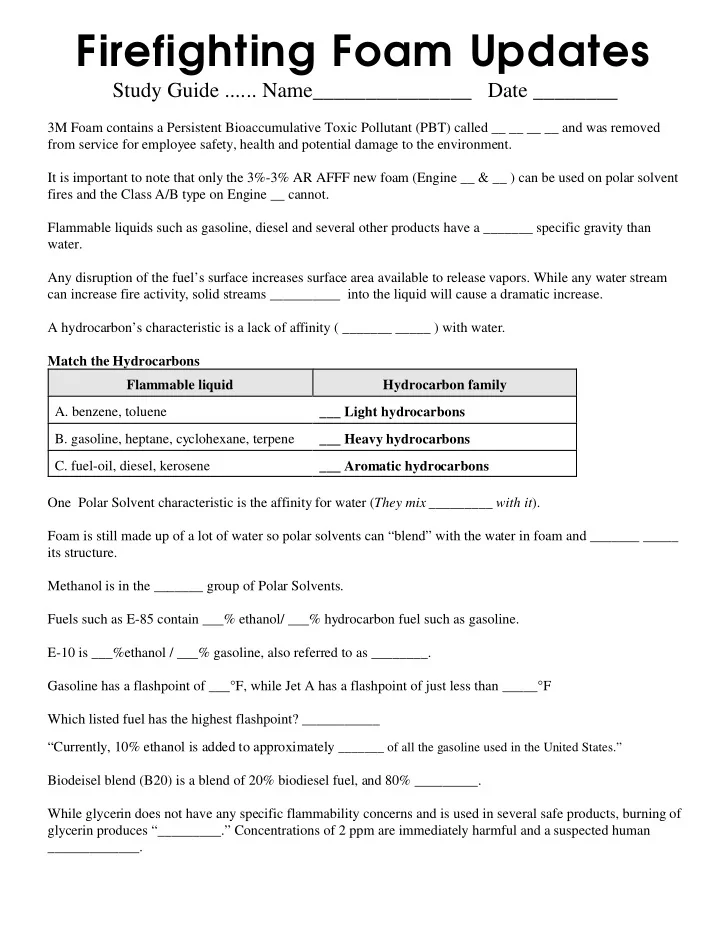
3M Foam contains a Persistent Bioaccumulative Toxic Pollutant (PBT) called __ __ __ __ and was removed from service for employee safety, health and potential damage to the environment. It is important to note that only the 3%-3% AR AFFF new foam (Engine __ & __ ) can be used on polar solvent fires and the Class A/B type on Engine __ cannot. Flammable liquids such as gasoline, diesel and several other products have a _______ specific gravity than water. Any disruption of the fuel’s surface increases surface area available to release vapors. While any water stream can increase fire activity, solid streams __________ into the liquid will cause a dramatic increase. A hydrocarbon’s characteristic is a lack of affinity ( _______ _____ ) with water. Match the Hydrocarbons Flammable liquid Hydrocarbon family
- A. benzene, toluene
___ Light hydrocarbons
- B. gasoline, heptane, cyclohexane, terpene
___ Heavy hydrocarbons
- C. fuel-oil, diesel, kerosene
___ Aromatic hydrocarbons One Polar Solvent characteristic is the affinity for water (They mix _________ with it). Foam is still made up of a lot of water so polar solvents can “blend” with the water in foam and _______ _____ its structure. Methanol is in the _______ group of Polar Solvents. Fuels such as E-85 contain ___% ethanol/ ___% hydrocarbon fuel such as gasoline. E-10 is ___%ethanol / ___% gasoline, also referred to as ________. Gasoline has a flashpoint of ___°F, while Jet A has a flashpoint of just less than _____°F Which listed fuel has the highest flashpoint? ___________ “Currently, 10% ethanol is added to approximately _______ of all the gasoline used in the United States.” Biodeisel blend (B20) is a blend of 20% biodiesel fuel, and 80% _________. While glycerin does not have any specific flammability concerns and is used in several safe products, burning of glycerin produces “_________.” Concentrations of 2 ppm are immediately harmful and a suspected human _____________.