1 1
May 6, 2015 1 1 Safe Harbor Statement Certain statements in the - - PowerPoint PPT Presentation
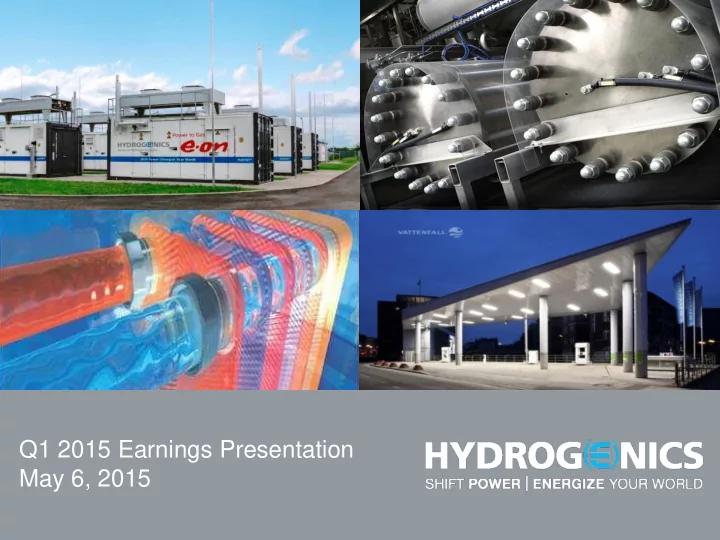
Q1 2015 Earnings Presentation May 6, 2015 1 1 Safe Harbor Statement Certain statements in the Business Update and Order Backlog sections contain forward-looking statements within the meaning of the safe harbor provisions of the U.S.
2
Safe Harbor Statement
Certain statements in the Business Update and Order Backlog sections contain forward-looking statements within the meaning of the “safe harbor” provisions of the U.S. Private Securities Litigation Reform Act of 1995, and under applicable Canadian securities laws. These statements are based
- n management’s current expectations and actual results may differ from these forward-looking statements due to numerous factors, including: our
inability to increase our revenues or raise additional funding to continue operations, execute our business plan, or to grow our business; our inability to address a slow return to economic growth, and its impact on our business, results of operations and consolidated financial condition; our limited
- perating history; inability to implement our business strategy; fluctuations in our quarterly results; failure to maintain our customer base that
generates the majority of our revenues; currency fluctuations; failure to maintain sufficient insurance coverage; changes in value of goodwill; failure of a significant market to develop for our products; failure of hydrogen being readily available on a cost-effective basis; changes in government policies and regulations; failure of uniform codes and standards for hydrogen fuelled vehicles and related infrastructure to develop; liability for environmental damages resulting from our research, development or manufacturing operations; failure to compete with other developers and manufacturers of products in our industry; failure to compete with developers and manufacturers of traditional and alternative technologies; failure to develop partnerships with original equipment manufacturers, governments, systems integrators and other third parties; inability to obtain sufficient materials and components for our products from suppliers; failure to manage expansion of our operations; failure to manage foreign sales and operations; failure to recruit, train and retain key management personnel; inability to integrate acquisitions; failure to develop adequate manufacturing processes and capabilities; failure to complete the development of commercially viable products; failure to produce cost-competitive products; failure or delay in field testing of our products; failure to produce products free of defects or errors; inability to adapt to technological advances or new codes and standards; failure to protect our intellectual property; our involvement in intellectual property litigation; exposure to product liability claims; failure to meet rules regarding passive foreign investment companies; actions of our significant and principal shareholders; dilution as a result of significant issuances of our common shares and preferred shares; inability of US investors to enforce US civil liability judgments against us; volatility of our common share price; dilution as a result of the exercise of options; and failure to meet continued listing requirements of Nasdaq. Readers should not place undue reliance on Hydrogenics’ forward-looking statements. Investors are encouraged to review the section captioned “Risk Factors” in our regulatory filings with the Canadian securities regulatory authorities and the US Securities and Exchange Commission for a more complete discussion of factors that could affect our future performance. Furthermore, the forward-looking statements contained herein are made as of the date
- f this presentation, and we undertake no obligation to revise or update any forward-looking statements in order to reflect events or circumstances
that may arise after the date of this presentation, unless otherwise required by law. The forward-looking statements contained in this presentation are expressly qualified by this.
3
Q1 2015 Highlights
- $4.4M of projects awarded by California Energy
Commission to integrate Celerity into Heavy Duty Vehicles
– New Flyer 12m bus for Sunline Transit – Class 8 Drayage Truck for TTSI at the Port of LA
- Kolon JV significant order visibility with near term
market potential in excess 100MW
- Continuing strong Power-to-Gas interest
extending beyond Western Europe as energy storage needs becomes more mainstream
- Overall outlook intact for growth
4
Fuel Cells: Differentiated Mobility Product Platform
4
- New Flyer 40ft battery transit bus operated by SunLine
Transit over its regular route in Coachella Valley, California
- Port of LA class 8 drayage truck to be used on the
Alameda Corridor as well as in the ports of Long Beach and Los Angeles.
- Celerity platform attracting significant international
interest for bus, truck, train and other mobility applications in NA, EU & Asia
5
MW Fuel Cell Systems for Power Generation: Kolon JV
- Site preparation underway in Korea for 1st MW Pilot Plant
with facility operation scheduled for early Q3
- After confirmation of technology in Korea, rapid order
intake expected (Q4 2015) – Remaining 9MW of secured orders to be shipped after first megawatt validated – More than 100MW of accessible market identified
- South Korean policies and availability of excess industrial
hydrogen pave the way for attractive market dynamics and expected high demand
Cost, performance, scale and zero carbon emissions now enable new markets for continuous power generation at utility scale
200MW package system
6
Energy Storage Assoc. 25th Annual Conference Dallas – May 27-29
Energy Storage: Leading Technology & Installed Systems
7
New Study on Commercialization of Energy Storage in Europe
- FCH-JU study evaluated commercial
viability of energy storage to enable increasing levels of renewable generation in the short term and long term
- McKinsey & Co. provided analytical support
for the study released in March 2015
- Three types of storage technologies
– Power to Power – Conversion of Power to Heat – Power to Gas for Transport and Industry
- One of key findings is that conversion of
electricity to hydrogen through electrolysis can productively use excess renewable energy in the high-RES scenario contributing to the decarbonization of the gas grid and mobility sectors
8
Energy Storage Business Outlook
- First of its kind 1.5MW unit underwent successful factory acceptance tests
in Germany and will be commissioned at customer site during Q2
- Hydrogenics awarded over $18M in energy storage projects during 2014
- Recent Ontario IESO award will provide first MW-scale North American
reference site – engineering underway with site deployment planned for 2016
- Overall pipeline for energy storage at $80M – each project is first of its kind
for customer
– Bids in process; long lead times a reality of technology adoption
9
Company Outlook Supported by Pipeline Trends
- Strong backlog at $55M, of which $35M will ship within next 12 months
- Capability to book and ship during first six months of the year
- Already secured substantial programs with established customers – additional
- rders to follow
- MW power generation (Kolon) next step is substantial, following proof of 1MW
- Energy storage pipeline has 1-15MW projects with good maturity
$M
50 100 150 200 250 300
Revenue 2014 Firm Orders for 2015 Delivery Weighted Regular Business Pipeline MW Power Generation Balance of Major Programs Energy Storage Pipeline Delivery > 1 yr
Pending Customer Firm-up Qualified Leads Firm Order with PO Revenue
10
Outlook for Balance of 2015
- Historically quarter to quarter fluctuation remains a reality; with much
larger orders ahead, the upside swings are going to grow
- OnSite industrial hydrogen will continue as a stable base business
accounting for up to 50% of revenue
- Power-to-Gas energy storage project wins subject to funding awards
and favorable regulatory environment
- Kolon JV confirmed run in Q3 and significant order flow in Q4
- Multiple awards for heavy duty mobility applications based on Celerity
platform for buses and trucks in EU, China and NA
11
Summary: Poised for Significant Expansion
- Demonstrated ability to scale the business and manage costs
- Strong, active pipeline of large P2G opportunities – expected to
accelerate after E.ON PEM system up and running, serving as showcase installation
- Kolon JV the impetus to rapid growth in multi-megawatt fuel cell power
generation
- Ready to serve increasing demand for electrified transport on new
Celerity Platform Cost Discipline
Differentiated Growth Platform Multiple Ways to Win
12 0.0 4.0 8.0 12.0 2014 2015
Power Systems OnSite Generation
Notes
Revenue was $7.5 million, a 7% decrease year-over-year, reflecting shipment timing and the decline in the value
- f the Euro compared to the US dollar.
Revenue
Three months ended March 31, 2015
$M
Revenue by Business Unit
7.5 8.1 2 4 6 OnSite Generation Power Systems
6.0 2.1 3.3 4.2
2014 2015
$M
Q1 Revenue
13
- 10.0
20.0 30.0 40.0 2014 2015
Power Systems OnSite Generation
10 20 30 40 50 60 OnSite Generation Power Sytems
12.9 54.9 8.3 20.9
2014 2015
Three months ended March 31, 2015
Gross Margin By Business Unit
23.8 15.3
Gross Margin
Notes
Gross margin was 15.3% of revenue for the quarter, versus 23.8% in the prior-year period, reflecting a change in the product mix as well as higher indirect overhead costs as a percentage of revenue when compared to the prior year period.
% %
Q1 Gross Margin
14
1 2 3 4 5 2014 2015 2.8 2.5 0.9 1.0
R&D SG&A
Three months ended March 31, 2015
Notes
- Cash operating costs decreased 5% primarily reflecting lower SG&A expenses in the current year as a result
- f the impact of lower exchange rates on expenses denominated in Euros and Canadian dollars.
- Cash operating costs are defined as the sum of selling, general and administrative expenses (“SG&A”) and
research and product development (“R&D”), less amortization and depreciation, stock-based compensation expense and compensation costs indexed to our share price. This is a non-IFRS measure and may not be comparable to similar measures used by other companies. Management uses this measure as a rough estimate of the amount of fixed costs to operate the Corporation and believes this is a useful measure for investors for the same purpose. Refer to the reconciliation of this measure to loss from operations.
3.7 3.5
$M
Q1 Cash Operating Costs
15
Three months ended Mar. 31 Change 2015 2014 $ % Revenue $ 7.5 $ 8.1 (0.6) (7)% Gross Profit 1.2 1.9 (0.7) (37)%
Gross Margin %
15.3% 23.8% Operating Expenses
Selling, general and administrative (excluding stock-based compensation, amortization and depreciation)
2.5 2.7 (0.2) (7)%
Research and product development
1.0 0.9 0.1 11% Adjusted EBITDA $ (2.3) $ (1.7) $ 0.6 35% Notes
- Adjusted EBITDA is defined as net loss excluding: cash settled long term compensation indexed to share price, share settled
stock-based compensation expense, net finance income and expenses, depreciation and amortization. Adjusted EBITDA is a non-IFRS measure and may not be comparable to similar measures used by other companies.
- Management uses Adjusted EBITDA as a useful measure of ongoing operational results. Refer to slide 15 for a reconciliation of
this measure to net loss.
(in $ millions)
Q1 Results
16
- Jan. 1/15
Backlog Orders Received FX Orders Delivered
- Mar. 31/15
Backlog OnSite Generation $ 28.3 $ 4.6 $ (1.9) $ 3.3 $ 27.7 Power Systems 33.9 1.1 (2.7) 4.2 28.1 Total $ 62.2 $ 5.7 $ (4.6) $ 7.5 $ 55.8
As at March 31, 2015 ($M)
Order Backlog
Expected Revenue Recognition During next 12 mths Beyond next 12 mths OnSite Generation 27.7
- Power Systems
7.5 20.6 Total 35.2 20.6
17
Cash and cash equivalents and restricted cash $ 9.5 $ 10.4 (0.9) (9)% Trade, other and grants receivable 11.8 12.9 (1.1) (8)% Inventories 14.2 14.7 (0.5) (4)% Trade and other payables 10.9 13.2 (2.3) (17)%
- Dec. 31,
2014 $ %
($M)
Change
- Mar. 31,
2015
Consolidated Balance Sheet Highlights
18
Three months ended March 31, 2015 Three months ended March 31, 2014 Cash operating costs $ 3.5 $ 3.7 Less: Gross profit (1.2) (1.9) Add: Stock-based compensation 0.1 0.1 Add: Deferred compensation plans indexed to share price (0.1) 1.6 Add: Amortization and depreciation 0.1 0.1 (Income)/Loss from operations $ (2.4) $ (3.6)
($M)
Reconciliation of Non-IFRS Measures – Cash Op. Costs
19
Three months ended March 31, 2015 Three months ended March 31, 2014 Adjusted EBITDA loss $ 2.3 $ 1.7 Stock-based compensation (cash settled and share settled)
- 1.7
Amortization and depreciation 0.1 0.1 Finance (income) loss, net 1.0 0.2 Net loss $ 3.4 $ 3.7
($M)
Reconciliation of Non-IFRS Measures – Adj. EBITDA
20