May 20, 2015 Workshop 3: Appeal Strategy and Stamina LOCATION: - - PowerPoint PPT Presentation

may 20 2015
SMART_READER_LITE
LIVE PREVIEW

May 20, 2015 Workshop 3: Appeal Strategy and Stamina LOCATION: - - PowerPoint PPT Presentation

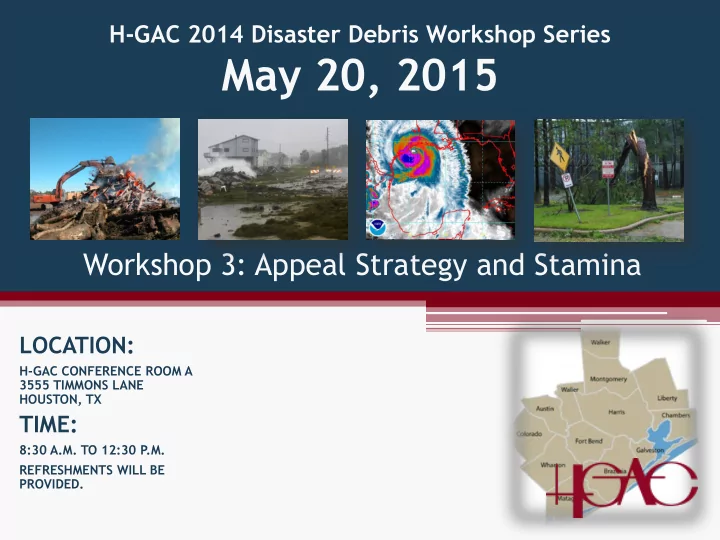
H-GAC 2014 Disaster Debris Workshop Series May 20, 2015 Workshop 3: Appeal Strategy and Stamina LOCATION: H-GAC CONFERENCE ROOM A 3555 TIMMONS LANE HOUSTON, TX TIME: 8:30 A.M. TO 12:30 P.M. REFRESHMENTS WILL BE PROVIDED. AGENDA

slide-1
SLIDE 1

H-GAC 2014 Disaster Debris Workshop Series

May 20, 2015

Workshop 3: Appeal Strategy and Stamina

LOCATION:

H-GAC CONFERENCE ROOM A 3555 TIMMONS LANE HOUSTON, TX

TIME:

8:30 A.M. TO 12:30 P.M. REFRESHMENTS WILL BE PROVIDED.

slide-2
SLIDE 2

AGENDA

  • Introductions and Purpose
  • How Do Appeals Work?
  • Project Pitfalls
  • Break
  • Audit and Closeout
  • Case Studies
  • Questions and Answers with Panelists
  • Adjourn

2

slide-3
SLIDE 3

Part 1: Introduction and Purpose

slide-4
SLIDE 4

WELCOME

  • Introductions
  • Name
  • Agency

4

slide-5
SLIDE 5

PURPOSE

  • Provide an overview of the appeal process.
  • Identify pitfalls to avoid unfavorable

eligibility determinations.

  • Discuss duration and tips for maintaining

stamina.

  • Review appeal case studies and lessons

learned.

5

slide-6
SLIDE 6

Part 2: How Do Appeals Work?

slide-7
SLIDE 7

PUBLIC ASSISTANCE PROGRAM APPEAL PROCEDURES

  • Manual describes policies,

procedures and responsibilities for FEMA Public Assistance (PA) appeal process

  • Stafford Act
  • Sandy Recovery

Improvement Act (SRIA)

7

slide-8
SLIDE 8

KEY TERMS AND DEFINITIONS

  • Administrative Record
  • All documents and

materials directly or indirectly considered by FEMA in making eligibility determination and subsequent first appeal decision

8

Record may include:

  • PWs (all versions)
  • Determination

memoranda

  • Backup documentation
  • Correspondence
  • Photographs
  • Technical reports
  • Other relevant

information

slide-9
SLIDE 9

KEY TERMS AND DEFINITIONS

  • Dispute Resolution Pilot Program
  • Program authorized by the SRIA
  • PA Applicant can request alternative dispute

resolution

  • Arbitration by independent review panel

9

slide-10
SLIDE 10

KEY TERMS AND DEFINITIONS

  • Dispute Resolution Pilot Program
  • Set forth in 44 C.F

.R. § 206.210

  • Declarations made after October 30, 2012
  • Dispute $1M and more
  • Subject to non-federal cost share
  • First appeal filed and received first decision

10

slide-11
SLIDE 11

KEY TERMS AND DEFINITIONS

  • Public Assistance Determination Memorandum
  • One page synopsis of an eligibility

determination

  • Completed by PA Program staff
  • Intended to concisely and accurately

document and explain determination

11

slide-12
SLIDE 12

ROLES AND RESPONSIBILITIES

12

Public Assistance Appeal Branch (PAAB)

  • Overall administration of FEMA appeal system

PA Program staff in FEMA Regional Offices

  • Process appeal

PA Program staff in FEMA Joint Field Offices

  • NOT directly involved with appeal process
slide-13
SLIDE 13

KICKOFF MEETING

  • PA Program Staff must provide information on

appeal and dispute resolution processes

  • Informally discuss eligibility issues
  • Discuss prior to eligibility determination
  • Timeline for filing appeal
  • Contact for receiving determinations
  • Contents and structure of first appeal
  • Option to pursue arbitration
  • Information and documentation in 1st appeal

13

slide-14
SLIDE 14

DEVELOPING PROJECT WORKSHEETS

  • PA Program staff
  • Use Project Worksheet Development Guide
  • Develop administrative record
  • Coordinate with Deployable Field Counsel
  • Categorize documents in EMMIE system

14

Developing the administrative record will help ensure that project information is robust and complete which will be beneficial in a dispute.

slide-15
SLIDE 15

DISCUSSING UNRESOLVED ISSUES

  • When discussions with PA Program Staff are at

an impasse:

  • Consult with FEMA Alternative Dispute

Resolution staff

  • Identify, clarify and attempt to resolve

eligibility issues BEFORE an official eligibility determination is made

15

slide-16
SLIDE 16

DISCUSSING UNRESOLVED ISSUES

  • FEMA staff should offer facilitated discussion

when:

  • Appeal would qualify for resolution under

Dispute Resolution Pilot Program

  • Dispute amount is greater that $1M
  • Project is subject to a non-federal cost share

16

slide-17
SLIDE 17

DISCUSSING UNRESOLVED ISSUES

  • Document facilitated discussion:
  • Date discussion was offered
  • Date discussion was conducted
  • Outcomes of the discussion

17

slide-18
SLIDE 18

DISCUSSING UNRESOLVED ISSUES

  • Following facilitated discussion:
  • FEMA has five business days to issue

eligibility determination, OR

  • Provide additional actions to resolve dispute

18

slide-19
SLIDE 19

ELIGIBILITY DETERMINATIONS SUBJECT TO APPEAL

  • 1. Applicant, facility, work, and/or cost is

ineligible.

  • 2. Awarding a PW or amendment of a PW.
  • 3. Denying a request for an alternate project.
  • 4. Denying a request for an improved project.
  • 5. Denying a hazard mitigation proposal.

19

slide-20
SLIDE 20

ELIGIBILITY DETERMINATIONS SUBJECT TO APPEAL

  • 6. Denying a request for a time extension.
  • 7. Denying a request for a net small project
  • verrun.
  • 8. Denying a request for additional funding for

the closeout of a large project.

  • 9. Acting upon an Office of the Inspector

General recommendation.

20

slide-21
SLIDE 21

FIRST APPEAL

  • Must contain documented justification

supporting the appeal position

  • Specify monetary figure in dispute
  • Cite provision in federal law or policy with

which the determination was inconsistent

21

slide-22
SLIDE 22

FIRST APPEAL

22

The opportunity to provide documentation and information is at the first appeal stage. FEMA will NOT accept additional materials after it issues a first appeal decision.

slide-23
SLIDE 23

APPEAL TIMELINE

23

Applicant has 60 days to submit appeal Administrative officer has 90 days to respond with decision First appeal goes to FEMA Regional Administrator Second appeal goes to FEMA’s Assistant Administrator for Recovery

slide-24
SLIDE 24

ADMINISTRATIVE RECORD CHECKLIST

24

  • Handout
slide-25
SLIDE 25

Part 3: Project Pitfalls

slide-26
SLIDE 26

KEY STEPS IN PUBLIC ASSISTANCE PROCESS

26

GOVERNOR’S REQUEST PRELIMINARY DAMAGE ASSESSMENT DISASTER EVENT DISASTER DECLARATION REQUEST FOR PUBLIC ASSISTANCE KICKOFF MEETING APPLICANTS’ BRIEFING INITIATE FEMA PROGRAMS GRANTEE, SUBGRANTEE OBLIGATION PROJECT REVIEW PROJECT CLOSEOUT PROJECT FORMULATION DISASTER CLOSEOUT

slide-27
SLIDE 27

PRELIMINARY DAMAGE ASSESSMENT

  • Damage assessment teams
  • Information collection
  • Correspondence with FEMA
  • Plan for audit in advance

27

Documentation:

  • Damage reports
  • Photos
  • Deployment schedule
  • Damage assessment

forms

  • Disaster summary
  • Record of

communication

slide-28
SLIDE 28

DISASTER DECLARATION

  • Pre disaster preparations
  • Declaration process
  • Correspondence with FEMA

28

Documentation:

  • Chronological

summary

  • Description of

damage

  • Background
  • Situation
  • Special

circumstances

slide-29
SLIDE 29

OPERATIONS

  • Force account labor
  • Force account equipment
  • Overtime procedures
  • Previous implementation

29

Documentation:

  • Timesheets
  • Daily logs
  • ICS forms
  • Position descriptions
  • Resource types
  • Compensation

procedures

  • Documentation of

implementation in previous events

slide-30
SLIDE 30

PROCUREMENT

  • Pre qualified vendors
  • Disadvantaged business

enterprise participation

  • Competitive bid process
  • Emergency procurement

procedures

  • Previous implementation

30

Documentation:

  • Procurement

procedures for normal and emergency

  • perations
  • Bid solicitation and

advertisement

  • RFP documents
  • Documentation of

implementation of emergency procedures

slide-31
SLIDE 31

EMERGENCY ROAD CLEARING

  • Road clearing teams
  • Force account

documentation

  • Contracted services/time

and materials contracts

31

Documentation:

  • Priority road lists
  • Timesheets,

equipment logs

  • Contractor invoices
  • Procurement scope
  • f work
slide-32
SLIDE 32

PUBLIC INFORMATION

32

Documentation:

  • Press releases
  • Set out procedures
  • Call center

documentation

  • Schedule for pass

completion

  • Public notices
  • Providing information to

the whole community

slide-33
SLIDE 33

SPECIAL DEBRIS PROGRAMS

  • Right of way collection
  • Private property debris

removal

  • Waterway
  • Hazardous limbs and

stumps

  • Derelict vessels

33

Documentation:

  • Health and safety

procedures

  • Public notices
  • Priority road lists
  • Maintenance and

jurisdictional records

  • Monitoring

documentation

slide-34
SLIDE 34

PROJECT WORKSHEET COMPONENTS

  • Disaster details
  • Applicant details
  • Project details
  • Key staff
  • State info
  • PW package

34

Documentation:

  • Project worksheet
  • DDD-Scope of work continuation
  • Scope notes
  • Cost continuation
  • Special considerations
  • Hazard mitigation proposal
  • Direct admin costs
  • Force account summary
  • Payroll data
  • Fringe benefits
  • Labor
  • Equipment inventory
  • Narrative
  • Exit briefing
slide-35
SLIDE 35

APPEAL ANALYST CHECKLIST

  • Handout

35

Documentation:

  • All documentation

and information must be submitted with the first appeal

slide-36
SLIDE 36

BREAK

slide-37
SLIDE 37

Part 4: Audits and Closeout

slide-38
SLIDE 38

PROJECT CLOSEOUT/AUDITS

  • Increased documentation requirements
  • Must use technology to support real time

audits

38

slide-39
SLIDE 39

PROJECT CLOSEOUT/AUDITS

  • Purpose is to clarify

all recovery work has been completed

  • Appeal have been

resolved

  • Eligible costs can be

reimbursed

  • Last step in PA

Process

39

slide-40
SLIDE 40

PROJECT CLOSEOUT/AUDITS

40

  • FEMA
  • Field audits
  • Project Worksheet review/approval
  • State
  • Closeout audits
slide-41
SLIDE 41

PROJECT CLOSEOUT/AUDITS

41

  • Department of Homeland Security (DHS) Office
  • f Emergency Management Oversight
  • Immediate
  • Capacity audit – 3 months to 1 year
  • Early warning audit
  • Testimonial audit
  • Program audit
slide-42
SLIDE 42

PROJECT CLOSEOUT/AUDITS

42

  • Office of Inspector General (OIG)
  • Final Audits
  • 5 years
  • 10 years
  • 20 years
slide-43
SLIDE 43

PROJECT CLOSEOUT/AUDITS

43

  • How does DHS select applicants for audit?
  • Congressionally mandated
  • Current or potential dollar magnitude
  • Congressional, state or FEMA requests
  • Reports of allegations of impropriety
slide-44
SLIDE 44

RECENT OIG REPORTS

44

  • OIG Report #1
  • Subgrantee had employee timecards and payroll

records to support cost but did not have activity logs to indicate what employees were doing

  • Claiming equipment use on Thanksgiving;

however, no records of any township employee working on that holiday

  • Township purchased equipment (computer) but

had no record of using the computer for debris removal activities

slide-45
SLIDE 45

RECENT OIG REPORTS

45

  • OIG Report #2
  • Subgrantee accepted funding for debris removal

prior to entering into an agreement with the County to remove debris on Subgrantee maintained roads

  • Subgrantee could not support cost of time and

materials contractors (no time sheets or equipment activity logs)

  • For the debris removal work that County did

manage, there were no contractor invoices or load tickets to support the claims

slide-46
SLIDE 46

RECENT OIG REPORTS

46

  • OIG Report #3
  • FEMA incorrectly told applicants that they

needed to follow state law or their own contracting procedures – this was incomplete information

  • Local governments can use their own contracting

procedures ONLY if their procedures follow federal guidelines

slide-47
SLIDE 47

Part 5: Case Studies

slide-48
SLIDE 48

PORT OF GALVESTON

  • 705.(c)
  • Gulf Copper final 2nd appeal decision pending,

$1.1M

  • Gulf Copper Plate Shop 1st appeal decision

pending, $674K

  • Pelican Island repair potential, $4.3M

48

slide-49
SLIDE 49

PORT OF GALVESTON

  • Insurance
  • 67 PWs de-obligated for insurance

review/duplication of benefits, $23M

  • Incorrect application of insurance by FEMA

49

slide-50
SLIDE 50

LOCAL SCHOOL DISTRICT

  • Overview
  • Large local school

district impacted by Hurricane Ike

  • Debris and damage to

buildings

  • Urgency to reopen

schools

  • Contractor conducted

debris removal as part of disaster services

50

slide-51
SLIDE 51

TIMELINE

  • 09/13/08 – Hurricane Ike makes landfall
  • 09/18/08 – Debris Removal Crews Start Work
  • 09/29/08 – School District Reopens
  • Fall 2008/Winter 2009 – School District Requests

Back-Up from Contractor

  • Sept. 2009 – FEMA denies initial claim of $1.4mm

51

slide-52
SLIDE 52

TIMELINE

  • April 2010 – School District Appeals
  • Dec. 2010 – Appeal Accepted - ~$300k
  • Sept. 2012/March 2013 – Audit Performed
  • April 2013 – Audit Report
  • Sept. 2013 – PW Closeout and Final Payment

52

slide-53
SLIDE 53

FEMA’S ISSUES WITH DEBRIS REMOVAL PROGRAM

  • Alleged contractor improprieties
  • Applicant failed to monitor debris removal

program = no second source of documentation

  • No load tickets at loading sites = impossible

to determine debris origin

  • No certification or individual numbering of

debris trucks = no actual capacity verifications or delivery time audits

  • Applicant used T&M contract, which is most

monitoring intensive, but did not monitor

53

slide-54
SLIDE 54

OUTCOME

  • Debris removed quickly
  • School District was one of first to reopen

after Hurricane Ike despite direct hit

  • School District commended Contractor for

quality of work

  • School District only reimbursed ~$300k for

$1.4 mm worth of work

54

slide-55
SLIDE 55

Part 6: Question and Answers with Panelists

slide-56
SLIDE 56

QUESTIONS FOR PANELISTS

  • Appeal process
  • Project pitfalls
  • Audit and closeout
  • Case studies

56

slide-57
SLIDE 57

Part 7: Next Steps/Adjourn

slide-58
SLIDE 58

QUESTIONS?

58

slide-59
SLIDE 59

NEXT STEPS

59

Workshop Date Workshop 4: Advanced Technology in Debris Management June 23, 2015

slide-60
SLIDE 60

ADJOURN

Thank you!

John Buri

Director, Post Disaster Programs Tetra Tech (713) 737-5763 john.buri@tetratech.com

Asad Kahn

Senior Project Manager, Post Disaster Programs Tetra Tech (954) 243-1717 asad.khan@tetratech.com

Sean McChristian

Porter Hedges LLP www.porterhedges.com

60