SLIDE 1
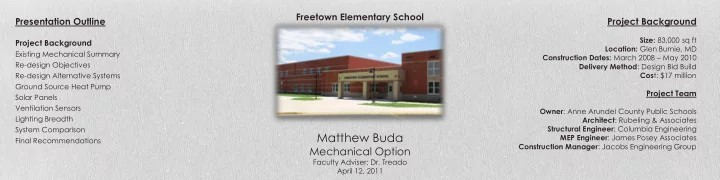
Freetown Elementary School Project Background
Size: 83,000 sq ft Location: Glen Burnie, MD Construction Dates: March 2008 – May 2010 Delivery Method: Design Bid Build Cost: $17 million
Project Team
Owner: Anne Arundel County Public Schools Architect: Rubeling & Associates Structural Engineer: Columbia Engineering MEP Engineer: James Posey Associates Construction Manager: Jacobs Engineering Group
Presentation Outline
Project Background
Existing Mechanical Summary Re-design Objectives Re-design Alternative Systems Ground Source Heat Pump Solar Panels Ventilation Sensors Lighting Breadth System Comparison Final Recommendations
Matthew Buda
Mechanical Option
Faculty Adviser: Dr. Treado April 12, 2011
SLIDE 2
Site Layout Old School New School Presentation Outline
Project Background
Existing Mechanical Summary Re-design Objectives Re-design Alternative Systems Ground Source Heat Pump Solar Panels Ventilation Sensors Lighting Breadth System Comparison Final Recommendations
SLIDE 3
Building Layout
First Floor Classrooms Administration Media/Computer Lab Extended Daycare Cafeteria/Kitchen/Gym Mechanical Room Storage Second Floor Classrooms Storage
Presentation Outline
Project Background
Existing Mechanical Summary Re-design Objectives Re-design Alternative Systems Ground Source Heat Pump Solar Panels Ventilation Sensors Lighting Breadth System Comparison Final Recommendations
SLIDE 4 Existing Mechanical Systems
ERU-1
Air Handling Units
Constant Volume – Rooftop Air Handling Unit AHU-1 : General Music Classroom AHU-2 : Instrumental Music Classroom AHU-3 : Cafeteria AHU-4A : Gymnasium AHU-6: Media Center Variable Volume/ Variable Temperature - Rooftop Air Handling Unit AHU-5 : Administration Air Source Heat Pump HPU-1A – Extended Daycare Energy Recovery Units – Rooftop Air Handling Units with Fan Coil Units
ERU-1 : Classrooms ERU-2 : Classrooms
Mechanical Room 2 pipe changeover system
Two Natural Gas Boilers rotated monthly Domestic Water Heater Air Cooled Chiller
SLIDE 5
Existing Mechanical Systems
Air Handling Units
Constant Volume – Rooftop Air Handling Unit AHU-1 : General Music Classroom AHU-2 : Instrumental Music Classroom AHU-3 : Cafeteria AHU-4A : Gymnasium AHU-6: Media Center Variable Volume/ Variable Temperature - Rooftop Air Handling Unit AHU-5 : Administration Air Source Heat Pump HPU-1A – Extended Daycare Energy Recovery Units – Rooftop Air Handling Units with Fan Coil Units
ERU-1 : Classrooms ERU-2 : Classrooms Modeled in TRACE Annual Energy Consumption Electric : 2,529,487 kWh Gas : 1,222 therms Building : 114,845 BTU/(ft2-year) Lighting 52% of Total Building Energy Primary Cooling 22% of Total Building Energy
Mechanical Room 2 pipe changeover system
Two Natural Gas Boilers rotated monthly Domestic Water Heater Air Cooled Chiller
SLIDE 6
Re-design Objectives
Reduce energy consumption Reduce emissions Maintain a comfortable environment Be more sustainable
Presentation Outline
Project Background
Existing Mechanical Summary Re-design Objectives Re-design Alternative Systems Ground Source Heat Pump Solar Panels Ventilation Sensors Lighting Breadth System Comparison Final Recommendations Selected Depth Systems Ground Source Heat Pump Solar Panels Ventilation Sensors Breadths Occupancy Sensors with Daylighting Rainwater collection system
Re-design Alternative Systems
SLIDE 7
Ground Source Heat Pump
Selection Vertical Closed Loop Peak Cooling Load > Peak Heating Load 231 tons Layout 2 tons per 300ft = 116 bores 20 ft spacing between bores Layout Bore Detail
Presentation Outline
Project Background
Existing Mechanical Summary Re-design Objectives Re-design Alternative Systems Ground Source Heat Pump Solar Panels Ventilation Sensors Lighting Breadth System Comparison Final Recommendations
SLIDE 8
Ground Source Heat Pump
Modeled in TRACE Annual Energy Consumption Electric : 2,294,989 kWh Gas : 0 therms Building : 103,100 BTU/(ft2-year)
SLIDE 9
Ground Source Heat Pump Presentation Outline
Project Background
Existing Mechanical Summary Re-design Objectives Re-design Alternative Systems Ground Source Heat Pump Solar Panels Ventilation Sensors Lighting Breadth System Comparison Final Recommendations Payback Emissions
SLIDE 10
Solar Panels Analysis
100% of Space Heating and Domestic Hot Water Compare to 1,222 therms of Natural Gas Peak in January : 265,250 BTU/hr UA = qhl / (Tbp-Tout) Tbp =65 deg F Tout = 27 deg F UA = 3267W/K Modeled in Combisys: TRNSED
Presentation Outline
Project Background
Existing Mechanical Summary Re-design Objectives Re-design Alternative Systems Ground Source Heat Pump Solar Panels Ventilation Sensors Lighting Breadth System Comparison Final Recommendations
SLIDE 11
Solar Panels
Footprint and Cost Comparison
Presentation Outline
Project Background
Existing Mechanical Summary Re-design Objectives Re-design Alternative Systems Ground Source Heat Pump Solar Panels Ventilation Sensors Lighting Breadth System Comparison Final Recommendations
SLIDE 12
Solar Panels Analysis
100% Domestic Hot Water Used year round
Presentation Outline
Project Background
Existing Mechanical Summary Re-design Objectives Re-design Alternative Systems Ground Source Heat Pump Solar Panels Ventilation Sensors Lighting Breadth System Comparison Final Recommendations
SLIDE 13
Ventilation Sensors
Volatile Organic Compounds (VOC)
Humans – breath, cosmetics – acetone/ethanol/CO2 Office Equipment – printers, computers – benzene, styrene Building materials – paints, carpets – formaldehyde, ketones
VOC Ranges
Presentation Outline
Project Background
Existing Mechanical Summary Re-design Objectives Re-design Alternative Systems Ground Source Heat Pump Solar Panels Ventilation Sensors Lighting Breadth System Comparison Final Recommendations
Source: BAPI
SLIDE 14
Ventilation Sensors
Study of a 6,000 cubic foot elementary classroom 1 teacher and 30 students Slightly lower because students not wearing cologne, perfume and lotions IEQ output direct indication of occupancy
Presentation Outline
Project Background
Existing Mechanical Summary Re-design Objectives Re-design Alternative Systems Ground Source Heat Pump Solar Panels Ventilation Sensors Lighting Breadth System Comparison Final Recommendations
Source: BAPI
SLIDE 15
Lighting Breadth
Occupancy Sensors with Daylighting controls Infrared Ultrasonic Dual Technology/Hybrid
Presentation Outline
Project Background
Existing Mechanical Summary Re-design Objectives Re-design Alternative Systems Ground Source Heat Pump Solar Panels Ventilation Sensors Lighting Breadth System Comparison Final Recommendations Control Automatic switching Manual switching Dimming ballast for daylighting Dimming of different zones Sensor LC-100 Power Pack DT-200 Dual Tech. Occ. Sensor LS-201 Dimming Photosensor Typical Classroom
SLIDE 16
Lighting Breadth
Lighting Against Windows 2-lamp dimming ballast Tandem wiring DT-200 18 minute time delay LS-201 Mount between 5 and 8 feet from window
Presentation Outline
Project Background
Existing Mechanical Summary Re-design Objectives Re-design Alternative Systems Ground Source Heat Pump Solar Panels Ventilation Sensors Lighting Breadth System Comparison Final Recommendations Occupancy Sensors with Daylighting controls Infrared Ultrasonic Dual Technology/Hybrid
Source: WattStopper
SLIDE 17
Lighting Breadth
Modeled in TRACE as Standard Stepped Controller Compared to the as-designed lighting controls Savings 5% energy reduction $14,029 a year in utilities Total First Cost $7,463 37 Sensors - $5,644 Labor - $1,819 Simple Payback 6 months Effect Energy reduction from controls Increase in energy use for heating with decrease in lighting load
Presentation Outline
Project Background
Existing Mechanical Summary Re-design Objectives Re-design Alternative Systems Ground Source Heat Pump Solar Panels Ventilation Sensors Lighting Breadth System Comparison Final Recommendations
SLIDE 18
System Comparison
Solar Panels Ground Source Heat Pump Ventilation Sensors Advantages 13% total energy savings Relatively quick payback Disadvantages Schedule Weather during construction Advantages 35% Energy Savings on heating Disadvantages Very expensive Long Payback Advantages Quick payback Better air quality Disadvantages Extra cost
SLIDE 19
Final Recommendations
Ground Source Heat Pump Reasonable Payback at 6.2 years Ventilation Sensors Better indoor air quality increase in productivity Lighting Occupancy Sensors Daylighting
Presentation Outline
Project Background
Existing Mechanical Summary Re-design Objectives Re-design Alternative Systems Ground Source Heat Pump Solar Panels Ventilation Sensors Lighting Breadth System Comparison Final Recommendations
SLIDE 20 Thank you
Siman Sinai, Jacobs Matt Tressler, McClure Fellow Students
SLIDE 21
Questions?