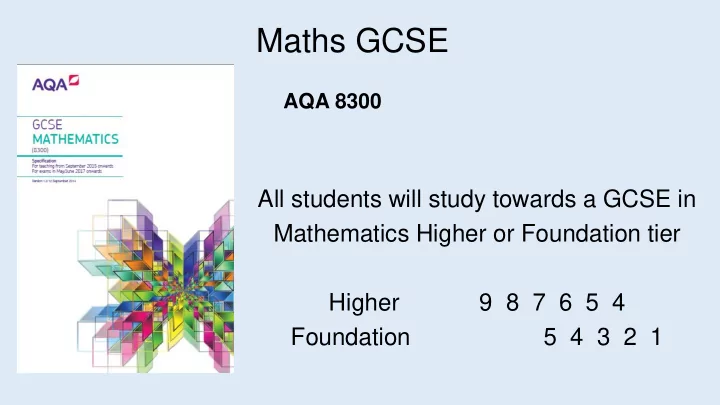
Maths GCSE AQA 8300 All students will study towards a GCSE in - - PowerPoint PPT Presentation

maths gcse
SMART_READER_LITE
LIVE PREVIEW

Maths GCSE AQA 8300 All students will study towards a GCSE in - - PowerPoint PPT Presentation

Maths GCSE AQA 8300 All students will study towards a GCSE in Mathematics Higher or Foundation tier Higher 9 8 7 6 5 4 Foundation 5 4 3 2 1 Eight things you need to know about the new GCSE 1. Its


slide-1
SLIDE 1

Maths GCSE

AQA 8300

All students will study towards a GCSE in Mathematics Higher or Foundation tier Higher 9 8 7 6 5 4 Foundation 5 4 3 2 1

slide-2
SLIDE 2

Eight things you need to know about the new GCSE

  • 1. It’s bigger
  • 2. There’s more content at both tiers
  • 3. There are new Assessment Objectives
  • 4. There are more formulae that pupils will need to memorise

for the exams

  • 5. There are more examination papers for pupils to take
  • 6. The structure of the papers has changed
  • 7. There’s a new grading system
  • 8. The assessments will be more demanding
slide-3
SLIDE 3
  • Surds
  • Reverse percentages
  • Factorising quadratics
  • Trigonometry – the sine, cosine and tangent ratios, including to know

the exact values of sin, cos and tan 30°, 60° and 45°

  • Using an inequality to specify error intervals due to rounding
  • Circle properties
  • Vectors
  • Tree diagrams
  • Standard form
  • Compound interest
  • Simultaneous equations
  • Direct and inverse proportion
  • Fractional scale factors of enlargements
  • Conditional probability and tree diagrams
  • Frequency trees
  • Venn diagrams
  • Fibonacci type sequences, quadratic sequences, geometric progressions
  • 2. There’s more content at both tiers – New to Foundation
slide-4
SLIDE 4
  • 2. There’s more content at both tiers – New to Higher
  • The gradient at a point on a curve as a rate of change
  • The area under a graph
  • Geometric progressions
  • Composite and inverse functions
  • Iteration
  • The location of turning points on a quadratic function by

completing the square

  • Expanding products of more than two binomials
slide-5
SLIDE 5
  • 3. There are new

assessment objectives

  • Less rote learning more on problem

solving

  • Multi-step solutions
  • Less clearly structured questions
  • More open ended questions
  • Real life contexts
slide-6
SLIDE 6
  • 4. There are more formulae that pupils will need to memorise

for the exams

slide-7
SLIDE 7
  • 5. There are more examination papers for pupils to take
slide-8
SLIDE 8
  • 6. The structure of the papers has changed
slide-9
SLIDE 9

Top 3% of pupils who currently get an A* will achieve a 9 7 is anchored to old A 5 is set between B and C 4 is anchored to old C 1 is the old F and G

New maths GCSE grades

  • 7. There’s a new grading system
slide-10
SLIDE 10
  • 8. The assessments will be more demanding – foundation question

More questions involving reasoning and problem solving

slide-11
SLIDE 11
  • 8. The assessments will be more demanding – higher question
slide-12
SLIDE 12
  • Devised a 7- 11 scheme of learning
  • Building new content into the curriculum eg Venn

diagrams, function notation….

  • Rewritten all the internal exams at KS3 and KS4
  • Back to basics with numeracy skills
  • Pupils issued with notebooks to help focus and revision
  • Constantly reviewing what we do and how we do it.
  • 90% A* - C for the last 3 years

Maths at QES

slide-13
SLIDE 13

Written Methods

slide-14
SLIDE 14
slide-15
SLIDE 15

Be equipped

slide-16
SLIDE 16

What can you do to help?

Be positive ‘I was never very good at Maths…’

  • Talk about numbers
  • Real life situations: shopping, offers, best

buys, interest rates, cooking times, bills

  • Mental maths: the more automatic

responses that pupils can accurately recall the better

  • Discuss problem solving strategies: drawing

diagrams, underlining important facts and reading questions carefully can all help

  • Does their answer make sense? Estimating

as a checking strategy is useful

slide-17
SLIDE 17

Resilience

slide-18
SLIDE 18

Confidence