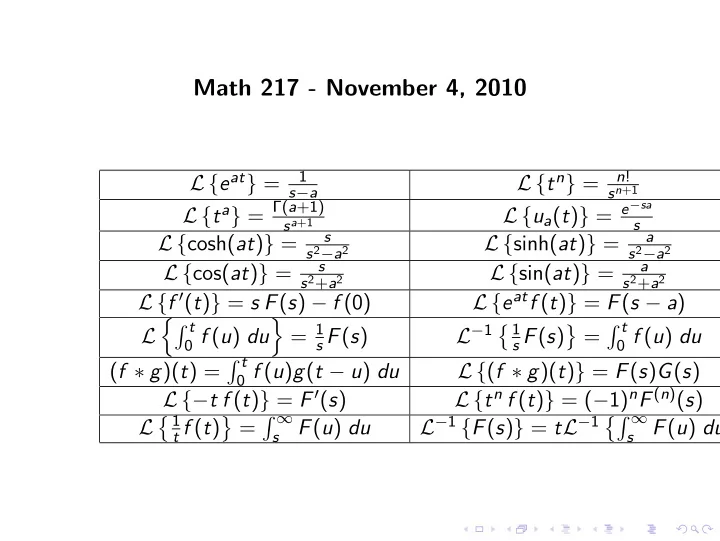
Math 217 - November 4, 2010 1 n ! L { e at } = L { t n } = s n +1 s - - PowerPoint PPT Presentation

math 217 november 4 2010
SMART_READER_LITE
LIVE PREVIEW

Math 217 - November 4, 2010 1 n ! L { e at } = L { t n } = s n +1 s - - PowerPoint PPT Presentation

Math 217 - November 4, 2010 1 n ! L { e at } = L { t n } = s n +1 s a L { t a } = ( a +1) L { u a ( t ) } = e sa s a +1 s L { cosh( at ) } = s L { sinh( at ) } = a s 2 a 2 s 2 a 2 L { cos( at ) } = s L { sin( at ) } = a s 2 +


slide-1
SLIDE 1

Math 217 - November 4, 2010

L {eat} =

1 s−a

L {tn} =

n! sn+1

L {ta} = Γ(a+1)

sa+1

L {ua(t)} = e−sa

s

L {cosh(at)} =

s s2−a2

L {sinh(at)} =

a s2−a2

L {cos(at)} =

s s2+a2

L {sin(at)} =

a s2+a2

L {f ′(t)} = s F(s) − f (0) L {eatf (t)} = F(s − a) L t

0 f (u) du

  • = 1

s F(s)

L−1 1

s F(s)

  • =

t

0 f (u) du

(f ∗ g)(t) = t

0 f (u)g(t − u) du

L {(f ∗ g)(t)} = F(s)G(s) L {−t f (t)} = F ′(s) L {tn f (t)} = (−1)nF (n)(s) L 1

t f (t)

  • =

s

F(u) du L−1 {F(s)} = tL−1 ∞

s

F(u) du

slide-2
SLIDE 2
  • 1. Set up the partial fractions for the following fractions.

(If you run out of things to be doing, work on the solutions).

(a) s2 (s − 1)(s − 2)(s − 3) = (b) s2 (s − 1)3(s − 2)(s − 3) = (c) s2 (s2 + 1)(s2 + 2)2(s − 3) =

slide-3
SLIDE 3
  • 1. Set up the partial fractions for the following fractions.

(If you run out of things to be doing, work on the solutions).

(a) s2 (s − 1)(s − 2)(s − 3) = A s − 1 + B s − 2 + C s − 3 Solution: A = 1/2, B = −4, C = 9/2. (b) s2 (s − 1)3(s − 2)(s − 3) = A s − 1 + B (s − 1)2 + C (s − 1)3 + D s − 2 + Solution: A = 23/8, B = 7/4, C = 1/2, D = 4, E = 9/8. (c) s2 (s2 + 1)(s2 + 2)2(s − 3) =As + B s2 + 1 + Cs + D s2 + 2 + Es + F (s2 + 2)2 + G s − Solution: 2 s + 6 11 (s2 + 2) − 19 s + 57 100 (s2 + 1) + s + 3 10 (s2 + 1)2 + 9 1100 (s − 3)

slide-4
SLIDE 4
  • 2. Find the inverse laplace transform for the functions in the previous
  • problem. (Even if you did not solve the partial fractions, you can

still do this problem, just leave the constants as A, B, C, etc.)

slide-5
SLIDE 5
  • 2. Find the inverse laplace transform for the functions in the previous
  • problem. (Even if you did not solve the partial fractions, you can

still do this problem, just leave the constants as A, B, C, etc.) Solution: Here are a few basics: L−1

  • 1

s − a

  • =eat

L−1

  • 1

(s − a)2

  • =teat

L−1

  • 1

(s − a)3

  • =1

2t2eat L−1

  • 1

s2 + a2

  • =1

a sin(at) L−1

  • s

s2 + a2

  • = cos(at)

L−1

  • 1

(s2 + a2)2

  • =????

L−1

  • s

(s2 + a2)2

  • =????
slide-6
SLIDE 6

Lecture Problems

  • 3. Solve the system using the Laplace Transform

x′ =x − y − 2 x(0) = −1 y′ =2x − y + 1 y(0) = 2

(a) What are the transformed equations? (b) Set up a nice linear system of equations in X and Y . (c) Solve your system for X and Y . (d) Do partial fractions on X and Y . (e) Find the inverse Laplace transform (solve for x and y).

slide-7
SLIDE 7

Lecture Problems

  • 3. Solve the system using the Laplace Transform

x′ =x − y − 2 x(0) = −1 y′ =2x − y + 1 y(0) = 2

(a) What are the transformed equations? sX + 1 =X − Y − 2 s sY − 2 =2X − Y + 1 s (b) Set up a nice linear system of equations in X and Y . (s − 1)X + Y = −2 − 2 s −2X + (s + 1)Y = 2 + 1 s (c) Solve your system for X and Y . X = −s2 + 5x + 3 s(s2 + 1) Y = 2s2 − 3s − 5

slide-8
SLIDE 8
  • 4. Find the inverse transforms (transformation of integrals)

(a) L−1

  • 1

s − 3

  • =

(b) L−1

  • 1

s(s − 3)

  • =

(c) L−1

  • 1

s2(s − 3)

  • =

(d) L−1

  • 1

s3(s − 3)

  • =
slide-9
SLIDE 9
  • 4. Find the inverse transforms (transformation of integrals)

(a) L−1

  • 1

s − 3

  • = e3t

(b) L−1

  • 1

s(s − 3)

  • =

t e3u du = 1 3(e3t − 1) (c) L−1

  • 1

s2(s − 3)

  • =

t 1 3(e3u − 1) du = e3 t 9 − t 3 − 1 9 (d) L−1

  • 1

s3(s − 3)

  • = e3 t

27 − t2 6 − t 9 − 1 27