UPPER SUSQUEHANNA RIVER BASIN FLOOD RISK MANAGEMENT 237 217 200 - - PowerPoint PPT Presentation

upper susquehanna river basin flood risk management
SMART_READER_LITE
LIVE PREVIEW

UPPER SUSQUEHANNA RIVER BASIN FLOOD RISK MANAGEMENT 237 217 200 - - PowerPoint PPT Presentation

1 UPPER SUSQUEHANNA RIVER BASIN FLOOD RISK MANAGEMENT 237 217 200 80 252 237 217 200 119 174 237 217 200 27 .59 FEASIBILITY STUDY 255 0 163 131 239 110 112 62 102 130 255 0 163 132 65 135 92 102 56 120 255 0


slide-1
SLIDE 1

217 217 217 200 200 200 255 255 255 163 163 163 131 132 122 239 65 53 110 135 120 112 92 56 62 102 130 102 56 48 130 120 111 237 237 237 80 119 27 252 174 .59

“The views, opinions and findings contained in this report are those of the authors(s) and should not be construed as an official Department of the Army position, policy or decision, unless so designated by other official documentation.”

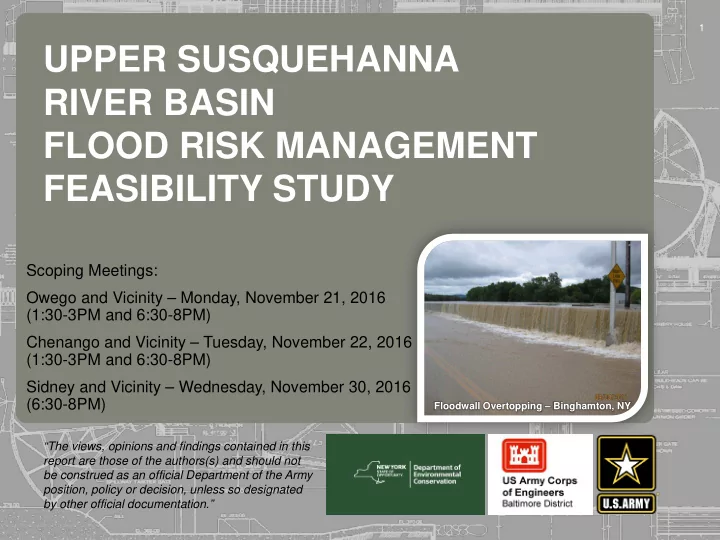
Scoping Meetings: Owego and Vicinity – Monday, November 21, 2016 (1:30-3PM and 6:30-8PM) Chenango and Vicinity – Tuesday, November 22, 2016 (1:30-3PM and 6:30-8PM) Sidney and Vicinity – Wednesday, November 30, 2016 (6:30-8PM)

UPPER SUSQUEHANNA RIVER BASIN FLOOD RISK MANAGEMENT FEASIBILITY STUDY

Floodwall Overtopping – Binghamton, NY 1

slide-2
SLIDE 2

AGENDA

  • Opening remarks and

introductions

  • U.S. Army Corps of Engineers,

Baltimore District

  • New York State Department of

Environmental Conservation

  • Scoping meeting purpose
  • Background and status
  • Overview of the study
  • Study process
  • Study progress
  • Schedule
  • Q&A

Binghamton, NY - Tropical Storm Lee Flooding (September 2011) 2

slide-3
SLIDE 3
  • Scoping meetings held in accordance with the National

Environmental Policy Act, and the purpose of the meeting is to:

  • Obtain public comments and input into the scope of the feasibility study
  • Discuss the study process
  • Discuss the study progress
  • Review study schedule and important dates
  • Discuss flooding problems in the basin

Submit comments via comment cards or email comments and/or photos of flooding, or

  • ther information related to flooding problems, to:

UpperSRBStudy@usace.army.mil

Visit the study webpage at http://www.nab.usace.army.mil/USRB_Feasibility_Study/

SCOPING MEETING PURPOSE

3

slide-4
SLIDE 4

BACKGROUND AND STATUS

  • Flood events of 2006 and 2011 resulted

in study authorization to investigate flood risk

  • Congressional authorization passed in 2008
  • Initial Federal interest determination
  • December 2011
  • Feasibility Study
  • July 2016-July 2019

Binghamton, NY - Tropical Storm Lee Flooding (September 2011) Johnson City, NY - Tropical Storm Lee Flooding (September 2011) Vestal, NY - Tropical Storm Lee Flooding (September 2011) 4

slide-5
SLIDE 5
  • Problem
  • Upper Susquehanna River Basin

in New York represents a flood prone area that repeatedly experiences flooding damages.

  • Purpose
  • Identify and evaluate flood risk to

communities within the Upper Susquehanna River Basin.

  • Goal
  • Identify

flood risk management strategies and alternatives to manage and reduce flood risk, including residual risk in areas with existing flood risk management infrastructure.

OVERVIEW OF THE STUDY

Johnson City, NY - Tropical Storm Lee Flooding (September 2011) Johnson City, NY - Tropical Storm Lee Flooding (September 2011) 5

slide-6
SLIDE 6

LEVEE SAFETY PROGRAM - OVERVIEW

6

slide-7
SLIDE 7
  • Authority from Congress
  • Define Problems, Needs, and

Opportunities

  • Complete an evaluation of the watershed to

screen opportunities to reduce flood risk.

  • Establish Objectives and Constraints
  • Collect Information and Data
  • Characterize existing conditions
  • Flooding mapping
  • Scoping meeting
  • Forecast Future Conditions
  • Identify and Evaluate Strategies,

Measures, and Alternatives

  • Structural
  • Non-structural
  • Compare Alternatives
  • Benefit-Cost Analyses
  • Completeness, Effectiveness, Efficiency, and

Acceptability

  • Select a Plan
  • National Environmental Policy Act draft report

and EIS for public review

STUDY PROCESS

Typical levee Typical floodwall Basement Fill, Addition, and Elevation

Floodproofing (courtesy of climatetechwiki.org)

7

slide-8
SLIDE 8
  • Initial watershed screening for flooding problems (Ongoing)
  • Existing data analyses
  • Scoping meetings
  • Flood analyses (Ongoing)
  • Evaluation of existing flood risk management structures
  • Forecasted future conditions to present possible future scenarios
  • Economics analyses (Planned)
  • Measures screening and initial array of alternatives (Planned)
  • Evaluate and compare alternatives (Planned)
  • Benefit-cost analyses
  • Tentatively selected plan (Planned)
  • Draft Report – public review and comment (Planned)
  • Final Report (Planned)
  • Chief’s Report (Planned)

STUDY PROGRESS

8

slide-9
SLIDE 9

LEVEE SAFETY PROGRAM - ACTIVITIES

  • Routine Activities
  • Inspections for Operations & Maintenance
  • Technical Assistance/Modification

Reviews (federally constructed systems)

  • Screening Level Risk Assessments

(Levee Screenings)

  • Risk Communication
  • Non-Routine Activities
  • Interim Risk Reduction Measures
  • Further Study/Action
  • Flood-fight Training

Routine Inspection in Vestal, NY Joint Flood-fight Training in Kirkwood, NY 9

slide-10
SLIDE 10

MAJOR DELIVERABLES

  • Comprehensive flood modeling
  • Update topographic surveys
  • Environmental Impact Statement and Feasibility Report

Sidney, NY - Flooding at Amphenol Manufacturing Plant 10

slide-11
SLIDE 11

SCHEDULE

  • Next steps:
  • Watershed flood risk screening (Winter 2016)
  • Flooding analyses (Spring 2017)
  • Economics analyses (Spring 2017)
  • Cost estimates (Spring 2017)
  • Initial array of alternatives (Aug 2017)
  • Alternatives analyses (Fall 2017)
  • Tentatively selected plan (Jan 2018)
  • Release of the Draft Report and EIS for public

review (April 2018)

  • Final Report (January 2019)
  • Chief of Engineers Report (July 2019)
  • Congressional authorization (multiple years)
  • Design and Construction (multiple years)

Binghamton, NY - Tropical Storm Lee Flooding (September 2011) 11

slide-12
SLIDE 12

QUESTIONS?

Presenter Contact Information: David W. Robbins – David.W.Robbins@usace.army.mil (410) 962-0685 Planning Division, Baltimore District U.S. Army Corps of Engineers Email comments to UpperSRBStudy@usace.army.mil http://www.nab.usace.army.mil/USRB_Feasibility_Study/

12