Stormwater Action Plan Manager's Report September 24, 2019 Fast - - PowerPoint PPT Presentation

stormwater action plan
SMART_READER_LITE
LIVE PREVIEW

Stormwater Action Plan Manager's Report September 24, 2019 Fast - - PowerPoint PPT Presentation

Stormwater Action Plan Manager's Report September 24, 2019 Fast development in 1940s followed History reasonable stormwater standards for the time. Infrastructure designed at a certain Develop capacity to underground streams, and ment


slide-1
SLIDE 1

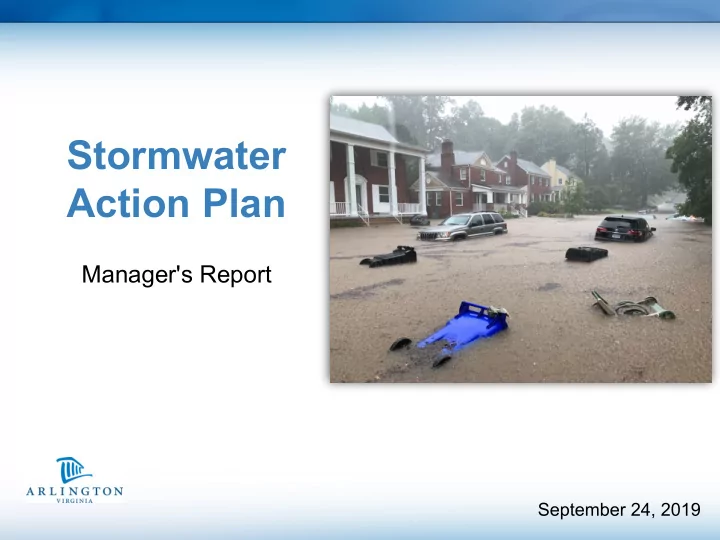
Stormwater Action Plan

Manager's Report

September 24, 2019
slide-2
SLIDE 2

2

Summary Overview

Fast development in 1940s followed reasonable stormwater standards for the time.

History

Infrastructure designed at a certain capacity to underground streams, and lots were built with no overland relief.

Develop ment

Emergence of watershed scale & localized flooding from intense short periods of rainfall.

Recent Trends

Intense storms, coupled with current capacity & limited overland relief, have

  • verwhelmed parts of our stormwater

system.

Result

slide-3
SLIDE 3

3

1920s 1950s

  • Pre 1930s: Arlington was mostly farmland.

Storm drainage was handled privately by

  • landowners. Limited stormwater regulations.
  • 1930-1950: Population tripled due to federal

workforce boom before & after World War II.

  • Stream network initially served as stormwater

management system. 66% of streams were encased in stormwater pipes.

History and Development

1930s: View from Rosslyn

slide-4
SLIDE 4

4

Waverly Hills – Then & Now

  • 1934 aerial shows Waverly Hills was un-developed
  • Stream can be seen prior to development occurring
  • Most development occurred in the early 40’s
  • Right aerial of 2019 shows a lot more development has occurred

Today 1934

slide-5
SLIDE 5

5

Recent Storms & Comparison

  • Impact varies with frequency, duration & rainfall

intensity.

  • 2006, 2018-19: High intensity events caused

significant flooding damage & private property loss.

  • Impact of flashflood event can equal or exceed

historical hurricane event.

Photo from July 8, 2019 flash flood emergency

slide-6
SLIDE 6

6

Flood Damage Calls

Map demonstrates flood calls from the following storms in relation to high risk flooding projects identified in Stormwater Master Plan:

  • July 8, 2019
  • July 25, 2018
  • May 22, 2018
  • June 2006
slide-7
SLIDE 7

7

Where We Are - Stormwater Program

slide-8
SLIDE 8

8

Ongoing Efforts

  • County's first Stormwater Master Plan (SMP) was adopted in 1957

and last updated in 2014. SMP remains appropriate for a long-term, balanced program that is focused on the entire spectrum of stormwater challenges, including:

  • operations and maintenance of existing infrastructure,
  • capital reinvestment and expansion,
  • stormwater quality compliance in the context of the MS4 permit,
  • education and outreach
  • Risk Assessment & Management Project will identify High Risk

Flood Areas based on historic, current & projected storm/rainfall trends, with recommendations for mitigation and adaptation strategies.

  • Other long-term planning efforts that require legal/regulatory

action are being explored.

slide-9
SLIDE 9

9

Flood Resilient Arlington

Given historical data & recent climate trends, Arlington aims to educate & provide direct support to assist those in high risk flood areas. The following are steps in

  • ur communications and
  • utreach plan.
slide-10
SLIDE 10

10

Short-Term Outreach Activities

  • Site visits – visits began in September

– 70 high risk homes (“high risk” is characterized as having received more than 4-feet of water during July 8 storm).

  • Two public forums – October 24 & 26

– experts on flood proof design, flood insurance and installation of floodproof measures

  • Story Map – Fall 2019

– visual presentation on County website to educate public on historical development & present day stormwater challenges

  • CIP & Budget Process Engagement – Fall

2019/Spring 2020

– Opportunity for input in capital improvement plan and budget process via online feedback forums and public hearings

slide-11
SLIDE 11

11

Flood Resilient Arlington How we move forward

Homeowners and Business Perspective:

  • Need to make financial decisions regarding

buying/selling/renovations

  • Would like action from County and when

projects will move forward

slide-12
SLIDE 12

12

FY21-30 CIP Investment Strategy

  • Significant CIP investment:

– Address priority high-risk flooding areas, including watershed-scaled projects – Capital maintenance – Maintain water quality/regulatory programs (MS4 Permit) – Deliver other key planning projects (e.g. Risk Assessment Management Project and Initial Utility Feasibility Study)

slide-13
SLIDE 13

13

Policy Analysis

  • Engineering solutions

– Upgrade storm sewer system – piping solutions – Detention – large tanks for water storage – Detention with pumping – Property acquisition option for overland relief

  • Appropriate balance between government
  • vs. private investment must be part of the

strategy

slide-14
SLIDE 14

14

Public-Private Range of Options

Actions that could have meaningful impact on flooding risk over time (Because the water has to go somewhere)

slide-15
SLIDE 15

15

Public-Private Options to Reduce Contributory Stormwater Runoff

Plant more trees Increase design standards for

  • n-site

homes Multi-parcel review to limit grade change & retaining walls onsite Change lot coverage ratios

More long-term impact

These options manage runoff & accumulation from re/development, not watershed scale challenges

slide-16
SLIDE 16

16

What Homeowners Can Do Now

  • Come to public forums

– Thursday October 24, 6:30-8:30 p.m. at Central Library Auditorium – Saturday, October 26,10 a.m.-12 p.m. at George Mason University Arlington Campus in multi-purpose room

  • Sign up for Arlington Alert
  • Ask insurance agent about flood insurance and about a

sewer backup endorsement to your homeowner’s or renter’s policy

  • Stay involved with budget & CIP engagement

processes