Math 217 - December 6, 2010 Theorem (Frobenius Series) Suppose x = 0 - - PowerPoint PPT Presentation

math 217 december 6 2010 theorem frobenius series
SMART_READER_LITE
LIVE PREVIEW

Math 217 - December 6, 2010 Theorem (Frobenius Series) Suppose x = 0 - - PowerPoint PPT Presentation

Math 217 - December 6, 2010 Theorem (Frobenius Series) Suppose x = 0 is a regular singular point of the equation x 2 y + xp ( x ) y + q ( x ) y = 0 . Let r 1 and r 2 be the roots, r 1 r 2 of the indicial equation r ( r 1) + p 0 r


slide-1
SLIDE 1

Math 217 - December 6, 2010 Theorem (Frobenius Series)

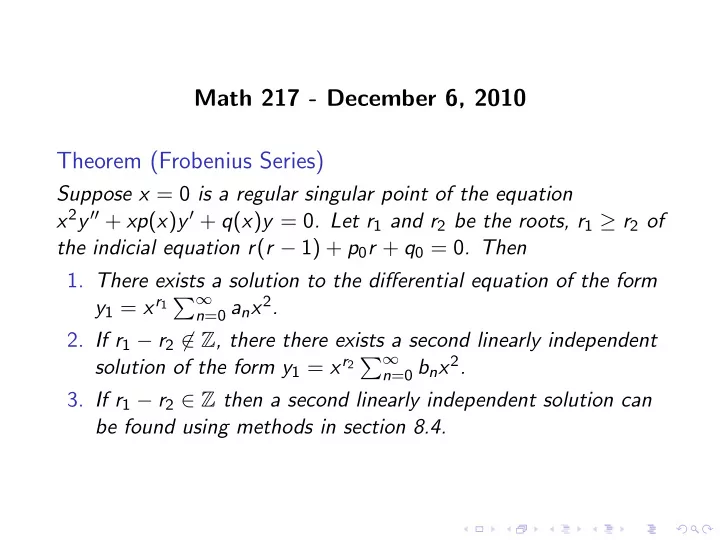
Suppose x = 0 is a regular singular point of the equation x2y′′ + xp(x)y′ + q(x)y = 0. Let r1 and r2 be the roots, r1 ≥ r2 of the indicial equation r(r − 1) + p0r + q0 = 0. Then

  • 1. There exists a solution to the differential equation of the form

y1 = xr1 ∞

n=0 anx2.

  • 2. If r1 − r2 ∈ Z, there there exists a second linearly independent

solution of the form y1 = xr2 ∞

n=0 bnx2.

  • 3. If r1 − r2 ∈ Z then a second linearly independent solution can

be found using methods in section 8.4.

slide-2
SLIDE 2
  • 1. What does the above theorem say about solutions to the

differential equation (sin x)y′′ + 1 x y′ + y = 0

slide-3
SLIDE 3

Lecture Problems

  • 2. Using the root r = −1, find the Frobenius series solution to

2x2y′′ + 3xy′ − (x2 + 1)y = 0

slide-4
SLIDE 4

Lecture Problems

  • 2. Using the root r = −1, find the Frobenius series solution to

2x2y′′ + 3xy′ − (x2 + 1)y = 0 Solution: y = b0x−1

  • 1 + 1

2x2 + 1 40x4 + 1 2160x6 + 1 224640x8 + · · ·

slide-5
SLIDE 5
  • 3. Find a Frobenius solution to

xy′′ + exy = 0

slide-6
SLIDE 6
  • 3. Find a Frobenius solution to

xy′′ + exy = 0 Solution: Roots: 1, 0. y = a0x

  • 1 − 1

2x − 1 12x2 + 1 144x3 + 23 2880x4 + 197 86400x5 + · · · · · ·

slide-7
SLIDE 7
  • 4. Find a Frobenius solution to

4x2y′′ − 4x2y′ + (1 + 2x)y = 0

slide-8
SLIDE 8
  • 4. Find a Frobenius solution to

4x2y′′ − 4x2y′ + (1 + 2x)y = 0 Solution: Roots: 1/2, 1/2. y = x1/2 Side note, a second linearly independent solution is y2 = x1/2

  • ln x +

  • n=1

4nxn n!n