Mastering Techniques of Persuasion Creating the Presentation, - - PowerPoint PPT Presentation

mastering techniques of persuasion
SMART_READER_LITE
LIVE PREVIEW

Mastering Techniques of Persuasion Creating the Presentation, - - PowerPoint PPT Presentation

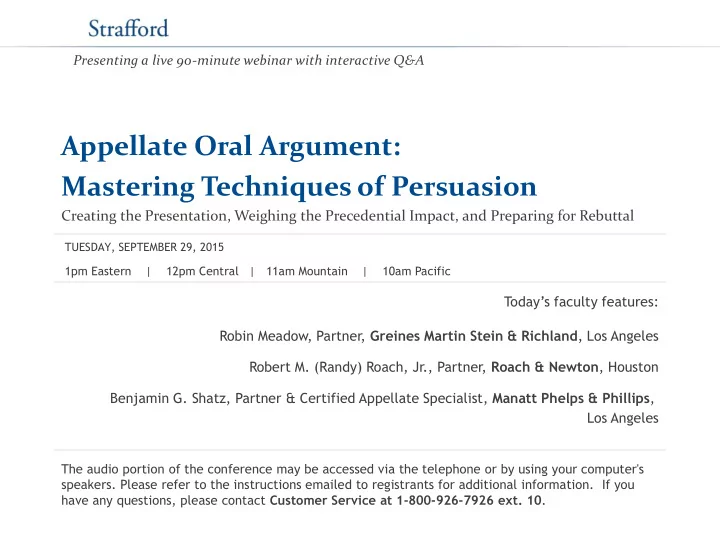
Presenting a live 90-minute webinar with interactive Q&A Appellate Oral Argument: Mastering Techniques of Persuasion Creating the Presentation, Weighing the Precedential Impact, and Preparing for Rebuttal TUESDAY, SEPTEMBER 29, 2015 1pm


slide-1
SLIDE 1

The audio portion of the conference may be accessed via the telephone or by using your computer's

  • speakers. Please refer to the instructions emailed to registrants for additional information. If you

have any questions, please contact Customer Service at 1-800-926-7926 ext. 10.

Presenting a live 90-minute webinar with interactive Q&A

Appellate Oral Argument: Mastering Techniques of Persuasion

Creating the Presentation, Weighing the Precedential Impact, and Preparing for Rebuttal

Today’s faculty features:

1pm Eastern | 12pm Central | 11am Mountain | 10am Pacific TUESDAY, SEPTEMBER 29, 2015

Robin Meadow, Partner, Greines Martin Stein & Richland, Los Angeles Robert M. (Randy) Roach, Jr., Partner, Roach & Newton, Houston Benjamin G. Shatz, Partner & Certified Appellate Specialist, Manatt Phelps & Phillips, Los Angeles

slide-2
SLIDE 2

Tips for Optimal Quality

Sound Quality If you are listening via your computer speakers, please note that the quality

  • f your sound will vary depending on the speed and quality of your internet

connection. If the sound quality is not satisfactory, you may listen via the phone: dial 1-866-961-8499 and enter your PIN when prompted. Otherwise, please send us a chat or e-mail sound@straffordpub.com immediately so we can address the problem. If you dialed in and have any difficulties during the call, press *0 for assistance. Viewing Quality To maximize your screen, press the F11 key on your keyboard. To exit full screen, press the F11 key again.

FOR LIVE EVENT ONLY

slide-3
SLIDE 3

Continuing Education Credits

In order for us to process your continuing education credit, you must confirm your participation in this webinar by completing and submitting the Attendance Affirmation/Evaluation after the webinar. A link to the Attendance Affirmation/Evaluation will be in the thank you email that you will receive immediately following the program. For additional information about continuing education, call us at 1-800-926-7926

  • ext. 35.

FOR LIVE EVENT ONLY

slide-4
SLIDE 4

Program Materials

If you have not printed the conference materials for this program, please complete the following steps:

  • Click on the ^ symbol next to “Conference Materials” in the middle of the left-

hand column on your screen.

  • Click on the tab labeled “Handouts” that appears, and there you will see a

PDF of the slides for today's program.

  • Double click on the PDF and a separate page will open.
  • Print the slides by clicking on the printer icon.

FOR LIVE EVENT ONLY

slide-5
SLIDE 5

Appellate Oral Argument: Mastering Techniques of Persuasion

Presentation and Post-Argument Matters

A live 90-minute CLE webinar with interactive Q&A by Strafford Publications, Inc. Presented by Robin Meadow, Randy Roach, and Benjamin Shatz Tuesday, September 29, 2015, 1:00 p.m. EST Randy Roach rroach@roachnewton.com

slide-6
SLIDE 6
  • I. Purpose of Oral Argument

The primary purpose is to help the Court do its job

  • The Court’s job is to decide cases
  • The Court must choose between two

competing rules of law being proposed as the right holding given the facts

6

slide-7
SLIDE 7
  • I. Purpose of Oral Argument

The primary purpose is not to say what you want to say

  • What you want to say may be irrelevant to

how the Court decides the case

  • Only the Court know how / on what basis it

may decide the case

7

slide-8
SLIDE 8
  • I. Purpose of Oral Argument

What does the Court want in order to do its job?

  • Answers to its questions

 Questions are opportunities to address and

persuade on the issues key to the Court’s deliberations

 Questions are not obstacles to be overcome

  • n the way to making the point the advocate

considers important

8

slide-9
SLIDE 9
  • I. Purpose of Oral Argument

What does the Court want in order to do its job?

  • Answers to its questions

 Questions help you determine (to the best of

your limited ability) what is substantively important to the Court

 Questions are the window into the Court’s

deliberations

9

slide-10
SLIDE 10
  • I. Purpose of Oral Argument

How can you help the Court do its job?

  • By giving the Court the basis for them to

persuade themselves

  • By properly framing the issues
  • By clashing with opponents on the “whys” of

the law

  • By clashing with opponents on the “whats” of

the law in the brief

10

slide-11
SLIDE 11
  • I. Purpose of Oral Argument

How else can you help the Court do its job?

  • By going beyond the briefs
  • Be the master of the record and the law
  • By maximizing your credibility
  • Avoid mistakes that diminish credibility
  • By provoking questions and issues

11

slide-12
SLIDE 12
  • I. Purpose of Oral Argument

What should you avoid doing?

  • Don’t give a prepared speech / oration
  • Don’t regurgitate what the Court already heard

from the brief

  • Don’t just say what’s best for you
  • Don’t just say what’s worst for your opponent
  • Don’t avoid discussing your weaknesses
  • Don’t avoid discussing your opponent’s

strengths

12

slide-13
SLIDE 13
  • I. Purpose of Oral Argument

Who should present argument?

  • Trial counsel? First chair of the appellate

team? Second or more junior chair?

  • Who best knows what the Court wants?
  • Who can best answer the Court’s concerns?
  • Who has the most credibility with the Court?
  • What is the nature of the case?
  • Ultimately, it’s a client call

13

slide-14
SLIDE 14
  • I. Purpose of Oral Argument

Should you ever waive argument?

  • Will it help the Court do its job?
  • As the appellee, do you want to invite further

discussion?

  • Is it cost-effective?

14

slide-15
SLIDE 15

Appellate Oral Argument: Mastering Techniques of Persuasion Preparing for the Argument

Robin Meadow RMeadow@gmsr.com

slide-16
SLIDE 16

OVERARCHING CONSIDERATIONS

  • What questions will the court ask?
  • What two or three points must I try to

get across if I have the opportunity?

  • What is the theme of my argument?

GMSR 16

slide-17
SLIDE 17

PREPARATION TASKS

Timeline

  • Immediately upon calendaring: Begin

updating authorities

  • About two weeks before argument:

Start personal preparation

  • About a week before argument: Hold

moot court/brainstorming session

  • The day before argument: Stop

preparing and give your brain a day’s rest

GMSR 17

slide-18
SLIDE 18

PREPARATION TASKS

Update key legal authorities

  • Have someone Shepardize key

authorities

  • Are the cases still good?
  • Do they lead to any new authority?
  • Consider whether to notify the court of

any post-briefing cases

  • Obligation to advise of directly applicable

cases

  • Otherwise, the only question is whether you

may need to cite the case in argument

GMSR 18

slide-19
SLIDE 19

PREPARATION TASKS

Re-think the case as you go

  • You’re likely to have new insights into

how the court should view the case.

  • This isn’t the same as changing your

core theory of the case, which you generally can’t do at oral argument

  • But what if you conclude you’ve left

something out of your briefs that should be there?

GMSR 19

slide-20
SLIDE 20

PREPARATION TASKS

Start reviewing the case and developing your argument notebook Why have an argument notebook?

GMSR 20

slide-21
SLIDE 21

PREPARATION TASKS

Re-read the briefs argument by argument

  • Study both sides’ key cases
  • Use some technique to help you access

commit key aspects of the cases

  • RM approach: Write up and put in your

notebook a precis with a couple of key facts that will quickly bring the case to memory—"merchandising rights for Roger Rabbit"—and the key holdings

GMSR 21

slide-22
SLIDE 22

PREPARATION TASKS

Review key portions of the record

  • Review and highlight key portions of the

record

  • Decide what portions, if any, you may

want to have in court

  • Don’t even think about taking the entire

record, unless it’s very short

GMSR 22

slide-23
SLIDE 23

PREPARATION TASKS

Review key portions of the record RM approach:

  • Create digital copies of items as you go
  • Assemble them in record-citation order
  • Print them and take them in your

notebook

  • Why not use an iPad or laptop?

GMSR 23

slide-24
SLIDE 24

PREPARATION TASKS

Prepare for questions

  • The fear factor
  • Nervousness is unavoidable; embrace it
  • It will disappear when you stand up to argue
  • The best antidote is to know that you’ve

planned well

  • Never forget that questions are your

friends

GMSR 24

slide-25
SLIDE 25

PREPARATION TASKS

Prepare for questions

  • Will there be a need to explain any

complex legal points?

  • What are the toughest questions the

court might ask?

  • What kind of questions might come from

a judge who doesn’t fully, or correctly, understand the facts or law?

GMSR 25

slide-26
SLIDE 26

PREPARATION TASKS

Prepare for questions RM approach: Write down anticipated questions and formulate answers with record and case citations as needed

GMSR 26

slide-27
SLIDE 27

PREPARATION TASKS

Prepare your must-say points

  • Consider these in light of any new

theme you’ve come up with

  • Carefully prepare your opening
  • A very few words that capture your side of

the case

  • Expect that with a "hot panel," you may not

get to say much

  • But plan for a cold panel, too

GMSR 27

slide-28
SLIDE 28

PREPARATION TASKS

Moot Court/Brainstorming session

  • How formal should it be?
  • Who should be involved?
  • What roles should the participants play?
  • How much time should you spend?

GMSR 28

slide-29
SLIDE 29

PREPARATION TASKS

Moot Court/Brainstorming session RM approach

  • Structure: Role-playing mixed with

brainstorming; no formal present

  • Participants: Client, trial counsel, the

appellate team, and a wild-card player

  • Participants’ role: Questions and

criticism—should not answer questions

  • Time: Until people run out of questions

GMSR 29

slide-30
SLIDE 30

PREPARATION TASKS

Rehearse

  • In the shower, while commuting,

wherever you are

  • Ask yourself questions and speak the

answers to help internalize them

  • Work through any problems and go

through the drill again; write ideas down

  • Goal: Not to memorize, but to have

ready answers for any questions

GMSR 30

slide-31
SLIDE 31

Appellate Oral Argument: Mastering Techniques of Persuasion

Presentation and Post-Argument Matters

Tuesday, September 29, 2015 Benjamin G. Shatz BShatz@Manatt.com

slide-32
SLIDE 32

32

Webinar Overview

Manatt, Phelps & Phillips, LLP

I. Purposes of Oral Argument II. Preparation

III. Presentation IV. Post-Argument Matters

slide-33
SLIDE 33

33

  • III. Presentation of Oral Argument
  • Don’t phone it in!

– Look sharp: appearance and demeanor count – Speak slowly and clearly – Make eye contact; do not read

Manatt, Phelps & Phillips, LLP

slide-34
SLIDE 34

34

  • III. Presentation of Oral Argument (continued)
  • Project confidence and credibility

– Be conversational, not argumentative – Be respectful, courteous, and calm – Be direct; avoid humor and visual aids – Be clear, concise, and focused

  • Emphasize logic and common sense
  • Cite to cases, law, and the record sparingly
  • No jury arguments

– Do not interrupt the court – Do not ask the court questions – Do not stray from the record – Monitor your time – Know when it’s time to sit down

Manatt, Phelps & Phillips, LLP

slide-35
SLIDE 35

35

  • III. Presentation of Oral Argument (continued)
  • Types of questions

– Factual questions – Case law questions

  • “what’s your best case?”

– Policy questions – Standard of review questions – Hypotheticals

  • Don’t fight hypos; know what you can concede
  • If the court asks, it’s important

Manatt, Phelps & Phillips, LLP

slide-36
SLIDE 36

36

  • III. Presentation of Oral Argument (continued)
  • Answering questions

– Listen carefully to the question

  • Don’t miss the softballs
  • Think about how to answer

– Answer the question

  • Answer the question!
  • Do not comment on the question
  • Begin with “yes” or “no”

– Don’t have an answer?

  • Don’t bluff; say so
  • Seek leave to submit a letter

Manatt, Phelps & Phillips, LLP

slide-37
SLIDE 37

37

  • III. Presentation of Oral Argument (continued)
  • Dealing with a cold panel

– Have you already won? – Try to elicit questions

  • As appellant

– Hit key points quickly – Start with your best point – Know how to open and close

Manatt, Phelps & Phillips, LLP

slide-38
SLIDE 38

38

  • III. Presentation of Oral Argument (continued)
  • As respondent/appellee

– Pay close attention – Respond to what you heard – Have you already won? – Correct important misstatements – Adjust your comments to fit the conversation – Know how to close

Manatt, Phelps & Phillips, LLP

slide-39
SLIDE 39

39

  • III. Presentation of Oral Argument (continued)
  • Rebuttal

– Don’t waive it in advance; clearly request it – Waive rebuttal if you don’t need it – Take good notes during argument

  • Rebut; don’t raise new issues

– Be concise; rebut only what is necessary

  • Rifle shots; short; punchy; pointed
  • Correct important misstatements

– Close strongly

Manatt, Phelps & Phillips, LLP

slide-40
SLIDE 40

40

  • IV. Post-Argument Matters
  • Confer with client
  • Supplemental briefing?
  • Calendaring next steps?
  • E-notification and docket monitoring
  • Get & transcribe recording? (Westlaw audio/transcript)
  • Consider complementing opposing counsel?
  • Consider settlement?
  • Learn from the experience to improve

Manatt, Phelps & Phillips, LLP