Appellate Oral Argument: Mastering Techniques of Persuasion - - PowerPoint PPT Presentation

appellate oral argument mastering techniques of persuasion
SMART_READER_LITE
LIVE PREVIEW

Appellate Oral Argument: Mastering Techniques of Persuasion - - PowerPoint PPT Presentation

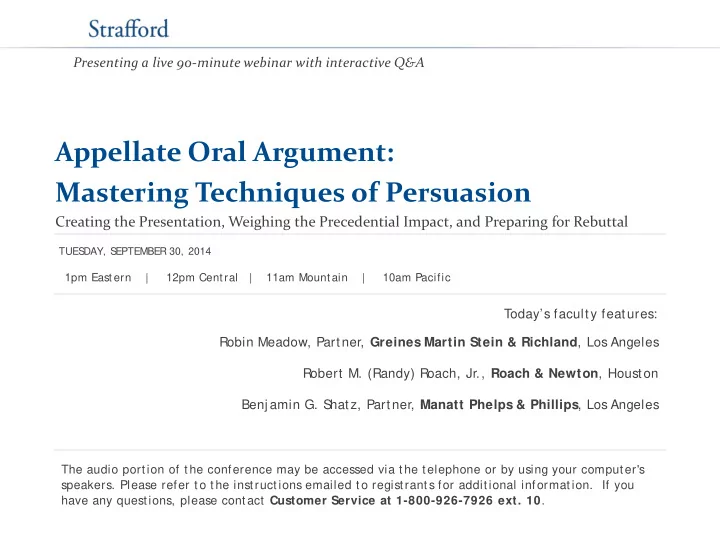
Presenting a live 90-minute webinar with interactive Q&A Appellate Oral Argument: Mastering Techniques of Persuasion Creating the Presentation, Weighing the Precedential Impact, and Preparing for Rebuttal TUES DAY, S EPTEMBER 30, 2014 1pm


slide-1
SLIDE 1

Appellate Oral Argument: Mastering Techniques of Persuasion

Creating the Presentation, Weighing the Precedential Impact, and Preparing for Rebuttal

Today’s faculty features:

1pm East ern | 12pm Cent ral | 11am Mount ain | 10am Pacific

The audio portion of the conference may be accessed via the telephone or by using your computer's

  • speakers. Please refer to the instructions emailed to registrants for additional information. If you

have any questions, please contact Customer Service at 1-800-926-7926 ext. 10.

TUES DAY, S EPTEMBER 30, 2014

Presenting a live 90-minute webinar with interactive Q&A

Robin Meadow, Partner, Greines Martin Stein & Richland, Los Angeles Robert M. (Randy) Roach, Jr., Roach & Newton, Houston Benj amin G. S hatz, Partner, Manatt Phelps & Phillips, Los Angeles

slide-2
SLIDE 2

Tips for Optimal Quality

S

  • und Qualit y

If you are listening via your computer speakers, please note that the quality

  • f your sound will vary depending on the speed and quality of your internet

connection. If the sound quality is not satisfactory, you may listen via the phone: dial 1-866-258-2056 and enter your PIN when prompted. Otherwise, please send us a chat or e-mail sound@ straffordpub.com immediately so we can address the problem. If you dialed in and have any difficulties during the call, press *0 for assistance. Viewing Qualit y To maximize your screen, press the F11 key on your keyboard. To exit full screen, press the F11 key again.

FOR LIVE EVENT ONLY

slide-3
SLIDE 3

Continuing Education Credits

For CLE purposes, please let us know how many people are listening at your location by completing each of the following steps:

  • In the chat box, type (1) your company name and (2) the number of

attendees at your location

  • Click the S

END button beside the box If you have purchased S trafford CLE processing services, you must confirm your participation by completing and submitting an Official Record of Attendance (CLE Form). Y

  • u may obtain your CLE form by going to the program page and selecting the

appropriate form in the PROGRAM MATERIALS box at the top right corner. If you'd like to purchase CLE credit processing, it is available for a fee. For additional information about CLE credit processing, go to our website or call us at 1-800-926-7926 ext. 35.

FOR LIVE EVENT ONLY

slide-4
SLIDE 4

Program Materials

If you have not printed the conference materials for this program, please complete the following steps:

  • Click on the ^ symbol next to “ Conference Materials” in the middle of the left -

hand column on your screen.

  • Click on the tab labeled “ Handouts” that appears, and there you will see a

PDF of the slides for today's program.

  • Double click on the PDF and a separate page will open.
  • Print the slides by clicking on the printer icon.

FOR LIVE EVENT ONLY

slide-5
SLIDE 5

Appellate Oral Argument: Mastering Techniques of Persuasion

Presentation and Post-Argument Matters

A live 90-minute CLE webinar with interactive Q&A by Strafford Publications, Inc. Presented by Robin Meadow, Randy Roach, and Benjamin Shatz Tuesday, September 30, 2014, 10:00-11:30 a.m. PST Randy Roach rroach@roachnewton.com

slide-6
SLIDE 6
  • I. Purpose of Oral Argument

The primary purpose is to help the Court do its job

  • The Court’s job is to decide cases
  • The Court must choose between two

competing rules of law being proposed as the right holding given the facts

6

slide-7
SLIDE 7
  • I. Purpose of Oral Argument

The primary purpose is not to say what you want to say

  • What you want to say may be irrelevant to

how the Court decides the case

  • Only the Court know how / on what basis it

may decide the case

7

slide-8
SLIDE 8
  • I. Purpose of Oral Argument

What does the Court want in order to do its job?

  • Answers to its questions

 Questions are opportunities to address and

persuade on the issues key to the Court’s deliberations

 Questions are not obstacles to be overcome

  • n the way to making the point the advocate

considers important

8

slide-9
SLIDE 9
  • I. Purpose of Oral Argument

What does the Court want in order to do its job?

  • Answers to its questions

 Questions help you determine (to the best of

your limited ability) what is substantively important to the Court

 Questions are the window into the Court’s

deliberations

9

slide-10
SLIDE 10
  • I. Purpose of Oral Argument

How can you help the Court do its job?

  • By giving the Court the basis for them to

persuade themselves

  • By properly framing the issues
  • By clashing with opponents on the “whys” of

the law

  • By clashing with opponents on the “whats” of

the law in the brief

10

slide-11
SLIDE 11
  • I. Purpose of Oral Argument

How else can you help the Court do its job?

  • By going beyond the briefs
  • Be the master of the record and the law
  • By maximizing your credibility
  • Avoid mistakes that diminish credibility
  • By provoking questions and issues

11

slide-12
SLIDE 12
  • I. Purpose of Oral Argument

What should you avoid doing?

  • Don’t give a prepared speech / oration
  • Don’t regurgitate what the Court already heard

from the brief

  • Don’t just say what’s best for you
  • Don’t just say what’s worst for your opponent
  • Don’t avoid discussing your weaknesses
  • Don’t avoid discussing your opponent’s

strengths

12

slide-13
SLIDE 13
  • I. Purpose of Oral Argument

Who should present argument?

  • Trial counsel? First chair of the appellate

team? Second or more junior chair?

  • Who best knows what the Court wants?
  • Who can best answer the Court’s concerns?
  • Who has the most credibility with the Court?
  • What is the nature of the case?
  • Ultimately, it’s a client call

13

slide-14
SLIDE 14
  • I. Purpose of Oral Argument

Should you ever waive argument?

  • Will it help the Court do its job?
  • As the appellee, do you want to invite further

discussion?

  • Is it cost-effective?

14

slide-15
SLIDE 15

Appellate Oral Argument: Mastering Techniques of Persuasion Preparing for the Argument

Robin Meadow RMeadow@gmsr.com

slide-16
SLIDE 16

OVERARCHING CONSIDERATIONS

  • What questions will the court ask?
  • What two or three points must I try to

get across if I have the opportunity?

  • What is the theme of my argument?

GMSR 16

slide-17
SLIDE 17

PREPARATION TASKS

Timeline

  • Immediately upon calendaring: Begin

updating authorities

  • About two weeks before argument:

Start personal preparation

  • About a week before argument: Hold

moot court/brainstorming session

  • The day before argument: Stop

preparing and give your brain a day’s rest

GMSR 17

slide-18
SLIDE 18

PREPARATION TASKS

Update key legal authorities

  • Have someone Shepardize key

authorities

  • Are the cases still good?
  • Do they lead to any new authority?
  • Consider whether to notify the court of

any post-briefing cases

  • Obligation to advise of directly applicable

cases

  • Otherwise, the only question is whether you

may need to cite the case in argument

GMSR 18

slide-19
SLIDE 19

PREPARATION TASKS

Re-think the case as you go

  • You’re likely to have new insights into

how the court should view the case.

  • This isn’t the same as changing your

core theory of the case, which you generally can’t do at oral argument

  • But what if you conclude you’ve left

something out of your briefs that should be there?

GMSR 19

slide-20
SLIDE 20

PREPARATION TASKS

Start reviewing the case and developing your argument notebook Why have an argument notebook?

GMSR 20

slide-21
SLIDE 21

PREPARATION TASKS

Re-read the briefs argument by argument

  • Study both sides’ key cases
  • Use some technique to help you access

commit key aspects of the cases

  • RM approach: Write up and put in your

notebook a precis with a couple of key facts that will quickly bring the case to memory—"merchandising rights for Roger Rabbit"—and the key holdings

GMSR 21

slide-22
SLIDE 22

PREPARATION TASKS

Review key portions of the record

  • Review and highlight key portions of the

record

  • Decide what portions, if any, you may

want to have in court

  • Don’t even think about taking the entire

record, unless it’s very short

GMSR 22

slide-23
SLIDE 23

PREPARATION TASKS

Review key portions of the record RM approach:

  • Create digital copies of items as you go
  • Assemble them in record-citation order
  • Print them and take them in your

notebook

  • Why not use an iPad or laptop?

GMSR 23

slide-24
SLIDE 24

PREPARATION TASKS

Prepare for questions

  • The fear factor
  • Nervousness is unavoidable; embrace it
  • It will disappear when you stand up to argue
  • The best antidote is to know that you’ve

planned well

  • Never forget that questions are your

friends

GMSR 24

slide-25
SLIDE 25

PREPARATION TASKS

Prepare for questions

  • Will there be a need to explain any

complex legal points?

  • What are the toughest questions the

court might ask?

  • What kind of questions might come from

a judge who doesn’t fully, or correctly, understand the facts or law?

GMSR 25

slide-26
SLIDE 26

PREPARATION TASKS

Prepare for questions RM approach: Write down anticipated questions and formulate answers with record and case citations as needed

GMSR 26

slide-27
SLIDE 27

PREPARATION TASKS

Prepare your must-say points

  • Consider these in light of any new

theme you’ve come up with

  • Carefully prepare your opening
  • A very few words that capture your side of

the case

  • Expect that with a "hot panel," you may not

get to say much

  • But plan for a cold panel, too

GMSR 27

slide-28
SLIDE 28

PREPARATION TASKS

Moot Court/Brainstorming session

  • How formal should it be?
  • Who should be involved?
  • What roles should the participants play?
  • How much time should you spend?

GMSR 28

slide-29
SLIDE 29

PREPARATION TASKS

Moot Court/Brainstorming session RM approach

  • Structure: Role-playing mixed with

brainstorming; no formal present

  • Participants: Client, trial counsel, the

appellate team, and a wild-card player

  • Participants’ role: Questions and

criticism—should not answer questions

  • Time: Until people run out of questions

GMSR 29

slide-30
SLIDE 30

PREPARATION TASKS

Rehearse

  • In the shower, while commuting,

wherever you are

  • Ask yourself questions and speak the

answers to help internalize them

  • Work through any problems and go

through the drill again; write ideas down

  • Goal: Not to memorize, but to have

ready answers for any questions

GMSR 30

slide-31
SLIDE 31

Appellate Oral Argum ent: Mastering Techniques of Persuasion

Presenta tion a nd Post-Argum ent Ma tters

A live 90-minute CLE webinar with interactive Q&A by Strafford Publications, Inc. Presented by Robin Meadow, Randy Roach, and Benjamin Shatz Tuesday, September 30, 2014, 10:00 — 11:30 a.m. PST Benjamin G. Shatz BShatz@Manatt.com

slide-32
SLIDE 32

32

Webinar Overview

Manatt, Phelps & Phillips, LLP

I. Purposes of Oral Argument II. Preparation

III. Presentation IV. Post-Argument Matters

slide-33
SLIDE 33

33

  • III. Presentation of Oral Argum ent
  • Don’t phone it in!

– Look sharp: appearance and demeanor count – Speak slowly and clearly – Make eye contact; do not read

Manatt, Phelps & Phillips, LLP

slide-34
SLIDE 34

34

  • III. Presentation of Oral Argum ent (continued)
  • Project confidence and credibility

– Be conversational, not argumentative – Be respectful, courteous, and calm – Be direct; avoid humor and visual aids – Be clear, concise, and focused

  • Emphasize logic and common sense
  • Cite to cases, law, and the record sparingly
  • No jury arguments

– Do not interrupt the court – Do not ask the court questions – Do not stray from the record – Monitor your time – Know when it’s time to sit down

Manatt, Phelps & Phillips, LLP

slide-35
SLIDE 35

35

  • III. Presentation of Oral Argum ent (continued)
  • Types of questions

– Factual questions – Case law questions

  • “what’s your best case?”

– Policy questions – Standard of review questions – Hypotheticals

  • Don’t fight hypos; know what you can concede
  • If the court asks, it’s important

Manatt, Phelps & Phillips, LLP

slide-36
SLIDE 36

36

  • III. Presentation of Oral Argum ent (continued)
  • Answering questions

– Listen carefully to the question

  • Don’t miss the softballs
  • Think about how to answer

– Answer the question

  • Answer the question!
  • Do not comment on the question
  • Begin with “yes” or “no”

– Don’t have an answer?

  • Don’t bluff; say so
  • Seek leave to submit a letter

Manatt, Phelps & Phillips, LLP

slide-37
SLIDE 37

37

  • III. Presentation of Oral Argum ent (continued)
  • Dealing with a cold panel

– Have you already won? – Try to elicit questions

  • As appellant

– Hit key points quickly – Start with your best point – Know how to open and close

Manatt, Phelps & Phillips, LLP

slide-38
SLIDE 38

38

  • III. Presentation of Oral Argum ent (continued)
  • As respondent/appellee

– Pay close attention – Respond to what you heard – Have you already won? – Correct important misstatements – Adjust your comments to fit the conversation – Know how to close

Manatt, Phelps & Phillips, LLP

slide-39
SLIDE 39

39

  • III. Presentation of Oral Argum ent (continued)
  • Rebuttal

– Don’t waive it in advance; clearly request it – Waive rebuttal if you don’t need it – Take good notes during argument

  • Rebut; don’t raise new issues

– Be concise; rebut only what is necessary

  • Rifle shots; short; punchy; pointed
  • Correct important misstatements

– Close strongly

Manatt, Phelps & Phillips, LLP

slide-40
SLIDE 40

40

  • IV. Post-Argum ent Matters
  • Confer with client
  • Supplemental briefing?
  • Calendaring next steps?
  • E-notification and docket monitoring
  • Get & transcribe recording? (Westlaw audio/transcript)
  • Consider complementing opposing counsel?
  • Consider settlement?
  • Learn from the experience to improve

Manatt, Phelps & Phillips, LLP