Management in North Carolina Marine Fisheries Study Committee - - PowerPoint PPT Presentation

management in
SMART_READER_LITE
LIVE PREVIEW

Management in North Carolina Marine Fisheries Study Committee - - PowerPoint PPT Presentation

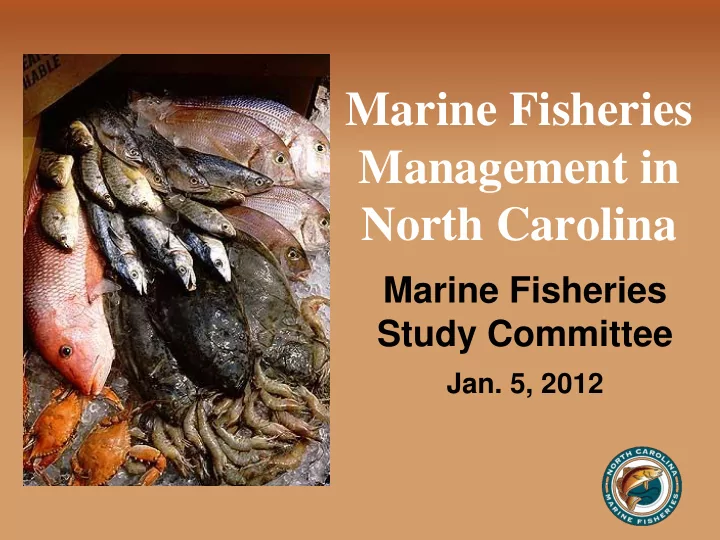
Marine Fisheries Management in North Carolina Marine Fisheries Study Committee Jan. 5, 2012 Total Commercial Landings & Value 250 120 100 200 Dollars (millions) 80 150 Pounds (millions) 60 100 40 50 20 0 0 Pounds Landed


slide-1
SLIDE 1

Marine Fisheries Management in North Carolina

Marine Fisheries Study Committee

  • Jan. 5, 2012
slide-2
SLIDE 2
slide-3
SLIDE 3

Total Commercial Landings & Value

20 40 60 80 100 120 50 100 150 200 250

Dollars (millions)

Pounds Landed Total Ex-vessel Value Total

Pounds (millions)

slide-4
SLIDE 4

Commercial Landings & Value Without Menhaden

Pounds (millions)

20 40 60 80 100 120 50 100 150 200 250

Dollars (millions)

Pounds Landed Without Menhaden Ex-vessel Value Without Menhaden

slide-5
SLIDE 5

5,000,000 10,000,000 15,000,000 20,000,000 25,000,000 30,000,000 35,000,000 40,000,000 Total Catch (harvest and release) Release Harvest

Number of Fish (discards and harvest) Number of Fish (discards and harvest)

Recreational Landings 1989-2010

(number of fish all species)

slide-6
SLIDE 6

Commercial Economic Impact

Year Imports excluded 2009 $267,410,000 2008 $304,923,000 2007 $289,038,000 2006 $464,977,000

slide-7
SLIDE 7

Recreational Economic Impact

Year Includes trip & durable expenditures 2009 $1,785,194,000 2008 $2,291,227,000 2007 $2,295,623,000 2006 $2,515,467,000

slide-8
SLIDE 8

Total Economic Impact

Year Imports excluded 2009 $2,052,604,000 2008 $2,596,150,000 2007 $2,584,661,000 2006 $2,980,444,000

slide-9
SLIDE 9

Fisheries Reform Act of 1997

(GS 143B-289.51)

Management of North Carolina’s coastal fisheries is largely governed by this law, which revamped the state fisheries management process by:

– Restructuring the Marine Fisheries Commission – Mandating Fishery Management Plans for significant species – Requiring the Coastal Habitat Protection Plan – Implementing a new license structure

slide-10
SLIDE 10

Changes to FRA

  • Requirement that fishery management

plans achieve sustainable harvest

  • Requirement that fishery management

plans rebuild overfished stocks within 10 years

  • Coastal Recreational Fishing License

– Not part of the original FRA; it was a key component of the Moratorium Steering Committee recommendation – Created CRFL grant program

slide-11
SLIDE 11

Marine Fisheries Commission

The N.C. Marine Fisheries Commission is a nine-member board, appointed by the governor, to set policy for the management of the state’s marine fisheries.

slide-12
SLIDE 12

MFC Make-up

  • Three commercial fishermen

– One must be a licensed dealer, processor or distributor

  • Three recreational fishermen

– One must be involved with the sports fishing industry

  • Two at-large
  • One fisheries scientist
slide-13
SLIDE 13

Commission Members

Rob Bizzell

Chairman At-large Anna Beckwith At-large Allyn Powell Scientist

Joe Shute

Recreational Industry

Chris Elkins

Recreational Fisherman

Darrell Taylor

Recreational Fisherman

Bradley Styron

Commercial Fisherman

Joseph J. Smith

Commercial Industry

Mikey Daniels

Commercial Fisherman

slide-14
SLIDE 14

MFC Purpose

(G.S. 143B-289.51)

  • Manage, restore, develop, cultivate, conserve,

protect, and regulate the marine and estuarine resources

  • Implement state laws relating to coastal

fisheries by adoption of rules and policies

  • Implement management measures regarding
  • cean and marine fisheries
  • Advise the state regarding marine fisheries

within the jurisdiction of regional and federal boards and councils

slide-15
SLIDE 15

Shortlist of MFC Powers & Duties

(G.S. 143B-289.52)

  • Administer licenses and

regulate time, seasons, size limits, trip limits, fishing methods and fishing gears

  • Provide fair regulation of

commercial and recreational fishing in the public interest

  • Govern mariculture of shellfish

and other marine resources on public grounds

  • Adopt relevant federal laws

and regulations as state rules

  • Close waters to shellfishing for

propagation

  • Delegate to the fisheries

director authority to suspend

  • r implement a particular rule

by proclamation

  • Comment on permit

applications affecting marine resources

  • Adopt fishery management

plans

  • Approve the Coastal Habitat

Protection Plan

  • Establish advisory committees
slide-16
SLIDE 16

The Division of Marine Fisheries is dedicated to ensuring sustainable marine and estuarine fisheries and habitats for the benefit and health

  • f the people of North Carolina.
slide-17
SLIDE 17

N.C. Division of Marine Fisheries

  • State agency responsible for

management of North Carolina’s coastal fisheries

  • Collects and analyzes data necessary

to recommend management actions to the Marine Fisheries Commission

  • Implements rules and policies passed

by the Marine Fisheries Commission

slide-18
SLIDE 18

Division Structure

  • Housed under the N.C. Department of

Environment and Natural Resources

  • Director appointed by the governor

– Works with, but not for the Marine Fisheries Commission

slide-19
SLIDE 19

10 DMF Sections

  • Administration
  • Fisheries

Management

  • Resource

Enhancement

  • Marine Patrol
  • License & Statistics
  • Protected Resources
  • Habitat Protection
  • Shellfish Sanitation

& Recreational Water Quality

  • Administrative

Services

  • Maintenance

Services

slide-20
SLIDE 20

Seven Offices

  • Morehead City – Headquarters
  • Morehead City – Central District
  • Wilmington – Southern District
  • Washington – Pamlico District
  • Elizabeth City – Northern District
  • Manteo – Field Office
  • Nags Head – Shellfish Lab
slide-21
SLIDE 21

324 Positions

Permanent Fulltime 268 Temporary Fulltime 56

slide-22
SLIDE 22

Staff Duties Include:

  • Producing fishery

management plans

  • Selling fishing

licenses and analyzing statistics

  • Researching the

stock status of species and recommending fisheries management actions

  • Educating the public about fisheries issues
  • Monitoring water quality for shellfish harvest and

recreational activities

  • Coordinating with other state, regional and

federal fisheries authorities

slide-23
SLIDE 23

Staff Duties Include:

  • Enforcing fisheries

rules

  • Building oyster

sanctuaries, artificial reefs and other resource enhancement projects

  • Monitoring protected species interactions
  • Reviewing environmental permits
  • Administering Coastal Recreational Fishing

License grants

  • Serve as lead staff for the Coastal Habitat

Protection Plan

slide-24
SLIDE 24

Other Fisheries Agencies

  • N.C. Wildlife Resources Commission

Responsible for inland fisheries management in North Carolina

  • Atlantic States Marine Fisheries

Commission

Federally mandated compact that coordinates fisheries management in state waters between the East Coast states

slide-25
SLIDE 25

Other Fisheries Agencies

  • National Marine Fisheries Service

— Federal agency that regulates ocean waters between three and 200 miles from shore.

  • South Atlantic Fishery Management Council

— Regional council that develop fishery management plans for federal waters, focusing on species primarily associated with waters south of Hatteras

  • Mid-Atlantic Fishery Management Council

— Regional council that develop fishery management plans for federal waters, focusing on species primarily associated with waters north of Hatteras

slide-26
SLIDE 26

Key Philosophy of Fisheries Reform Act

The General Assembly

“recognizes the need to protect

  • ur coastal fishery resources and

to balance the commercial and recreational interests through better management of these resources.”

  • S.L. 1997-400, H.B. 1097
slide-27
SLIDE 27

Old Management

  • Based on hot-

topic issues and emotional

  • utcries
  • No formal

criteria for planning or management decisions

New Management

  • Formal criteria

for planning and management decisions

  • Based on

scientific analysis

  • Structured

system for public input

slide-28
SLIDE 28

FRA Major Impacts

  • Changed commercial licensing structure and

increased license fees

  • Created Recreational Commercial Gear License
  • Reduced size and reorganized Marine Fisheries

Commission

  • Increased law enforcement civil penalties
  • Set up stakeholder committees to advise the

Marine Fisheries Commission

  • Mandated fishery management plans
  • Mandated Coastal Habitat Protection Plan
slide-29
SLIDE 29

Impacts to DMF

Revised the agency’s mission:

“The Division of Marine Fisheries is dedicated to ensuring sustainable marine and estuarine fisheries and habitats for the benefit and health of the people

  • f North Carolina.”
  • Makes management decisions based on sound data and
  • bjective analysis
  • Views public participation as essential for successful

fisheries management

  • Enforces rules fairly and consistently
slide-30
SLIDE 30

Programs Created/Enhanced

  • Coastal Habitat Protection Plan
  • Strategic Habitat Areas

Habitat Protection Section

  • Stock Assessments
  • Fishery Management Plans

Stock Assessment Program

  • Social and Economic Analysis

Socio- Economics Program

slide-31
SLIDE 31

Programs Created/Enhanced

  • Shell recycling
  • Reef construction
  • Sanctuaries

Oyster Restoration

  • New commercial licenses
  • Recreational Commercial Gear

sales partnership with Wildlife Resources Commission

License Programs

  • Data collection for stock

assessments, management plans, Coastal Habitat Protection Plan

Biological Sampling Programs

slide-32
SLIDE 32

Coastal Habitat Protection Plan

  • Recognized that overfishing is not the
  • nly roadblock to sustainable harvest
  • Documented ecological role of aquatic

habitats for coastal fisheries

  • Recommended management changes to

improve coastal fisheries habitats

  • Required multiple agencies and regulatory

boards to work together to improve coastal fisheries habitats

slide-33
SLIDE 33

A Fishery Management Plan is:

A document that guides management

  • f coastal fishery stocks with the

goal of ensuring the long-term sustainability of those stocks

  • Division of Marine Fisheries develops

with the aid of advisory committees

  • Marine Fisheries Commission adopts

plan and management measures

slide-34
SLIDE 34

Fishery Management Plans Include:

  • Stock assessment
  • Characterization of the

fishery

  • Habitat considerations
  • Identified issues &

concerns

  • Management strategies
slide-35
SLIDE 35

Fishery management plans must achieve sustainable harvest within 10 years of adoption of the plan.

G.S. 113-182.1(6)

slide-36
SLIDE 36

Public Input Opportunities

Joint Legislative Commission on Governmental Operations MFC Meetings/Hearings Additional Public Meetings Advisory Committee Meetings

slide-37
SLIDE 37

Current MFC Advisory Committees:

Regional Standing

  • Northeast
  • Southeast
  • Central
  • Inland

Subject Matter

  • Southern Flounder
  • Spotted Seatrout
  • Striped Bass
  • Blue Crab
  • Shrimp
  • Striped Mullet
  • Finfish
  • Shellfish
  • Crustacean
  • Habitat & Water Quality

FMP

  • Strategic Habitat Areas
  • Coastal Recreational

Fishing License

  • Sea Turtle
slide-38
SLIDE 38

N.C. FMPs

  • Southern Flounder
  • Red Drum*
  • Oyster*
  • Hard Clam*
  • Interjurisdictional*
  • Kingfish
  • Bay Scallop*
  • River Herring*
  • Shrimp
  • Blue Crab*
  • Striped Bass
  • Striped Mullet

Completed Blue Crab Amd. 2 Striped Mullet Review Shrimp Review

*Denotes plans that have completed amendments

Spotted Seatrout Southern Flounder Amd. I Striped Bass Amd. I In Progress

slide-39
SLIDE 39

FMP Measures

  • Increased size limit to 14 inches

commercial, 15 inches recreational

  • Implemented gear restrictions to

reduce undersized discards Improvements

  • Reduced fishing mortality
  • Increased spawning stock
  • Improved age structure

Challenges

  • Interactions with protected species
  • Gauging the impact of sea turtle

lawsuit settlement

– 2009 stock assessment shows stock is overfished and

  • verfishing is occurring

Southern Flounder

Completed: February 2005 Amendment: In process Initial Status: Overfished (Depleted) Current Status: Depleted

slide-40
SLIDE 40

Southern Flounder Commercial Landings & Value

$0 $1,000,000 $2,000,000 $3,000,000 $4,000,000 $5,000,000 $6,000,000 $7,000,000 $8,000,000 $9,000,000 1,000,000 2,000,000 3,000,000 4,000,000 5,000,000 6,000,000

Value ($) Pounds

POUNDS VALUE

slide-41
SLIDE 41

200,000 400,000 600,000 800,000 1,000,000 1,200,000 1,400,000 1,600,000

Landings (Number of Fish) Year

Total Catch (release and harvest) Release Harvest

Recreational Southern Flounder Landings

slide-42
SLIDE 42

Red Drum

Completed: March 2001 Amended: November 2008 Initial Status: Overfished Current Status: Recovering FMP Measures

  • Reduced recreational bag limit from

five fish to one

  • Implemented commercial trip limit
  • Prohibited harvest over 27 inches

Improvements

  • Two recent stock assessments show

North Carolina has achieved a stock rebuilding goal set by ASMFC in 2002 − N.C. DMF in 2007 − ASMFC in 2009 Challenges

  • Management of a long-lived,

recovering stock

slide-43
SLIDE 43

Red Drum Commercial Landings and Value

$0 $50,000 $100,000 $150,000 $200,000 $250,000 $300,000 $350,000 $400,000 $450,000 50,000 100,000 150,000 200,000 250,000 300,000 350,000 400,000

Value ($) Pounds

POUNDS VALUE

slide-44
SLIDE 44

100,000 200,000 300,000 400,000 500,000 600,000 700,000 800,000 TOTAL CATCH RELEASED ALIVE HARVEST

Recreational Red Drum Landings

Number of fish

slide-45
SLIDE 45

River Herring

FMP Completed: February 2000 Amended: September 2007 Initial Status: Depleted/Unknown

(Albemarle Sound/Other Waters)

Current Status: Depleted/Unknown

(Albemarle Sound/Other Waters)

FMP Measures

  • No-harvest provision
  • Allows discretionary fishery for

research purposes and to benefit cultural festival

  • Funding for research
  • Designation of Anadromous Fish

Spawning Areas Improvements

  • Research (ASMA)

– Spawning area survey, migration impediment survey, expanded juvenile sampling, commercial pound net survey

Challenges

  • Impacts from closure still unknown
  • Unknown bycatch in ocean

trawl fishery

  • Impediments to spawning

migration

slide-46
SLIDE 46

River Herring Commercial Landings & Value

$0 $50,000 $100,000 $150,000 $200,000 $250,000 200,000 400,000 600,000 800,000 1,000,000 1,200,000 1,400,000 1,600,000 1,800,000 2,000,000

Value ($) Pounds

POUNDS VALUE

slide-47
SLIDE 47

Chowan River Blueback Herring Spawning Stock Biomass

2,000,000 4,000,000 6,000,000 8,000,000 10,000,000 12,000,000 14,000,000 Female Spawning Stock Biomass Target

Pounds

slide-48
SLIDE 48

Interjurisdictional

(27 Species) Completed: September 2002 Amended: June 2008 Initial Status: Varies by Species Current Status: Varies by Species FMP Measures

  • Adopted federal and interstate FMPs

by reference to comply with state law

  • Coordinated state efforts for

participation in federal and interstate FMP processes

  • Set forth public outreach procedures

for federal and interstate issues Improvements

  • Improved public participation
  • Facilitated compliance with federal

regulations Challenges

  • Federal data deficiencies
  • Federal legislation
  • Parity for North Carolina
  • Coordination with state FMPs
slide-49
SLIDE 49

Conclusions

  • The mission of the Division of Marine

Fisheries was developed from statutory requirements in the FRA.

  • Requirements of the FRA have resulted in

management decisions being more deliberative and based on sound data and analysis.

  • Management decisions are made following
  • ne of the most open and public processes

in state government.

slide-50
SLIDE 50

Conclusions

  • The key to successful management under

the FRA is to base management decisions

  • n sound data and analysis.
  • A healthy resource fairly and equitably

benefits all user groups.

slide-51
SLIDE 51
slide-52
SLIDE 52

Equipment

  • One 44-foot

research vessel

  • One 48-foot (ocean-

going) patrol vessel

  • Seven dump trucks
  • 10 frontend loaders
  • One crane
  • Four forklifts
  • Large fleet of cars,

trucks, vessels

  • Three fixed wing

aircraft

  • One 135-foot

landing craft

  • Five self-propelled

barges ranging from 32 feet to 60 feet

slide-53
SLIDE 53

What Does a Stock Assessment Do?

  • Provides past and present stock

status - Is the stock getting bigger or smaller?

  • Makes predictions on a stock’ s

response to management options

slide-54
SLIDE 54

What does age structure tell us?

  • At what age the fish are harvested
  • How long the fish live
  • How many of what age make up the

stock

slide-55
SLIDE 55

Hypothetical Human Population

Unstressed

2 4 6 8 10 12 14 16 18 20 Population (millions) Age

slide-56
SLIDE 56

Stressed

2 4 6 8 10 12 14 16 18 20 Population (millions) Age

slide-57
SLIDE 57

At War

2 4 6 8 10 12 14 16 18 20 Population (millions) Age

slide-58
SLIDE 58

What Is Mortality?

Rate that fish die

  • Fishing mortality = death from fishing

–Landings –Discards

  • Natural mortality = any other death

–Predation –Disease –Environmental –Old age

slide-59
SLIDE 59

Sustainable Resource

$50 Monthly Light Bill

$1,000 Principal (SSB) 5% Interest (F) $50 Earnings (Sustainable Harvest) $800 Principal (Red Tide) 5% Interest $40 Earnings $790 Principal $800 Principal 8% Interest F Rebuilding $64 Earnings $814 Principal

slide-60
SLIDE 60

Uncertainty in Data Projections

Arises from many sources

  • Input data
  • Model assumptions
  • Environmental Influences
  • Model Limitations
slide-61
SLIDE 61