Malawi Tea Revitalization Programme 2020 Working towards a - - PowerPoint PPT Presentation

malawi tea revitalization programme 2020 working towards
SMART_READER_LITE
LIVE PREVIEW

Malawi Tea Revitalization Programme 2020 Working towards a - - PowerPoint PPT Presentation

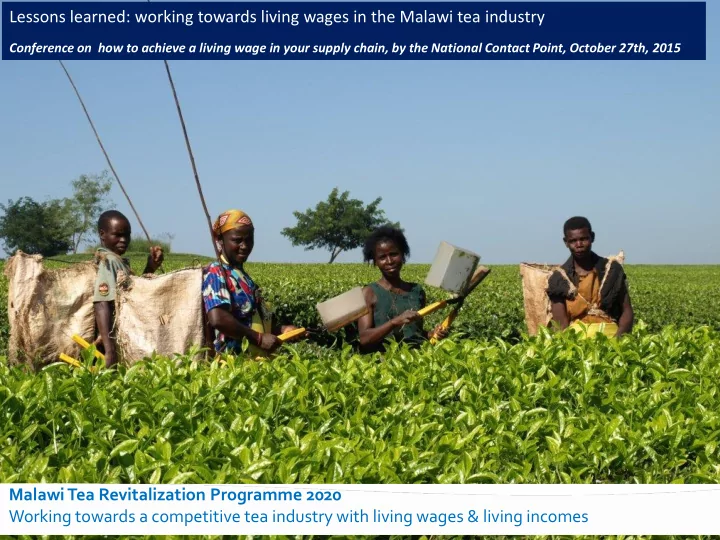
Lessons learned: working towards living wages in the Malawi tea industry Conference on how to achieve a living wage in your supply chain, by the National Contact Point, October 27th, 2015 Malawi Tea Revitalization Programme 2020 Working towards a


slide-1
SLIDE 1

Malawi Tea Revitalization Programme 2020 Working towards a competitive tea industry with living wages & living incomes Lessons learned: working towards living wages in the Malawi tea industry

Conference on how to achieve a living wage in your supply chain, by the National Contact Point, October 27th, 2015

slide-2
SLIDE 2

Steps taken in tea supply chain on living wage

Year Milestone 2007 NGO activism on low wages in the tea industry 2011 Multi-stakeholder collaboration started to understand wages in the tea industry 2013 Report released on ‘understanding wages in the tea industry’; tea industry accepted findings and agreed to take action in Malawi 2014 Living wage benchmark for rural Malawi calculated per Anker methodology; conversations with producers in Malawi intensified; agreement that living wage debate needs to include the competetiveness of the Malawi tea sector. 2015 Supply chain commitment on living wage agreed; Malawi tea revitalization Programme started 2020 Target to reach living wage for tea workers in Malawi

slide-3
SLIDE 3

Supply Chain commitment

slide-4
SLIDE 4

Strengths  Low production costs / break-even point  Relatively high yields  SADC duty advantages  Red colour for certain markets  Cost effective blend component Weaknesses  Low prices  Low perceived quality  Seasonality (reduces quality and capacity utilisation)  Aging tea bushes (replanting is too slow)  Cost of inbound/outbound logistics  Access to and cost of finance  Costs of doing business (utilities, services, spares)  Power outages  Under fertilising Opportunities  Replanting higher yielding/quality clones inc drought tolerance  Better quality leaf from existing bushes  Irrigation to extend growing season and increase yields  Worker productivity inc longer term mechanisation  Revitalisation programme  Smallholder Tea Farmers (yields, quality, incomes)  New markets inc. local sales  Diversification Threats  Reduced customer base due to reputational risks  Changing weather patterns  ‘Imposition’ of unsustainable wages  Extended/more frequent low prices periods  Longer term shortage of labour

Malawi Tea – Competitive Analysis

slide-5
SLIDE 5

Support to industry on HR development (WUSC volunteer?)

Significant progress towards a living wage Healthy, motivated productive workforce with greater opportunities for women Profitable estate sector investing in its future Profitable smallholder sector investing in its future

15 15/16 16/17 17/18 19/20

Thriving Sustainable Tea Industry in Malawi

slide-6
SLIDE 6

Significant progress towards a living wage Healthy, motivated productive workforce with greater opportunities for women Profitable estate sector investing in its future Profitable smallholder sector investing in its future

2015 2016 2017 2018 2019 2020

Thriving Sustainable Tea Industry in Malawi

Costed

  • ptions to

improve nutritional value of midday meal for workers HR assessment Capacity building of unions, employers and government to improve wage setting process and worker representation Assessment of finance

  • ptions to support

clonal replanting and engagement with finance institutions Sustainable procurement commitments voluntarily agreed with interested buyers Support to industry

  • n HR

practices CBA negotiated between workers and employers Living income benchmark developed and strategy for progression towards it Acceleration

  • f replanting

and clonal development Continued investment in quality and factory improvements Engagement with producers, smallholder associations and financial institutions on increased value sharing with smallholders and equity stakes in factories Expansion of Farmer Field Schools to improve yields, and quality, business skills and diversify income Smallholders getting larger share of made tea price through good prices for quality tea and equity stake in production facilities Analysis of options for improving in-kind benefits Introduction of improved meals Links to GIZ Healthcare Programme made Programme to eradicate discrimination and harassment & identify and develop capable female workers Financial training for workers and facilitating access to financial services Skills development programme for workers

Draft Roadmap to date
slide-7
SLIDE 7

Key lessons learned

  • Wages are complicated; not a ‘simple compliance’ issue
  • Need to create a common truth and share ambitions and concerns; wage ladders

and living wage benchmarks help

  • Sector wide collaboration is key; individual projects are not enough. Involve

producers and unions from the start

  • We are talking business, which means that the bottom line should be guaranteed

for producers. Seek opportunities to combine living wage agenda with investment agenda

  • Government and union endorsement is very important; living wage might mean

increased mechanisation, redundancies and unemployment