DOT1L Inhibitor EPZ-5676: Safety and Activity in Relapsed/Refractory - - PowerPoint PPT Presentation

dot1l inhibitor epz 5676 safety and activity in relapsed
SMART_READER_LITE
LIVE PREVIEW

DOT1L Inhibitor EPZ-5676: Safety and Activity in Relapsed/Refractory - - PowerPoint PPT Presentation

DOT1L Inhibitor EPZ-5676: Safety and Activity in Relapsed/Refractory Patients with MLL-Rearranged Leukemia Stein EM, Garcia-Manero, G, Rizzieri DA, Savona MR, Tibes R, Altman JK, Jongen-Lavrencic M, Dhner H, Armstrong S, Pollock RM, Waters NJ,


slide-1
SLIDE 1

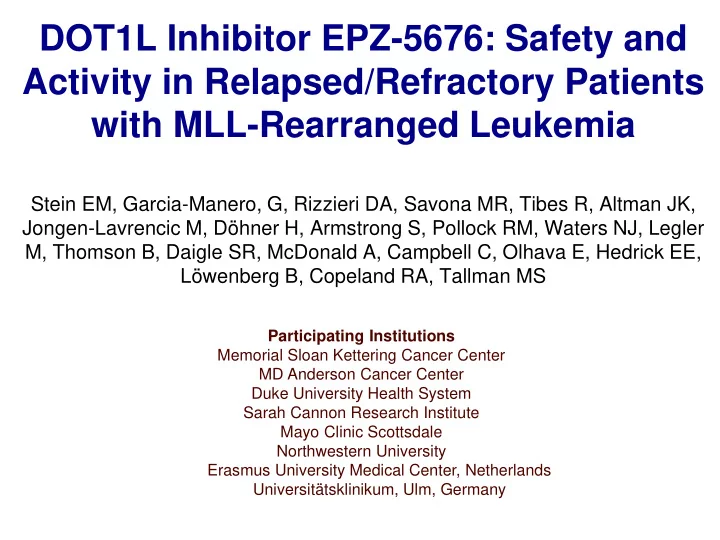
DOT1L Inhibitor EPZ-5676: Safety and Activity in Relapsed/Refractory Patients with MLL-Rearranged Leukemia

Stein EM, Garcia-Manero, G, Rizzieri DA, Savona MR, Tibes R, Altman JK, Jongen-Lavrencic M, Döhner H, Armstrong S, Pollock RM, Waters NJ, Legler M, Thomson B, Daigle SR, McDonald A, Campbell C, Olhava E, Hedrick EE, Löwenberg B, Copeland RA, Tallman MS

Participating Institutions Memorial Sloan Kettering Cancer Center MD Anderson Cancer Center Duke University Health System Sarah Cannon Research Institute Mayo Clinic Scottsdale Northwestern University Erasmus University Medical Center, Netherlands Universitätsklinikum, Ulm, Germany

slide-2
SLIDE 2

2013 Accomplishments

DOT1L Promotes MLL-r Leukemia via Aberrant H3K79 Methylation

No MLL Fusion MLL-Fusion Aberrant gene activation (e.g. HOXA9, MEIS1)

MLL normal

Normal gene expression Aberrant H3K79 methylation Normal H3K79 methylation Leukemogenesis Differentiation

Kristov and Armstrong (2007) Nature Rev Cancer: 823 Kristov et al (2008) Cancer Cell: 355 Courtesy, Dr. P. Ho and Dr. K. Maloney

2

slide-3
SLIDE 3

2013 Accomplishments

EPZ-5676 is a Potent and Highly Selective DOT1L Inhibitor

Biochemical Selectivity

3

10

  • 11

10

  • 10

10

  • 9

10

  • 8

10

  • 7

10

  • 6 > 1.0 X 10
  • 5

SMYD2 SETD7 EZH1 EZH2 EHMT2 WHSC1 SMYD3 PRMT1 PRMT8 CARM1 PRMT5 DOT1L WHSC1L1 EHMT1 PRMT3

Tumor Response in MLL-r MV4-11(AF4) Xenograft EPZ-5676

Daigle et al. (2013) Blood 122: 1017

slide-4
SLIDE 4

2013 Accomplishments

EPZ-5676-12-001 (NCT01684150)

First-in-Human phase 1 study

  • Objectives

– Primary: Determine Maximum Tolerated Dose (MTD) or Recommended Phase 2 Dose (RP2D) with a 21 or 28 day infusion – Secondary: Describe safety, pharmacokinetics & pharmacodynamics

  • Study Design

– Part 1: Dose Escalation

  • 3+3 design
  • Adult patients with advanced hematologic malignancies
  • Initial cohorts not MLL-r restricted

‒ Part 2: Expansion

  • Restricted to MLL-r (translocations and Partial Tandem

Duplications: PTD)

4

slide-5
SLIDE 5

2013 Accomplishments

Definitions

  • Dose Limiting Toxicity DLT (per CTCAE v4.03)

– Occurrence within 28 days of cycle 1 – Grade > 3 non-hematologic clinically significant suspected adverse reaction assessed as:

  • Unrelated to disease progression
  • Inter-current illness or
  • Concomitant medications

– Prolonged (> 42 days) grade 4 neutropenia or thrombocytopenia

  • Maximum Tolerated Dose (MTD)

– Dose level below which > 1 of 3 patients or > 2 of 6 patients experiences a DLT

  • Data cut-off: 6-Oct-2014

5

slide-6
SLIDE 6

2013 Accomplishments

Patient Characteristics

Total patients n=42 (%)

Median age, years (range) 52 (19 to 81 ) Sex Female 17 (40) Disease at study entry ALL AML / MDS MPN (CMML) 6 (14) 34 / 1 (81 / 2) 1 (2) MLL rearrangement t(6;11) t(11;19) PTD t(4;11)

  • ther MLL-r

t(9;11) t(10;11) No MLL rearrangement 8 (19) 8 (19) 5 (12) 4 (10) 4 (10) 3 (7) 2 (5) 8 (19) Prior attempts at remission 1 13 (31) 2 13 (31) 3 10 (24) >4 6 (14) Number of patients with prior allogeneic hematopoietic cell transplants (*one patient with two prior HCTs) 16* (38)

6

slide-7
SLIDE 7

2013 Accomplishments

Drug Exposure and Pharmacokinetics

7

  • Median number of cycles

completed: 2 (range 1 – 7)

  • Median duration of

treatment in weeks: 4.5 (range: 1 – 27)

  • Concentration at steady

state (Css) achieved by 24 hours and AUC dose proportional

– Low total body clearance and short half life (t1/2)

slide-8
SLIDE 8

2013 Accomplishments

8 8 8

Pharmacodynamics

8

  • Evidence of target H3K79me2 inhibition in PBMC
  • bserved at all dose exposures
  • Clinical response and leukocytosis/differentiation

associated with >30% methyl mark reduction

8 8 8

N=23 Leukocytosis or Differentiation Complete Remission Non-responder

slide-9
SLIDE 9

2013 Accomplishments

Safety: Treatment Related Adverse Events

  • Total incidence (all grades): 16 patients (38%)

– 10 patients < grade 2

  • Majority gastrointestinal

– 4 patients with grade 3

  • Leukocytosis (n=3)
  • Anemia (n=1)
  • Dose Limiting Toxicities

– 90 mg/m2/d dose escalation cohort (n=6)

  • None

– 90 mg/m2/d expansion cohort (n=17)

  • Grade 4 reversible cardiac failure with concurrent sepsis
  • Grade 4 reversible hypophosphatemia during rapid WBC drop
  • MTD not reached

9

slide-10
SLIDE 10

2013 Accomplishments

Safety: Most Frequent Adverse Events (≥15%) Regardless of Attribution

10

Adverse event All Grades n=42 (%) Grade ≥3 n=42 (%)

Febrile neutropenia 10 (24) 8 (19) Fatigue 14 (33) 4 (10) Anemia 7 (17) 5 (12) Pneumonia 7 (17) 5 (12) Dyspnea 8 (19) 2 (5) Mucosal inflammation 8 (19) 2 (5) Constipation 10 (24) 1 (2) Fever 10 (24) 1 (2) QTcF prolongation (total n=34) 11 (34) Nausea 13 (31) Peripheral edema 9 (21) Chills 7 (17) Diarrhea 7 (17) Vomiting 7 (17) PR prolongation (total n=34) 5 (15)

slide-11
SLIDE 11

2013 Accomplishments

  • 9 patients (8/34 MLL-r) had either:

– marrow response and/or – resolution of leukemia cutis and/or – leukocytosis or differentiation

11

Clinical Activity

Dose mg/m2/day Number

  • f

patients (n=42) Marrow Response (n=3) Leukemia cutis resolved (n=2) Leukocytosis or Differentiation (n=8)

12 1

  • 24

5

  • 1

36 4

  • 1

2 54 6 2 CR 1 1 80 3

  • 2

90

(28 day CIV)

23 1 PR

  • 2

11

slide-12
SLIDE 12

2013 Accomplishments

Clinical Activity: Marrow Response and Leukemia Cutis

12

Disease MLL-r Dose Response (weeks on study) Extra- medullary Disease MPN (CMML) 01-101 t(11;19) 54 mg/m2/day Cytogenetic CR (27) Resolved leukemia cutis AML 04-401 t(11;19) 54 mg/m2/day Morphologic CR (16*) NA AML 01-105 Other: trisomy 11 90 mg/m2/day PR (12) NA AML 03-300

t(6;11) 36 mg/m2/day

  • (6)

Resolved leukemia cutis

* Off-study for Hematopoietic Cell Transplant

slide-13
SLIDE 13

2013 Accomplishments

Clinical Activity: Resolution of Leukemia Cutis Patient 01-101: CMML, t(11;19) at 54 mg/m2/day

13

Cycle 1 day 1 Cycle 2 day 1 Cycle 3 day 1 Cycle 4 day 1

Courtesy, Dr. Klaus Busum

Cycle 4 day 1

slide-14
SLIDE 14

2013 Accomplishments

Clinical Activity: Leukocytosis and Differentiation Patient 01-103: AML, t(11;19) at 90 mg/m2/day

14

lymphocytes blasts Monocytes 16% Neutrophils 25% Monocytes 14% C1D22 WBC 38.4 X 10⁹/L Neutrophils 47% C2D1 MLL FISH: neutrophil

Rise of absolute monocyte/neutrophil 50% above baseline and above ULN

C1D15 t(11;19) FISH positive neutrophil

Median day of onset: C1D15 (range: 8-28 days)

Baseline WBC 13.2 X 10⁹/L

slide-15
SLIDE 15

2013 Accomplishments

Conclusions and Next Steps

  • Dose escalation through 90 mg/m2/d without reaching

protocol-defined MTD

  • Acceptable safety profile
  • Clinical activity, including CRs and clonal differentiation,
  • bserved in heavily pre-treated MLL-r patients
  • Currently enrolling up to 20 patients at 54 mg/m2/d based
  • n observed clinical responses and clinical activity
  • Molecular characterization of patient samples to identify

patient selection and response biomarkers

– myAML panel – 193 commonly mutated genes in AML – Whole genome RNA-Seq – Pathway analysis

15

slide-16
SLIDE 16

2013 Accomplishments

16

Acknowledgements

We thank the investigators and their teams and most importantly the patients and families who participated in the study.