Case # SH2017-0156 Unmasking of Multiorgan Involvement by Systemic - - PowerPoint PPT Presentation

case sh2017 0156
SMART_READER_LITE
LIVE PREVIEW

Case # SH2017-0156 Unmasking of Multiorgan Involvement by Systemic - - PowerPoint PPT Presentation

2017 Workshop of the Society for Hematopathology/European Association for Haematopathology Molecular Genetics of Hematopoietic Neoplasms Chicago, Illinois Session 4: Genetic Testing in the Diagnosis of Myeloid Neoplasms, Excluding Acute


slide-1
SLIDE 1

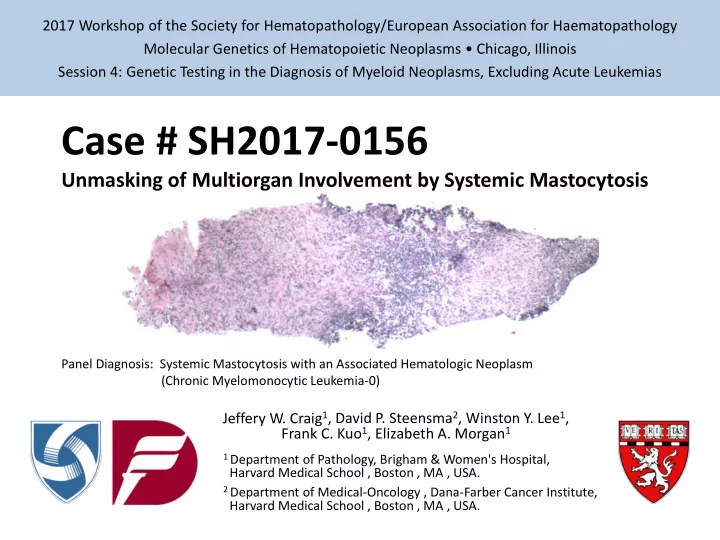
Case # SH2017-0156

Unmasking of Multiorgan Involvement by Systemic Mastocytosis

2017 Workshop of the Society for Hematopathology/European Association for Haematopathology Molecular Genetics of Hematopoietic Neoplasms • Chicago, Illinois Session 4: Genetic Testing in the Diagnosis of Myeloid Neoplasms, Excluding Acute Leukemias Jeffery W. Craig1, David P. Steensma2, Winston Y. Lee1, Frank C. Kuo1, Elizabeth A. Morgan1

1 Department of Pathology, Brigham & Women's Hospital,

Harvard Medical School , Boston , MA , USA.

2 Department of Medical-Oncology , Dana-Farber Cancer Institute,

Harvard Medical School , Boston , MA , USA. Panel Diagnosis: Systemic Mastocytosis with an Associated Hematologic Neoplasm (Chronic Myelomonocytic Leukemia-0)

slide-2
SLIDE 2

Clinical History

  • Presentation: LUQ pain w/ self-palpated splenomegaly, fatigue and weight loss
  • Imaging (CT):
  • Splenomegaly (16.8 cm; no focal lesions)
  • Retroperitoneal adenopathy (≤ 2.6 cm)
  • Abdominal varices (c/w portal hypertension)
  • CBC-Diff: • WBC 10.7 K/uL (H)
  • ANC 5.9 K/uL
  • AMC 2.8 K/uL (H)
  • HCT 35.8 % (L)
  • MCV 90.0 fL
  • PLT 139 K/uL (L)
  • Pathology workup:
  • Bone marrow core biopsy
  • Lymph node core biopsy
  • Liver core biopsy
  • Referred to DFCI for Hematology-Oncology consultation based on the BM findings:

“suspicious for a myeloproliferative neoplasm”

Patient: 72-year-old male, retired physician

  • Labs:
  • ALT 13 U/L
  • AST 18 U/L
  • ALP 519 U/L (H)
  • Tbili

3.9 mg/dL (H)

  • ALB 3.3 g/dL

(L)

  • PT-INR 1.5 (H)
slide-3
SLIDE 3

Microscopic Findings: Bone Marrow Biopsy

Ancillary Studies:

  • Cytogenetics:

46,XY[20]

  • MDS/MPN FISH:

No abnormalities

Preliminary Findings:

  • Markedly hypercellular (90%)
  • Myeloid hyperplasia
  • Megakaryocytic dysplasia
  • Mild reticulin fibrosis
  • No increase in CD34+ blasts
  • No ring sideroblasts
slide-4
SLIDE 4

Molecular Genetic Findings

  • Molecular analysis:
  • Performed on peripheral blood during initial consultation
  • “Rapid Heme Panel” (95-gene NGS assay):
  • Results:
  • Pathogenic Single Nucleotide Variants and Small Insertions/Deletions:
  • ASXL1 NM_015338 c.1926_1927insT p.G642fs* - in 70.6% of 119 reads
  • KIT NM_000222 c.2447A>T p.D816V - in 41.8% of 593 reads
  • TET2 NM_001127208 c.2596C>T p.Q866* - in 45.4% of 1442 reads
  • TET2 NM_001127208 c.3765C>G p.Y1255* - in 46.7% of 302 reads
  • Concurrent CBC-Diff:
  • WBC 6.7 K/uL
  • ANC 2.4 K/uL
  • AMC 2.5 K/uL (H)
  • HCT 35.7 % (L)
  • MCV 95.5 fL
  • PLT 138 K/uL (L)
slide-5
SLIDE 5

Microscopic Findings: Bone Marrow Biopsy

Deeper Levels:

  • Scattered fibrotic foci

containing intermediate-sized cells with elongated nuclei, condensed chromatin, indistinct nucleoli and abundant pale cytoplasm with well-defined cell borders

slide-6
SLIDE 6

Microscopic Findings: Bone Marrow Clot Preparation

Need H&E from clot prep!

Deeper Levels:

  • Large lymphoid aggregate

surrounded by intermediate-sized cells with elongated nuclei, condensed chromatin, indistinct nucleoli and abundant pale cytoplasm with well-defined cell borders

slide-7
SLIDE 7

Immunohistochemistry: Bone Marrow Biopsy/Clot Prep

Mast cell tryptase H&E Mast cell tryptase H&E CD25 KIT CD25 KIT

slide-8
SLIDE 8

Lymph Node Core Biopsy

Mast cell tryptase H&E CD25 KIT

  • Requested for additional evaluation
  • f unexplained lymphadenopathy

following bone marrow workup

  • Outside Interpretation:
  • Flow cytometry: no abnormal

T-cells, polyclonal B-cells

  • Histology: No evidence of

lymphoproliferative disorder

  • r malignancy
  • “Area of irregular fibrosis with

bland spindle cells consistent with myofibroblasts”; “could be reactive in nature”

  • Post-molecular interpretation:
  • SYSTEMIC MASTOCYTOSIS
slide-9
SLIDE 9

Liver Core Biopsy

H&E KIT Mast cell tryptase CD25

  • Requested for additional evaluation of unexplained

cholestatic liver injury and portal hypertension w/ varices & progressive ascites

  • Hepatology workup: Negative serological evaluation

(ANA, LKM, AMA, A1AT, IgG4, HepC, etc.)

  • Outside Interpretation:
  • Chronic biliary tract disease with prominent

portal fibrous expansion, patchy mononuclear cell infiltrates and ductular reaction

  • No granulomas, bile duct inflammation or

concentric periductular fibrosis

  • Differential: primary biliary cirrhosis vs.

sclerosing cholangitis (2° to CMML?)

  • Post-molecular interpretation:
  • SYSTEMIC MASTOCYTOSIS
slide-10
SLIDE 10

Clinical Follow-Up

  • Unifying Diagnosis:
  • Systemic mastocytosis with an associated hematologic neoplasm (SM-AHN)
  • SM component: Aggressive systemic mastocytosis (ASM)
  • AHN component: Chronic myelomonocytic leukemia (CMML-0)
  • Serum tryptase level elevated at 88 ng/mL (ref. <11.5 ng/mL)
  • Treatment:
  • Midostaurin:
  • Multi-kinase inhibitor capable of inhibiting KIT D816V
  • Effective in patients with advanced systemic mastocytosis
  • Initiated October 2016
  • Plan to delay CMML-directed therapy for as long as possible
  • Outcome:
  • “Continuing to get better on a regular basis” per recent clinic note
  • Reduction in ascites and organomegaly
  • Improved appetite with intentional weight gain
  • Increased physical activity level

Patient: 72-year-old male, retired physician

slide-11
SLIDE 11

Diagnostic criteria for Systemic Mastocytosis

(2008 WHO Classification of tumors of hematopoietic and lymphoid tissues)

  • Requires the major criterion and 1 minor criterion OR ≥ 3 minor criteria

Major criterion: Multifocal, dense infiltrates of mast cells (≥15 mast cells in aggregates) detected in sections of bone marrow and/or other extracutaneous organ(s). Minor criteria:

  • 1. In biopsy sections of bone marrow or other extracutaneous organs, >25% of

the mast cells in the infiltrate are spindle-shaped or have atypical morphology

  • r, of all mast cells in bone marrow aspirate smears, >25% are immature or

atypical mast cells.

  • 2. Detection of an activating point mutation at codon 816 of KIT in bone marrow,

blood or another extracutaneous organ.

  • 3. Mast cells in bone marrow, blood or other extracutaneous organs express CD2

and/or CD25 in addition to normal mast cell markers.

  • 4. Serum total tryptase persistently exceeds 20 ng/mL (unless there is an

associated clonal myeloid disorder, in which case this parameter is not valid).

slide-12
SLIDE 12

Systemic Mastocytosis with an Associated Hematologic Neoplasm (SM-AHN)

  • Diagnosis:
  • Requires clear morphologic evidence of :

(1) Systemic mastocytosis (not pure cutaneous mastocytosis) (2) An associated clonal hematologic non-MC lineage disease

  • Associated hematologic neoplasms (AHN) include:
  • Common: MDS, AML, MPN, MDS/MPN (typically CMML)
  • Rare: NHL, PCN
  • Morphology is heterogeneous and largely dependent on the type of AHN
  • May be difficult to establish in specimens where one component

predominates

  • SM may be identified retrospectively following therapy for the AHN
  • 2nd most common subtype of SM (after indolent systemic mastocytosis)
  • True incidence is likely underestimated
slide-13
SLIDE 13

Systemic Mastocytosis with an Associated Hematologic Neoplasm (SM-AHN)

  • Clinical:
  • Presentation and course generally dominated by the AHN
  • Major exception is aggressive systemic mastocytosis, characterized by high

disease burden with organomegaly and organ dysfunction

  • Genetics:
  • KIT mutations, especially KIT D816V, present within the MC component of the

majority of SM-AHN

  • KIT mutations variably present in the non-mast cell component of SM-AHN

(CMML > AML > MPN > LPD)

  • KIT D816V thought to function as a “differentiation inducer” or “phenotype

modulator”, rather than as a strong oncogenic driver

  • Differential Diagnosis:
  • Non-mast cell myelogenous tumors with signs of mast cell differentiation
  • Tryptase-positive AML
  • Myelomastocytic leukemia
slide-14
SLIDE 14

KIT mutations in systemic mastocytosis &

  • ther hematopoietic malignancies
  • Systemic mastocytosis (all subtypes):
  • >90% of cases possess gain-of-function mutations in the KIT proto-oncogene
  • Result in stem cell factor-independent activation of KIT
  • Vast majority are somatic
  • Rare germline mutations associated with familial mastocytosis
  • Majority cluster in exons 11 and 17
  • Mutations in exons 8, 9, and 10 encountered infrequently
  • Hallmark D816V mutation is seen in >80% of cases
  • Affects the second intracellular tyrosine kinase domain (exon 17)
  • D816V is resistant to imatinib
  • Responsive to other kinase inhibitors (e.g. midostaurin)
  • Postulated cell of origin is a pluripotent CD34+ hematopoietic progenitor cell
  • KIT mutations may be confined to mast cells or present within additional

hematopoietic lineages

slide-15
SLIDE 15

KIT mutations in systemic mastocytosis &

  • ther hematopoietic malignancies
  • Other hematopoietic malignancies:
  • KIT mutations are also seen in AML with t(8;21) or inv(16)
  • 20% of core-binding factor AML
  • Impart poor prognosis
  • KIT mutations are rarely reported in other myeloid malignancies (<5%)
  • e.g. MDS, MPN, other acute leukemias
  • Often viewed as a marker of molecular progression
  • Unknown how frequently such mutations represent undetected

involvement by systemic mastocytosis

slide-16
SLIDE 16

Case Considerations

  • PROPOSAL #1:

KIT mutation analysis should be included in the molecular diagnostic workup of all newly diagnosed myeloid neoplasms, in part to assist with the recognition of

  • therwise unsuspected/undetected systemic mastocytosis.
  • PROPOSAL #2:

Additional testing for systemic mastocytosis should be performed in all patients with newly diagnosed myeloid neoplasms harboring KIT mutations (e.g. IHC panel, serum tryptase measurement).

slide-17
SLIDE 17

References

  • 1. Arber DA, Orazi A, Hasserjian R, et al. The 2016 revision to the World Health Organization classification of myeloid neoplasms and acute leukemia. Blood.

2016;127(20):2391-2405.

  • 2. Arock M, Sotlar K, Akin C, et al. KIT mutation analysis in mast cell neoplasms: recommendations of the European Competence Network on Mastocytosis.
  • Leukemia. 2015;29(6):1223-1232.
  • 3. Garcia-Montero AC, Jara-Acevedo M, Teodosio C, et al. KIT mutation in mast cells and other bone marrow hematopoietic cell lineages in systemic mast cell

disorders: a prospective study of the Spanish Network on Mastocytosis (REMA) in a series of 113 patients. Blood. 2006;108(7):2366-2372.

  • 4. Gotlib J, Kluin-Nelemans HC, George TI, et al. Efficacy and Safety of Midostaurin in Advanced Systemic Mastocytosis. N Engl J Med. 2016;374(26):2530-

2541.

  • 5. Jaffe ES, Arber DA, Campo E, Harris NL, Quintanilla-Martinez L. Hematopathology. Second edition. ed. Philadelphia, PA: Elsevier; 2017.
  • 6. Jawhar M, Schwaab J, Meggendorfer M, et al. The clinical and molecular diversity of mast cell leukemia with or without associated hematologic neoplasm.
  • Haematologica. 2017;102(6):1035-1043.
  • 7. Jawhar M, Schwaab J, Schnittger S, et al. Additional mutations in SRSF2, ASXL1 and/or RUNX1 identify a high-risk group of patients with KIT D816V(+)

advanced systemic mastocytosis. Leukemia. 2016;30(1):136-143.

  • 8. Jawhar M, Schwaab J, Schnittger S, et al. Molecular profiling of myeloid progenitor cells in multi-mutated advanced systemic mastocytosis identifies KIT

D816V as a distinct and late event. Leukemia. 2015;29(5):1115-1122.

  • 9. Orfao A, Garcia-Montero AC, Sanchez L, Escribano L, REMA. Recent advances in the understanding of mastocytosis: the role of KIT mutations. Br J
  • Haematol. 2007;138(1):12-30.
  • 10. Pardanani A. Systemic mastocytosis in adults: 2015 update on diagnosis, risk stratification, and management. Am J Hematol. 2015;90(3):250-262.
  • 11. Schwaab J, Schnittger S, Sotlar K, et al. Comprehensive mutational profiling in advanced systemic mastocytosis. Blood. 2013;122(14):2460-2466.
  • 12. Sotlar K, Colak S, Bache A, et al. Variable presence of KITD816V in clonal haematological non-mast cell lineage diseases associated with systemic

mastocytosis (SM-AHNMD). J Pathol. 2010;220(5):586-595.

  • 13. Stoecker MM, Wang E. Systemic mastocytosis with associated clonal hematologic nonmast cell lineage disease: a clinicopathologic review. Arch Pathol

Lab Med. 2012;136(7):832-838.

  • 14. Swerdlow SH, International Agency for Research on Cancer., World Health Organization. WHO classification of tumours of haematopoietic and lymphoid
  • tissues. Lyon, France: International Agency for Research on Cancer; 2008.
  • 15. Valent P, Akin C, Hartmann K, et al. Advances in the Classification and Treatment of Mastocytosis: Current Status and Outlook toward the Future. Cancer
  • Res. 2017;77(6):1261-1270.
  • 16. Verstovsek S. Advanced systemic mastocytosis: the impact of KIT mutations in diagnosis, treatment, and progression. Eur J Haematol. 2013;90(2):89-98.
slide-18
SLIDE 18

Acknowledgements: Afshin Shameli, M.D. Geraldine Pinkus, M.D. Jason Hornick, M.D., Ph.D.

Panel Diagnosis:

Systemic Mastocytosis with an Associated Hematologic Neoplasm (Chronic Myelomonocytic Leukemia-0)