
SLIDE 1
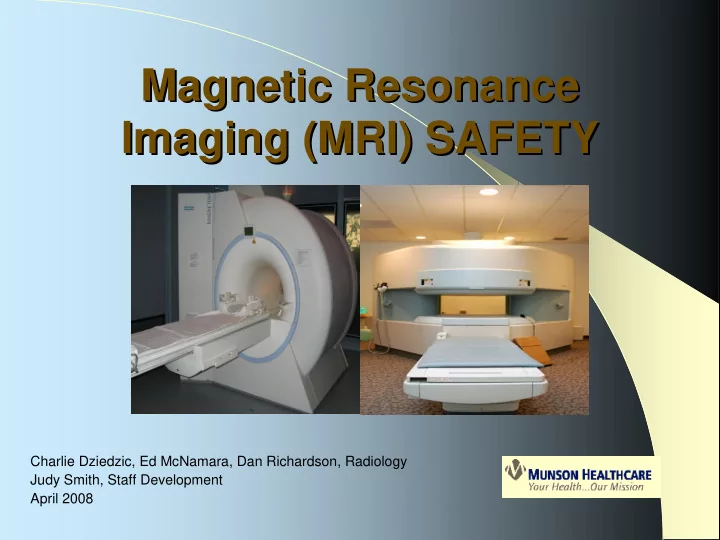
Magnetic Resonance Magnetic Resonance Imaging (MRI) SAFETY Imaging (MRI) SAFETY
Charlie Dziedzic, Ed McNamara, Dan Richardson, Radiology Judy Smith, Staff Development April 2008
Magnetic Resonance Magnetic Resonance Imaging (MRI) SAFETY Imaging - - PowerPoint PPT Presentation
Magnetic Resonance Magnetic Resonance Imaging (MRI) SAFETY Imaging (MRI) SAFETY Charlie Dziedzic, Ed McNamara, Dan Richardson, Radiology Judy Smith, Staff Development April 2008 Goal and Objectives Goal and Objectives Goal This course will
Charlie Dziedzic, Ed McNamara, Dan Richardson, Radiology Judy Smith, Staff Development April 2008
This course will enable the learner to provide a safe environment for patients and staff who are in the presence
1. Describe basic knowledge of magnetic fields and their influence on objects near them. 2. Describe the importance of safety when working around the MRI scanner. 3. Identify precautions that should be taken to avoid accidents when working near the MRI scanner. 4. Identify precautions that should be taken when patients have implantable devices or metallic foreign bodies.
Magnetic resonance imaging (MRI) is a noninvasive, painless medical test that helps physicians diagnose and treat medical conditions by providing views of the inside of the human body. MR imaging uses a powerful magnetic field, radio waves and a computer to produce detailed three-dimensional pictures of internal body structures.
The MRI scanner is a large magnet (10,000 lbs.) with a tremendously strong magnetic
a force field which can affect objects that are close to it. As you approach the MRI scanner, the attractive force field increases rapidly. Most people have had some experience with natural magnets and their attractive forces (e.g., in science classes, by playing with them or by using a magnet to attach papers to a refrigerator door). This strong magnetic field can have adverse effects on patients and staff who are within the scanner’s magnetic force field.
* An object that is attracted by a magnet and which can become magnetized itself.
All MRI magnets have a magnetic field that extends into the exam room. Anyone entering the MRI scanner room will be exposed to the magnetic attraction of the scanner. The closer you get to the scanner, the stronger the magnetic pull. Any ferromagnetic object* brought into the MRI scanner room will become magnetized and can become a… Dangerous Projectile!
The “missile effect” refers to the capability of the MRI magnetic field to attract a ferromagnetic
The “missile effect” can pose a significant risk to a patient in the scanner and to anyone who is in the path of the attracted object. Metal objects can become dangerous projectiles if they are taken into the scan room!
(cont.)
Ferromagnetic metal alloys usually contain iron, nickel or
(cont.)
Delayed patient care…It takes 4 days to remove the
Possible injury to patient or staff. Possible damage to the MRI scanner. Approximate cost due to each “missile effect” incident: $250,000.
(cont.)
(cont.)
(cont.)
Cardiac pacemakers Neurostimulators Pain control pumps Penile implants Cochlear implants
Displacement and heating of these implants may cause a life-threatening situation!
(cont.) Displacement of these implants may cause a life-threatening situation!
(cont.) Mechanically or electrically activated implants may stop or malfunction in the presence of the MRI magnetic field. Patients with pacemakers have died during or shortly after MRI exams due to disruption of pacemaker function by the MRI system. Hospital staff with pacemakers or other implanted electronic devices could also be affected, if they come within the strong magnetic field of the MRI.
(cont.) Risks for these patients include:
Discomfort or painful sensations due to
possible displacement (movement) of the jewelry.
Patient burns due to heat generated from
the interaction between the jewelry and the electromagnetic fields. All patients with body piercing jewelry must be screened for jewelry removal before they have their MRI scan!
Some patients are now wearing trans- dermal patches for medication delivery. Many of these patches contain aluminum foil or other metallic components which can cause excessive heating, leading to burns in patients undergoing a MRI scan. All patients with transdermal patches must be screened for patch removal before they have their MRI scan.
(cont.)
All patients with tattoos must be screened before they have their MRI scan. Many patients scheduled for an MRI scan will present with tattoos. These tattoos will be either cosmetic
anywhere on the body. Some of these tattoos will contain ferromagnetic material which can cause heating, swelling, or burning at the tattoo site.
(cont.)
(cont.)
(cont.)
MR imaging is recognized as a beneficial diagnostic tool to assess a wide range of diseases and conditions that affect pregnant women and their fetuses. MR imaging in pregnant women should
referring physician and radiologist agree that the findings of the MRI has the potential to change or alter the care of the mother or fetus and that the benefit
The Policies, Guidelines, and Recommendations for MRI Imaging, Safety and Patient Management issued by the Safety Committee of the Society for MRI imaging states: “MRI may be used for pregnant women if
inadequate or if the MRI provides important information that would otherwise require exposure to ionizing radiation (CT, fluoroscopy, etc.)”
(cont.)
All pregnant patients must be screened before they have their MRI scan.
Body-piercing jewelry Displacement, Heat Transdermal skin patches Burning Tattoos Burning Aneurysm clips Displacement Stents Displacement Cochlear implants Displacement Penile implants Displacement
All patients must complete the Magnetic Resonance Imaging Information Form before they have an MRI scan. You can access the form on the next page.
(cont.) (cont.)
Contribute page
All patients with a history of injury by a
metallic foreign body must be screened and evaluated before being placed in the magnetic field of an MRI scanner.
Examples of metallic foreign bodies:
(cont.) (cont.)
BBs Bullets Pellets Shrapnel Buckshot Eye or body metal fragments
Information that must be supplied by the
patient, a family member, or by hospital staff for a patient with an implant includes: Make and model of implant Manufacturer of implant Date of implant insertion
Medical Alert Cards: Most people who
get an implant receive a medical alert card stating whether or not the implant is MRI compatible. These cards should be checked by the MRI technologist.
(cont.) (cont.)
Contribute page
Joint Commission. (2008). Preventing accidents and Injuries in the MRI suite [Sentinel Event Alert], 38. Retrieved from http://www.jointcommission.org/SentinelEvents/SentinelEventAlert/sea_38.htm MR Research Facility. (2007). MR Safety. Retrieved March 12, 2008, from http://www.mrc.wayne.edu/safety.htm Gould, Todd. (n.d.). How MRI Works. How Stuff Works. Retrieved March 12, 2008, from http://www.howstuffworks.com/mri.htm Further Questions? Call Ed McNamara in Radiology, 56403