(DTAA) Dr. Nikolaos Melas, PhD Vascular and Endovascular - - PowerPoint PPT Presentation

dtaa
SMART_READER_LITE
LIVE PREVIEW

(DTAA) Dr. Nikolaos Melas, PhD Vascular and Endovascular - - PowerPoint PPT Presentation

ENDOVASCULAR REPAIR OF DESCENDING THORACIC AORTIC ANEURYSMS (DTAA) Dr. Nikolaos Melas, PhD Vascular and Endovascular Surgeon Military Doctor Associate in 1st department of Surgery, Aristotle


slide-1
SLIDE 1

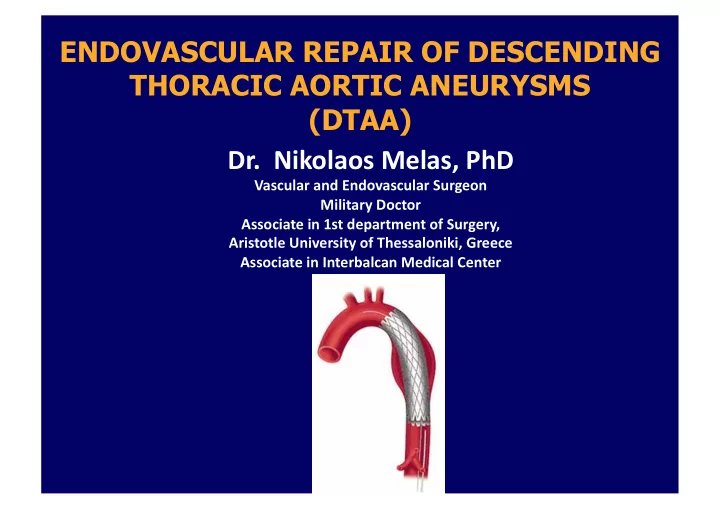
ENDOVASCULAR REPAIR OF DESCENDING THORACIC AORTIC ANEURYSMS (DTAA)

  • Dr. ¡ ¡Nikolaos ¡Melas, ¡PhD

Vascular ¡and ¡Endovascular ¡Surgeon Military ¡Doctor Associate ¡in ¡1st ¡department ¡of ¡Surgery, Aristotle ¡University ¡of ¡Thessaloniki, ¡Greece Associate ¡in ¡Interbalcan ¡Medical ¡Center

slide-2
SLIDE 2

DESCENDING THORACIC AORTIC PATHOLOGIES

  • pose a challenging problem for

cardiovascular surgeons

  • DTAA, dissections, tears, ulcers

potentially morbid entities with an increasing incidence in the latest years.

(1,2,3,4,5)

  • For TAAs is 10 cases per 100,000 people per year
  • 30 - 40 % occurring exclusively in the DTA
  • Aortic dissection is affecting 9000 patients per year in the United States alone.
  • 1. Clouse WD, Hallett JW Jr, Schaff HV, Gayari MM, Ilstrup DM, Melton LJ III. Improved prognosis of thoracic aortic aneurysms: a populationbased study. JAMA 1998;280:1926-9.
  • 2. Bickersta. LK, Pairolero PC, Hollier LH, Melton LJ, Van Peenen HJ, Cherry KJ, et al. Thoracic aortic aneurysms: a population-based study. Surgery 1982;92:1103–8.
  • 3. Crawford ES, Hess KR, Cohen ES, Coselli JS, Sa. HJ. Ruptured aneurysm of the descending thoracic and thoracoabdominal aorta. Ann Surg 1991;213:417–25.
  • 4. Johansson G, Markstrom U, Swedenborg J. Ruptured thoracic aortic aneurysms: a study of incidence and mortality rates. J Vasc Surg 1995;21:985–8.
  • 5. Fann JI, Miller DC. Aortic dissection. Ann Vasc Surg 1995;9:311–23.
slide-3
SLIDE 3

If left untreated, is devastating:

  • expansion
  • rupture
  • vital organ ischemia
  • cardiopulmonary collapse due to blood exsanguination
  • ultimately death

Actuarial 1- and 5-year survivals:

  • for patients with DTA, not operated on, are 60% and 20%, respectively. 1

The annual risk of rupture, dissection, or death (6 cm DTAA) is over 14%. 2

Natural history of descending thoracic aortic aneurysms

  • 1. Kouchoukos NT, Dougenis D. Surgery of the thoracic aorta. N Engl J Med 1997;336:1876–88
  • 2. Elefteriades JA. Natural history of thoracic aortic aneurysms. Ann Thor Surg 2002;74:S1877–80.
slide-4
SLIDE 4

STANDARD TREATMENT

  • open resection and graft interposition (via a left

thoracotomy) after the first successful attempt from DeBakey ME and Cooley MA in 1953. 1,2

  • has been found to improve survival when compared with

medical therapy alone. 3

  • 1. DeBakey ME, Cooley MA. Succesfull resection of aneurysm of thoracic aorta and replacement by graft. De

J Am Med Assoc. 1953 Jun 20;152(8): 673-676 2. DeBakey ME, McCollum CH, Graham JM. Surgical treatment of aneurysms of the descending thoracic aorta: long-term results in 500 patients. J Cardiovasc Surg 1978;19: 571–6.

  • 3. Crawford ES et al. Thoracoabdominal aortic aneurysm: observations regarding the natural course of the
  • disease. J Vasc Surg 1986;3:578–82.
slide-5
SLIDE 5
  • Even with the advent of cardiopulmonary bypass,

profound hypothermia, circulatory arrest, spinal cord protection and ICU support, the results slightly

  • improved. 1-8

RESULTS FROM CONVENTIONAL TREATMENT OF DTAA

(MORBIDITY, MORTALITY AND SURVIVAL)

  • 1. Crawford ES et al. Thoracoabdominal aortic aneurysm: observations regarding the natural course of the disease. J Vasc Surg 1986;3:578–82.
  • 2. DeBakey ME, et al. Surgical treatment of aneurysms of the descending thoracic aorta: long-term results in 500 patients. J Cardiovasc Surg 1978;19: 571–6.
  • 3. Clouse WD, et al. Improved prognosis of thoracic aortic aneurysms: a populationbased study. JAMA 1998;280:1926-9.
  • 4. Coselli JS, et al. Thoracoabdominal aortic aneurysm repair: review and update of current strategies. Ann Thorac Surg 2002;74:S1881–4.
  • 5. Kouchoukos NT, et al. Surgery of the thoracic aorta. N Engl J Med 1997;336:1876–88
  • 6. Safi HJ, et al. Thoracic and thoracoabdominal aneurysm repair using cardiopulmonary bypass, profound hypothermia, and circulator arrest via left side of the

chest incision. J Vasc Surg 1998;28:591–8.

  • 7. Cambria RP, et al. Epidural cooling for spinal cord protection during thoracoabdominal aneurysm repair. J Vasc Surg 2000;31:1093–102.
  • 8. Rectenwald JE, et al. Functional outcome after thoracoabdominal aortic aneurysm repair. J Vasc Surg 2002;35: 640–7.
slide-6
SLIDE 6

ENDOVASCULAR APROACH

  • Advent of endovascular AAA stent-grafts: Parodi in 1991, 1
  • So, Volodos was the pioneer in endovascular treatment of DTA in
  • 1991. 2
  • Soon afterwards Dake et al in 1992 used homemade devices that

combined polyester grafts and modified Gianturco Z-stents with promising results. 3

  • Since then, many studies have shown the technical feasibility and

effectiveness of DTAA endovascular repair, as well as the potential

  • complications. 3-28
  • 1. Parodi JC, et al Transfemoral intraluminal graft implantation for abdominal aortic aneurysms. Ann Vasc Surg 1991;5: 491-9.
  • 2. Volodos NL, et al. Clinical experience of the use of self-fixing synthetic prostheses for remote endoprosthetics of the thoracic and abdominal aorta and iliac arteries through femoral artery and intraoperative endoprosthesis for aortia reconstruction.

Vasa Suppl 1991;33: 93-5.

  • 3. Dake MD, et al. Transluminal placement of endovascular stent-grafts for the treatment of descending thoracic aortic aneurysms. N Engl J Med 1994;331:1729–34.
  • 4. Ehrlich M, et al. Endovascular stent graft repair for aneurysms on the descending thoracic aorta. Ann Thorac Surg 1998;66:19–25.
  • 5. Mitchell RS, et al. Thoracic aortic aneurysm repair with an endovascular stent graft: the ‘‘.rst generation.’’ Ann Thorac Surg 1999;67:1971–4.
  • 6. Temudom T, et al. Endovascular grafts in the treatment of thoracic aortic aneurysms and pseudoaneurysms. Ann Vasc Surg 2000;14:230–8.
  • 7. Grabenwoger M, et al. Thoracic aortic aneurysms: treatment with endovascular self-expandable stent-grafts. Ann Thor Surg 2000;69:441–5.
  • 8. Taylor PR, et al. Thoracic aortic stent grafts—early commercial experience from two centers using commercially available devices. Eur J Vasc Endovasc Surg 2001;22:70–6.
  • 9. Greenberg R, et al. Endovascular repair of descending thoracic aortic aneurysms: an early experience with intermediate-term follow-up. J Vasc Surg 2000;31:147–56.
  • 10. Bortone AS, et al. Endovascular stent-graft treatment for diseases of the descending thoracic aorta. Eur J Cardiovasc Thorac Surg 2001;20:514–9.
  • 11. White RA, et al. Endovascular exclusion of descending thoracic aortic aneurysms and chronic dissections: Initial clinical results with the AneuRx device. J Vasc Surg 2001;33:927–34.
  • 12. Won JY, et al. Elective endovascular treatment of descending thoracic aortic aneurysms and chronic dissections with stentgrafts. J Vasc Interv Radiol 2001;12:575–82.
  • 13. Cambria RP, et al. Evolving experience with thoracic aortic stent graft repair. J Vasc Surg 2002;35:1129–36.
  • 14. Thompson CS, et al. Endoluminal stent grafting of the thoracic aorta: initial experience with the Gore Excluder. J Vasc Surg 2002;35:1163–70.
  • 15. Totaro M, et al. Endoluminal stent grafting of the descending thoracic aorta. Ital Heart J 2002;3:366–9.
  • 16. Najibi S, et al. Endoluminal versus open treatment of descending thoracic aortic aneurysms. J Vasc Surg 2002;36:732–7.
  • 17. Criado FJ, Clark NS, Barnatan MF. Stent graft repair in the aortic arch and descending thoracic aorta: a 4-year experience. J Vasc Surg 2002;36:1121–8.
  • 18. Herold U, et al. Endoluminal stent graft repair for acute and chronic type B aortic dissection and atherosclerotic aneurysm of the thoracic aorta. Eur J Cardiothorac Surg 2002;22:891–7.
  • 19. Chabbert V, et al. Midterm outcomes of thoracic aortic stent-grafts. J Endovasc Ther 2003;10:494–504.
  • 20. Fattori R, et al. Descending thoracic aortic diseases: stent-graft repair. Radiology 2003;229:176–83.
  • 21. Scharrer-Pamler R, et al. Complications after endovascular treatment of thoracic aortic aneurysms. J Endovasc Ther 2003;10:711–8.
  • 22. Lamme B, et al. Endovascular treatment of thoracic aortic pathology. Eur J Vasc Endovasc Surg 2003;25:532–9.
  • 23. Lepore V, et al. Treatment of descending thoracic aneurysms by endovascular stent grafting. J Cardiovasc Surg 203;18: 436–43.
  • 24. Krohg-Sorensen K, et al. Acceptable short-term results after endovascular repair of diseases of the thoracic aorta in high risk patients. Eur J Cardiothorac Surg 2003;24:379–87.
  • 25. Lambrechts D, et al. Endovascular treatment of the descending thoracic aorta. Eur J Vasc Endovasc Surg 2003; 26:437–44.
  • 26. Ellozy SH, et al. Challenges of endovascular tube-graft repair of thoracic aortic aneurysm: midterm follow-up and lessons learned. J Vasc Surg 2003;38:676–83.
  • 27. Czerny M, Cejna M, Hutschala D, Fleck T, Holzenbein T, Schoder M, et al. Stent-graft placement in atherosclerotic descending thoracic aneurysms: midterm results. J Endovasc Ther 2004;11:26–32.
  • 28. Melissano et al. Disappointing results with a new commercially available thoracic endograft. J Vasc Surg 2004;39:124–30.
slide-7
SLIDE 7

ADVANTAGES OF ENDOVASCULAR REPAIR well documented

  • avoidance of major thoracic or thoracoabdominal incisions
  • decreased need for general anesthesia
  • shorter operative time
  • minimal blood lose and need for transfusions
  • lack of aortic crossclamping, avoidance of cardiopulmonary

bypass

  • less postoperative pain
  • shorter hospital and ICU stays and quicker recuperation.
  • 30-day mortality
  • Morbidity
  • paraplegia

especially

slide-8
SLIDE 8

OPEN vs EVAR Open surgery1-10

Centers of excellence

EVAR (DTAA)11-36

All reports (25 Centers)

30-day mortality 8-20% (elective) 60% (ruptured) 10% (0-25%) Morbidity 50% 10 % Paraplegia Up to 8% 0% (only 7 out of 25 reports with

approximately 5% paraplegia).

5–year survival 60-70% To be determined

(equal or increased with K-M analysis)

  • 1. DeBakey ME, et al. J Cardiovasc Surg 1978;19: 571–6.
  • 2. Clouse WD, et al. JAMA 1998;280:1926-9.
  • 3. Svensson LG, et al. J Vasc Surg 1993;17:357–70.
  • 4. Coselli JS, et al. Ann Thorac Surg 2002;74:S1881–4.
  • 5. Kouchoukos NT, Dougenis D. N Engl J Med 1997;336:1876–88
  • 6. Safi HJ, et al. J Vasc Surg 1998;28:591–8.
  • 7. Cambria RP, et al. J Vasc Surg 2000;31:1093–102.
  • 8. Rectenwald JE, et al. J Vasc Surg 2002;35: 640–7.
  • 9. Sa. HJ, et al. Semin Thorac Cardiovasc Surg 1998;10:41–4.
  • 10. Hamilton IN, Hollier LH. Semin Thorac Cardiovasc Surg 1998;10:35–9.
  • 11. Dake MD, et al. N Engl J Med 1994;331:1729–34.
  • 12. Ehrlich M, et al. Ann Thorac Surg 1998;66:19–25.
  • 13. Mitchell RS, et al.’’ Ann Thorac Surg 1999;67:1971–4.
  • 14. Temudom T, et al. Ann Vasc Surg 2000;14:230–8.
  • 15. Grabenwoger M, et al. Ann Thor Surg 2000;69:441–5.
  • 16. Taylor PR, et al. Eur J Vasc Endovasc Surg 2001;22:70–6.
  • 17. Greenberg R, et al. J Vasc Surg 2000;31:147–56.
  • 18. Bortone AS, et al. Eur J Cardiovasc Thorac Surg 2001;20:514–9.
  • 19. White RA, et al. J Vasc Surg 2001;33:927–34.
  • 20. Won JY, et al. J Vasc Interv Radiol 2001;12:575–82.
  • 21. Cambria RP, et al. J Vasc Surg 2002;35:1129–36.
  • 22. Thompson CS, et al. J Vasc Surg 2002;35:1163–70.
  • 23. Totaro M, et al. Ital Heart J 2002;3:366–9.
  • 24. Najibi S, et al. J Vasc Surg 2002;36:732–7.
  • 25. Criado FJ, Clark NS, Barnatan MF. J Vasc Surg 2002;36:1121–8.
  • 26. Herold U, et al. Eur J Cardiothorac Surg 2002;22:891–7.
  • 27. Chabbert V, et al. J Endovasc Ther 2003;10:494–504.
  • 28. Fattori R, et al. Radiology 2003;229:176–83.
  • 29. Scharrer-Pamler R, et al. J Endovasc Ther 2003;10:711–8.
  • 30. Lamme B, et al. Eur J Vasc Endovasc Surg 2003;25:532–9.
  • 31. Lepore V, et al. J Cardiovasc Surg 203;18: 436–43.
  • 32. Krohg-Sorensen K, et al. Eur J Cardiothorac Surg 2003;24:379–87.
  • 33. Lambrechts D, et al. Eur J Vasc Endovasc Surg 2003; 26:437–44.
  • 34. Ellozy SH, et al. J Vasc Surg 2003;38:676–83.
  • 35. Czerny M,, et al. J Endovasc Ther 2004;11:26–32.
  • 36. Melissano et al. J Vasc Surg 2004;39:124–30.
slide-9
SLIDE 9

DISADVANTAGES OF ENDOVASCULAR REPAIR

  • long-term data is still lacking.
  • Endoleak, migration, material fatigue and

sac pressurization are all potential complications of descending thoracic aortic pathology endografting, which should be dealt with caution and special consideration, making strict follow-up mandatory.

slide-10
SLIDE 10

Materials-Methods

Criteria for endovascular repair of descending TAA

(Harbor-UCLA Medical Center. Jason T. Lee, Rodney A. White. Current status of thoracic aortic endograft repair. Surg Clin N Am 84 (2004) 1295–1318)

Number of patients fulfilling the criteria

Descending thoracic aneurysm > 5.5 cm in diameter 4 Aneurysm 4.5–5.5 cm with increase in size by 0.5 cm in last 6 months or twice size normal 1 Symptomatic / ruptured aneurysm 2 / 0 Saccular aneurysm Nonaneurysmal proximal aortic neck > 20 mm in length that measures between 22 and 40 mm (dependent on device availability) 7 No extension of aneurysm into abdominal aorta (distal neck at least 20 mm above celiac) that measures between 22 and 40 mm (dependent on device availability) 7 Patent iliac or femoral arteries that allow introduction of 22–25 F delivery sheath (device dependent) 7 Life expectancy at least 12 months 7 Able to consent for appropriate trials and follow-up protocols 7 Absence of general contraindications for every endovascular procedure: age < 18, allergy to contrast medium, coagulopathy, pregnancy-lactation, creatinine level > 1.7 mg/dl, groin infection and connective tissue disease. 7
slide-11
SLIDE 11

“Endofit” ( Endomed, Phoinix, AZ, USA)

Endoskeleton : bare proximal stent and internal stents made of nitinol The first covered stent is doubled to increase radial force and sealing Fabric : ePTFE in 2 layers that encapsulates the stent skeleton with a thermal process that avoids the need for fixation sutures (no interface of metallic stent with either the blood , the aortic wall or the incoming wires).

slide-12
SLIDE 12

Shape: tubular (30 - 30mm …. 42 - 42mm) or tapered (36 – 24mm …..40 – 24mm) Sheath: hydrophyllum/flexible (maximal trackability through tortuous or calcified iliacs / arch) Package: preloaded or cartridge Deployment : self-expanding device 30-42 mm 30-42 mm 24-42 mm 30-42 mm 22-24 Fr

slide-13
SLIDE 13

PROCEDURE

slide-14
SLIDE 14

Preparation

Both groins and left arm are prepared In a fully image guided OR

slide-15
SLIDE 15

Access

Surgical exposure of right femoral and left brachial artery

slide-16
SLIDE 16

7 Fr sheath Guide wire or Terrumo 260cm

slide-17
SLIDE 17

6 / 7 Fr sheath Guide wire or Terrumo 150cm 6 / 7 Fr Angiographic catheter

slide-18
SLIDE 18
  • 7Fr Angiographic catheter over the guide wire
  • The guide wire is exchanged with a Supra core extra stiff 260cm

wire

17 cm soft and flexible tip, specially designed for thoracic arch trackability and stability

slide-19
SLIDE 19

Initial DSA

External landmarks are set if necessary

slide-20
SLIDE 20

Sheath positioning

An “empty” 22-24Fr Endomed hydrophyllum sheath with dialator over the supra core wire and advanced proximally to the desired position

Simultaneous DSA assists positioning

slide-21
SLIDE 21

Graft loading

The Endofit graft comes in a simple cartridge which is loaded over the wire in the sheath and advanced proximally with the “pusher” (dilator upside down) pusher

slide-22
SLIDE 22

Graft deployment

Simultaneous DSA assists accurate deployment The pusher is held still The sheath is withdrawn BP sould remain 80-90 mmHg during deployment

slide-23
SLIDE 23

If a second graft is needed

  • Another DSA is performed through the 7 Fr angio catheter which is inserted

via the valve of the endomed sheath

  • New landmarks are set
  • And the second graft is delivered and deployed with the same manner
slide-24
SLIDE 24

Completion DSA

Absence of proximal endoleak Absence of distal endoleak

slide-25
SLIDE 25

Endoleak type I distal (1st month), repaired with an extension

Preop Ct 1st month PO Ct angio 6th month PO Ct angio

slide-26
SLIDE 26

Frame kinking at the proximal bare stent / Surveillance Preoperative and postoperative plain chest radiogram. No graft migration was

  • identified. On the contrary the proximal bare stent was slightly kinked,

probably because of the arch morphology, causing no further complications.

slide-27
SLIDE 27

A-B fistula

slide-28
SLIDE 28

Comparison to other cohorts

100% 0% 10-15% 10% 10%