Aortic Syndromes Aortic Aneurysm Aortic Dissection Intramural - - PDF document

aortic syndromes
SMART_READER_LITE
LIVE PREVIEW

Aortic Syndromes Aortic Aneurysm Aortic Dissection Intramural - - PDF document

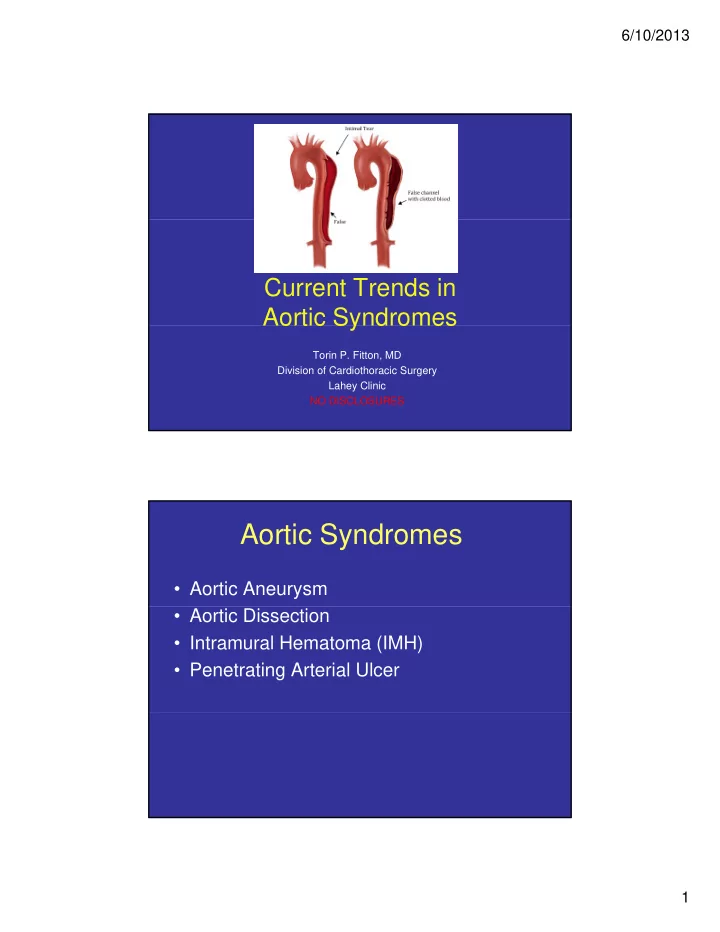
6/10/2013 Current Trends in Aortic Syndromes Aortic Syndromes Torin P. Fitton, MD Division of Cardiothoracic Surgery Lahey Clinic NO DISCLOSURES Aortic Syndromes Aortic Aneurysm Aortic Dissection Intramural Hematoma (IMH)


slide-1
SLIDE 1

6/10/2013 1

Current Trends in Aortic Syndromes Aortic Syndromes

Torin P. Fitton, MD Division of Cardiothoracic Surgery Lahey Clinic NO DISCLOSURES

  • Aortic Aneurysm

Aortic Syndromes

  • Aortic Dissection
  • Intramural Hematoma (IMH)
  • Penetrating Arterial Ulcer
slide-2
SLIDE 2

6/10/2013 2

Objectives

  • Spectrum of Aortic Syndromes

Hi t i l Mil t

  • Historical Milestones
  • Risk Factors & Epidemiology
  • Aortic Imaging Modalities
  • Classification Schema
  • Operative Techniques & Outcomes
  • Operative Techniques & Outcomes
  • Endovascular Repair [TEVAR]

Historical Milestones

  • 1760 Nicholls autopsy of King George II reveals intimal tear & aortic

wall hematoma after he collapsed while straining on a commode

  • 1761 Morgagni coins term ‘aortic dissection’

1761 Morgagni coins term aortic dissection

  • 1930 Erdheim describes histologic changes-cystic medionecrosis
  • 1935 Gurin attempts repair by fenestrating iliac artery
  • 1948 Contrast angiography introduced for diagnosis
  • 1955 DeBakey surgically treats patients with primary repair
  • 1956 Cooley & DeBakey: Cardiopulmonary bypass with selective

anterior cerebral perfusion used (mainstay of contemporary aortic surgery) g y)

  • 1965 DeBakey classification schema;
  • 1965 Wheat medical treatment to decrease bp & wall stress (dp/dt)
  • 1975 Griepp uses hypothermic circulatory arrest
  • 1990 Endovascular stents
slide-3
SLIDE 3

6/10/2013 3

There is no disease more conducive to conducive to clinical humility than aneurysm

  • f the aorta.

Sir William Osler

Risk Factors for Aortic Syndromes

  • Connective Tissue Disorders

– Marfan Syndrome – Ehlers-Danlos Syndrome – Loeys-Dietz Syndrome Loeys Dietz Syndrome

  • Degenerative

– Atherosclerosis/Hypertensive – Cystic Medial Necrosis

  • Congenital

– Bicupsid Aortic Valve/Ascending Aortopathy – Coarctation of the Aorta

  • Inflammatory
  • Inflammatory

– Arteritis/Vasculitis – Bacterial/Syphylitic

  • Familial predisposition Aneurysm/Dissection
  • Aortic Dissection
slide-4
SLIDE 4

6/10/2013 4

Epidemiology of Thoracic Aortic Aneurysms

  • 30-60,000 deaths/year

th

  • 18th most common cause of

death (more than HIV)

  • Frequency increasing
  • Circadian-Diurnal variation
  • Exact prevalence unknown
  • Anterior MI
  • Sudden cardiac death

Epidemiology of Aortic Dissections

  • Estimated 2.6-3.5/100,000

patient years

  • IRAD Database:
  • Mean age 63
  • 2:1 male predominance
  • Older patients: 72% have

HTN, atherosclerosis, or previous heart surgery previous heart surgery

  • Younger patients have

Marfan’s or bicupsid AoV

Tsai et al, Circulation 2005

slide-5
SLIDE 5

6/10/2013 5

Criteria for Intervention on the Diseased Aorta Diagnosis of Aortic Syndromes

  • Poor prognosis after dissection/rupture mandates

intervention before it occurs

  • Biomarker identifying risk/presence of aortic syndromes

would help differentiate chest pain syndromes with would help differentiate chest pain syndromes with different management

  • Matrix metallo-proteinases
  • Circulating smooth muscle myosin chain
  • Inflammatory markers: CRP, fibrinogen, elastin

fragments fragments

  • Ribonucleic acid signatures
  • Currently no available, reliable biomarker assay

Elefteriades et al, J Am Coll Cardiol 2010

slide-6
SLIDE 6

6/10/2013 6

Annual Rates of Complications Related to Aortic Size

Elefteriades et al, J Am Coll Cardiol 2010

Hinge Points Defining Lifetime Risks

Elefteriades et al, J Am Coll Cardiol 2010

Size best criteria determining intervention Imaging most reliable diagnostic tool

slide-7
SLIDE 7

6/10/2013 7

Aortic Imaging Modalities

Goals of Aortic Imaging

  • Confirmation of Diagnosis

Confirmation of Diagnosis

  • Classification
  • Tear localization & extent

(dissection)

  • Indicators of Emergency
  • Pericardial/Mediastinal/

Pleural hemorrhage g

  • Arch & Side-branch

involvement

Aortic Imaging Modalities

  • Each imaging modality is

t f ifi ti accurate for a specific portion

  • f aorta
  • Need multiple modalities
  • Compare images versus all

previous images

  • Changes < 3 mm imperceptible
  • Changes < 3 mm imperceptible

because aorta is dynamic structure

slide-8
SLIDE 8

6/10/2013 8

Echocardiography

  • Available
  • Crisp images
  • Aortic root to STJ
  • Assess for AI,

tamponade, LV fxn

  • TEE better for arch,

prox desc Ao

Computed Tomography

Widely available Excellent for distal ascending aorta, arch & head vessels, descending thoracic & abdominal aorta Axial cuts at root/valve level make measurement difficult

slide-9
SLIDE 9

6/10/2013 9

Computed Tomography/M2S

CT Axial Coronal & Saggital CT Axial, Coronal & Saggital cuts facilitate 3-D reconstruction using specialized operative planning software

MRI

  • Beautiful images
  • Highly accurate
  • Limited availability,

especially in emergencies

slide-10
SLIDE 10

6/10/2013 10

Indications for Operative Intervention Operative Indications For Ascending & Arch Aorta

  • Size >5.5 cm atherosclerotic, degenerative or

hypertensive aneurysms hypertensive aneurysms

  • Size >5.0 cm with bicupsid aortic valve,

connective tissue disorder, familial history of aneurysms/dissection

  • Enlargement >0.5cm/6-12 months

S t ti A ti V l R it ti

  • Symptomatic Aortic Valve Regurgitation
slide-11
SLIDE 11

6/10/2013 11

Operative Indications for Descending Aorta

  • Size greater than 6.0 cm

>5 5 ti ti di d f ili l

  • >5.5 cm connective tissue disorders, familial

history aneurysm/dissection

Median size 5.4 cm in Type B dissection as indication is usually aneursymal enlargment of false lumen

  • Enlargement > 0.5 cm/6-12 months

S t ti

  • Symptomatic aneurysm

– Persistent pain, rupture, visceral

malperfusion,

Operative Indications for Aortic Dissections

Tsai et al, Circulation 2005

slide-12
SLIDE 12

6/10/2013 12

Aortic Syndrome y Classification Schema

Aortic Dissection Classification

  • Classification

– Multiple systems p y – All based on location of intimal tear – DeBakey & Stanford classifications used most frequently – Stanford A:

  • Any dissection involving

ascending aorta no matter ascending aorta no matter primary tear

– Stanford B:

  • Dissection involves only the

descending aorta

slide-13
SLIDE 13

6/10/2013 13

Crawford Classification

Extent Origin and Location I

Distal to L SCA to above renal arteries

II

Distal to L SCA to below renal arteries

III

6th IC space to below renal arteries 12th IC space to iliac bifurcation

IV

12th IC space to iliac bifurcation

V

Below 6th IC space to above the renal arteries

Penetrating Arterial Ulcers Intramural Hematoma

Advanced imaging g g has defined precursors to aortic dissection/rupture Likely all part of a continuum

Tsai et al, Circulation 2005

slide-14
SLIDE 14

6/10/2013 14

Intramural Hematoma

  • Collection of blood within the wall
  • f the aorta without an identified
  • f the aorta without an identified

intimal tear

  • Proposed pathology:

– Vasovasorum rupture/aortic media abnormality – Continuum of aortic dissection: noncommunicating aortic dissection with thrombosed false lumen

Penetrating Arterial Ulcer

  • Deep ulceration of

atherosclerotic plaques can lead to: – IMH – Aortic Dissection – Perforation – Pseudoaneurysm

  • Treatment of IMH/PAU based
  • n aortic dissection

classification

slide-15
SLIDE 15

6/10/2013 15

Operative Techniques p q and Outcomes

Pioneers of Aneurysm & Dissection Surgery

Operative Mortality 60%

Cooley DA, DeBakey ME JAMA 1956; 162:1158

60%

slide-16
SLIDE 16

6/10/2013 16

Era of Era of Modern

Modern Aneurysm Surgery

Aneurysm Surgery Bentall-Bono Procedure

Composite AVR

  • Aortic Valve
  • Coronary button (Bono

modification)

  • Asc Ao Graft
slide-17
SLIDE 17

6/10/2013 17

2 Pages 3 Fig

1 Ref

Cabrol Modification

slide-18
SLIDE 18

6/10/2013 18

Ascending Aorta and Hemiarch Replacement Total Arch and Elephant Trunk Replacement

slide-19
SLIDE 19

6/10/2013 19

Valve-sparing Aortic Root Replacement

Reimplantation (David) Remodeling (Yacoub)

Repair of Type B Dissection Thoracoabdominal Aneurysm

slide-20
SLIDE 20

6/10/2013 20

Outcomes of Aortic Dissection

  • Operative mortality

– Type A: 7 -12% – Type B: 35-75%

  • Surgical Long-term Survival

– 1, 5, 10, 15 year

  • Type A: 67%, 55%, 37%, &

24%

  • Type B: 56%, 48%, 29%, &

11% M di l L t S i l

  • Medical Long-term Survival
  • Type B: 73%, 58%

– no significant survival difference versus surgical therapy Tsai et al, Circulation 2005

T horacic E ndo- V ascular A neurysm R epair p

slide-21
SLIDE 21

6/10/2013 21

Endovascular Repair

  • Appealing alternative option given
  • pen repair mortality 35-75%
  • Many of those dying in medical

therapy arm did die from complications of the dissection

  • Goals of Endovascular Repair
  • Reconstruction of segment

containing entry tear

  • Induction of thrombosis of

false lumen

  • Reestablishment of true lumen

and side-branch flow

Endovascular Devices

MEDTRONIC TALENT GORE TAG COOK TX2

Stanford Device

slide-22
SLIDE 22

6/10/2013 22

Five-Year Results of Endovascular Treatment with the Gore TAG Device Compared with Open Repair of Thoracic Aortic Aneurysms

TEVAR Open

O ti M t lit 2 1% 11 7% Operative Mortality 5-year Survival Paraplegia/Paraparesis Stroke Major Adverse Events (MAE)

Vascular complications Endoleaks

2.1% 68% 2.8% 3.5% 28% 14% 10 6% 11.7% 67% 13.8% 4.3% 70% 4%

  • LOS

Return to Activity 10.6% 5-7 days 30 days 14-26 days 8 months

Makaroun et al, J Vasc Surg 2008

Endoleaks

I Leak at attachment site A Proximal end II III B Distal end C Iliac occlusion site Flow from patent branch vessels A Simple (1 branch) B Complex (> 2 branches) Graft Defect IV V

A Leak at junction or disconnect of graft B Graft disruption

Graft Wall porosity Endotension (aneurysm expansion-no endoleaks)
slide-23
SLIDE 23

6/10/2013 23

Randomized Comparison of Strategies for Type B: Aortic Dissection: Investigation of STEnt Grafts in Aortic Dissection Trial [INSTEAD]

  • Role of TEVAR in

improving outcomes of improving outcomes of uncomplicated Type B dissection unknown

  • Persistent false-lumen

perfusion is a risk factor for adverse

  • utcomes
  • utcomes
  • Uncomplicated chronic

Type B aortic dissections

Nienaber et al., Circulation 2009

Randomized Comparison of Strategies for Type B: Aortic Dissection: Investigation of STEnt Grafts in Aortic Dissection Trial

  • End-points

All t lit – All-cause mortality at 2 years – Aorta-related death – Progressive aortic th l pathology

  • Additional

surgery

slide-24
SLIDE 24

6/10/2013 24

Randomized Comparison of Strategies for Type B: Aortic Dissection: Investigation of STEnt Grafts in Aortic Dissection Trial

  • No significant difference

in mortality at 2 years N diff i t

  • No difference in aorta-

related mortality

  • Significant decreases in

false-lumen diameter and rates of false – lumen thrombosis Randomized Comparison of Strategies for Type B: Aortic Dissection: Investigation of STEnt Grafts in Aortic Dissection Trial

  • Endovascular therapy failed to improve 2-year

py p y survival rate

– Spinal injury complication: 2.8% v 15%

  • TEVAR definitely influences aortic remodeling

– Study underpowered to evaluate mortality end-point – Mortality benefits not likely to be seen at 2 years – Remodeling may modulate late death related to Type B dissection

  • Aneurysm development/Late rupture 20-50% by 5 years
slide-25
SLIDE 25

6/10/2013 25

Conclusion

  • Aortic Syndromes are increasing in incidence
  • Diagnosis remains elusive

Diagnosis remains elusive

  • Aortic Dissection is associated with high rates of

morbidity & mortality with little change over the decades since repair became feasible

  • Mid-term results of TEVAR with aneurysms are

encouraging

  • Mid-term results of TEVAR with aortic dissection

Mid term results of TEVAR with aortic dissection are unclear

  • Early referral for mildly dilated aortas or

medically managed dissections/old dissections

Common questions

  • Medication regimens
  • Exercise limitations