Chronic Aortic Dissection Treatment of Chronic Aortic Dissection Is - - PowerPoint PPT Presentation

chronic aortic dissection
SMART_READER_LITE
LIVE PREVIEW

Chronic Aortic Dissection Treatment of Chronic Aortic Dissection Is - - PowerPoint PPT Presentation

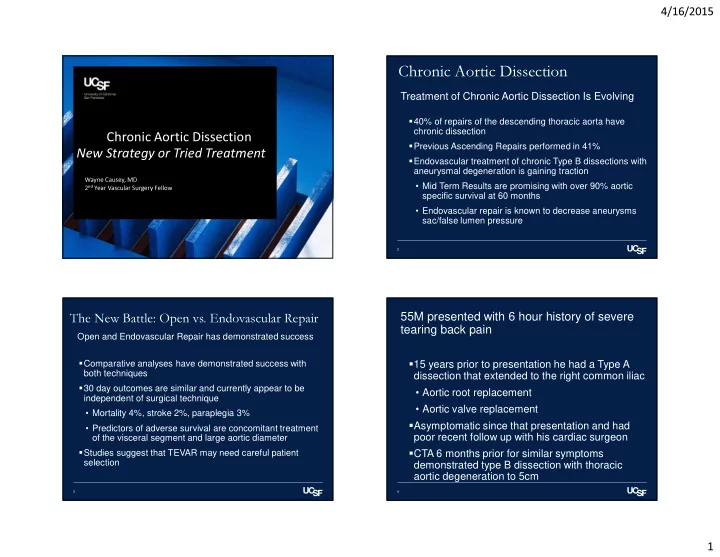
4/16/2015 Chronic Aortic Dissection Treatment of Chronic Aortic Dissection Is Evolving 40% of repairs of the descending thoracic aorta have chronic dissection Chronic Aortic Dissection Previous Ascending Repairs performed in 41% New


slide-1
SLIDE 1

4/16/2015 1

Chronic Aortic Dissection New Strategy or Tried Treatment

Wayne Causey, MD 2nd Year Vascular Surgery Fellow

Chronic Aortic Dissection

40% of repairs of the descending thoracic aorta have chronic dissection Previous Ascending Repairs performed in 41% Endovascular treatment of chronic Type B dissections with aneurysmal degeneration is gaining traction

  • Mid Term Results are promising with over 90% aortic

specific survival at 60 months

  • Endovascular repair is known to decrease aneurysms

sac/false lumen pressure

Treatment of Chronic Aortic Dissection Is Evolving

2

The New Battle: Open vs. Endovascular Repair

Comparative analyses have demonstrated success with both techniques 30 day outcomes are similar and currently appear to be independent of surgical technique

  • Mortality 4%, stroke 2%, paraplegia 3%
  • Predictors of adverse survival are concomitant treatment
  • f the visceral segment and large aortic diameter

Studies suggest that TEVAR may need careful patient selection Open and Endovascular Repair has demonstrated success

3

15 years prior to presentation he had a Type A dissection that extended to the right common iliac

  • Aortic root replacement
  • Aortic valve replacement

Asymptomatic since that presentation and had poor recent follow up with his cardiac surgeon CTA 6 months prior for similar symptoms demonstrated type B dissection with thoracic aortic degeneration to 5cm

55M presented with 6 hour history of severe tearing back pain

4

slide-2
SLIDE 2

4/16/2015 2

Presentation

His pain was different and now localized to the chest, back, and upper abdomen

  • PMHx: HTN, HLD, Renal cell carcinoma

(treated 20 years prior, no recurrence)

  • PSHx: Left nephrectomy, Aortic valve and

root replacement

  • Remote 10 pack year smoking history

No abdominal tenderness Exam with palpable pulses (including radial and pedal pulses) Cr 0.8; H/H 14/40

5

CT Angiogram Chest/Abdomen/Pelvis

Type B Aortic Dissection Begins just distal to the left subclavian artery; normal proximal aorta measures 33mm

Thoracic Aorta

Dissection extends throughout the entire thoracic aorta with maximal diameter 5.8 cm

Abdominal Aorta

Aorta measures 2.8cm at maximal diameter and all visceral vessels fed

  • ff the true lumen,

except the right renal which has a large fenestration

slide-3
SLIDE 3

4/16/2015 3

How would you manage this patient?

  • A. Anti-impulse therapy and pain

control

  • B. Stent-graft placement in the

descending thoracic aorta

  • C. Open thoracic aortic repair
  • D. Thoracoabdominal aortic repair

9

A n t i

  • i

m p u l s e t h e r a p y a n . . . S t e n t

  • g

r a f t p l a c e m e n t i n . . . O p e n t h

  • r

a c i c a

  • r

t i c r e p a i r T h

  • r

a c

  • a

b d

  • m

i n a l a

  • r

t i . . .

38% 14% 0% 48%

After 72 hours, his pain persisted but HR and BP were well controlled.

How would you manage this patient?

  • A. Continued anti-impulse control and repeat

CTA in 1 week

  • B. TEVAR with coverage of the left subclavian

and carotid/subclavian bypass

  • C. TEVAR with coverage of the left subclavian
  • D. Open thoracic aortic aneurysm repair
  • E. Continue anti-impulse therapy and repeat

CTA in 1 month

10

C

  • n

t i n u e d a n t i

  • i

m p u l s e . . . T E V A R w i t h c

  • v

e r a g e

  • f

t . . T E V A R w i t h c

  • v

e r a g e

  • f

t . . O p e n t h

  • r

a c i c a

  • r

t i c a n . . . C

  • n

t i n u e a n t i

  • i

m p u l s e t h . . .

18% 30% 35% 3% 15%

Patient returns in 1 month with continued pain, requesting repair as he cannot function

What would be your operative approach (3cm landing zone if left subclavian covered, right vertebral dominant) Size based on normal proximal aorta and covering left subclavian

  • A. Cover the entry tear only
  • B. Cover the throacic aorta to the level of

the celiac, subclavian revascularization if symptomatic

  • C. Cover the thoracic aorta to the level of

the celiac; carotid-subclavian bypass

  • D. Coil embolize the false lumen, cover the

thoracic aorta to the level of the celiac, carotid-subclavian bypass

  • E. Open thoracic aortic aneurysm repair

11

Cover the entry tear only Cover the throacic aorta .. Cover the thoracic aorta .. Coil embolize the false l... Open thoracic aortic an...

11% 38% 5% 11% 35%

Open thoracotomy through 4th and 9th interspaces

Left heart bypass Proximal clamp between left CCA and subclavian, dissection to that level but not involving the left subclavian 34mm Dacron Tube graft from left subclavian to diaphragmatic aorta

12

Proximal Descending Thoracic Aorta

slide-4
SLIDE 4

4/16/2015 4

Distal

4/16/2015 Presentation Title and/or Sub Brand Name Here 13

Descending Thoracic Aorta at Diaphragm

Recovery

Pain resolved after repair and subsequent recovery False lumen in abdominal segment unchanged and false lumen not thrombosed Abdominal aortic aneurysmal changes may be treated with multibranch graft repair

14

Conclusion

Endovascular repair of chronic dissections is evolving

  • Extent of coverage
  • Adjunctive procedures are emerging
  • Young patients and those with poor follow up

compliance may be best served with open surgical repair

15