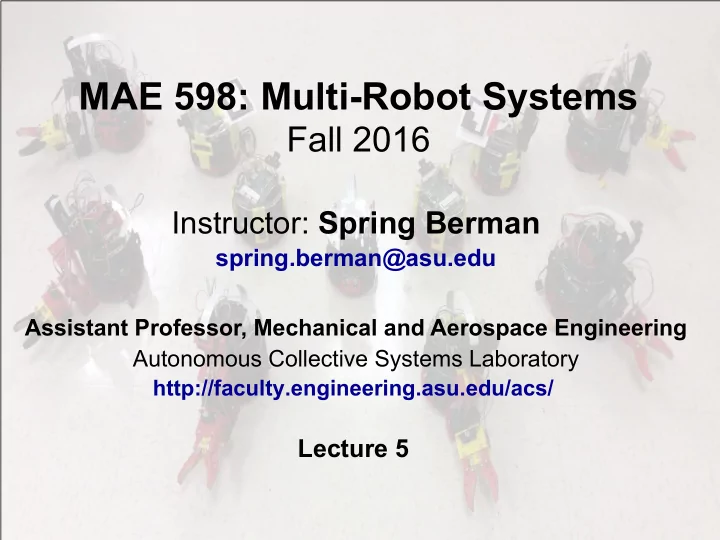
MAE 598: Multi-Robot Systems Fall 2016 ! Instructor: Spring Berman - - PowerPoint PPT Presentation

mae 598 multi robot systems
SMART_READER_LITE
LIVE PREVIEW

MAE 598: Multi-Robot Systems Fall 2016 ! Instructor: Spring Berman - - PowerPoint PPT Presentation

MAE 598: Multi-Robot Systems Fall 2016 ! Instructor: Spring Berman spring.berman@asu.edu Assistant Professor, Mechanical and Aerospace Engineering Autonomous Collective Systems Laboratory http://faculty.engineering.asu.edu/acs/ Lecture 5


slide-1
SLIDE 1

MAE 598: Multi-Robot Systems

Fall 2016!

Instructor: Spring Berman

spring.berman@asu.edu

Assistant Professor, Mechanical and Aerospace Engineering Autonomous Collective Systems Laboratory

http://faculty.engineering.asu.edu/acs/

Lecture 5

slide-2
SLIDE 2

Spontaneous Interac-on.dependent

Microscopic Model: Task Switching cij = Prob(a"par%cular"combina%on"of"reactants"in"the"reac%on"

associated"with"kij will react) per timestep Δt3

cij

Tunable!

cij = cij

enc ⋅ cij react Tunable!

Robot"executes"transi%on"with" probability""""""""""""""at"each"Δt" """""" "

task j task i

kij cijΔt

kij = f (cij)

Robot"encounters"poten%al"reactant" in"next"Δt with"probability" """"","executes"transi%on"with" probability""

cij

encΔt

cij

react

2 ASU MAE 598 Multi-Robot Systems Berman

slide-3
SLIDE 3

Mesoscopic model

Chemical Master Equation Time-evolution equation for

N elements, S species

Species populations (integers)

Microscopic model

Directed"graph" Adjacent"complexes:

cijdt

[Gillespie, Annu. Rev.

  • Phys. Chem. ’07]

Modeling Approach

slide-4
SLIDE 4

Macroscopic model N elements, S species

Species populations (integers)

Microscopic model

Directed"graph" Adjacent"complexes: Numerical realizations of N(t) using a Stochastic Simulation Algorithm [Gillespie, J. Comp. Phys. 1976]

cijdt

[Gillespie, Annu. Rev.

  • Phys. Chem. ’07]

Modeling Approach

slide-5
SLIDE 5

Mesoscopic model Macroscopic model Ni →∞, V →∞, Ni /V finite

Species"concentra%ons;""!

ci

Tx = ci, i =1,..,S − rank(S)

Thermodynamic"limit!

E(N(t)/V)

Linear3model3 3 3 3 3 3Mul-.affine3model!

  • nly!

="Vector"of"complexes!

Modeling Approach

slide-6
SLIDE 6

Top-Down Controller Synthesis

! Controller synthesis:

""""Design"rate"constants"kij

! Analysis:"establish" theore%cal"guarantees"on" performance" Decentralized robot control policies based on cij that produce desired collective behavior Broadcast kij

Macro- scopic model Microscopic model

slide-7
SLIDE 7

Analysis of Macroscopic Model

Equilibrium!

Equilibria3characteriza-on3

333

Model"must"have"a"unique,"posi%ve," asympto%cally"stable"equilibrium"

(="final"swarm"popula%on"distribu%on)""

!!!!

! Chemical Reaction Network Theory

  • General network topology, mass action kinetics:
  • M. Feinberg, F. Horn, R. Jackson (1970’s, 1980’s)
  • More restricted topology, monotone kinetics:
  • E. Sontag, D. Angeli, P. de Leenheer (2000’s)

! Algebraic Graph Theory

! Lyapunov Stability Theory

7 ASU MAE 598 Multi-Robot Systems Berman

slide-8
SLIDE 8

Hybrid System Macroscopic Models

8

U!

[Berman, Halász, Kumar HSCC’07]

˙ x = M1K1y(x)

  • 3Reachability3analysis3

333

Algorithms"for"systems"with"mul%Jaffine"dynamics"

"""

unstable stable

˙ x = M2K 2y(x)

8 ASU MAE 598 Multi-Robot Systems Berman

slide-9
SLIDE 9

9

Reallocation of a Swarm among Multiple Sites

Develop a strategy for redistributing a swarm of robots among multiple sites in specified population fractions to perform tasks at each site

Applications:

  • surveillance of multiple

buildings

  • search-and-rescue
  • reconnaissance
  • environmental monitoring
  • construction

ASU MAE 598 Multi-Robot Systems Berman

[Berman, Halász, Hsieh, Kumar, IEEE Trans. on Robotics 2009]

slide-10
SLIDE 10

10

Required Robot Controller Properties

Synthesize robot controllers that:

  • can be computed a priori by an external supervisor
  • are based on a set of parameters that are independent of

swarm size

  • do not require inter-robot communication
  • have provable guarantees on performance
  • can be optimized for fast convergence to the desired

allocation among sites, with a constraint on robot traffic between sites

  • require minimal adjustments when task demands change

ASU MAE 598 Multi-Robot Systems Berman

slide-11
SLIDE 11

11

Objective

  • Develop a strategy for redistributing a swarm of

robots among multiple sites in specified fractions

ASU MAE 598 Multi-Robot Systems Berman

slide-12
SLIDE 12

12

Objective

  • Develop a strategy for redistributing a swarm of

robots among multiple sites in specified fractions

0.08 0.08 0.08 0.36 0.08 0.08 0.08 0.08 0.08

ASU MAE 598 Multi-Robot Systems Berman

slide-13
SLIDE 13

13

Objective

  • Develop a strategy for redistributing a swarm of

robots among multiple sites in specified fractions

ASU MAE 598 Multi-Robot Systems Berman

slide-14
SLIDE 14

14

Approach

" Decentralized decision-making, no communication for control

  • Promotes scalability, robustness to changes in swarm size
  • In contrast to coalition-formation algorithms such as market-based

approaches Dias et al., “Market-based Multirobot Coordination: A Survey and Analysis”

  • Proc. IEEE, 2006

Challenges: Difficult to use centralized control,

communication across sites may be risky or impossible

# Robots redistribute themselves autonomously by switching

stochastically between sites

Inspired by social insect behavior, particularly ant house-hunting (select a new nest and move the colony there)

Franks et al., “Information flow, opinion polling and collective intelligence in house-hunting social insects,” Phil. Trans. of the Royal Society B, 2002

Simple rules based on local sensing, physical contact

ASU MAE 598 Multi-Robot Systems Berman

slide-15
SLIDE 15

New" site"1" New" site"2" (beOer)" Damaged"nest"

Assess"1" Assess"2" Recruit"to"1" Recruit"to"2" Search"" Occupy"old"nest" Occupy"1" Occupy"2"

15

“House-Hunting” in Temnothorax albipennis

Tandem3run3 Transport3

Courtesy of Prof. Stephen Pratt, ASU

slide-16
SLIDE 16

New" site"1" New" site"2" (beOer)" Damaged"nest"

Assess"1" Assess"2" Recruit"to"1" Recruit"to"2" Search"" Occupy"old"nest" Occupy"1" Occupy"2"

33Site3pop. 33Site3pop.

< q ≥ q

16

“House-Hunting” in Temnothorax albipennis

Tandem3run3 Transport3

Courtesy of Prof. Stephen Pratt, ASU

slide-17
SLIDE 17

New" site"1" New" site"2" (beOer)" Damaged"nest"

Assess"1" Assess"2" Recruit"to"1" Recruit"to"2" Search"" Occupy"old"nest" Occupy"1" Occupy"2"

< q ≥ q

Rates"of"switching" between"tasks" determine"final" alloca%on" "

17

“House-Hunting” in Temnothorax albipennis

Tandem3run3 Transport3

kij = f (site pop., q)

ASU MAE 598 Multi-Robot Systems Berman

  • 33Site3pop. < q
  • 33Site3pop. ≥ q
slide-18
SLIDE 18

task j task i

kij

Xi ~3chemical3species3i

Unimolecular3(spontaneous)

Microscopic Model

Rate3constant3kij

Controllers

Yr Yr Yr

Yr ⊂ Rn

Task j Task i

ASU MAE 598 Multi-Robot Systems Berman 18

Decisions modeled as chemical reactions

slide-19
SLIDE 19

Macroscopic Model [Franks 2002]

θ(X) = 1 when X > 0, 0 otherwise

Site 0 (home) is destroyed; Site 2 is better than Site 1

Active Ants pN Passive Ants (1 – p)N

19 ASU MAE 598 Multi-Robot Systems Berman

slide-20
SLIDE 20

Macroscopic Model: Active Ants

Naive Recruiters Assessors

2 1 µi = rate of discovery

  • f site i

20 ASU MAE 598 Multi-Robot Systems Berman

slide-21
SLIDE 21

Macroscopic Model: Active Ants

Naive Recruiters Assessors

2 1 ki = rate at which

assessors of site i become recruiters to i

21 ASU MAE 598 Multi-Robot Systems Berman

slide-22
SLIDE 22

Macroscopic Model: Active Ants

Naive Recruiters Assessors

2 1 λi = rate at which

recruiters lead tandem runs to site i

T = Quorum

[Franks 2002]

22 ASU MAE 598 Multi-Robot Systems Berman

slide-23
SLIDE 23

Macroscopic Model: Active Ants

Naive Recruiters Assessors

2 1 ρij = rate of switching

allegiance from site i to site j

23 ASU MAE 598 Multi-Robot Systems Berman

slide-24
SLIDE 24

Macroscopic Model: Passive Ants

2 1 φi = rate at which

recruiters perform transports to site i

[Franks 2002]

T = Quorum

24 ASU MAE 598 Multi-Robot Systems Berman

slide-25
SLIDE 25

208 ants

Macroscopic Mesoscopic Microscopic

Agreement between macroscopic , mesoscopic, and microscopic models

(modified ant house-hunting model)

Spring Berman, Adam Halasz, Vijay Kumar, and Stephen Pratt, “Bio-Inspired Group Behaviors for the Deployment of a Swarm of Robots to Multiple Destinations” ICRA 2007.

slide-26
SLIDE 26

Mesoscopic Model Fluctuations in Recruiter Populations

  • Effect of population size on steady-state Y1,Y2: N = 52, 208, 832

Dashed lines are macroscopic steady-state values N = 208: Std dev is < 9% of mean

26 ASU MAE 598 Multi-Robot Systems Berman

slide-27
SLIDE 27

= set of sites can travel from i to j M Sites

1 2 3 4 5 6 7 8 9

# Model interconnection topology of sites as a directed graph

kij = Transition probability per unit time for

  • ne robot at site i to travel to site j

# Assume that is strongly connected

(directed path btwn. each pair of sites)

k56 k45 k65

  • Choose for rapid, efficient redistribution

# Assume that each robot:

  • knows , all kij , task at each site
  • can navigate between sites
  • can sense neighboring robots

Approach to Swarm Multi-Site Deployment

27 ASU MAE 598 Multi-Robot Systems Berman

slide-28
SLIDE 28

28

Macroscopic Model

Microscopic Model

  • N robots, M behavior

states: {Doing task at site

1, Doing task at site 2, …, Doing task at site M}

  • Could also include states

that represent travel between pairs of sites

  • Ordinary differential

equations in terms of kij and the fraction of robots

xi at each site i

Abstraction

  • D. Gillespie, “Stochastic Simulation of

Chemical Kinetics,” Annu. Rev. Phys. Chem., 2007

∞ → N

Approach

i j

t kijΔ − 1

t kijΔ

ASU MAE 598 Multi-Robot Systems Berman

slide-29
SLIDE 29

29

Macroscopic Model

Microscopic Model

  • Switch according to kij ;

motion control for tasks at sites, navigation

  • Analysis and
  • ptimization tools to

choose kij

Approach

i j

t kijΔ − 1

t kijΔ

“Top-down” controller synthesis approach is computationally inexpensive and gives guarantees on performance

ASU MAE 598 Multi-Robot Systems Berman

slide-30
SLIDE 30

Conservation constraint:

Macroscopic Model

i j

= Fraction of robots at site i at time t

Instantaneous switching

(a) (b)

30 ASU MAE 598 Multi-Robot Systems Berman

slide-31
SLIDE 31

= Target fraction of robots at site i

Base Continuous Model

#

There is a unique, stable equilibrium [Halász et al., IROS07] " If kij are chosen so that (c) , the system always converges to the target distribution

(a) (b)

31 ASU MAE 598 Multi-Robot Systems Berman

slide-32
SLIDE 32

32

Simulation Methodology

# Swarm of 250 robots monitors the perimeters of 4 buildings on

UPenn campus while redistributing to the desired allocation

Two possible site interconnection graphs

3 2 4 1

Swarm initially split between sites 3 and 4

ASU MAE 598 Multi-Robot Systems Berman

slide-33
SLIDE 33

33

Simulate sequence of stochastic transitions using Gillespie’s Direct Method Compare the sets

  • f optimized kij

Simulation Methodology

ASU MAE 598 Multi-Robot Systems Berman

  • D. Gillespie, “A General Method for Numerically Simulating

the Stochastic Time Evolution of Coupled Chemical Reactions,” J. Comp. Physics, 1976

slide-34
SLIDE 34

34

Local potentials to ensure arrival at goal cell [1]

+ repulsive potentials for inter-robot collision avoidance [2]

Simulation Methodology

ASU MAE 598 Multi-Robot Systems Berman

Yr

Yr ⊂ R2

Site j Site i

Controllers

[2] D. C. Conner et al., “Composition of local potential functions for global robot control and navigation,” IROS 2003 [1] H. G. Tanner, et al., “Flocking in fixed and switching networks,” IEEE Trans. Autom. Control, 2007.

slide-35
SLIDE 35

35

Simulation of Swarm Reallocation

ASU MAE 598 Multi-Robot Systems Berman

slide-36
SLIDE 36

Agreement between macroscopic and microscopic models

# Verifies the validity of our controller synthesis approach

36 ASU MAE 598 Multi-Robot Systems Berman