
SLIDE 1
Creating A Clean, Affordable and Resilient Energy Future For the Commonwealth
MA Leading by Example Council Meeting
January 23, 2018
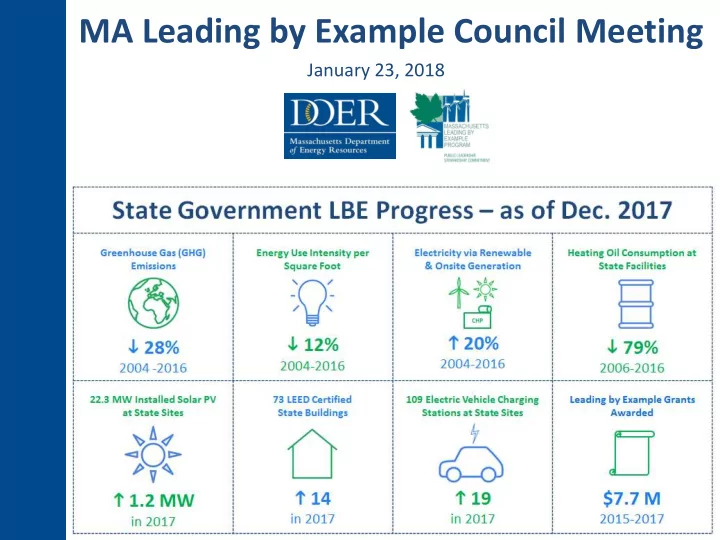
MA Leading by Example Council Meeting January 23, 2018 Creating A - - PowerPoint PPT Presentation
MA Leading by Example Council Meeting January 23, 2018 Creating A Clean, Affordable and Resilient Energy Future For the Commonwealth Agenda Welcome & Introductions MA Trial Courts Energy and Sustainability Overview News from
Creating A Clean, Affordable and Resilient Energy Future For the Commonwealth
January 23, 2018
Creating A Clean, Affordable and Resilient Energy Future For the Commonwealth
Building
Fall River District Courts Gold Ruane Judicial Center (Essex Co. Juvenile Court) Gold Taunton District Court Gold
LEED Certified Buildings
8% 12% 3% 23% 2%
40%
20,000 30,000 40,000 50,000 60,000 LBE Baseline FY05 FY06 FY07 FY08 FY09 FY10 FY11 FY12 FY13 FY14 FY15 FY16 FY17 LBE 2020 Target GHG Emissions (MTCO2e)
Trial Court Annual GHG Emissions w/ % change from LBE baseline
In FY17, GHG emissions have decreased 39 percent from the LBE Baseline, reducing
(Emissions equivalent to removing 3,357 cars from the road)
Previous 3:45am building start time Updated 6:00am building start time
Edward Brooke Courthouse: Building Start Time Before & After
1-3 hours of energy savings each weekday Billing Info 2016 kWh 2017 kWh % change Feb 395,680 341,920
March 387,560 351,760
April 392,080 364,000
May 422,000 370,600
(Table: MassEnergyInsight data)
schedule gradually in 15
every few weeks to identify
time
identified for
facilities
▫ Total estimated savings: 2.3million kWh and $450,000 in energy costs
▫ 3 Demand Response Programs implemented in 2017 at Springfield, Salem, and Worcester Courts CoFFEE Funding: $36,000 Est. Annual DR Revenue: $51,000
▫ Recycling initiatives (Single Stream) ▫ Tracking energy efficiency projects via MEI ▫ Outreach to staff to increase awareness about conservation methods both at work and home by host lighting technology workshops at regional courthouses for staff.
automate selected existing locations.
largest electrical consumer. New focus is Worcester Trial Court.
Facility Optimization & Utility Bill Management.
solar PV project at Plymouth Trial Court.
Creating A Clean, Affordable and Resilient Energy Future For the Commonwealth
Creating A Clean, Affordable and Resilient Energy Future For the Commonwealth
(
calculator, and internal combustion engine vehicle emissions on fueleconomy.gov’s car finder
(LBE’s Fuel Efficiency Standard Calculator also an available resource) mass.gov/service-details/leading-by-example-tools-guidance-and-tracking
Creating A Clean, Affordable and Resilient Energy Future For the Commonwealth
Blog/Visual: American Council for an Energy Efficient Economy Visual: US Energy Information Administration (pg. 18)
Creating A Clean, Affordable and Resilient Energy Future For the Commonwealth
Photo: Hornsdale Power Reserve Photo: China Daily Article: ThinkProgress Article/Photo: USA Today Article: Yahoo/Engadget
capacity
lithium ion battery
30,000 homes
Creating A Clean, Affordable and Resilient Energy Future For the Commonwealth
Article: ThinkProgress Article/Photo: San Francisco Chronicle Table: Lazard
Creating A Clean, Affordable and Resilient Energy Future For the Commonwealth
Article/Photo: Car and Driver Article/Photo: New York Times
manufacturer when each automaker reaches 200,000 units US Dept. of Energy: Residential Renewable Energy Tax Credit:
decline in amounts starting 2020
Production Tax Credit
Creating A Clean, Affordable and Resilient Energy Future For the Commonwealth
2017 2017
(Separate analyses by NOAA and NASA)
warmest years since 1880
recent El Niño and La Niña patterns statistically removed, 2017 would have been warmest on record
surface temperature has risen about 2° (F) in last century or so, driven largely by increased CO2 and other human-made emissions
2016 2015 2016 2015
Creating A Clean, Affordable and Resilient Energy Future For the Commonwealth
Creating A Clean, Affordable and Resilient Energy Future For the Commonwealth
Creating A Clean, Affordable and Resilient Energy Future For the Commonwealth
Creating A Clean, Affordable and Resilient Energy Future For the Commonwealth
awarded $20M in grants for 26 energy storage projects
market and deliver benefits to ratepayers and grid
storage
solar plus storage
state projects:
grant
system to demonstrate integration of renewable distributed generation
behind-the-meter solar plus storage
Press Release, Project Descriptions
Creating A Clean, Affordable and Resilient Energy Future For the Commonwealth
Creating A Clean, Affordable and Resilient Energy Future For the Commonwealth
Creating A Clean, Affordable and Resilient Energy Future For the Commonwealth
National Grid Nantucket Electric d/b/a National Grid NSTAR d/b/a Eversource Energy WMECO d/b/a Eversource Energy Fitchburg Gas & Electric d/b/a Unitil Block 1 Base Compensation Rate ($/kWh) $0.15563 $0.17000 $0.17000 $0.14288 $0.15563
masmartsolar.com mass.gov/service-details/smart-competitive-procurement
Creating A Clean, Affordable and Resilient Energy Future For the Commonwealth
processes under the SMART Program:
DOER.SMART@state.ma.us and should be sent with the subject line “SMART Guideline Comments.” Comments are due by 5 PM on February 23, 2018.
Creating A Clean, Affordable and Resilient Energy Future For the Commonwealth
Municipality Designation Grant
Abington $164,900 Brimfield $134,500 Canton $158,315 Chester $130,170 Cummington $127,245 Douglas $145,940 Duxbury $139,705 Franklin $183,020 Grafton $157,485 Hinsdale $130,410 Lawrence $594,140 Leicester $158,800 Middleborough $197,655 New Braintree $127,285 Orange $159,830 Plainville $144,025 Royalston $129,365 Sharon $148,740 Shelburne $132,575 Southampton $138,595 Stoneham $169,615 Waltham $281,080 Webster $180,885 Wellesley $137,250 West Boylston $145,435
Creating A Clean, Affordable and Resilient Energy Future For the Commonwealth
Creating A Clean, Affordable, and Resilient Energy Future For the Commonwealth
Example: Utility serves 1,000,000 MWh of load in 2017 and has an
1,000,000 MWh x 0.0425 = 42,500 MWh (number of AECs they must procure)
26
What is the APS? New Ren. Thermal Technologies Ground Source Heat Pumps Air Source Heat Pumps Program Logistics Solar Thermal Biofuels Biogas/ Compost Heat Exch. Biomass Fuel Cells Waste to Energy Qualification and Application Examples Links and Discussion
Creating A Clean, Affordable, and Resilient Energy Future For the Commonwealth
27
What is the APS? New Ren. Thermal Technologies Ground Source Heat Pumps Air Source Heat Pumps Program Logistics Solar Thermal Biofuels Biogas/ Compost Heat Exch. Biomass Fuel Cells Waste to Energy Qualification and Application Examples Links and Discussion
Creating A Clean, Affordable, and Resilient Energy Future For the Commonwealth
28
What is the APS? New Ren. Thermal Technologies Ground Source Heat Pumps Air Source Heat Pumps Program Logistics Solar Thermal Biofuels Biogas/ Compost Heat Exch. Biomass Fuel Cells Waste to Energy Qualification and Application Examples Links and Discussion
Creating A Clean, Affordable, and Resilient Energy Future For the Commonwealth
29
What is the APS? New Ren. Thermal Technologies Ground Source Heat Pumps Air Source Heat Pumps Program Logistics Solar Thermal Biofuels Biogas/ Compost Heat Exch. Biomass Fuel Cells Waste to Energy Qualification and Application Examples Links and Discussion
Creating A Clean, Affordable, and Resilient Energy Future For the Commonwealth
30
What is the APS? New Ren. Thermal Technologies Ground Source Heat Pumps Air Source Heat Pumps Program Logistics Solar Thermal Biofuels Biogas/ Compost Heat Exch. Biomass Fuel Cells Waste to Energy Qualification and Application Examples Links and Discussion
Creating A Clean, Affordable, and Resilient Energy Future For the Commonwealth
31
94.4 75.8 70.8
60 65 70 75 80 85 90 95 100 105 1990 1995 2000 2005 2010 2015 2020 Million Metric Tons of CO2 equivalent
Massachusetts GHG Emissions
Actual Emissions Projected Emissions 2020 Limit
What is the APS? New Ren. Thermal Technologies Ground Source Heat Pumps Air Source Heat Pumps Program Logistics Solar Thermal Biofuels Biogas/ Compost Heat Exch. Biomass Fuel Cells Waste to Energy Qualification and Application Examples Links and Discussion
Creating A Clean, Affordable, and Resilient Energy Future For the Commonwealth
32
What is the APS? New Ren. Thermal Technologies Ground Source Heat Pumps Air Source Heat Pumps Program Logistics Solar Thermal Biofuels Biogas/ Compost Heat Exch. Biomass Fuel Cells Waste to Energy Qualification and Application Examples Links and Discussion
Creating A Clean, Affordable, and Resilient Energy Future For the Commonwealth
33
Size Classification
Small Intermediate Large AEC calculation basis Calculated net renewable thermal output Calculated net renewable thermal based on indirect metering Calculated net renewable thermal output based on direct metering of fuel input Metered net renewable thermal output Solar thermal: evacuated tube and flat plate solar hot water Collector surface area less than
Collector surface area between 660 and 4,000 sq ft
than or equal to 4,000 sq ft Solar thermal: solar hot air
than 10,000 sq ft Solar sludge dryer
Eligible Biomass Fuel
1,000,000 Btu per hour Capacity greater than 1,000,000 Btu per hour Compost heat exchange system
Air source heat pump: electric motor or engine driven Output capacity less than or equal to 134,000 Btu per hour
134,000 and 1,000,000 Btu per hour Output capacity greater than or equal to 1,000,000 Btu per hour Ground source heat pump Output capacity less than or equal to 134,000 Btu per hour
134,000 and 1,000,000 Btu per hour Output capacity greater than or equal to 1,000,000 Btu per hour Deep geothermal
report their thermal output
What is the APS? New Ren. Thermal Technologies Ground Source Heat Pumps Air Source Heat Pumps Program Logistics Solar Thermal Biofuels Biogas/ Compost Heat Exch. Biomass Fuel Cells Waste to Energy Qualification and Application Examples Links and Discussion
Creating A Clean, Affordable, and Resilient Energy Future For the Commonwealth
34
What is the APS? New Ren. Thermal Technologies Ground Source Heat Pumps Air Source Heat Pumps Program Logistics Solar Thermal Biofuels Biogas/ Compost Heat Exch. Biomass Fuel Cells Waste to Energy Qualification and Application Examples Links and Discussion
Creating A Clean, Affordable, and Resilient Energy Future For the Commonwealth
emitting renewable thermal technologies”
renewable thermal technologies:
35
More information on these multipliers can be found in the Guideline
What is the APS? New Ren. Thermal Technologies Ground Source Heat Pumps Air Source Heat Pumps Program Logistics Solar Thermal Biofuels Biogas/ Compost Heat Exch. Biomass Fuel Cells Waste to Energy Qualification and Application Examples Links and Discussion
Creating A Clean, Affordable, and Resilient Energy Future For the Commonwealth
36
What is the APS? New Ren. Thermal Technologies Ground Source Heat Pumps Air Source Heat Pumps Program Logistics Solar Thermal Biofuels Biogas/ Compost Heat Exch. Biomass Fuel Cells Waste to Energy Qualification and Application Examples Links and Discussion
Creating A Clean, Affordable, and Resilient Energy Future For the Commonwealth
Fahrenheit and greater than or equal to 2.5 at 17 degree Fahrenheit
total annual heating and cannot have any supplemental, non-renewable heating sources
nameplate capacity of the existing heating source equipment
the above requirements but more efficient systems will generate larger incentives based on metered thermal output
37
What is the APS? New Ren. Thermal Technologies Ground Source Heat Pumps Air Source Heat Pumps Program Logistics Solar Thermal Biofuels Biogas/ Compost Heat Exch. Biomass Fuel Cells Waste to Energy Qualification and Application Examples Links and Discussion
Creating A Clean, Affordable, and Resilient Energy Future For the Commonwealth
efficiency ratios for their type of ground source heat pump
Electric Code and manufacturer’s specifications
and certifications
are water-to-water units
comply with any of the above requirements but more efficient systems will generate larger incentives based on metered thermal output
38
What is the APS? New Ren. Thermal Technologies Ground Source Heat Pumps Air Source Heat Pumps Program Logistics Solar Thermal Biofuels Biogas/ Compost Heat Exch. Biomass Fuel Cells Waste to Energy Qualification and Application Examples Links and Discussion
Creating A Clean, Affordable, and Resilient Energy Future For the Commonwealth
Officials
39
What is the APS? New Ren. Thermal Technologies Ground Source Heat Pumps Air Source Heat Pumps Program Logistics Solar Thermal Biofuels Biogas/ Compost Heat Exch. Biomass Fuel Cells Waste to Energy Qualification and Application Examples Links and Discussion
Creating A Clean, Affordable, and Resilient Energy Future For the Commonwealth
such as
must contain at least 10% by volume Eligible Liquid Biofuel
Eligible Liquid Biofuel delivered to an end user for intermediate systems
Eligible Liquid Biofuel delivered to an end user for large systems
biofuel generators is capped at 20% of the total projected annual compliance obligation for retail suppliers
40
What is the APS? New Ren. Thermal Technologies Ground Source Heat Pumps Air Source Heat Pumps Program Logistics Solar Thermal Biofuels Biogas/ Compost Heat Exch. Biomass Fuel Cells Waste to Energy Qualification and Application Examples Links and Discussion
Creating A Clean, Affordable, and Resilient Energy Future For the Commonwealth
41
What is the APS? New Ren. Thermal Technologies Ground Source Heat Pumps Air Source Heat Pumps Program Logistics Solar Thermal Biofuels Biogas/ Compost Heat Exch. Biomass Fuel Cells Waste to Energy Qualification and Application Examples Links and Discussion
Creating A Clean, Affordable, and Resilient Energy Future For the Commonwealth
42
What is the APS? New Ren. Thermal Technologies Ground Source Heat Pumps Air Source Heat Pumps Program Logistics Solar Thermal Biofuels Biogas/ Compost Heat Exch. Biomass Fuel Cells Waste to Energy Qualification and Application Examples Links and Discussion
Creating A Clean, Affordable, and Resilient Energy Future For the Commonwealth
decomposition or thermal gasification of Eligible Biomass Fuel. Eligible Biogas Fuel does not include natural gas but does include renewable natural gas, which is Eligible Biogas Fuel upgraded to a quality similar to natural gas
an anaerobic digester, as defined by MassDEP, or a landfill that has received all applicable permits from the MassDEP or comparable environmental agency responsible for regulating such facilities
Generation Unit in a dedicated pipeline
recover or exchange heat from the aerobic biodegradation of organic matter during the production of compost
metered
43
What is the APS? New Ren. Thermal Technologies Ground Source Heat Pumps Air Source Heat Pumps Program Logistics Solar Thermal Biofuels Biogas/ Compost Heat Exch. Biomass Fuel Cells Waste to Energy Qualification and Application Examples Links and Discussion
Creating A Clean, Affordable, and Resilient Energy Future For the Commonwealth
facilities:
are protective of public health and limit eligibility only to best-in-class commercially-feasible technologies, with regard to reducing emissions of particulate matter sized 2.5 microns or less and carbon monoxide and
gas emissions compared to a high efficiency unit utilizing the fuel that is being displaced;
any significant deterioration of efficiency or emissions due to boiler cycling, if feasible;
by best-in-class commercially-feasible technologies; and
requirements that fuel shall be provided by means of sustainable forestry practices.
44
What is the APS? New Ren. Thermal Technologies Ground Source Heat Pumps Air Source Heat Pumps Program Logistics Solar Thermal Biofuels Biogas/ Compost Heat Exch. Biomass Fuel Cells Waste to Energy Qualification and Application Examples Links and Discussion
Creating A Clean, Affordable, and Resilient Energy Future For the Commonwealth
45
What is the APS? New Ren. Thermal Technologies Ground Source Heat Pumps Air Source Heat Pumps Program Logistics Solar Thermal Biofuels Biogas/ Compost Heat Exch. Biomass Fuel Cells Waste to Energy Qualification and Application Examples Links and Discussion
Creating A Clean, Affordable, and Resilient Energy Future For the Commonwealth
particulate matter emissions performance standards are protective of public health
for comparable systems and are differentiated by system size and fuel type:
46
A boiler or furnace of less than 3,000,000 Btu per hour rated heat input must meet applicable emissions limits below: Pellets / Liquid Biofuels / Biogas Chips Particulate Matter emissions (PM) ≤ 0.08 lb PM2.5 per MMBtu input ≤ 0.10 lb PM2.5 per MMBtu input
≤ 0.05 lbs total PM per MMBtu input if
EN303-5 is used to verify emissions ≤ 0.03 lb PM2.5 per MMBtu input at sensitive populations
≤ 0.03 lb PM2.5 per MMBtu input at sensitive populations Carbon monoxide (CO) 270 ppm at 7% oxygen 270 ppm at 7% oxygen A boiler or furnace of greater than or equal to 3,000,000 Btu per hour rated heat input: PM, CO, and other relevant criteria pollutants Commonwealth of Massachusetts Department of Environmental Protection (MassDEP) plan approval required, pursuant to 310 CMR 7.02(5).
For the purpose of this provision, sensitive populations include schools, hospitals, nursing homes, or additional facilities determined by the Department.
What is the APS? New Ren. Thermal Technologies Ground Source Heat Pumps Air Source Heat Pumps Program Logistics Solar Thermal Biofuels Biogas/ Compost Heat Exch. Biomass Fuel Cells Waste to Energy Qualification and Application Examples Links and Discussion
Creating A Clean, Affordable, and Resilient Energy Future For the Commonwealth
that shows, based on the type of woody biomass used, that there was a 50% reduction in greenhouse gases over a 30-year time period
compliance under the RPS and relies closely on data from the Manomet Study
chips)
47
What is the APS? New Ren. Thermal Technologies Ground Source Heat Pumps Air Source Heat Pumps Program Logistics Solar Thermal Biofuels Biogas/ Compost Heat Exch. Biomass Fuel Cells Waste to Energy Qualification and Application Examples Links and Discussion
Creating A Clean, Affordable, and Resilient Energy Future For the Commonwealth
48
Creating A Clean, Affordable, and Resilient Energy Future For the Commonwealth
placed on DOER’s list of eligible suppliers
are different requirements on the composition of the woody biomass that must used by a biomass system:
49
Class Fuel being displaced Minimum combined percentage of Residues Class I Natural gas, electric resistance, propane, fuel
55% Class II Electric resistance, propane, fuel oil #6, fuel
50% Class III Fuel oil #6, fuel oil #2 35%
If a Generation Unit wishes to be exempt from the required GHG analysis they can simply purchase fuel from a supplier
required GHG reductions
What is the APS? New Ren. Thermal Technologies Ground Source Heat Pumps Air Source Heat Pumps Program Logistics Solar Thermal Biofuels Biogas/ Compost Heat Exch. Biomass Fuel Cells Waste to Energy Qualification and Application Examples Links and Discussion
Creating A Clean, Affordable, and Resilient Energy Future For the Commonwealth
thresholds below:
50 Lead boiler system size (heat output) Thermal storage required < 80,000 Btu/hr 80 gallons 80,000 Btu/hr - 119,000 Btu/hr 1 gallon per 1,000 Btu/hr 119,000 Btu/hr – 1 MMBtu/hr 119 gallons > 1 MMBtu/hr 2 gallons per 1,000 Btu/hr
test lab results based eligible testing methods that demonstrate the system is capable of the following:
believe that the inclusion of thermal storage would deteriorate the efficiency or air emissions performance of the Generation Unit.
What is the APS? New Ren. Thermal Technologies Ground Source Heat Pumps Air Source Heat Pumps Program Logistics Solar Thermal Biofuels Biogas/ Compost Heat Exch. Biomass Fuel Cells Waste to Energy Qualification and Application Examples Links and Discussion
Creating A Clean, Affordable, and Resilient Energy Future For the Commonwealth
51
Performance Requirement Pellets Chips Thermal efficiency at nominal output
≥ 85% Higher Heating Value ≥ 75% Higher Heating Value
≥ 80% Lower Heating Value if EN303-5 is
used to verify particulate emissions Start up Adhere to manufacturer’s ignition protocol Modulation/shut off The system must automatically modulate to lower output and/or turn itself off when the heating load decreases or is satisfied Pressurized portion of the system Compliant with 522 CMR 4.00 Thermal storage Required, unless an exception is issued by the Department Fuel storage The system must have covered bulk storage Feedstock conveyance The system must be automatically fed from feedstock storage to the furnace or boiler
What is the APS? New Ren. Thermal Technologies Ground Source Heat Pumps Air Source Heat Pumps Program Logistics Solar Thermal Biofuels Biogas/ Compost Heat Exch. Biomass Fuel Cells Waste to Energy Qualification and Application Examples Links and Discussion
Creating A Clean, Affordable, and Resilient Energy Future For the Commonwealth
emission control device (e.g., electrostatic precipitator), does not have to meet the fuel quality specifications
utilize an emission control device (e.g., electrostatic precipitator) must meet the following fuel quality specifications:
must receive a MassDEP plan approval pursuant to 310 CMR 7.02(5), which shall dictate fuel quality specifications
52
Fuel quality specifications Pellets Chips
Calorific value Great than 8,000 Btu per pound Greater than or equal to 5,500 Btu per pound Moisture Less than or equal to 8 percent Less than or equal to 35 percent Ash content by weight Less than or equal to 1 percent Less than or equal to 1.5 percent Chip Size (percent retained by a half inch mesh screen) Not applicable 75 percent or adhere to manufacturer’s protocol Chlorides Less than or equal to 300 parts per million Not applicable
What is the APS? New Ren. Thermal Technologies Ground Source Heat Pumps Air Source Heat Pumps Program Logistics Solar Thermal Biofuels Biogas/ Compost Heat Exch. Biomass Fuel Cells Waste to Energy Qualification and Application Examples Links and Discussion
Creating A Clean, Affordable, and Resilient Energy Future For the Commonwealth
Sustainable Forestry Management is defined as: Practicing a land stewardship ethic that integrates the reforestation, managing, growing, nurturing, and harvesting of trees for useful products with the conservation of soil, air and water quality, wildlife and fish habitat, and aesthetics and the stewardship and use of forests and forest lands in a way, and a rate, that maintains their biodiversity, productivity, regeneration capacity, vitality, and potential to fulfill, now and in the future, relevant ecological, economic, and social functions at local, national, and global levels, and that does not cause damage to
benefits to meet the needs of societies; and
conservation and sustainable management.
53
What is the APS? New Ren. Thermal Technologies Ground Source Heat Pumps Air Source Heat Pumps Program Logistics Solar Thermal Biofuels Biogas/ Compost Heat Exch. Biomass Fuel Cells Waste to Energy Qualification and Application Examples Links and Discussion
Creating A Clean, Affordable, and Resilient Energy Future For the Commonwealth
managed forests. Sustainable Forest Managed must be verified as follows:
under the long term management option, and signed by a state forester that attests to best management practices, and biomass harvesting and retention guidelines.
forester attesting that the harvest complied Sustainable Forestry Management definition, best management practices of the host state, and biomass harvesting and retention guidelines.
that includes Forest Stewardship Council (FSC) and Program for the Endorsement of Forest Certification (PEFC), which includes the Sustainable Forestry Initiative (SFI) and American Tree Farm System (ATFS).
54
What is the APS? New Ren. Thermal Technologies Ground Source Heat Pumps Air Source Heat Pumps Program Logistics Solar Thermal Biofuels Biogas/ Compost Heat Exch. Biomass Fuel Cells Waste to Energy Qualification and Application Examples Links and Discussion
Creating A Clean, Affordable, and Resilient Energy Future For the Commonwealth
chemical reaction to produce electricity, thermal energy, and water.
commonly done with natural gas
under the RPS
higher overall efficiency than the current average overall efficiency for emitting locational marginal units in ISO-NE
must have an overall efficiency of at least 55%
3,412,000 BTUs of net Useful Thermal Energy they generate
55
What is the APS? New Ren. Thermal Technologies Ground Source Heat Pumps Air Source Heat Pumps Program Logistics Solar Thermal Biofuels Biogas/ Compost Heat Exch. Biomass Fuel Cells Waste to Energy Qualification and Application Examples Links and Discussion
Creating A Clean, Affordable, and Resilient Energy Future For the Commonwealth
56
What is the APS? New Ren. Thermal Technologies Ground Source Heat Pumps Air Source Heat Pumps Program Logistics Solar Thermal Biofuels Biogas/ Compost Heat Exch. Biomass Fuel Cells Waste to Energy Qualification and Application Examples Links and Discussion
Creating A Clean, Affordable, and Resilient Energy Future For the Commonwealth
57
What is the APS? New Ren. Thermal Technologies Ground Source Heat Pumps Air Source Heat Pumps Program Logistics Solar Thermal Biofuels Biogas/ Compost Heat Exch. Biomass Fuel Cells Waste to Energy Qualification and Application Examples Links and Discussion
Creating A Clean, Affordable, and Resilient Energy Future For the Commonwealth
58
What is the APS? New Ren. Thermal Technologies Ground Source Heat Pumps Air Source Heat Pumps Program Logistics Solar Thermal Biofuels Biogas/ Compost Heat Exch. Biomass Fuel Cells Waste to Energy Qualification and Application Examples Links and Discussion
Creating A Clean, Affordable, and Resilient Energy Future For the Commonwealth
59
What is the APS? New Ren. Thermal Technologies Ground Source Heat Pumps Air Source Heat Pumps Program Logistics Solar Thermal Biofuels Biogas/ Compost Heat Exch. Biomass Fuel Cells Waste to Energy Qualification and Application Examples Links and Discussion
Creating A Clean, Affordable, and Resilient Energy Future For the Commonwealth
60
Creating A Clean, Affordable, and Resilient Energy Future For the Commonwealth
61
What is the APS? New Ren. Thermal Technologies Ground Source Heat Pumps Air Source Heat Pumps Program Logistics Solar Thermal Biofuels Biogas/ Compost Heat Exch. Biomass Fuel Cells Waste to Energy Qualification and Application Examples Links and Discussion
Creating A Clean, Affordable, and Resilient Energy Future For the Commonwealth
62
What is the APS? New Ren. Thermal Technologies Ground Source Heat Pumps Air Source Heat Pumps Program Logistics Solar Thermal Biofuels Biogas/ Compost Heat Exch. Biomass Fuel Cells Waste to Energy Qualification and Application Examples Links and Discussion
Creating A Clean, Affordable, and Resilient Energy Future For the Commonwealth
63
What is the APS? New Ren. Thermal Technologies Ground Source Heat Pumps Air Source Heat Pumps Program Logistics Solar Thermal Biofuels Biogas/ Compost Heat Exch. Biomass Fuel Cells Waste to Energy Qualification and Application Examples Links and Discussion
Creating A Clean, Affordable, and Resilient Energy Future For the Commonwealth
64
What is the APS? New Ren. Thermal Technologies Ground Source Heat Pumps Air Source Heat Pumps Program Logistics Solar Thermal Biofuels Biogas/ Compost Heat Exch. Biomass Fuel Cells Waste to Energy Qualification and Application Examples Links and Discussion
Creating A Clean, Affordable, and Resilient Energy Future For the Commonwealth
for Renewable Thermal Generation Units – Part 1 (Calculations for Small and Intermediate Generation Units)
Output for Renewable Thermal Generation Units – Part 2 (Metering for Intermediate and Large Generation Units)
Thermal Generation Units
Renewable Thermal Generation Units Using Eligible Woody Biomass
65
What is the APS? New Ren. Thermal Technologies Ground Source Heat Pumps Air Source Heat Pumps Program Logistics Solar Thermal Biofuels Biogas/ Compost Heat Exch. Biomass Fuel Cells Waste to Energy Qualification and Application Examples Links and Discussion
Creating A Clean, Affordable, and Resilient Energy Future For the Commonwealth
66
What is the APS? New Ren. Thermal Technologies Ground Source Heat Pumps Air Source Heat Pumps Program Logistics Solar Thermal Biofuels Biogas/ Compost Heat Exch. Biomass Fuel Cells Waste to Energy Qualification and Application Examples Links and Discussion
Creating A Clean, Affordable and Resilient Energy Future For the Commonwealth
Creating A Clean, Affordable and Resilient Energy Future For the Commonwealth
resiliency of each site
Examples: solar plus storage, combined heat and power, microgrids
Department of Veteran’s Affairs
Department of Mental Health
Department of Developmental Services
Department of Public Health
Department of Youth Services
Evaluation of 12 state-owned 24/7 medical care facilities for
energy resiliency
Creating A Clean, Affordable and Resilient Energy Future For the Commonwealth
Creating A Clean, Affordable and Resilient Energy Future For the Commonwealth
Recipient Technology Description Amount Awarded UMass Amherst Feasibility Study (Alt. Fuels Analysis) Grant for an alternative fuels analysis feasibility study of the expansion of Central Heating Plant and campus electrical distribution system at UMass Amherst. Includes the study of:
$100,000
Correction Feasibility Study (Solar Canopy) Grant for a solar canopy feasibility study of 67,000 sq. ft. parking area (three parking lots) at the Department of Correction’s Milford Headquarters. $30,300 MA National Guard Solar PV Canopy Grant for 205kW solar canopy at Natick Readiness Center. Annually, expected to:
Will include a dual-head EV charging station and pre-wiring for future additional stations. $256,250
mass.gov/service-details/leading-by-example-grants
Creating A Clean, Affordable and Resilient Energy Future For the Commonwealth
conversions
Posted on LBE Website (Tools: Tracking and Guidance) mass.gov/service-details/leading-by-example-tools-guidance-and-tracking
Calculator provides:
Creating A Clean, Affordable and Resilient Energy Future For the Commonwealth
Trial Court
Bristol Community College Bunker Hill Community College Massasoit Community College North Shore Community College Quinsigamond Community College Roxbury Community College Springfield Tech. Community College Bridgewater State University Fitchburg State University Framingham State University
Salem State University Worcester State University UMass Amherst UMass Medical School UMass Boston UMass Lowell UMass Dartmouth
If you haven’t already submitted your form
Kehne: chelsea.kehne@state.ma.us
Creating A Clean, Affordable and Resilient Energy Future For the Commonwealth
State
landscaping Higher Education
Municipal
residential energy efficiency program, solar
energy storage, municipal energy reductions Individual
Regional School District: energy reductions, national and local outreach
Karen Rasnick: Office of Vehicle Management team: Fuel Efficiency Standard, collaboration/outreach
Roxbury CC OVM Team
MassDOT-Highway
MCLA
State Recipients w/ State Officials:
Creating A Clean, Affordable and Resilient Energy Future For the Commonwealth Certified, 3, 4% Silver, 25, 34% Gold, 42, 58% Platinum, 3, 4%
State LEED Buildings
public area sign that that highlights the building’s energy features?
Creating A Clean, Affordable and Resilient Energy Future For the Commonwealth
LBE and UMass Clean Energy Extension:
Screening - Intake Form
renewable thermal options
Draft Form: