
SLIDE 1
C.C.JENSEN, INC. 1
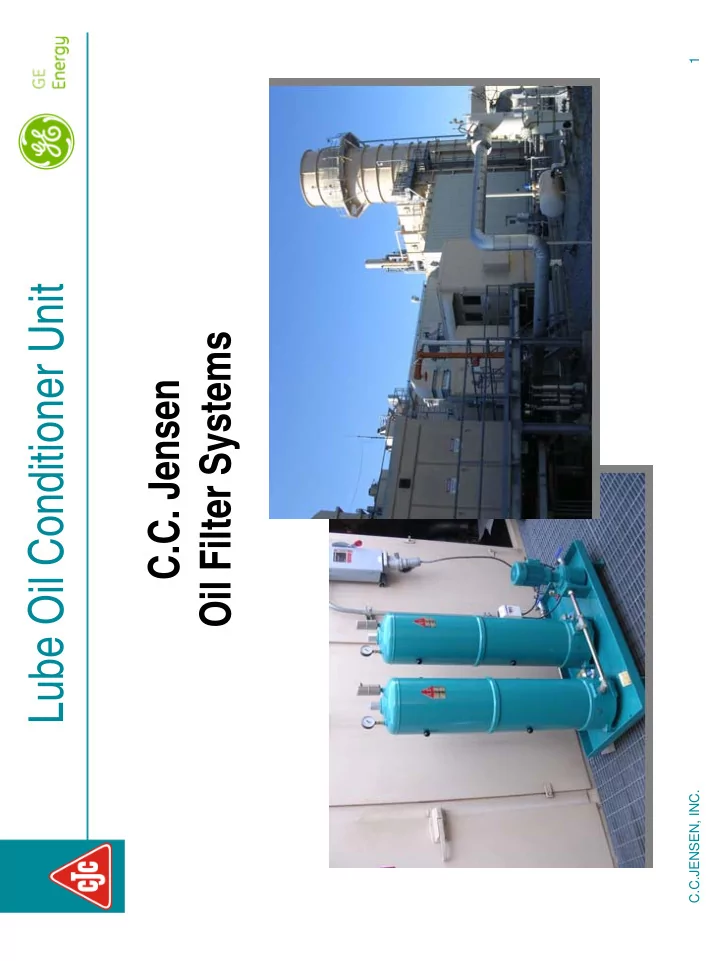
Lube Oil Conditioner Unit Oil Filter Systems C.C. Jensen - - PDF document
1 Lube Oil Conditioner Unit Oil Filter Systems C.C. Jensen C.C.JENSEN, INC. Lube Oil Conditioner Unit Agenda Functional Testing Results Sub Micron Particle Count Patch Colorimetric Test Gravimetric Analysis Varnish
C.C.JENSEN, INC. 1
C.C.JENSEN, INC. 2
C.C.JENSEN, INC. 3
C.C.JENSEN, INC. 4
C.C.JENSEN, INC. 5
Calpine Broad River Energy Center Gaffney, SC Run Time: December 13, 2005 to Present
C.C.JENSEN, INC. 6
“ “It is recommended that both of these tests be used to monitor th It is recommended that both of these tests be used to monitor the e performance of oil conditioning equipment. performance of oil conditioning equipment.” ”
GE Energy Services, Technical Information Letter, 1528 GE Energy Services, Technical Information Letter, 1528-
3
Provides a quantifiable scale to trend varnish potential Scale: 0 to 100 0 to 40 = Normal 41 to 60 = Caution 61 to 100 = Critical
Determines the effectiveness of removal of varnish particles (0.2 – 2 micron) Test: ASTM F 312-97 Standard Test Method for Microscopical Sizing and Counting Particles from Aerospace Fluids on Membrane Filters
C.C.JENSEN, INC. 7
C.C.JENSEN, INC. 8
December 13, 2005 December 13, 2005 March 3, 2006 March 3, 2006 March 17, 2006 March 17, 2006 BEFORE BEFORE AFTER AFTER
C.C.JENSEN, INC. 9
A 27/27 INITIAL WEIGHT (g) Flask 372 44 B 27/27 INITIAL WEIGHT (g) FINAL WEIGHT (g) GAIN/LOSS 381 26 35 Filter Flask Filter Average (Filter) FINAL WEIGHT (g) GAIN/LOSS 403 31 12 32 395 14 10 16 11 24
C.C.JENSEN, INC. 10
Sent: Thursday, February 16, 2006 6:03 AM To: 'Justin Stover' Subject: RE: Progress Report
Justin, Finally got a dispatch of several of our units. First time we have been called on to run in about 5 months. Unit 3 (the one the CC Jensen unit is on) worked beautifully. Unit 2 (treated by the ISOPur HR unit) failed to start due to a sticking IGV servo. When manually cycled several times the IGV servo began to work properly. We tested the servo for Unit 1 (which currently has a Kleentek unit running on the sump). This servo was very sticky and actually had to be replaced. We will need to send the servo off for reconditioning to eliminate the varnish build up. As a result of this inspection we removed the servo from Unit 2. It had varnish on it but not as bad as Unit 1. The last chance hydraulic filter was completely loaded with contamination that had been flushed into it from the header. When we checked Unit 3 the IGV servo looked completely free of varnish and the last chance filter had absolutely no evidence of varnishing. This is antidotal evidence which supports the lab results. Moving this unit to Turbine 1 to see what happens after Kleentek will be very valuable to you and GE.
C.C.JENSEN, INC. 11
Sample Date 0.2 - 1 µ 1 - 2 µ Total % Removed Notes 13-Dec-05 281 216 497 Baseline Unit Hours (Total / Test): 3,781 / 0 22-Dec-05 346 432 778
86 108 194 61.0% 31-Jan-06 75 118 193 61.2% 6-Mar-06 43 172 215 56.7% 17-Mar-06 15 57 72 85.5% Unit Hours (Total / Test): 3,790 / 9 1-Jun-06 2,123,610 4,260 2,127,870
13-Jun-06 2,552,080 1,756,740 4,308,820
23-Jun-06 130 108 238 52.1% 8 - A 27/27 Inserts added on 23-Jun-06 24-Jun-06 3,811 473 4,284
43 129 172 65.4% Unit Hours (Total / Test): 4,040 / 259
C.C.JENSEN, INC. 12
C.C.JENSEN, INC. 13
C.C.JENSEN, INC. 14
99.996% Reduction
C.C.JENSEN, INC. 15
Note: On June 13 the total was 4,308,820 Note: Total On June 30 was 172
C.C.JENSEN, INC. 16
C.C.JENSEN, INC. 17
C.C.JENSEN, INC. 18
C.C.JENSEN, INC. 19
C.C.JENSEN, INC. 20
Cellulose Molecules
Step 1 ”Film” Diffusion Varnish particles are transported from the oil to the boundary of the fiber bundle (adsorbent) Step 2 Macropore Diffusion Takes place within the adsorbent, among or between molecules Step 3 Micropore Diffusion From the pore fluid to the molecules
C.C.JENSEN, INC. 21
C.C.JENSEN, INC. 22
Reliability (based upon Calpine trial) Mean Time Between Failures (MTBF) MTBF = 4,368* * From 12/13/05 to 06/13/06 182 Days = 4,368 hours Design Life 30 Year Design Life 24/7/365 Operation Design Life 30 Year Design Life 24/7/365 Operation