Lower Aquifer System in the Coastal Area, Tanzania Said Suleiman - - PowerPoint PPT Presentation

lower aquifer system in the coastal area tanzania
SMART_READER_LITE
LIVE PREVIEW

Lower Aquifer System in the Coastal Area, Tanzania Said Suleiman - - PowerPoint PPT Presentation

Geochemical Characterization of the Upper and Lower Aquifer System in the Coastal Area, Tanzania Said Suleiman Bakari Per Aagaard Rolf D. Vogt Dept. of Geosciences, University of Oslo, Norway Ruden Fridtjov Ruden Aquifer Development Ltd,


slide-1
SLIDE 1

Said Suleiman Bakari Per Aagaard Rolf D. Vogt

  • Dept. of Geosciences,

University of Oslo, Norway

Ruden Fridtjov

Ruden Aquifer Development Ltd, Norway

Vuai Said Ali Department of Physical Sciences, The University of Dodoma, Tanzania October 2009

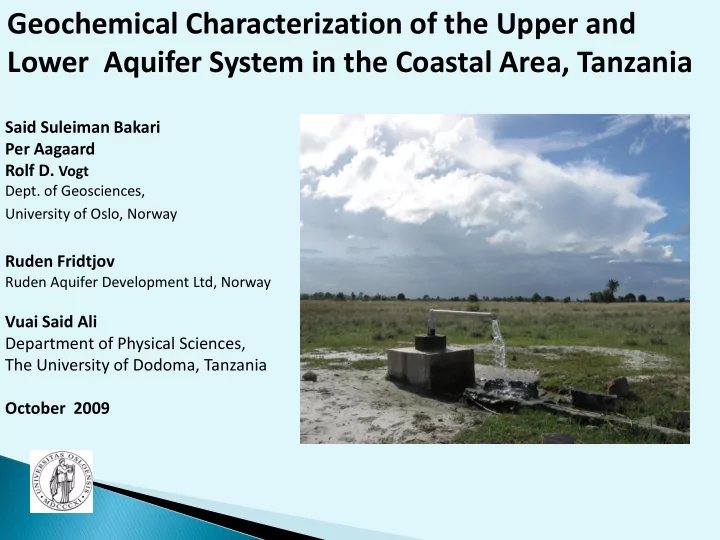
Geochemical Characterization of the Upper and Lower Aquifer System in the Coastal Area, Tanzania

slide-2
SLIDE 2

Current (2009) Projected (2020) Population 3,000,000 > 5,000,000 Water demand (m3/day) 280,500 550,000 Actual water supply (m3/day) 180,000 Water deficit (m3/day) 100,500

2

The rapid pace of urban development, and prolonged droughts and deforestation has led to increased the demand for freshwater resources in coastal Tanzania

This presentation focuses on Geochemical Characterization

  • f the Upper and Lower Aquifer System in the Coastal Area,

Tanzania

slide-3
SLIDE 3

3

Searching for a groundwater source to augment surface water as a source for public water supply The regional neogene aquifer was discovered in the alluvial plain of coastal area in Dar es Salaam

slide-4
SLIDE 4

Our specif ific ic

  • bjective

ctives

  • to
  • examin

amine e closely sely the e hydrogeoch

  • geochemi

mical cal char harac acteristics teristics of grou

  • undwa

dwater ter in the coas

  • asta

tal l aquif ifer er syst stems ems

  • and to asses

s the water er quali ality ty and cross-fl flow

  • w

con

  • ntam

amin inat atio ion betw twee een n the e aquifer ifer units ts and surfa face ce pollu luti tion

4

To use groundwater in a sustainable manner in this region, an accurate estimation of the discovered aquifer and the existing groundwater was conducted;

slide-5
SLIDE 5

5

Study Area and Hydrogeological Setting

Stud udy area ≈10.000 km2 Loca cati tion

  • n

39 39oE E - 39 39o45’E 6o30’S -7o30’S Tempera ratu ture re ranges ges 18 to 32oC C mean n annua ual preci ecipita tati tion

  • n

1100 0 mm mean n annua ual valu lue of

  • f

actu tual evapora rati tion

  • n

1900 0 mm.

slide-6
SLIDE 6

Mat aterial rial an and Methods hods

Water er sampli mpling

6-deep ep wells (200- 610m)

3-River River water ter 13 13- shall allow well lls s (<100 100m)

Analysed d paramete ters Physio- chemic ical al: pH, EC, DO, Temp,

Major anions s & cations

Trace ce metal: l: Mn Mn Geoche chemical cal Characte acterisati risation Piper diagram were re used to c classify fy and characte acterize rize the ground ndwa wate ter quality. y.

6

slide-7
SLIDE 7

7

  • Average saturated thickness of the aquifer ≈ 1000 m
  • Flow direction: W-E driven by artesian pressure-western hinterland

The main Kimbiji production well (PW6)

Artesian flow > 3 l/s

slide-8
SLIDE 8

Sam ampl ple Code de Village age (Area) ea) Dept pth (m) (m) pH pH Temp mp. ( ( oC ) DO (mg/L) /L) ORP (mV) EC (µS/c /cm) m) Water er Type

Groundwater samples from Lower Aquifer System

PW1 Mpiji 200 7.71 30.2 2.13 nm 1057 Na-HCO3-Cl PW5 Mpera 200 6.16 28.5 1.89 nm 362.0 Na-Cl-HCO3 PW7 Kimbiji 200 7.85 30.1 1.39

  • 51.1

1154 Na-HCO3-Cl PW3 Mpiji 610 7.76 29.7 2.46 nm 2570 Na-Cl PW4 Mpera 600 6.35 30.8 2.48 nm 359.0 Na-Cl-HCO3 PW6 Kimbiji 612 8.33 34.6 0.49

  • 81.2

866.0 Na-HCO3-Cl

Groundwater samples from Upper Aquifer System

PW2 Mpiji 80 7.79 29.6 6.35 nm 848.0 Na-Ca-Cl-HCO3 PW8 Kijichi 50 6.88 29.3 5.44 nm 358.0 Na-Ca-HCO3-Cl PW9 Mbagala 70 6.32 28.1 4.84 nm 1050 Na-Cl-NO3 PW10 Tandika 53 5.80 28.5 3.50 88.7 1197 Na-Ca-Mg-NO3-Cl PW11 Tazara 65 6.76 28.0 6.64 28.2 860.0 Na-Mg-Ca-Cl-NO3 PW12 Tabata 60 6.87 28.9 6.56 25.2 1211 Na-Cl PW13 Airport 100 7.53 28.7 4.01

  • 16.6

1168 Na-Cl-HCO3 PW14 Kigogo 60 7.17 29.5 4.46 42.0 3870 Na-Ca-Cl PW15 Ocean-Rd 11 7.43 28.4 4.40

  • 11.0

1097 Ca-Na-HCO3-Cl PW16 M’nyamala 50 7.08 28.0 3.69 9.50 1696 Na-Ca-Cl-HCO3 PW17 Tegeta 65 6.92 28.6 4.46 19.1 6130 Na-Ca-Cl-SO4 PW18 Kibaha 95 7.31 27.3 2.01

  • 4.30

5100 Na-Cl PW19 Ubungo 70 6.23 26.8 6.13 59.9 1790 Na-Mg-Cl

Riverwater Samples

R1 Kizinga 7.38 27.6 5.65 nm 651.0 Na-Ca-Cl-HCO3 R2 Ruvu 7.80 26.5 7.09

  • 33.3

97.40 Ca-Mg-Na-HCO3 R3 Mpiji 7.82 28.4 5.80 nm 688.0 Ca-HCO3

8
slide-9
SLIDE 9

The better water quality are in the lower groundwater dominated by Na–HCO3 water The upper groundwater fall under marine origin site, dominated by Na-Ca-Cl, as indication

  • f seawater intrusion

80 60 40 20 20 40 60 80 20 40 60 80 80 60 40 20 20 40 60 80 20 40 60 80

Ca Na HCO3 Cl Mg SO4

Legend:

Lower Aquifer Upper Aquifer River water

9

The piper diagram revealed that the hydrogeochemical composition

  • f the upper groundwater is affected by seawater intrusion
slide-10
SLIDE 10

0.5 1 1.5 2 2.5 3 3.5 4 4.5 10 20 30 40 50 Lower Aquifer (200-610m) Upper Aquifer (<100m) Na

+/Cl
  • (meq ratio)

Cl- (meq/L) 2 4 6 8 10 12 10 20 30 40 50 Lowe Aquifer (200 -610m) Upper Aquifer (<100m) Ca

2+/HCO 3
  • (meq ratio)

Cl- (meq/L)

b a

10

the e increa crease sed disc scharge harge and addit ition

  • nal

l recha harg rge e has a profou found nd effec ect t on the hydroc rochemis hemistr try y of the aquifer ifer, , and induc uced groun undwa water ter flus ushi hing ng and dilu luti tion. n.

slide-11
SLIDE 11

11

100 200 300 400 500 600 100 200 300 400 500 500 1000 1500

Well depth (m)

NO3

  • (mg/L)

Cl- (mg/L)

Nitrate Chloride

Upper Aquifer Lower Aquifer

Cl- from PW3 - originated from relict seawater in the lower aquifer system during the Pleistocene time

slide-12
SLIDE 12

Low NO3

  • with relation to Cl- , is evident that biogeochemical

processes is attenuating nitrate in the lower aquifer system

100 200 300 400 500 500 1000 1500 Lower Aquifer (200-610m) Upper Aquifer (<100m) NO

3
  • (mgL
  • 1)

Cl- (mgL-1)

12

slide-13
SLIDE 13

13 100 200 300 400 500 50 100 150 200 250 300 350 400

Lower Aquifer (200 - 610m) Upper Aquifer ( <100m) NO3

_ (mg/L)

HCO

3 _ (mg/L)

100 200 300 400 500 1 2 3 4 5 6 7

NO3

_ (mg/L)

DO (mg/L)

Low DO and high HCO3

_ in the lower aquifer indicating that dissolution

  • f the carbonate minerals via biodegradation of organic matter
slide-14
SLIDE 14

Sample Code Well Depth (m) HCO3

  • (mmoles/L)

Saturation Index (SI) for selected minerals Calcite Dolomite Gypsum Groundwater samples from Lower Aquifer System

PW1 200 4.294

  • 0.39
  • 1.33
  • 1.02

PW5 200 0.803

  • 0.25
  • 0.91
  • 1.14

PW7 200 5.917

  • 0.45
  • 1.33
  • 1.22

PW3 610 3.016

  • 0.15
  • 0.85
  • 0.97

PW4 600 1.115 0.15 0.01

  • 1.11

PW6 612 5.720

  • 0.36
  • 1.16
  • 1.18

Groundwater samples from Upper Aquifer System

PW2 80 2.614

  • 0.01
  • 0.52
  • 0.97

PW8 50 1.770 0.82 0.85

  • 0.75

PW9 70 1.016 0.64 0.37

  • 0.74

PW10 53 0.344 0.43 0.05

  • 0.74

PW11 65 1.492 0.87 0.57

  • 0.71

PW12 60 1.885 0.51

  • 0.19
  • 0.71

PW13 100 4.376 0.72 0.45

  • 0.72

PW14 60 4.737 0.42

  • 0.10
  • 0.70

PW15 11 4.327

  • 0.16
  • 1.47
  • 1.22

PW16 50 3.491 0.04

  • 0.41
  • 1.07

PW17 65 3.508

  • 0.48
  • 1.53
  • 1.06

PW18 95 5.556

  • 0.18
  • 0.92
  • 1.05

PW19 70 1.115

  • 0.32
  • 1.13
  • 0.89

Riverwater Samples

R1 1.328

  • 0.20
  • 0.91
  • 1.08

R2 0.574

  • 0.40
  • 1.29
  • 1.04

R3 2.065

  • 0.04
  • 1.03
  • 0.38

14

HCO3

_ - controlled

by dissolution of the carbonate minerals via biodegradation of

  • rganic matter
slide-15
SLIDE 15

15

  • Most of the groundwater from the upper aquifer is not suitable for drinking

water because of its high salinity which is mainly caused by saltwater intrusion

  • Hydrogeochemical data of shallow well samples are dominated by Na-Ca-Cl

type with chloride ( Cl-) as the dominant anion, while other type of waters are also observed

  • The better water quality was found at lower confined aquifer, where

groundwater of Na–HCO3 type prevails

  • Our findings show that the cation exchange reaction and dissolution of

carbonate minerals are mainly the geochemical processes in the aquifer system

  • Concentration of NO3
  • in groundwater revealed that at the moment there are

no cross-flow contamination between the upper and lower aquifer system

slide-16
SLIDE 16

16

  • We thank the staff of the;-
  • Dar es Salaam water supply authority (DAWASA) and the Ardhi

University-Dar es Salaam for their support during the sampling campaign.

  • Technicians in the Department of Geosciences laboratory,

University of Oslo for helpful water samples analysis.

  • This research was supported financially by the Quator Scheme

Programme.

slide-17
SLIDE 17

THANK

You for your attention