
SLIDE 1
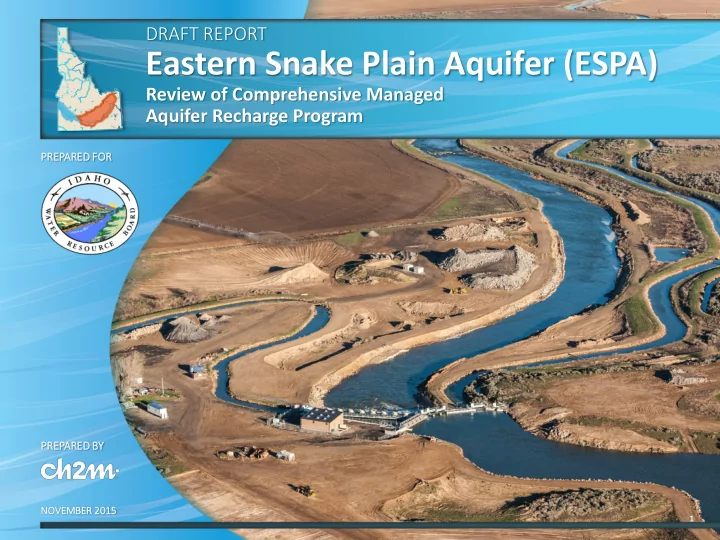
DRAFT REPORT
Eastern Snake Plain Aquifer (ESPA)
Review of Comprehensive Managed Aquifer Recharge Program
PREP EPARED ED F FOR
NOVEMBER 2 R 2015
PREP EPARED ED B BY
1
Eastern Snake Plain Aquifer (ESPA) Review of Comprehensive Managed - - PowerPoint PPT Presentation
DRAFT REPORT Eastern Snake Plain Aquifer (ESPA) Review of Comprehensive Managed Aquifer Recharge Program PREP EPARED ED F FOR PREP EPARED ED B BY NOVEMBER 2 R 2015 1 Project Objective and Overview Eastern Snake Plain Aquifer (ESPA)
DRAFT REPORT
Review of Comprehensive Managed Aquifer Recharge Program
PREP EPARED ED F FOR
NOVEMBER 2 R 2015
PREP EPARED ED B BY
1
Eastern Snake Plain Aquifer (ESPA) Review of Comprehensive Managed Aquifer Recharge Program 2
Provide an independent, technical review of the state’s managed recharge program
Eastern Snake Plain Aquifer (ESPA) Review of Comprehensive Managed Aquifer Recharge Program 3
Review and summarize existing reports
» Summary of the recharge program and its evolution over time
Summarize basin hydrogeology and limits to managed recharge Summarize water rights and water supply availability for managed recharge
Eastern Snake Plain Aquifer (ESPA) Review of Comprehensive Managed Aquifer Recharge Program 4
We believe the state is on the right path Sufficient water is available for recharging 150 to 250 thousand acre-feet annually To consistently achieve this goal, there may be site-specific improvements needed at recharge locations to overcome limitations, such as diversion, infiltration, and recharge capacity
» Managed recharge site identification and canal system improvements/modifications to capitalize on the 500 to 1,000 cfs of water available nearly every day of every winter downstream of Minidoka. » Canal capacity improvements upstream of Minidoka, combined with funding for
recharge upstream of Minidoka. » Expansion of canal capacity at key points of diversion throughout the basin to capture water that is available for recharge in the spring.
The State is implementing an adaptive implementation strategy, per the 2009 ESPA CAMP, and we believe this approach is appropriate. This phased approach provides an opportunity to adapt to future conditions
Eastern Snake Plain Aquifer (ESPA) Review of Comprehensive Managed Aquifer Recharge Program 5
Eastern Snake Plain Aquifer (ESPA) Review of Comprehensive Managed Aquifer Recharge Program 6
Policies guiding availability of water for managed recharge Physical and legal availability of water in Water District 01 Methods of analysis Primary results
» Timing and diversion rates » Annual volumes and duration » Limiting constraints
Other factors affecting recharge availability
» Climate » Capitalizing on availability: winter versus summer » Fish and wildlife needs » Water rights » Recharge in tributary basins
Eastern Snake Plain Aquifer (ESPA) Review of Comprehensive Managed Aquifer Recharge Program 7
Is an opportunistic use of available natural flow in upper Snake River Shall not interfere with optimal storage in upper Snake reservoirs Will be conducted in accordance with prior appropriation doctrine Will be consistent with water-rights administration in WD01 Shall not interfere with USBR’s unsubordinated Minidoka power right Will be consistent with State Water Plan and ESPA CAMP
Eastern Snake Plain Aquifer (ESPA) Review of Comprehensive Managed Aquifer Recharge Program 8
Natural flow past Milner Dam is available for managed recharge
Eastern Snake Plain Aquifer (ESPA) Review of Comprehensive Managed Aquifer Recharge Program 9
Eastern Snake Plain Aquifer (ESPA) Review of Comprehensive Managed Aquifer Recharge Program 10
No Recharge
NO
..
~
~ lner >O YES
WINTER
Recharge Availability
Season
SUMMER
IWRB
NO
Recharge Rights in ~
~
Priority at POD
YES
No Recharge at POD Recharge Below Minidoka, up to
Q Milner
Recharge Below Minidoka. up
to Natural Flow at Milner No Recharge Above Minidoka
NO
Q M1n1doka
>2,700 ds Recharge Above Minidoka. up
tO Q Minidoka >2,700 cfS
YES
Available Natural Flow
at Milner>O
NO
No Recharge
Recharge at any given POD is always limited by available natural flow at Milner. available flow at POD. and amount of IWRB water rights in priority at POD.
Eastern Snake Plain Aquifer (ESPA) Review of Comprehensive Managed Aquifer Recharge Program 11
ID Number(s) Type Priority Date Diversion (cfs) Point(s) of Diversion 01-7054 Permit 8/25/1980 1,200 Any (by current water supply bank rental agreement) 01-7142 Application 3/20/1998 2,831 Milner 01-10609 Application 3/20/1998 3,738 Minidoka to Milner 01-10612 Application 3/20/1998 2,106 Menan to Blackfoot 01-10613 Application 3/20/1998 3,206 SF: Heise to Lorenzo 21-7577, 7578, 7580, 13160 Application 3/20/1998 2,191 HF: Fall River, Henrys Fork, Teton River TOTAL 15,272
Applied availability flow chart to WD01 accounting data. Assumed diversion occurs under IWRB 1980- and 1998-priority rights. Analyzed irrigation years 1980-2014 (n = 35 years). Used daily time step, but summarized statistics over irrigation years. Conducted analysis independently at seven system nodes:
» Milner » Minidoka » Near Blackfoot » Shelley » Heise » Henrys Fork at St. Anthony » Teton River at St. Anthony
Eastern Snake Plain Aquifer (ESPA) Review of Comprehensive Managed Aquifer Recharge Program 12
Eastern Snake Plain Aquifer (ESPA) Review of Comprehensive Managed Aquifer Recharge Program 13
Availability generally decreases with distance upstream. ~1000 cfs available below Minidoka every day of winter during median year. Water not available during summer in about half of years. Water never available late August- late September.
Eastern Snake Plain Aquifer (ESPA) Review of Comprehensive Managed Aquifer Recharge Program 14
MEDIAN STATS Volume: 627k af/yr blw. Minidoka 149k af/yr ab. Mindoka Duration: 205 days/yr
(151 winter) 55 days/yr
(3 winter)
Eastern Snake Plain Aquifer (ESPA) Review of Comprehensive Managed Aquifer Recharge Program 15
Eastern Snake Plain Aquifer (ESPA) Review of Comprehensive Managed Aquifer Recharge Program 16
Constraint Milner Mid-Valley South Fork Henrys Fork No recharge: 0 flow at Milner No recharge: Power right NA 145 145 145 Recharge: flow at Milner 151 Recharge: Power right NA 3 3 Recharge: flow at POD 151 Recharge: water rights div. rate
Median number of days limited by given constraint
Eastern Snake Plain Aquifer (ESPA) Review of Comprehensive Managed Aquifer Recharge Program 17
Constraint Milner Mid-Valley South Fork Henrys Fork No recharge: water-rights priority 151 163 167 163 No recharge: 0 flow at Milner No recharge: Power right NA Recharge: flow at Milner 31 11 13 10 Recharge: Power right NA Recharge: flow at POD 31 2 Recharge: water rights div. rate 6 3 1
Median number of days limited by given constraint
Winter water available below Minidoka in all years Winter water available above Minidoka in years with high carryover Summer water available only in high- runoff years, regardless of location Period of record is reason for small differences between our results and IDWR 2000-2012 analysis
Eastern Snake Plain Aquifer (ESPA) Review of Comprehensive Managed Aquifer Recharge Program 18
Climatic period Below Minidoka Above Minidoka 1980-2014 1,200,000 600,000 500,000 150,000 2000-2014 600,000 200,000 200,000 7,000 Mean/median annual availability (ac-ft)
Winter
» Recharge 500-1000 cfs all winter downstream of Minidoka. » Establish administrative and logistical flexibility to recharge upstream of Minidoka on short notice late in winter. » Ice and snow in canals may limit opportunities for late-winter recharge. » Canals in Henrys Fork basin that divert water during winter for sub-irrigation and stock water provide opportunity for late-winter recharge.
Summer
» Canals already convey irrigation water when summer recharge becomes available during spring freshet. » Expanding canal capacity at key locations may be needed to capitalize on summer recharge availability.
Eastern Snake Plain Aquifer (ESPA) Review of Comprehensive Managed Aquifer Recharge Program 19
Key stream reaches of concern
» Henrys Fork: Downstream of Fall River » South Fork Snake River: Heise to Menan » Snake River: Menan to American Falls Reservoir
Primary streamflow needs
» Sufficient winter flow for juvenile trout survival » Spring-time freshet for channel and floodplain habitat maintenance
Potential effects of diversion for managed recharge
» Minidoka power right prevents winter recharge except when flows are already high, minimizing potential effects of winter recharge. » Substantial effects likely only if Minidoka power constraint is relaxed. » Water-rights priorities limit spring-time recharge to those years when high flows have greatest potential to benefit channel and floodplain. » Potential spring-timer effects are greatest in Shelley-American Falls reach.
Eastern Snake Plain Aquifer (ESPA) Review of Comprehensive Managed Aquifer Recharge Program 20
Permitted and pending water rights for managed recharge:
» 15,272 cfs IWRB + 3,985 cfs private = 19,257 cfs » Available natural flow exceeded this on less than 0.5% of days in 1980-2014.
Henrys Fork traditional winter diversion (sub-irrigation, stock water)
» 17 private rights with priorities 1902 or earlier » Maximum rate: 1,912 cfs » Historic rate: 329 cfs mean = 98,000 ac-ft/yr incidental recharge » Recommend encouraging this historic winter diversion but not counting it toward managed recharge goals.
Recharge in ESPA tributary basins:
» will not reduce managed recharge water availability in WD01 » is neutral to ESPA unless it uses water that historically reached Snake River as surface flow » is not helpful to ESPA if it simply offsets increased consumptive use (Wood R.)
Eastern Snake Plain Aquifer (ESPA) Review of Comprehensive Managed Aquifer Recharge Program 21
Water is available almost every day of every winter below Minidoka. Power right prevents winter recharge above Minidoka in half of years. Water available system-wide in half of years for ~30 days in May-June. Future availability depends on whether climate includes sequences of wet years like 1980-1987 and 1995-1999.
» If so, median availability is 600 kaf below Minidoka and 150,000 kaf above. » If not, median availability is 200 kaf below Minidoka and 7,000 kaf above.
Need to recharge 500-1000 cfs downstream of Minidoka all winter and be able to divert late-winter water upstream on short notice. Using spring freshet may require expanded canal capacity. If all applications are permitted, existing recharge rights are sufficient. Canal capacity, administrative and physical logistics, weather, and fish/wildlife concerns may limit recharge before water supply does.
Eastern Snake Plain Aquifer (ESPA) Review of Comprehensive Managed Aquifer Recharge Program 22