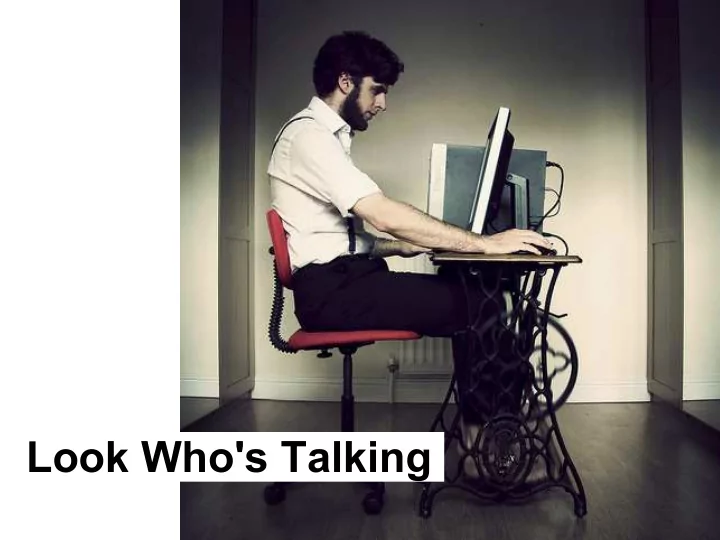
SLIDE 1
Look Who's Talking
SLIDE 2 The amish
- Cliche for for refusing technology
- Departures from Europe as successful innovators
- Ancestor of Anabaptist, but broke out
and moved to New World in 1710
"Old order" - still stick to horse and buggy "New order" - approve use of telephones and powered farm equipment "Beachy Amish" - permit both public electricity and automobiles
SLIDE 3
Bishops
20 - 30 families constitute a district with one bishop Decisions are usually made through consensus with the community Family in focus - not individuality Concerned about what kind of person one becomes when using the new technology When evaluating technology, the bishops of several districts meets
SLIDE 4 Does it bring us together,
The Bible teaches not to conform to the world - keep a separation "We don't want to stop the progress, we just want to slow it down Adopts technology that can enhance their productivity, wthin their self imposed limits
SLIDE 5
Telephone
"It holds people together by making communication among community members possible, and it separates them from the world and each other." "It is both evil and good" Was first not accepted in the business, but it began to be accepted later when they say its benefit In the beginning the amish also put it in their home, but when it become misused the bishops banned it Cell phone - lack of wire - handy but also a challenge Cell phone - harder to maintain separation between home and business
SLIDE 6
Modern dilemma:
How to balance the rights of the individual with the needs of the community? For the Amish the community comes first! What about the non Amish - the English and the others?
SLIDE 7
How do we evaluate technology?
Use it if it suits us? If it suits our individual needs? "is it convenient or amusing?" "would this have serious implications for my privacy?"
SLIDE 8
Can we learn anything from the amish? Identity theft social notworks - private data - biometrics
SLIDE 9 Hans-Joachim Jelena Mirkovic Ivica Milanovic Øyvind Bakkeli
SLIDE 10 Project goals:
Identify most common and accepted authentication methods for mobile services. Research what differences, opportunities and challenges concerning user authentication for mobile services compared with traditional stationary computers. Find out how do people accept them and what are their opinions regarding security on mobile device. Evaluation of a security / usability / privacy trade offs for different authentication mechanisms. Development of prototype based on results from previous steps.
SLIDE 11
Research on what is already developed and available in the area of user authentication for mobile and stationary services
Web browsing Research databases (IEEE, ACM, Elsevier) Literature
Getting know the users
Questionnaire
Prototype
Paper prototype Evaluation through interview with users
SLIDE 12
Classification in four groups:
Something that user knows Something that user has Something that user is Location based
SLIDE 13
Something that user knows
PIN/passwords Usability good, but security depends on users Password management problem
SLIDE 14
Something that user has
Tokes can be One Time Password generator devices, password cards, messages Appropriate for mobile devices, because mobile phone can be used both as terminal for providing service and token
SLIDE 15
Something that user is
centers around authentication based on that person's unique traits Fingerprint readers, face recognitions, iris scanning,… Good and bad solutions
SLIDE 16
Location based
Not used so much today Usage of services limited only to some area, or location can be used to determine the level of authentication one need
SLIDE 17
Results:
SLIDE 18
Next step in our project We want to determine what users would expect and tolerate to protect their personal information Hard copies and in online version Only stipulation is the respondents should be current or previous users of mobile handsets.
SLIDE 19
Feedback?
SLIDE 20
Feedback? Thank you for the help
SLIDE 21