Logistic Regression using Excel OLS with Nudge V1F 7/27/2017 V1F - - PDF document

logistic regression using excel ols with nudge v1f 7 27
SMART_READER_LITE
LIVE PREVIEW

Logistic Regression using Excel OLS with Nudge V1F 7/27/2017 V1F - - PDF document

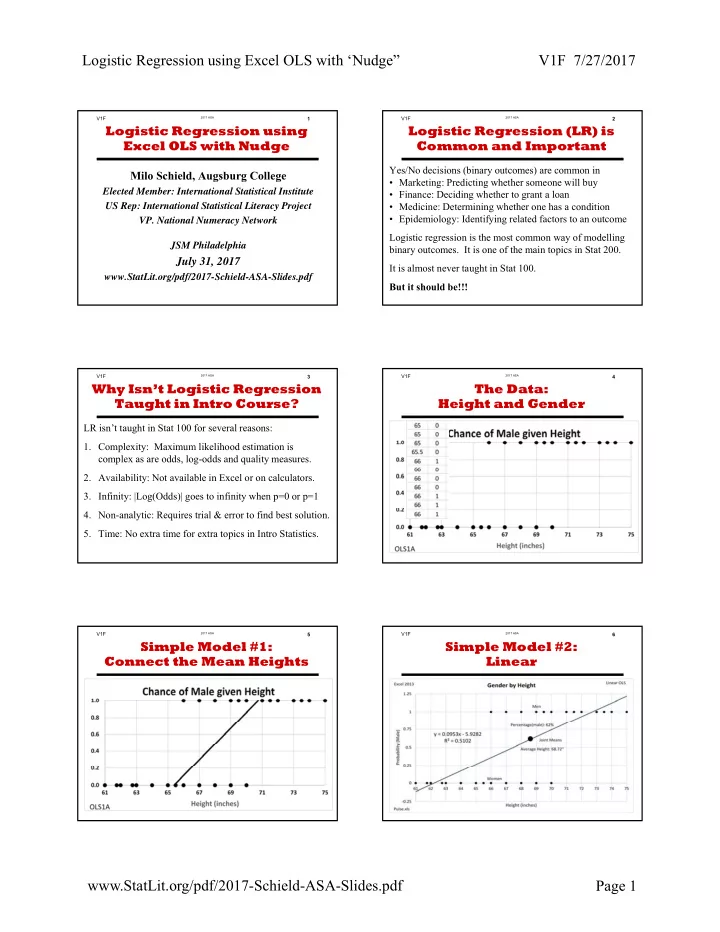
Logistic Regression using Excel OLS with Nudge V1F 7/27/2017 V1F 2017 ASA 1 V1F 2017 ASA 2 Logistic Regression using Logistic Regression (LR) is Excel OLS with Nudge Common and Important Yes/No decisions (binary outcomes) are


slide-1
SLIDE 1

Logistic Regression using Excel OLS with ‘Nudge” V1F 7/27/2017 www.StatLit.org/pdf/2017-Schield-ASA-Slides.pdf Page 1

2017 ASA

V1F 1

Milo Schield, Augsburg College

Elected Member: International Statistical Institute US Rep: International Statistical Literacy Project

  • VP. National Numeracy Network

JSM Philadelphia

July 31, 2017

www.StatLit.org/pdf/2017-Schield-ASA-Slides.pdf

Logistic Regression using Excel OLS with Nudge

2017 ASA

V1F 2

Yes/No decisions (binary outcomes) are common in

  • Marketing: Predicting whether someone will buy
  • Finance: Deciding whether to grant a loan
  • Medicine: Determining whether one has a condition
  • Epidemiology: Identifying related factors to an outcome

Logistic regression is the most common way of modelling binary outcomes. It is one of the main topics in Stat 200. It is almost never taught in Stat 100. But it should be!!!

Logistic Regression (LR) is Common and Important

2017 ASA

V1F 3

LR isn’t taught in Stat 100 for several reasons:

  • 1. Complexity: Maximum likelihood estimation is

complex as are odds, log-odds and quality measures.

  • 2. Availability: Not available in Excel or on calculators.
  • 3. Infinity: |Log(Odds)| goes to infinity when p=0 or p=1
  • 4. Non-analytic: Requires trial & error to find best solution.
  • 5. Time: No extra time for extra topics in Intro Statistics.

Why Isn’t Logistic Regression Taught in Intro Course?

2017 ASA

V1F 4

.

The Data: Height and Gender

2017 ASA

V1F 5

.

Simple Model #1: Connect the Mean Heights

2017 ASA

V1F 6

.

Simple Model #2: Linear

slide-2
SLIDE 2

Logistic Regression using Excel OLS with ‘Nudge” V1F 7/27/2017 www.StatLit.org/pdf/2017-Schield-ASA-Slides.pdf Page 2

2017 ASA

V1F 7

.

Simple Model #3: Logistic Curve

2017 ASA

V1F 8

This simple solution involves two shortcuts:

  • 1. Use the logistic function, but nudge the zero-one data to

be epsilon and one minus epsilon. This ‘nudge’ eliminates the infinities in Ln[Odds(p)].

  • 2. Use the Ordinary Least Squares (OLS) in place of

Maximum Likelihood Estimation (MLE). This eliminates the need for industrial-strength software. Benefits: This allows more attention to the results and to subsequent topics such as confounding and classification.

Simple Solution #4

2017 ASA

V1F 9

.

Ln[Odds(Nudged Prob)]

2017 ASA

V1F 10

.

OLS Results: Regress Gender on Height

2017 ASA

V1F 11

.

Translate back to P-space; Plot Probability vs. Height

2017 ASA

V1F 12

.

How close is OLS to MLE? Height: Fairly close…

slide-3
SLIDE 3

Logistic Regression using Excel OLS with ‘Nudge” V1F 7/27/2017 www.StatLit.org/pdf/2017-Schield-ASA-Slides.pdf Page 3

2017 ASA

V1F 13

.

MLE vs. OLS+Nudge: Significant Difference? No!

2017 ASA

V1F 14

.

How close is OLS to MLE? Weight: Fairly close…

2017 ASA

V1F 15

.

MLE vs. OLS+Nudge: No Significant Difference

2017 ASA

V1F 16

“the maximized log likelihood method has always impressed me as an exercise in excessive fine-tuning, reminiscent on some occasions of what Alfred North Whitehead identified as the fallacy of misplaced concreteness, and on others of what Freud described as the narcissism of small differences.” Comparing exact MLE with OLS regression of Ln[Odds(p)] where p is for grouped data: “The second reason is that in most real-world cases there is little if any practical difference between the results of the two methods.” Richard Lowry, Vassar. http://vassarstats.net/logreg1.html

Quotes

2017 ASA

V1F

Those teaching intro statistics needs to think broadly. Going deeper is good for those who plan to continue on. But almost none of those taking Stat 101 will take Stat 201. Introducing logistic regression using OLS is simple. The difference between MLE and OLS may not be significant .

17

Recommendation

Introducing logistic regression in STAT 101

  • pens the door for other multivariate items

such as confounding, classification analysis and discriminant analysis.

2017 ASA

V1F 18

OLS is not right in this case. We don’t want to teach our students bad methods. This OLS+nudge shortcut has a serious lack of rigor. This is unprofessional; we shouldn’t allow it.

So Why Won’t It Be Taught?

Reply: Lack of rigor vs. rigor mortis? Can the perfect be the enemy of the good? What is our goal? For students to

  • 1. understand some important ideas or
  • 2. be taught correctly even if they don’t understand?
slide-4
SLIDE 4

Logistic Regression using Excel OLS with ‘Nudge” V1F 7/27/2017 www.StatLit.org/pdf/2017-Schield-ASA-Slides.pdf Page 4

2017 ASA

V1F 19

Focus on GAISE 2017 goals.

  • Multivariate thinking
  • More focus on confounding

See Schield (2016) Offering Stat 102: Social Statistics for Decision Makers. http://www.statlit.org/pdf/2016-Schield-IASE.pdf

Conclusion

2017 ASA

V1F 20

.

Much More Important Issues Un-Scientific American (2017)

2017 ASA

V1F 21

Three strikes and you are out!

  • 1. Association is not statistically significant
  • 2. Association is not materially significant
  • 3. Author knows that both of these are true,

yet puts the association in the headline to the story

Much More Important Issues Un-Scientific American

Moral: Statistical educators need to put more attention on misuses of statistics in the everyday media. To do less is professional negligence.

2017 ASA

V1F 22

Carlberg, Conrad (2012). Decision Analytics: Microsoft

  • Excel. Que Publishing.

Lowry, R. (2017). E-mail http://vassarstats.net/logreg1.html Moore, David (2001). Statistical Literacy and Statistical Competence in the New Century. IASE Proceedings. http://iase-web.org/documents/papers/sat2001/Moore.pdf Schield, Milo (2017). Tools at www.StatLit.org/tools.htm Schield, Milo (2016). Logistic Regression using Minitab and Pulse dataset. http://www.statlit.org/pdf/2016- Minitab-MLE1-Test1.pdf

Bibliography

slide-5
SLIDE 5

2017 ASA

V1F 1

Milo Schield, Augsburg College

Elected Member: International Statistical Institute US Rep: International Statistical Literacy Project

  • VP. National Numeracy Network

JSM Philadelphia

July 31, 2017

www.StatLit.org/pdf/2017-Schield-ASA-Slides.pdf

Logistic Regression using Excel OLS with Nudge

slide-6
SLIDE 6

2017 ASA

V1F 2

Yes/No decisions (binary outcomes) are common in

  • Marketing: Predicting whether someone will buy
  • Finance: Deciding whether to grant a loan
  • Medicine: Determining whether one has a condition
  • Epidemiology: Identifying related factors to an outcome

Logistic regression is the most common way of modelling binary outcomes. It is one of the main topics in Stat 200. It is almost never taught in Stat 100. But it should be!!!

Logistic Regression (LR) is Common and Important

slide-7
SLIDE 7

2017 ASA

V1F 3

LR isn’t taught in Stat 100 for several reasons:

  • 1. Complexity: Maximum likelihood estimation is

complex as are odds, log-odds and quality measures.

  • 2. Availability: Not available in Excel or on calculators.
  • 3. Infinity: |Log(Odds)| goes to infinity when p=0 or p=1
  • 4. Non-analytic: Requires trial & error to find best solution.
  • 5. Time: No extra time for extra topics in Intro Statistics.

Why Isn’t Logistic Regression Taught in Intro Course?

slide-8
SLIDE 8

2017 ASA

V1F 4

.

The Data: Height and Gender

slide-9
SLIDE 9

2017 ASA

V1F 5

.

Simple Model #1: Connect the Mean Heights

slide-10
SLIDE 10

2017 ASA

V1F 6

.

Simple Model #2: Linear

slide-11
SLIDE 11

2017 ASA

V1F 7

.

Simple Model #3: Logistic Curve

slide-12
SLIDE 12

2017 ASA

V1F 8

This simple solution involves two shortcuts:

  • 1. Use the logistic function, but nudge the zero-one data to

be epsilon and one minus epsilon. This ‘nudge’ eliminates the infinities in Ln[Odds(p)].

  • 2. Use the Ordinary Least Squares (OLS) in place of

Maximum Likelihood Estimation (MLE). This eliminates the need for industrial-strength software. Benefits: This allows more attention to the results and to subsequent topics such as confounding and classification.

Simple Solution #4

slide-13
SLIDE 13

2017 ASA

V1F 9

.

Ln[Odds(Nudged Prob)]

slide-14
SLIDE 14

2017 ASA

V1F 10

.

OLS Results: Regress Gender on Height

slide-15
SLIDE 15

2017 ASA

V1F 11

.

Translate back to P-space; Plot Probability vs. Height

slide-16
SLIDE 16

2017 ASA

V1F 12

.

How close is OLS to MLE? Height: Fairly close…

slide-17
SLIDE 17

2017 ASA

V1F 13

.

MLE vs. OLS+Nudge: Significant Difference? No!

slide-18
SLIDE 18

2017 ASA

V1F 14

.

How close is OLS to MLE? Weight: Fairly close…

slide-19
SLIDE 19

2017 ASA

V1F 15

.

MLE vs. OLS+Nudge: No Significant Difference

slide-20
SLIDE 20

2017 ASA

V1F 16

“the maximized log likelihood method has always impressed me as an exercise in excessive fine-tuning, reminiscent on some occasions of what Alfred North Whitehead identified as the fallacy of misplaced concreteness, and on others of what Freud described as the narcissism of small differences.” Comparing exact MLE with OLS regression of Ln[Odds(p)] where p is for grouped data: “The second reason is that in most real-world cases there is little if any practical difference between the results of the two methods.” Richard Lowry, Vassar. http://vassarstats.net/logreg1.html

Quotes

slide-21
SLIDE 21

2017 ASA

V1F

Those teaching intro statistics needs to think broadly. Going deeper is good for those who plan to continue on. But almost none of those taking Stat 101 will take Stat 201. Introducing logistic regression using OLS is simple. The difference between MLE and OLS may not be significant .

17

Recommendation

Introducing logistic regression in STAT 101

  • pens the door for other multivariate items

such as confounding, classification analysis and discriminant analysis.

slide-22
SLIDE 22

2017 ASA

V1F 18

OLS is not right in this case. We don’t want to teach our students bad methods. This OLS+nudge shortcut has a serious lack of rigor. This is unprofessional; we shouldn’t allow it.

So Why Won’t It Be Taught?

Reply: Lack of rigor vs. rigor mortis? Can the perfect be the enemy of the good? What is our goal? For students to

  • 1. understand some important ideas or
  • 2. be taught correctly even if they don’t understand?
slide-23
SLIDE 23

2017 ASA

V1F 19

Focus on GAISE 2017 goals.

  • Multivariate thinking
  • More focus on confounding

See Schield (2016) Offering Stat 102: Social Statistics for Decision Makers. http://www.statlit.org/pdf/2016-Schield-IASE.pdf

Conclusion

slide-24
SLIDE 24

2017 ASA

V1F 20

.

Much More Important Issues Un-Scientific American (2017)

slide-25
SLIDE 25

2017 ASA

V1F 21

Three strikes and you are out!

  • 1. Association is not statistically significant
  • 2. Association is not materially significant
  • 3. Author knows that both of these are true,

yet puts the association in the headline to the story

Much More Important Issues Un-Scientific American

Moral: Statistical educators need to put more attention on misuses of statistics in the everyday media. To do less is professional negligence.

slide-26
SLIDE 26

2017 ASA

V1F 22

Carlberg, Conrad (2012). Decision Analytics: Microsoft

  • Excel. Que Publishing.

Lowry, R. (2017). E-mail http://vassarstats.net/logreg1.html Moore, David (2001). Statistical Literacy and Statistical Competence in the New Century. IASE Proceedings. http://iase-web.org/documents/papers/sat2001/Moore.pdf Schield, Milo (2017). Tools at www.StatLit.org/tools.htm Schield, Milo (2016). Logistic Regression using Minitab and Pulse dataset. http://www.statlit.org/pdf/2016- Minitab-MLE1-Test1.pdf

Bibliography