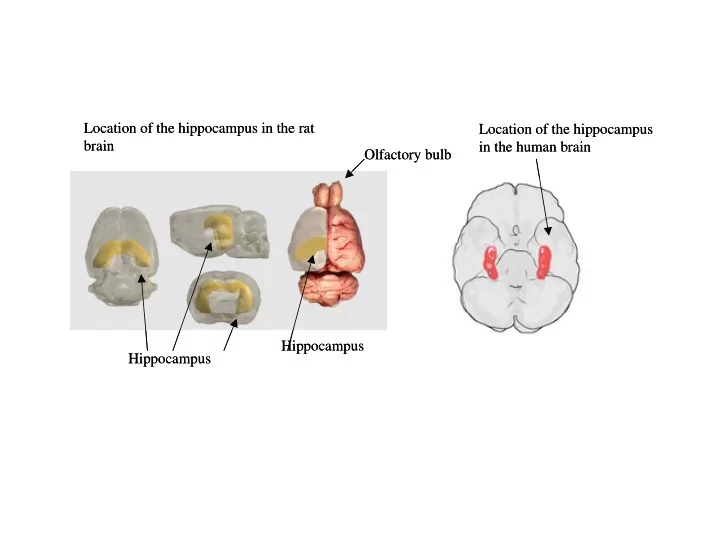
SLIDE 1
Location of the hippocampus in the rat brain Olfactory bulb Location of the hippocampus in the human brain Location of the hippocampus in the rat brain Olfactory bulb Location of the hippocampus in the human brain Hippocampus Hippocampus Hippocampus Hippocampus
SLIDE 2
SLIDE 3
Hippocampus: Thought to be involved in 1) short term memory 2) memory consolidation ) y 3) episodal memory 4) spatial orientation
SLIDE 4
Today: Spatial representation, spatial coding, place cells? Spatial representation, spatial coding, place cells?
SLIDE 5
SLIDE 6
SLIDE 7
SLIDE 8
SLIDE 9
SLIDE 10
SLIDE 11 White rat: actual position. red and green: model predictions spiking activity f ll
recorded in this animal
SLIDE 12 White rat: actual position. red and green: model predictions spiking activity f ll
recorded in this animal
Approach: at each time step, calculate the probability that rat is at coordinates (x,y) given the neural activity. The parameters of such a model are continuously updated and the model can predict the location of the rat better and better. The parameters can then give insight into the characteristics of the neural activity relevant to encoding position. The evolution of the parameters can give insights into the plasticity of the system.
SLIDE 13
SLIDE 14
In space
SLIDE 15
Cells fire only where there is food!
SLIDE 16
SLIDE 17
SLIDE 18 Exercise
1 5
You recorded from 7 neurons in the hippocampus while a rat was running around in a box. The circles represent each neuron’s “place field”.
* *
6 5 2
p a) What would you expect to see I your recordings while the rat followed the path depicted in red asterisks ? b) Could you predict the responses of an eighth neuron from
* * * * * * *
3 4 7
b) Cou d you p ed ct t e espo ses o a e g t eu o
- those of the 7 neurons you recorded?
* * * * * * * *
SLIDE 19
Visual neurons Hippocampal neurons
?
Hippocampal neurons
SLIDE 20
Visual neurons Hippocampal neurons
? ?
Hippocampal neurons
SLIDE 21
Is place cells the right name? p g
SLIDE 22
Simultaneous theta and gamma oscillations recoded in the rat hippocampus Simultaneous theta and gamma oscillations recoded in the rat hippocampus Theta oscillations : 4-10 Hz 100 ms Theta oscillations : 4-10 Hz 100 ms Gamma oscillations : 40-60 Hz Gamma oscillations : 40-60 Hz 25 ms 25 ms
SLIDE 23
SLIDE 24
There are approximately 5-7 gamma cycles in one theta cycle; hen a rat mo es on a linear track hippocampal p ramidal cells when a rat moves on a linear track, hippocampal pyramidal cells spike on a given gamma cycle depending on the rat's location (phase precession)
SLIDE 26
ate Firing ra Location (cm) ( )
SLIDE 27
SLIDE 28
ate Firing ra Location (cm )
f theta
( )
Phase of L ti ( ) Location (cm)
SLIDE 29
ase of theta ng rate/Pha Location (cm) Firi Spatial resolution of Spatial resolution of spike alone Spatial resolution of phase Spatial resolution of phase
SLIDE 30
Does rate alone convey information?
SLIDE 31
Nature 425, 828-832 (23 October 2003) | doi:10.1038/nature02058; , ( ) | ; Received 15 May 2003; Accepted 15 September 2003 Independent rate and temporal coding in hippocampal pyramidal cells John Huxter1 3 Neil Burgess1 2 & John O'Keefe1 2 John Huxter1,3, Neil Burgess1,2 & John O Keefe1,2
SLIDE 32
- a. Behavioural task: rat shuttles back and forth along linear track between food
rewards contained in cups attached to movable walls.
SLIDE 33
b, False-colour firing field of a place cell created from multiple runs in the eastward direction.
SLIDE 34
c, EEG theta rhythm and place cell firing (in red) for the same cell on a single eastward run. Ticks above the spikes indicate + to - zero crossings g p g (0°/360° phase) for each theta wave, lines through theta waves indicate 270°. Bursts of spikes occur at higher than theta frequency causing each successive burst to move to an earlier phase of the theta cycle, despite initially rising then falling firing rate Theta cycle phase of spikes for initially rising, then falling firing rate. Theta cycle phase of spikes for multiple runs from a place cell is plotted against position
SLIDE 35
Rate of bursts is higher than theta : as a consequence cells fire earlier and earlier during theta during theta (phase precession) Phase and rate co-vary
SLIDE 36 a, Phase depends on location, b i hi h t i th l thi d being highest in the early third
- f each field, lower in the
middle third, and lowest in the late third. c IFR starts low increases in c, IFR starts low, increases in the middle third and then decreases in the late part of the field. IFR: Instantaneous firing rate
SLIDE 37
Rate does not affect phase
SLIDE 38
Phase and rate can be independent – do they encode different variables?
SLIDE 39
Rate correlates with running speed!