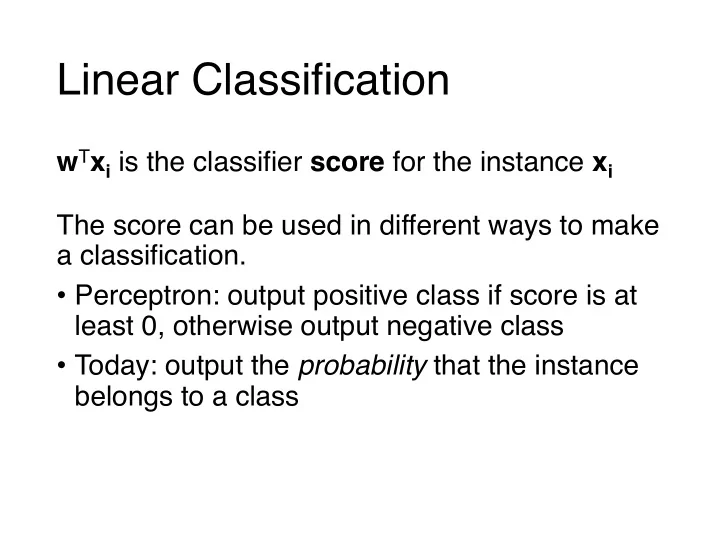
SLIDE 1 Linear Classification
wTxi is the classifier score for the instance xi The score can be used in different ways to make a classification.
- Perceptron: output positive class if score is at
least 0, otherwise output negative class
- Today: output the probability that the instance
belongs to a class
SLIDE 2
Activation Function
An activation function for a linear classifier converts the score to an output. Denoted ϕ(z), where z refers to the score, wTxi
SLIDE 3 Activation Function
Perceptron uses a threshold function: ϕ(z) = 1, z ≥ 0
SLIDE 4
Activation Function
Logistic function: ϕ(z) = 1 1 + e-z The logistic function is a type of sigmoid function (an S-shaped function)
SLIDE 5
Activation Function
Logistic function: ϕ(z) = 1 1 + e-z
Outputs a real number between 0 and 1 Outputs 0.5 when z=0 Output goes to 1 as z goes to infinity Output goes to 0 as z goes to negative infinity
SLIDE 6
Quick note on notation: exp(z) = ez
SLIDE 7 Logistic Regression
A linear classifier like perceptron that defines…
(same as perceptron)
- Activation: logistic function (instead of threshold)
This classifier gives you a value between 0 and 1, usually interpreted as the probability that the instance belongs to the positive class.
- Final classification usually defined to be the
positive class if the probability ≥ 0.5.
SLIDE 8 Logistic Regression
Confusingly: This is a method for classification, not regression. It is regression in that it is learning a function that
- utputs continuous values (the logistic function),
BUT you are using those values to predict discrete classes.
SLIDE 9
Logistic Regression
Considered a linear classifier, even though the logistic function is not linear. This is because the score is a linear function, which is really what determines the output.
SLIDE 10
Learning
How do we learn the parameters w for logistic regression? Last time: need to define a loss function and find parameters that minimize it.
SLIDE 11
Probability
Because logistic regression’s output is interpreted as a probability, we are going to define the loss function using probability. For help with probability, review OpenIntro Stats, Ch 2.
SLIDE 12 Probability
A conditional probability is the probability of a random variable given that some variables are known. P(Y | X) is read as “the probability of Y given X”
- r “the probability of Y conditioned on X”
The variable on the left hand side is what you want to know the probability of. The variable on the right-hand side is what you know.
SLIDE 13 Probability
P(yi = 1 | xi) = ϕ(wTxi) P(yi = 0 | xi) = 1 – ϕ(wTxi) Goal for learning: learn w that makes the labels in your training data more likely
- The probability of something you know to be true is 1,
so that’s what the probability should be of the labels in your training data.
Note: the convention for logistic regression is that the classes are 1 and 0 (instead of 1 and -1)
SLIDE 14
Learning
P(yi | xi) = ϕ(wTxi)yi * (1 – ϕ(wTxi))1–yi
SLIDE 15
Learning
P(yi | xi) = ϕ(wTxi)yi * (1 – ϕ(wTxi))1–yi
if yi = 1
SLIDE 16
Learning
P(yi | xi) = ϕ(wTxi)yi * (1 – ϕ(wTxi))1–yi
if yi = 0
SLIDE 17 Learning
P(yi | xi) = ϕ(wTxi)yi * (1 – ϕ(wTxi))1–yi
log P(yi | xi) = yi log(ϕ(wTxi)) + (1–yi) log(1–ϕ(wTxi)) Taking the logarithm (base e) of the probability makes the math work out easier.
SLIDE 18 Learning
log P(yi | xi) = yi log(ϕ(wTxi)) + (1–yi) log(1–ϕ(wTxi)) This is the log of the probability of an instance’s label yi given the instance’s feature vector xi What about the probability of all the instances? log P(yi | xi) This is called the log-likelihood of the dataset.
i=1 N
SLIDE 19 Learning
Our goal was to define a loss function for logistic
- regression. Let’s use log-likelihood… almost.
A loss function refers specifically to something you want to minimize (that’s why it’s called “loss”), but we want to maximize probability! So let’s minimize the negative log-likelihood: L(w) = -log P(yi | xi) = -yi log(ϕ(wTxi)) – (1–yi) log(1–ϕ(wTxi))
i=1 N i=1 N
SLIDE 20 Learning
We can use gradient descent to minimize the negative log-likelihood, L(w) The partial derivative of L with respect to wj is: dL/dwj = xij (yi – ϕ(wTxi))
i=1 N
SLIDE 21 Learning
We can use gradient descent to minimize the negative log-likelihood, L(w) The partial derivative of L with respect to wj is: dL/dwj = xij (yi – ϕ(wTxi)) if yi = 1…
The derivative will be 0 if ϕ(wTxi)=1
(that is, the probability that yi=1 is 1, according to the classifier)
i=1 N
SLIDE 22 Learning
We can use gradient descent to minimize the negative log-likelihood, L(w) The partial derivative of L with respect to wj is: dL/dwj = xij (yi – ϕ(wTxi)) if yi = 1…
The derivative will be positive if ϕ(wTxi) < 1
(the probability was an underestimate)
i=1 N
SLIDE 23 Learning
We can use gradient descent to minimize the negative log-likelihood, L(w) The partial derivative of L with respect to wj is: dL/dwj = xij (yi – ϕ(wTxi)) if yi = 0…
The derivative will be 0 if ϕ(wTxi)=0
(that is, the probability that yi=0 is 1, according to the classifier)
i=1 N
SLIDE 24 Learning
We can use gradient descent to minimize the negative log-likelihood, L(w) The partial derivative of L with respect to wj is: dL/dwj = xij (yi – ϕ(wTxi)) if yi = 0…
The derivative will be negative if ϕ(wTxi) > 0
(the probability was an overestimate)
i=1 N
SLIDE 25 Learning
We can use gradient descent to minimize the negative log-likelihood, L(w) The partial derivative of L with respect to wj is: dL/dwj = xij (yi – ϕ(wTxi)) So the gradient descent update for each wj is: wj += η xij (yi – ϕ(wTxi))
i=1 N i=1 N
SLIDE 26 Learning
So gradient descent is trying to…
- make ϕ(wTxi) = 1 if yi = 1
- make ϕ(wTxi) = 0 if yi = 0
But there’s a problem… ϕ(z) = 1 1 + e-z
z would have to be
∞ (or -∞) in order
to make ϕ(z) equal to 1 (or 0)
SLIDE 27 Learning
So gradient descent is trying to…
- make ϕ(wTxi) = 1 if yi = 1
- make ϕ(wTxi) = 0 if yi = 0
Instead, make “close” to 1 or 0
Don’t want to optimize “too” much while running gradient descent
SLIDE 28 Learning
So gradient descent is trying to…
- make ϕ(wTxi) = 1 if yi = 1
- make ϕ(wTxi) = 0 if yi = 0
Instead, make “close” to 1 or 0
We can modify the loss function that basically means, get as close to 1 or 0 as possible but without making the w parameters too extreme.
- How? That’s for next time.
SLIDE 29 Learning
Remember from last time:
- Gradient descent
- Uses the full gradient
- Stochastic gradient descent (SGD)
- Uses an approximate of the gradient based on a
single instance
- Iteratively update the weights one instance at a time
Logistic regression can use either, but SGD more common, and is usually faster.
SLIDE 30 Prediction
The probabilities give you an estimate of the confidence of the classification. Typically you classify something positive if ϕ(wTxi) ≥ 0.5, but you could create other rules.
- If you don’t want to classify something as positive
unless you’re really confident, use ϕ(wTxi) ≥ 0.99 as your rule. Example: spam classification
- Maybe worse to put a legitimate email in the spam
box than to put a spam email in the inbox
- Want high confidence before calling something spam