Life Organic Battery with PI: Dr. Jeremy Neubauer, NREL, Quick Charge - - PowerPoint PPT Presentation

life organic battery with
SMART_READER_LITE
LIVE PREVIEW

Life Organic Battery with PI: Dr. Jeremy Neubauer, NREL, Quick Charge - - PowerPoint PPT Presentation

Project: High Energy, Long Team: NREL, EIC Laboratories, Chemtura Corporation Life Organic Battery with PI: Dr. Jeremy Neubauer, NREL, Quick Charge Capability jeremy.neubauer@nrel.gov Technology Overview: Current Status: Non-aqueous


slide-1
SLIDE 1

1

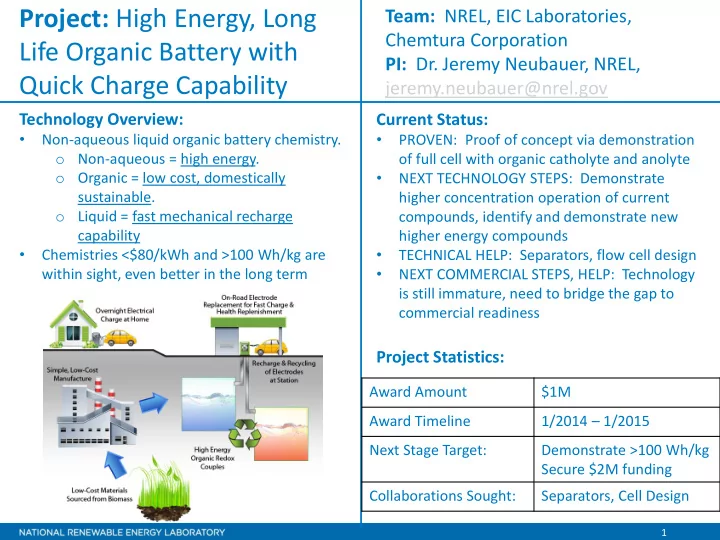
Project: High Energy, Long Life Organic Battery with Quick Charge Capability

Team: NREL, EIC Laboratories, Chemtura Corporation PI: Dr. Jeremy Neubauer, NREL, jeremy.neubauer@nrel.gov

Technology Overview:

  • Non-aqueous liquid organic battery chemistry.
  • Non-aqueous = high energy.
  • Organic = low cost, domestically

sustainable.

  • Liquid = fast mechanical recharge

capability

  • Chemistries <$80/kWh and >100 Wh/kg are

within sight, even better in the long term

Current Status:

  • PROVEN: Proof of concept via demonstration
  • f full cell with organic catholyte and anolyte
  • NEXT TECHNOLOGY STEPS: Demonstrate

higher concentration operation of current compounds, identify and demonstrate new higher energy compounds

  • TECHNICAL HELP: Separators, flow cell design
  • NEXT COMMERCIAL STEPS, HELP: Technology

is still immature, need to bridge the gap to commercial readiness Award Amount $1M Award Timeline 1/2014 – 1/2015 Next Stage Target: Demonstrate >100 Wh/kg Secure $2M funding Collaborations Sought: Separators, Cell Design

Project Statistics:

slide-2
SLIDE 2

2

Motivation, Vision, Objective

  • Traditional Li-Ion active materials are

not domestically sustainable, and cost more than $100/kWh on their

  • wn.
  • Less than 45% of drivers can

complete all of their travel with a 300 mile BEV

  • Vision: Liquid, non-aqueous organic

chemistries are domestically sustainable and could be quick- chargeable while meeting automotive performance requirements.

  • Objective: Provide proof-of-concept
slide-3
SLIDE 3

3

Major Accomplishment: Chemistry Databasing

  • Compiled a list of hundreds of organic redox compound

reactions with data on molecular weight, number of electrons transferred, redox potential, cost, NFPA ratings, and other info available from literature.

  • Compiled a list of dozens of organic solvents with data on

density, cost, melting, boiling, and flash points, viscosity, dielectric constant, NFPA ratings, and other info available from literature.

  • Approaching 100 screening tests of select compound and

solvent combinations in the lab (e.g. cyclic voltammetry, solubility, solvent stability, conductivity, etc.)

slide-4
SLIDE 4

4

Major Accomplishment: Computational Investigation

  • Developed DFT

methodologies for predicting reaction type, redox potentials and solubilities, and reversibility

  • Applied high throughput

tools to screen 4,000+

  • rganic redox

compounds

  • Selected promising

candidates based on projected cell-level performance and cost

Reduced Oxidized

slide-5
SLIDE 5

5

Major Accomplishment: Cell Development & Testing

  • Developed a cell design for

testing cells up to hundreds

  • f mAh, addressing

multiple issues with sealing, separation, and current collectors

  • Performed cycle life tests
  • n numerous compounds

in a half cell configuration

  • Demonstrated a full cell

with non-aqueous organic redox compounds for both catholyte and anolyte

Full Cell cycling results Example voltage response for candidate cathode compound

slide-6
SLIDE 6

6

Moving Forward

  • What we have now:
  • Strong capabilities for model-based design and laboratory-based

validation of organic battery compounds

  • A long list of compounds that don’t work
  • A short list of compounds that do work

» Currently estimating chemistry at <$400/kWh » Projecting that <$80/kWh is possible

  • What to do next:
  • Our 1 year RANGE seedling project is over
  • Seeking new funding to (1) expand the search for new promising

candidates and (2) continue development of identified promising candidates.

  • Seeking collaborations on separator technology, flow cell design,

and bridging the gap to commercial readiness