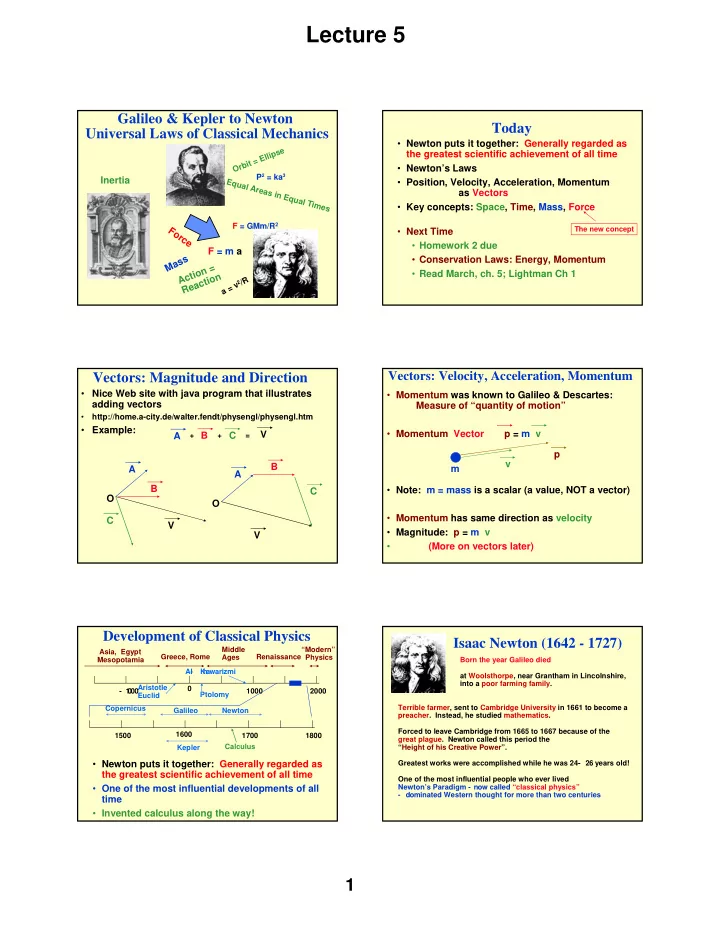
Lecture 5 Galileo & Kepler to Newton Today Universal Laws of - - PDF document

lecture 5
SMART_READER_LITE
LIVE PREVIEW

Lecture 5 Galileo & Kepler to Newton Today Universal Laws of - - PDF document

Lecture 5 Galileo & Kepler to Newton Today Universal Laws of Classical Mechanics Newton puts it together: Generally regarded as e s p the greatest scientific achievement of all time l i l E = t i b r O Newtons Laws P


slide-1
SLIDE 1

Lecture 5

1

Galileo & Kepler to Newton Universal Laws of Classical Mechanics

a = v

2

/ R F = GMm/R2 Equal Areas in Equal Times O r b i t = E l l i p s e P2 = ka3

Mass F = m a Force Inertia Action = Reaction

Today

  • Newton puts it together: Generally regarded as

the greatest scientific achievement of all time

  • Newton’s Laws
  • Position, Velocity, Acceleration, Momentum

as Vectors

  • Key concepts: Space, Time, Mass, Force
  • Next Time
  • Homework 2 due
  • Conservation Laws: Energy, Momentum
  • Read March, ch. 5; Lightman Ch 1

The new concept

Vectors: Magnitude and Direction

  • Nice Web site with java program that illustrates

adding vectors

  • http://home.a-city.de/walter.fendt/physengl/physengl.htm
  • Example:

O B A V C O B A C V A V B C

+ + =

Vectors: Velocity, Acceleration, Momentum

  • Momentum was known to Galileo & Descartes:

Measure of “quantity of motion”

  • Momentum Vector

p = m v

  • Note: m = mass is a scalar (a value, NOT a vector)
  • Momentum has same direction as velocity
  • Magnitude: p = m v
  • (More on vectors later)

m v p

Development of Classical Physics

  • Newton puts it together: Generally regarded as

the greatest scientific achievement of all time

  • One of the most influential developments of all

time

  • Invented calculus along the way!

Asia, Egypt Mesopotamia Aristotle Euclid Kepler Newton “Modern” Physics Greece, Rome Middle Ages Ptolomy Copernicus Renaissance Al

  • K

h awarizmi 1000 2000

  • 1

000 1600 1700 1800 1500 Galileo Calculus

Isaac Newton (1642 - 1727)

Born the year Galileo died at Woolsthorpe, near Grantham in Lincolnshire, into a poor farming family. Terrible farmer, sent to Cambridge University in 1661 to become a

  • preacher. Instead, he studied mathematics.

Forced to leave Cambridge from 1665 to 1667 because of the great plague. Newton called this period the “Height of his Creative Power”. Greatest works were accomplished while he was 24

  • 26 years old!

One of the most influential people who ever lived Newton’s Paradigm - now called “classical physics”

  • dominated Western thought for more than two centuries
slide-2
SLIDE 2

Lecture 5

2

“In the beginning of the year 1665, I found the method of approximating series and the Rule for reducing any dignity of any Binomial into such a series. The same year in … November had the direct method of Fluxions, and in January had the Theory of Colours, and in May following I had entrance into the inverse method of Fluxions. And the same year I began to think of the orb

  • f the Moon … from Kepler’s Rule of the periodical times of the

Planets … I deduced the forces which keep the Planets in their orbs must be reciprocally as the squares of their distances from the centres about which they revolve … All this was in the two plague years of 1665 and 1666, for in those days I was in the prime of my age for invention, and minded Mathematics and Philosophy more than any time since.”

Isaac Newton (1642 - 1727) continued

  • Suffered a mental breakdown in 1675.
  • In 1679 (responding to a letter from Hooke) suggested that

particles, when released, would spiral toward the center of the

  • earth. Hooke wrote back claiming the path would be an

ellipse.

  • Hating to be publicly contradicted, Newton began to work out

the mathematics of orbits.

  • Urged by Halley to publish his calculations and results,

Newton released Principia in 1687. This became one of the most important and influential works on physics of all times

Calculus – Newton vs. Leibnitz

  • First known steps – ancient Greece
  • Zeno’s paradox; Archimedes
  • Newton wrote a tract (circulated among

mathematicians) in 1666

  • First clear statement of the fundamental theorem of

calculus

  • Gottfried Wilhelm Leibnitz (1646 - 1716)
  • From a poor family

Child Prodigy

  • Famous German Mathematician and Philsopher
  • Invented Calculus 1674-5; published 1684 – Controversial

whether he had seen Newton’s work

Newton’s Three Laws

  • Inertia:

“Every body continues in its state of rest, or of uniform motion in a right line, unless it is compelled to change that state by a force impressed on it.”

  • Force, Mass, Acceleration (F=ma):
  • “The change in motion [rate of change of momentum] is

proportional to the motive force impressed; and is made in the direction of the right line in which that force is impressed.”

  • “Action = Reaction”:
  • “To every action [change of momentum] there is always opposed

an equal reaction; or, the mutual actions of two bodies are always equal, and directed to contrary parts.”

Newton’s First Law

“Every body continues in its state of rest, or of uniform motion in a right line, unless it is compelled to change that state by a force impressed on it.”

  • Same as Galileo’s law of inertia.
  • If a body moves with constant velocity in a straight line, then

there is NO net Force acting on the body.

  • If the body is moving in any other way (i.e. accelerating), then

there MUST be a Force acting on the body.

  • Galilean Relativity revisited:
  • “Rest” and “Uniform Motion” really are the same! No net force
  • n the object
  • As Galileo argued, no experiment in a steadily moving ship will

show that is is moving. Only by looking outside can you detect relative motion.

First Law Demo

Cart with constant velocity

slide-3
SLIDE 3

Lecture 5

3

First Law Demo

  • In what direction should you throw a ball if you

want it to return to you? Does it matter if you are “moving” or not?

v v v What does the trajectory look like if the thrower is “moving”?

thrower at rest thrower moves horizontally with speed v

The ball returns to the thrower. Both move so ball is always above the thrower. The laws of physics are the same whether

  • r not the thrower is moving relative to the observer!

Exercise

  • Suppose you are on an airplane travelling at

constant velocity with a speed of 500 miles per hour (roughly 200 m/s)

  • If you throw a ball straight up, does it return to

you?

  • How does it appear to you?
  • How does the path of the ball look to an observer
  • n the ground?
  • Can you think of any experiment done inside the

airplane that would detect the motion of the airplane at constant velocity?

Exercise - Solution

To person on airplane Time = 1 sec 1.25 m 200 m 1.25 m To person on ground - Time =1 sec

What about pouring coffee?

To person on airplane Time = 1/2 sec To person on ground Time =1/2 sec (We exaggerate and assume the coffee is poured 1.25 meters above the cup!) 1.25 m 1.25 m 100 m

Newton’s Second Law

  • “The change in motion [rate of change of momentum] is

proportional to the motive force impressed; and is made in the direction of the right line in which that force is impressed.

  • Equation:

Force = mass x acceleration

  • In terms of momentum:
  • Thus Force = rate of change of momentum
  • Quantitative Concepts: Force and Mass

F = m a p = m v F = m a = m ∆v/∆t = ∆p/∆t

Mass

  • What is this thing called Mass?
  • Mass is a property of an object. In Newton’s theory

it is always constant for a given object.

  • Mass is not weight, not volume, . . . .
  • Mass is a quantitative measure of how hard it is to

accelerate the object.

  • Mass of objects can be calibrated by measuring their

acceleration by the same force

  • Tested experimentally
  • - found to be true that different

measurements with different forces give consistent values of the mass

slide-4
SLIDE 4

Lecture 5

4

Force

  • What is a force?
  • Force is the tendency to cause acceleration.
  • Operationally defined by measuring accelerations.
  • Is this just a circular definition?
  • No! Forces can be related to physical systems.

Compressed springs, gravitational forces, …. This is the basis for the predictive power of Newton’s equations.

  • More later on Forces

This is the new idea not present in Galileo’s work

Force is a Vector

  • The “Net Force” or “Total Force” on an object is

the vector sum of all the forces on it due to other

  • bjects
  • This what goes in Newton’s Equation

Force = mass x acceleration Net Force F is the vector sum

  • f the three applied forces

f1 f2 F = 0 f1 f2 F F = m a

Second Law Demo

Cart with horizontal acceleration – caused by a horizontal force Does the ball land in the cup? Force

Newton’s Third Law

“To every action [change of momentum] there is always opposed an equal reaction; or, the mutual actions of two bodies are always equal, and directed to contrary parts.”

  • Consider collision of m1 with m2:
  • Newton’s Second Law says that the force acting on m2 (= F12)

during a time ∆t results in a change in the momentum of m2 (=∆p2) equal to the force times the time ( ∆p2 = F12 ∆t ). Similarly the change in momentum of m1 is given by: ∆p1 = F21 ∆t

  • Newton’s Third Law says that the force m1 exerts on m2 (= F12)

must be equal in magnitude, but in the opposite direction of the force m2 exerts on m1 (= F21), i.e., F12 =

  • F

2 1

  • Therefore, the change in momentum of m1 (= ∆p1) is equal in

magnitude, but in the opposite direction of the change in momentum of m2 (= ∆p2).

  • THE TOTAL MOMENTUM DOES NOT CHANGE!

∆p1 = F21 ∆t = - F12 ∆t = - ∆p2

Demonstration: Newton’s Third Law: Action/Reaction

  • Examples of equal and opposite forces
  • Does not matter which body “caused” the force
  • Person pushing on a table
  • How does a rocket accelerate?
  • Rocket Cart! ----

DEMONSTRATION!

  • Note that the total momentum does not change

(We will come back to this as an example of a “conservation law” -- momentum is “conserved”)

Exercise: Action/Reaction

  • Suppose a tennis ball (m= 0.1 kg) moving at a velocity v = 40

m/sec collides head-on with a truck (M = 500 kg) which is moving with velocity V = 10 m/sec.

  • During the collision, the tennis ball exerts a force on the truck

which is smaller than the force which the truck exerts on the tennis ball. TRUE or FALSE ?

  • The tennis ball will suffer a larger acceleration during the

collision than will the truck. TRUE or FALSE ?

  • Suppose the tennis ball bounces away from the truck after the
  • collision. How fast is the truck moving after the collision?

< 10 m/sec = 10 m/sec > 10 m/sec ?

slide-5
SLIDE 5

Lecture 5

5

Exercise: Action/Reaction solution

  • Suppose a tennis ball (m= 0.1 kg) moving at a velocity v = 40

m/sec collides head-on with a truck (M = 500 kg) which is moving with velocity V = 10 m/sec.

  • During the collision, the tennis ball exerts a force on the truck

which is smaller than the force which the truck exerts on the tennis ball. TRUE or FALSE ? Equal and opposite forces! The tennis ball will suffer a larger acceleration during the collision than will the truck. TRUE or FALSE ? Acceleration = Force / mass

  • Suppose the tennis ball bounces away from the truck after the
  • collision. How fast is the truck moving after the collision?

< 10 m/sec = 10 m/sec > 10 m/sec ? To conserve total momentum, the truck’s speed must decrease since the tennis ball moves in the opposite direction after the collision.

Summary – to this point

  • Definitions: displacement, velocity, acceleration,

momentum are vectors that describe motion

  • Newton’s three laws:
  • 1. A body moves with constant velocity unless acted upon

by a force -- equivalent to principle of inertia

  • 2. F=ma
  • 3. Equal and opposite forces -- action/reaction

(equivalent to conservation of momentum – more later)

  • Concept of Force, Mass
  • Mass is a scalar measure of “inertia” or resistance to

acceleration”

  • Force is a vector - tends to cause acceleration
  • The force in Newton’s equation is the “Net Force” -- the

vector sum of all forces on a body

  • Demonstrations of Laws

Curved Motion & Circular Motion

  • Curved motion is accelerated motion!

Force is required to change the Magnitude or Direction of Velocity

  • From First law motion continues in straight line at

constant velocity unless there is a force

  • Change of speed in the same direction requires a

force in that direction

  • Car speeding up
  • positive acceleration
  • Car slowing down
  • braking
  • negative acceleration
  • Demonstration last time of string applying force to a cart on

wheels

  • Change of direction of motion requires a force
  • -- even with no change in speed

Force Ball Force Motion Motion

Force is required to change the Direction of Velocity

  • Example: Circular Motion
  • Accelerates even though

speed does not change!

  • Object moves in circle

because of force from string

  • If string were suddenly cut,

ball would move in straight line at constant velocity v v

Acceleration & Circular Motion

  • Acceleration is the change in velocity per unit time.
  • Velocity is a vector (magnitude & direction).

v v2 v v1 v v1 v v2 ∆v v R R

a = ---- ∆v ∆t = -------- v2 - v1 ∆t The direction of the acceleration is centripetal, i.e. toward the center of the circle.

∆θ

| v1 | = | v2 | = v

Toward Center

slide-6
SLIDE 6

Lecture 5

6

Acceleration & Circular Motion

  • We now know the direction of the acceleration

(toward the center). How big is it?

v v2 v v1 R R v v1 v v2 ∆v v

∆θ ∆θ For small angles ∆θ, measured in radians:

∆v = v∆θ

| v1 | = | v2 | = v

  • To find the acceleration, we need to know how ∆Θ

is related to ∆t :

  • For one revolution, the angular displacement is: ∆θ = 2π (radians)
  • The time required for one revolution (period) is:

∆t = 2πR / v

  • Therefore,
  • Combining these equations:

∆θ / ∆t = v / R

a = ------ = v ------ = ------- ∆v ∆t ∆t ∆θ v2 R

Circular Motion

  • Centripetal Force must be provided by

something!

  • F = m v2 / R
  • Force is toward the center, perpendicular to

direction of motion

  • How does an automobile go around a

curve?

  • How does a rocket is space change

direction?

  • What makes the moon circle the earth?

HOMEWORK

Newton’s theory of gravity

  • Builds upon the idea that ALL curved motion is

due to some FORCE

  • Planets?
  • All objects in the universe?

Kepler’s Third Law Provides a Key

  • Kepler’s 3rd Law: P2 = k R3
  • But, period = P = 2π R / v ⇒ 4π2 R2 / v2 = k R3
  • Therefore,

v2 = 4π2 / k R

  • Substituting this form for v2 into Newton’s 2nd Law:
  • Uniform Circular Motion:

a = v2 / R

  • Newton’s 2nd Law:

F = ma = mv2 / R F = ----- ----- 4π2 k m R2

  • This is the force that the Sun must exert on a planet
  • f mass m , orbital radius R, in order that the planet
  • bey Kepler’s Laws in the circular motion

approximation.

Toward a Universal Theory of Gravitation

  • We have shown that Kepler’s Laws follow from

Newton’s 2nd Law if the force F on a planet is: F = ----- ----- 4π2 k m R2

  • Question: What more do we have to do to turn this

into a “Universal” Law of Gravitation?

  • Consider Newton’s 3rd Law:
  • If this is the force on the planet due to the Sun, then the planet

must also exert an equal force on the Sun, but in the opposite direction.

  • There is no mention of the Sun in this equation, but there must

be if this force describes the force on the Sun due to the planet.

  • Therefore, Kepler’s constant k is not really a universal

constant! It must depend on the mass of the Sun!!

Universal Law of Gravitation

  • The only form of the law that is symmetric in the

two masses (mass of sun and mass of planet) is:

  • This form of the law is universal.
  • Newton’s law of gravity: There is an attractive force
  • beying the above law between every pair of

masses in the universe. The constant G is universal and applies to all masses in the universe. F = G ------- Mm R2

Where M and m are the masses of any two bodies, R is the distance between them and G is a universal constant!

slide-7
SLIDE 7

Lecture 5

7

Newton Has Said More than Kepler!

  • Kepler’s Laws describe the motion of a planet about

the Sun.

  • Newton uses same laws that apply to all motion!
  • Newton’s framework (forces & masses) allows him

to generalize from the Sun-planet system to all bodies in the universe! This is “universal” gravitation!

  • Newton’s Third Law implies that each body exerts

equal and opposite forces on the other. Depends upon both masses.

  • Describes the moon orbiting the earth
  • The moons of Jupiter, and much more!
  • Totally different from Kepler’s approach.

Exercise: Kepler’s Laws

  • Suppose you know that the radius of Saturn’s orbit

is about 9 AU. (the radius of the Earth’s orbit = 1AU).

  • Can you predict the average speed of Saturn in its orbit in terms
  • f the average speed of the Earth in its orbit?
  • If you can, do it; if you can’t, what other information would

you need?

  • Can you predict the acceleration of Saturn in its orbit in terms of

the acceleration of the Earth in its orbit?

  • If you can, do it; if you can’t, what other information would

you need?

  • Can you predict the force that the Sun exerts on Saturn in terms of

the force that the Sun exerts on the Earth?

  • If you can, do it; if you can’t, what other information would

you need?

The Apple and the Moon I

  • Is Newton’s Gravitation Force Law really

“universal”? Does the same force law describe apples falling to the Earth and the Moon’s orbit about the Earth? Can we predict the acceleration due to gravity on the surface of the Earth from the Period & Radius of the Moon’s orbit?

  • Acceleration of the moon: amoon = v2 / R = 4π2R / P2
  • If due to gravitation, then also: amoon = F / mmoon = GMearth / R2

If we know P (period of moon = 1 lunar month), R (distance to the moon) , G (unversal constant measured much later) We can determine the mass of the earth! But Newton Did not know the value of G!

The Apple and the Moon II

  • Newton showed that the total force the Earth exerts
  • n an object near its surface can be calculated by

taking all the mass of the Earth to be concentrated at its center.

  • Therefore, Fg = mag = mg = GMearth m/ Rearth

2

  • The acceleration due to gravity at the surface of the

earth is: g = GMearth / Rearth

2

  • The acceleration of the moon is:

amoon = GMearth / Rmoon

2

gpred = amoon --------- Rmoon

2

Rearth

2

Putting in numbers: gpred = 9.76 m/sec2 Observed: g = 9.78 m/sec2

IT WORKS !!

Effects of gravity

  • Seen everywhere around us
  • Falling objects
  • Planets, Moons orbiting larger bodies
  • Double star systems rotating around each
  • ther
  • Galaxies - millions
  • f stars clustered

due to gravitational forces

  • See Feyman,

Chapter 5

Gravity is a VERY Tiny force

  • Force between two objects each 1 Kg at a

distance of 1 meter is F = G M1 M2 /R2 = 6.67 x 10 -11 N

  • 1 N is about the weight of one apple on the

earth

  • The reason the effects of gravity are so large

is that the masses of the earth, sun, stars, …. are so large -- and gravity extends so far in space

slide-8
SLIDE 8

Lecture 5

8

Additional Comments

  • Newton’s Theory of gravitation contains one

deeply unsatisfying aspect

  • Newton recognized the problem
  • The law f = G M m /r2 means “action at a distance”
  • Instantaneous force due on one object due to

another object no matter how far they are away from one another

  • What should a scientist do?

Summary

  • Newton’s 3 laws
  • Circular Motion
  • Centripetal (toward center) accel. a = v2/r
  • Centripetal force f = ma
  • Example: Ball on a string moving in a circle
  • Kepler’s Laws explained by gravitational force in

Newton’s laws

  • Universal law of gravitation: f = G M m /r2
  • The falling Apple and the Moon: each accelerates toward

the earth obeying the same law!

  • Motion on Earth and in the heavens obeying the same

simple laws!

  • Force of gravity – extremely weak – large effects for

large objects

Next Time

  • Conservation Laws
  • MORE important than Newton’s Equations! - still

valid in modern physics even though Newton’s laws are not !

  • The most useful conclusions without solving any

equations!

  • Conservation of momentum: Follows from Newton’s third

law. (Chapt. 2 in Text)

  • Conservation of energy: The most important and useful

law. (Chapt. 5 in Text, Chapter 4 in Feynman)

Extra - Position, Velocity, Acceleration are Vectors

  • A vector describes both magnitude and direction.
  • Position (and change of position) has magnitude

(distance) and direction

  • Velocity is change of

position vector per unit time.

  • Acceleration is change of

velocity vector per unit time. v = ---- ∆R ∆t = -------- R2 - R1 ∆t a = ---- ∆v ∆t = -------- v2 - v1 ∆t O R2 R1 ∆R

Extra - Addition of Vectors

  • Since a vector describes both magnitude and

direction, adding vectors must take into account the direction

  • Add vectors “head to tail” to get resultant vector
  • Example: A = B + C
  • Subtraction is just

adding the negative C = A - B O C B A O C B A O C

  • B

A