Learning Targets of Chinese 4 competences: Listening Speaking - - PowerPoint PPT Presentation

learning targets of chinese
SMART_READER_LITE
LIVE PREVIEW

Learning Targets of Chinese 4 competences: Listening Speaking - - PowerPoint PPT Presentation

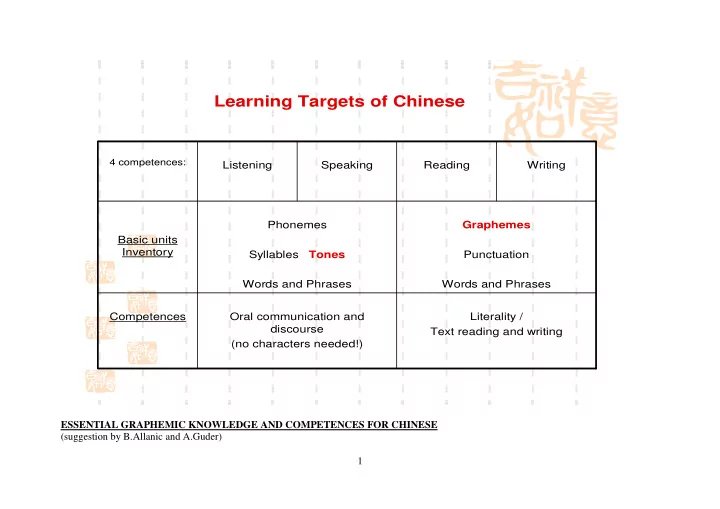
Learning Targets of Chinese 4 competences: Listening Speaking Reading Writing Phonemes Graphemes Basic units Inventory Syllables Tones Punctuation Words and Phrases Words and Phrases Competences Oral communication and Literality /


slide-1
SLIDE 1

1

Learning Targets of Chinese

Literality / Text reading and writing Oral communication and discourse (no characters needed!) Competences Graphemes Punctuation Words and Phrases Phonemes Syllables Tones Words and Phrases Basic units Inventory Writing Reading Speaking Listening

4 competences: ESSENTIAL GRAPHEMIC KNOWLEDGE AND COMPETENCES FOR CHINESE (suggestion by B.Allanic and A.Guder)

slide-2
SLIDE 2

2

A1

knowledge Graphemic receptive competence Graphemic productive competence Writing System Hanyu Pinyin

  • knows the function of letters and tone marks
  • f the pinyin alphabet as a transcription

system for the Chinese language

  • can understand familiar words

and sentences when written in Pinyin

  • can link Hanyu Pinyin with the

corresponding Chinese characters if a text or word is given in both writing systems

  • can write down isolated

words and short sentences in pinyin

  • can type characters and texts

with a computer using the pinyin input Characters Strokes and stroke directions

  • knows the basic principles of stroke order

and stroke direction

  • can write familiar characters

by hand correctly, respecting the imaginary squares to fill in

  • can type characters and texts

with a computer using the pinyin input character component structure

  • knows the main rules of composition of

complex characters, can distinguish simple (独体字) from complex (合体字) characters

  • knows the difference between characters and

components and does not confuse these two categories

  • knows the four main categories of

characters (in his/her mothertongue): pictographic (象形字), semantic compound (会 yi 字), phonetic loan (假借字) and semantic-phonetic ( 形声字)

  • knows the difference between semantic

components and phonetic components

  • knows about 20 semantic components and
  • can recognize about 20 semantic

components if they are parts of unknown characters

  • can write and copy unknown

characters without mistakes if they are composed of familiar components

slide-3
SLIDE 3

3 can name it in mothertongue

  • is familiar with certain graphic variants of

important semantic components 亻/人 扌/手 饣/ 食 忄/ 心 讠/言 氵/ 水

slide-4
SLIDE 4

4 sequences

  • f

characters

  • can see whether a given text is

written in Chinese traditional characters or mainland characters

  • r Japanese
  • can write by hand sentences,

respecting the proportion of each character and the space between characters characters and lexical extensions

  • knows that some characters function as

single words and others not

  • knows that most characters have a

morphemic function in di- or polysyllabic words

  • can understand more characters

than he/she can write by hand

A2

knowledge Graphemic receptive competence Graphemic productive competence Writing System Hanyu Pinyin see A1 see A1 see A1 Characters see A1

  • knows examples of characters that share the

same phonetic components see A1

  • can point out semantic classes of

unknown characters with the help

  • f their semantic components
  • can find unknown characters in

dictionaries (with help of radical / key components) or with help of electronic devices see A1 Punctuation

is able to understand the function of common Chinese punctuation marks, including dunhao 顿号(、) shenglüehao 省略号(……), shuminghao 书名号(《》〈〉) and zhuanminghao 专名号(﹒ ﹒). is able to use common Chinese punctuation marks in own short texts, including dunhao 顿号 (、)shenglüehao 省略号 (……), shuminghao 书名号 (《》〈〉) and zhuanminghao 专名号(﹒ ﹒).

slide-5
SLIDE 5

5

Most frequent and most useful semantic elements : 亻/人 person 氵 water, liquid 土 earth, locality 女 woman / female gender 火 / 灬 fire / verbs of cooking 木 wood 扌/ 手 hand / verb of doing sth with hand(s) 辶/走 verb of fast movement 口 mouth / (particle of orality) 讠/言 words / verbs of speech 饣/ 食 food 忄/ 心 heart / words of emotionality 月 moon // flesh / parts of the human body 贝 shell / money and trade

  • Cf. also the 104 graphic components list of France

High frequent xingshengzi, but of high obscurity: 就 到 还 作 在 都 点 High frequent bifunctional components : 马 , 隹

  • Available Reference material about vocabulary in (characters) words for Chinese language levels

(Guder 2011) Source basic 基 基 基 基础 础 础 础 elementary 初 初 初 初级 级 级 级 intermediate 中 中 中 中级 级 级 级 advanced 高 高 高 高级 级 级 级 Comme nt

Old HSK exam 旧汉语水平考试 (-2009) (800) 1033 (1604) 2018 (2305) 5253 (2905) 8822 no relation to CERF Official standard of the PRC for (300) 505 (900) (1800) (2700-3000) no

slide-6
SLIDE 6

6

TCFL 汉语国际教育用音节汉字词 汇等级划分 (2010) 2245 5456 9631-11092 relation to CERF New Practical Chinese Reader 新实用汉语课本 1 : (400) 400 2 : (700) 800 4 : (1200) 1900 no relation to CERF

Source A1 A2 B1 B2 C1 C2

New HSK exam 新汉语水平考试 (2010-) (0) 150 (0) 300 (623) 600 (1071) 1200 (1709) 2500 (2633) 5000 A1/ A2 without characters New HSK exam in the opinion of German FaCh 新汉语水平考试 (2010-) 在德国 FaCh 的说明 (623) 600 (1071) 1200 (1709) 2500 (2633) 5000 Taiwan TOCFL exam 华语文能力测验 (台湾 2011) 800 1500 5000 8000 A2 = 基础 „basic“

  • ther languages:

German, investigation of FaCh 2009 500 1000 2000 4-5000 8000 Suggestion EBCL project ?? p/a p/a p/a p/a p/a

Important observations:

  • No difference made anywhere between passive (reading) and active (writing) vocabulary
  • High consistency concerning B2 level and above (except New HSK)
  • in level A the number of characters is about equivalent to the number of words