LEARNING FROM REINVENTING CITIES TO PROGRESS ON CLEAN CONSTRUCTION - - PowerPoint PPT Presentation

learning from reinventing cities to progress on clean
SMART_READER_LITE
LIVE PREVIEW

LEARNING FROM REINVENTING CITIES TO PROGRESS ON CLEAN CONSTRUCTION - - PowerPoint PPT Presentation

LEARNING FROM REINVENTING CITIES TO PROGRESS ON CLEAN CONSTRUCTION APRIL 14 TH 2020 Odyssee Pleyel, Reinventing Cities Paris APRIL 14 TH 2020 Agenda 1. C40S WHOLE LIFE APPROACH TO DECARBONIZE OUR BUILT ENVIRONMENT Helene Chartier


slide-1
SLIDE 1

APRIL 14TH 2020

LEARNING FROM REINVENTING CITIES TO PROGRESS ON CLEAN CONSTRUCTION

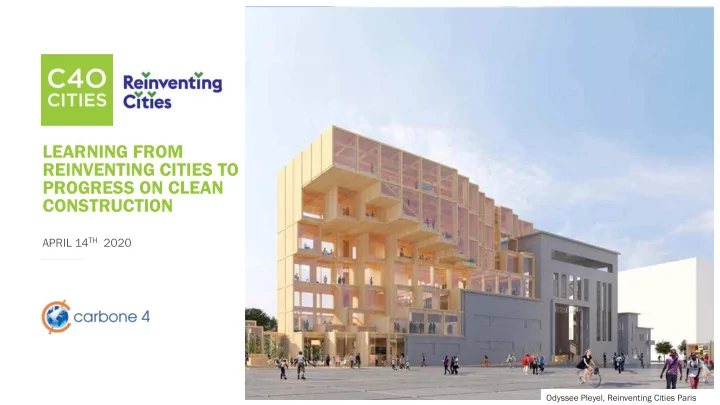
Odyssee Pleyel, Reinventing Cities Paris
slide-2
SLIDE 2

2

Agenda

LEARNING FROM REINVENTING CITIES TO PROGRESS ON CLEAN CONSTRUCTION

1. C40’S WHOLE LIFE APPROACH TO DECARBONIZE OUR BUILT ENVIRONMENT

Helene Chartier – Reinventing Cities Cécile Faraud – Clean Construction programme

2. LEARNING FROM REINVENTING CITIES TO PROGRESS ON CLEAN CONSTRUCTION

Christina Stuart - Carbone 4

3. Q&A AND DISCUSSION APRIL 14TH 2020

slide-3
SLIDE 3

3

Time for change in the Built Environment

à Carbo bon n neutral bu buildings m must be become t the n norm i if w f we w want t to a avoid c climate br breakdown Cit Citie ies account for ov

  • ver 70

70% of

  • f gl

global CO CO2 em emissions Bu Buil ildings ings accounts for

  • v
  • ver

50 50%

  • f
  • f

total ci city em emissions Half a million people die each year due to ou

  • utdoor

door air air po pollution caused by energy used in buildings By By 2050 2050 an an ad addit itio ional nal 2.5 bi billion pe peopl ple wi will li live in in ci cities. Need to build a ci city th the si size of

  • f St

Stockholm pe per we week unt until il 2050 2050

slide-4
SLIDE 4

4

C40’s Holistic approach of urban development

ü Whole l

life a approach

ü Net Z

Zero B Buildings

ü Clean C

Construction

ü Resilience &

& a adaptation

ü Su

Sustainabl ble l lifestyles

ü So

Social be benefits & & i inclusion

Tomorrow Montréal, Reinventing Cities Montreal

slide-5
SLIDE 5

5

Reinventing Cities

Re Reinventing Cit Citie ies em embraces es th this ho holistic ap approach ach In conjunction with C40’s main role to support Cities developing their Climate policies, Reinventing Cities competition aims to

ü Accelerate i

implementation

ü Mobi

bilize t the In Industry

ü Develop l

lighthouse p projects t to s serve a as a a m model & & inspire f for w wider c change

L’Innesto, Reinventing Cities Milan

slide-6
SLIDE 6

6

Cities

Identify underutilized sites, ready for redevelopment

C40

Organizes Reinventing Cities

Private Teams

  • f architects, developers,

project holders… submit creative proposals to redevelop the site

How does it work?

Carbon neutral projects & Innovative solutions for Climate

slide-7
SLIDE 7

7

A great tool to mobilize the Industry

  • 1.200+ firms joined the the 1st competition
  • 400+ press articles about Reinventing Cities
  • 1 Million hashtag impressions on social media
  • 300,000+ visitors on the website

And now, the 2nd edition, launched in December 2019

  • 25 new sites in 9 cities
  • and more to come!
slide-8
SLIDE 8

8

Initiate systemic change

Se Set ne new na natio iona nal s stand ndards § 1st

st zer

ero c carbon s n socia ial h hous using ing of Italy § larges est w wood b buil uilding ing of Iceland § 1st

st zer

ero c carbon neig n neighbour urhood of Paris § larges est ur urban s n solar f farm of Texas So Solut utio ions ns t that a are b e being eing r rep eplic icated ed § up upcy cycl cling ng buil uilding ing m mater eria ials from nearby demolition site in Oslo § modul ular t tec echno nology f for p passiv ive h e hous use e building in Chicago § cons nstruc uctio ion m n machine eng ine engines ines powered by electricity in Reykjavik Su Suppor pport chang nge o e of procur urem ement ent’s ’s r rul ules es & p & polic icies ies

MKNO, Reinventing Cities Paris

slide-9
SLIDE 9

9 Campus for living Cities, Reinventing Cities Madrid

§ Low-carbon materials : timber construction, local bio-sourced materials (mudbricks, hemp), upcycling materials § Sustainable Design: Passive House standards, reversible buildings, co-living spaces § Energy : on-site production of clean energy and sharing of surplus with the neighborhoods

New models of building and living

Te Kopua, Reinventing Cities Auckland Sunnyside Energy, Reinventing Cities Houston

slide-10
SLIDE 10

10

§ Sustainable lifestyle: zero-waste stores and restaurants, incubators for green start-ups, Circular Economy Lab, § Low carbon Mobility: Car-free sites, garages and services for bikes, EV implementation and car- & bike-pooling § Green Spaces : urban forests & agriculture including greenhouses, orchards, vineyard, aquaponic farm, beehives § Inclusion & social benefits: Zero carbon social housing, reactivation of a disused market in low income neighborhood, services for elderly and people with disabilities

Vitae, Reinventing Cities Milan Urban Village, Reinventing Cities Oslo

New models of building and living

Sunnyside Energy, Reinventing Cities Houston

slide-11
SLIDE 11

CLEAN CONSTRUCTION PROGRAMME

slide-12
SLIDE 12

12

Why does construction matter?

Co Constr tructi tion contributes mo more th than 23 23% of

  • f gl

global GH GHG em emis issio ions ns (Huang et al., 2017) By 2025 we will need to build 1 bi billion ne new ho

  • homes. Globally,

60 60% of

  • f bu

buildings th that wi will ex exist in in 2050 2050 ar are ye yet to to be be bu built. This is equivalent to constructing a ci city th the si size of

  • f

St Stoc

  • ckhol
  • lm or
  • r Mi

Milan (1.5 mi million pe peopl

  • ple) pe

per we week until 2050; a city the size of Sin Singapor pore or

  • r Ne

New Yo York ev every mo month unt until 2050 2050. Construction materials and the building sector are responsible for more than 30 30%

  • f
  • f

gl global re resource co cons nsum umption. Construction sites cause si significant ai air an and no noise pol pollution ion, linked to construction activities, the use

  • f

diesel machinery, lorry movements, and traffic congestion.

Winds stirring up construction site dust in Beijing Beijing Daxing International Airport construction

slide-13
SLIDE 13

13

Cement, concrete and steel impact

The cem cement ent in industry accounts for 8% of

  • f th

the world’s ’s em emis issio ions ns, and for 90% of the concrete industry emissions

“After water, concrete is the most widely used substance on Earth” The Guardian

The steel industry is responsible for at least 7% of

  • f

gl global em emis issio ions ns, and global consumption is ex expected to to do double by by 2050 2050

slide-14
SLIDE 14

14

C40 consumption-based emissions work

slide-15
SLIDE 15

15

Clean Construction Forum - scope

Embodied E Emissions 20 to 50% of a building whole-life emissions

Cl Clean Co Constr tructi tion is about tackling the invisible emissions of buildings and infrastructure during their whole life “Embodied carbon is the sum impact of all the greenhouse gas emissions attributed to the materials throughout their life cycle (extracting from the ground, manufacturing, construction, maintenance and end of life/disposal).”

Carbon Leadership Forum at the University of Washington

slide-16
SLIDE 16

16

Whole Life Approach to the Built Environment

LEARNING FROM REINVENTING CITIES TO PROGRESS ON CLEAN CONSTRUCTION

AIR QUALITY IMPROVEMENT INCREASED GREENSPACE REDUCTION IN WASTE CLOSED MATERIAL LOOPS INCREASED ENERGY EFFICIENCY LOW IMPACT MATERIALS RENEWABLE PRODUCTION ON SITE

slide-17
SLIDE 17

17

Clean Construction Forum - focus areas

ü Construction materials ü Construction sites ü Foster city to city learning ü Foster city-Industry dialogue

slide-18
SLIDE 18

18

Clean Construction programme objectives

ü Build the case for a systemic whole-life approach to buildings and infrastructure, by scoping city challenges and policies ü Support policy change and other incentivising actions, as well as providing opportunities for demonstration/implementation projects ü Aggregate demand-side and send strong signal to the market

slide-19
SLIDE 19

19

Agenda

LEARNING FROM REINVENTING CITIES TO PROGRESS ON CLEAN CONSTRUCTION

2. . LEARNIN ING F FROM R REIN INVENTIN ING C CIT ITIE IES T S TO P PROGRESS O SS ON C CLEAN CONSTRUCTIO ION

Chri rist stina S Stuart - Carb rbone 4 4

APRIL 14TH 2020

slide-20
SLIDE 20

20

Multi-sector expertise:

Carbone 4 is a leading consulting firm specialized in climate change mitigation and adaptation strategies

Carbone 4: who are we ?

MEDIA & SERVICES INDUSTRY PUBLIC SECTOR TRANSPORT FINANCE ENERGY BUILDINGS

About us:

50

climate experts

1 300

projects worldwide

40+

countries where we have worked

12

years old!

500+

clients

slide-21
SLIDE 21

21

Carbone 4: what do we do ?

Define Paris Agreement objectives Reduce emissions Increase carbon sinks REACH C H CAR ARBON N NEUTRAL ALIY IY BECOME R RESIL ILIE IENT Evaluate the physical climate risks along the value chain Assess transition risks Define and promote low-carbon products & services Measure your carbon footprint Anticipate sector specific changes

slide-22
SLIDE 22

22

Carbone 4: our role in Reinventing Cities ?

Carbone 4’s role was to conduct the environmental assessment of each project regarding the 10 Challenges Carbon Impact Resilience & sustainability Inclusion & Social benefits

1. Energy efficiency and low-carbon energy (mandatory) 2. Life Cycle Assessment & sustainable materials management (mandatory) 3. Low carbon mobility 4. Resilience & adaptation 5. Ecological services & green jobs 6. Sustainable water management 7. Sustainable waste management 8. Biodiversity, urban revegetation & agriculture 9. Inclusive actions, social benefits and community engagement

  • 10. Urban design & quality architecture
slide-23
SLIDE 23

23

Carbone 4: our role in Reinventing Cities ?

Carbone 4’s role was to conduct the environmental assessment of each project across 3 criteria:

Ambition level of the challenge objective Coherence between the solutions and the objective Use of rigorous methodologies and sources

1 2 3

slide-24
SLIDE 24

24

Carbone 4: our analysis

Carbone 4 looked at the compatibility of each project with the COP21 2015 Paris Agreement

slide-25
SLIDE 25

25

Carbone 4: our analysis

Carbone 4 looked at the compatibility of each project and the goal of “carbon neutrality”

slide-26
SLIDE 26

26

Carbone 4: our analysis

According to the Net Zero Initiative, a building can contribute to carbon neutrality if it follows three criteria :

1 2 3

Reduce emissions within your building scope Help reduce emissions outside of the building scope Develop carbon sinks within and outside your scope

slide-27
SLIDE 27

27

Carbone 4: our analysis

According to the Net Zero Initiative, a building can contribute to carbon neutrality if it follows three criteria :

Reduce emissions within your building scope Help reduce emissions outside of the building scope Develop carbon sinks within and outside your scope

1 2 3

slide-28
SLIDE 28

28

Carbone 4: our analysis

Reduce emissions within your building scope

1

Operational GHG emissions : energy Embodied GHG emissions : Construction materials

slide-29
SLIDE 29

29

Carbone 4: our analysis

Reduce emissions within your building scope

1

slide-30
SLIDE 30

30

Carbone 4: our analysis

Reduce emissions within your building scope : e.g. France

1

Materials = -80% by 2050 Energy =

  • 75%

by 2050

SNBC = Carbon neutral by 2050

546 MtCO2e 85 MtCO2e 2015 2050

slide-31
SLIDE 31

31

Carbone 4: our analysis

Reduce emissions within your building scope

1

  • Local solar panels for energy generation
  • Local and sustainable construction

materials : timber, stone, mudbricks and hemp

  • 100% reversible Buildings

The Collective For Climate Site: Porte de Montreuil, Paris

slide-32
SLIDE 32

32

Carbone 4: our analysis

Reduce emissions within your building scope

1

  • 90% emissions reduction by

upcycling local building components Recipe for Future Living Site : Fossumdumpa, Oslo

slide-33
SLIDE 33

33

Carbone 4: our analysis

Reduce emissions within your building scope

1

  • 95% of the building

components designed to be reused at the building’s end-of-life Tercer Sonido Site : Villaverde, Madrid

slide-34
SLIDE 34

34

Carbone 4: our analysis

Reduce emissions within your building scope

1

  • Construction machine

engines are to be powered by electricity instead of diesel

  • Structure 100% in timber

Lifandi Landslag Site : Ártún, Reykjavík

slide-35
SLIDE 35

35

Carbone 4: our analysis

37 2211 938

Wood Steel Recycled steel

Note: Different amount of each type of material are required for the same purpose. Steel for example has a very high kgCO2e/ton value, yet it is very strong so in most cases you need less of it than other materials. 866

Cement

Source: ADEME Carbon Base

Some example carbon footprints in kgCO2e per ton of material:

slide-36
SLIDE 36

36

Carbone 4: our analysis

According to the Net Zero Initiative, a building can contribute to carbon neutrality if it follows three criteria :

Reduce emissions within your building scope Help reduce emissions outside of the building scope Develop carbon sinks within and outside your scope

1 2 3

slide-37
SLIDE 37

37

Carbone 4: our analysis

Help reduce emissions outside of the building scope

2

Offer low-carbon services and activities to occupants : mobility, food…

slide-38
SLIDE 38

38

Carbone 4: our analysis

Help reduce emissions outside of the building scope

  • No parking for fossil-fuel

cars, but electric vehicles charging stations and partnerships with local car- sharing and transit

  • rganizations

Kelsey Civic Center San Francisco, Milan

2

slide-39
SLIDE 39

39

Carbone 4: our analysis

  • Include a low-carbon district heat

network that will benefit to the entire neighborhood L’Innesto Scalo Greco, Milan Help reduce emissions outside of the building scope

2

slide-40
SLIDE 40

40

Carbone 4: our analysis

According to the Net Zero Initiative, a building can contribute to carbon neutrality if it follows three criteria :

Reduce emissions within your building scope Help reduce emissions outside of the building scope Develop carbon sinks within and outside your scope

1 2 3

slide-41
SLIDE 41

41

Carbone 4: our analysis

Develop carbon sinks within and outside your scope

3

Develop carbon sinks : finance forests, CCS technology, use wood or bio- sourced products

slide-42
SLIDE 42

42

Carbone 4: our analysis

Develop carbon sinks within and outside your scope

  • An on-site urban forest and a 75%

increase in the vegetation cover of the site

  • 423,200kg of on-site food production

& 80 new jobs dedicated to the food production & food waste recovery Tomorrow Montreal Site : Montréal, Canada

3

slide-43
SLIDE 43

43

Carbone 4: our takeaways

Over 65% of winners strived for carbon neutrality Winners included embodied emission solutions :

  • Construction materials: 50% of the

winners used wood, 50% used recycled/upcycled

  • Construction material origin: local,

low-carbon freight Big focus on incubators and green services that foster sustainable lifestyles

* * * * *

Carbon accounting methodologies were diverse and not always well understood.

  • All 3 carbon accounts should remain

separate : induced, avoided and negative.

  • The perimeter of a carbon footprint

has to be well defined : Building scope ≠ neighborhood scope Carbon neutrality was not always well understood : a net zero building includes both embodied and operational carbon. Areas of improvement Achievements

slide-44
SLIDE 44

44

Q&A

slide-45
SLIDE 45

45