Clean Cities / 1
Chuck Feinberg, Executive Vice President, Greener by Design Chairman - - PowerPoint PPT Presentation
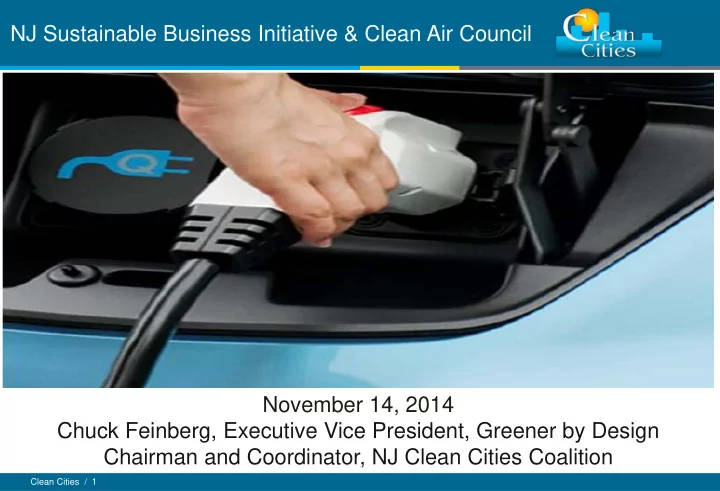
NJ Sustainable Business Initiative & Clean Air Council November 14, 2014 Chuck Feinberg, Executive Vice President, Greener by Design Chairman and Coordinator, NJ Clean Cities Coalition Clean Cities / 1 NJ Clean Cities Coalition The New
Clean Cities / 2
The New Jersey Clean Cities Coalition is a NJ registered IRS 501(c)3 non-profit corporation, and is formally designated by the US Dept of Energy as a Clean Cities Coalition. We are the only state-wide entity dedicated to the establishment of Public/Private Partnerships for the reduction of petroleum in transportation, and the advancement of alternative transportation fuels and advanced vehicle technologies. NJ Clean Cities Coalition
Clean Cities / 3
Local Coalition Support & Partnership Development:
A nation-wide backbone of direct support for Clean Cities coalitions & community leaders, strategic planning assistance
Consumer Information, Outreach, and Education: Fuel
Economy Guide, Alternative Fuel and Advance Vehicles Data Center, and other web based tools, publications, workshops.
Technical & Problem Solving Assistance: Access to National
Labs to address Market Barriers, Safety Issues, Technology shortfalls
Financial Assistance: Funding to Facilitate Infrastructure Development
and Vehicle Deployment projects (Competitive Awards)
Clean Cities - A voluntary, locally-based government/industry partnership DOE CC Mission: To advance the energy, economic, and environmental security
- f the U.S. by supporting local decisions to adopt practices that contribute to the
reduction of petroleum use in the transportation sector.
Clean Cities / 4
- DOE designation in 1997, as a BPU program
- Incorporated as a NJ Non-Profit and IRS 501(c)3
tax exempt entity in 2009
- Stakeholders represent the spectrum of public
and private interests
- Activities funded by:
- Member dues (various levels)
- Sponsorships
- grants & contracts
- Secured more than $18 million in grants for
stakeholders in the past 5 years
- Outreach to more than 3000 through: LinkedIn
Group, Facebook, Twitter, e-newsletter, www.njcleancities.org
- “Re-designation” due in 2015
New Jersey Clean Cities Coalition
Platinum & Gold members 2014
Clean Cities / 5
Clean Cities Portfolio of Technologies
Eliminate Alternative Fuels Electric Vehicles Biodiesel Ethanol Hydrogen Propane Natural Gas Fuel Economy More Fuel efficient vehicles, adopting smarter driving and vehicle purchasing habits Hybrids Light- and heavy-duty Electric hybrids Plug-In hybrids Hydraulic hybrids Idle Reduction Heavy-Duty Trucks School & Transit Buses Light-Duty Vehicles
Post Sandy Theme = FUEL DIVERSIFICATION!
Clean Cities / 6
Not just about Alternative Fuels - Idle Reduction Is the Low-Hanging Fruit of Fuel Economy
Clean Cities / 7
NJCCC Public/Private Partnership Projects
- DOE Clean Cities Program Support
- EPA Diesel Emission Reduction Program
- Marine Vessel Engine Replacements
- CNG Fleet & Infrastructure Program
- Regional Electric Vehicle Network
Planning, with NYSERDA/TCI
Clean Cities / 8
NJ CNG Vehicle & Infrastructure Project
- NJCCC led a public/private team to implement the first statewide
deployment of AFVs and infrastructure in NJ.
- Effectively leveraged federal investment of $15mil with an
additional $34 mil of non-federal for $49mil total project cost.
- Transitioned 305 highly visible vehicles to CNG from 15 fleets
statewide (trash collection trucks and shuttle buses). Installed 6 CNG fueling stations.
- “Stimulated” the market for all alternative fuels by providing
- utreach & education to fleets, regulators and the public.
- Base program displaces more than 2,000,000 gallons of
petroleum and avoids more than 900,000 pounds of identified criteria pollutants and greenhouse gas emissions per year.
Clean Cities / 9
Vessel Engine Replacements
- NJCCC is leading a public/private team to repower
unregulated engines in vessels operating in NY Harbor & Vicinity with new Tier 2 and Tier 3 compliant engines.
- Many of the existing engines date back to the 1970’s, with no
emission controls.
- EPA-assisted project provides significant emission benefits,
petroleum reduction through increased efficiency, and public
- education. A 3rd round of funding for more vessels is pending.
Clean Cities / 10
CC Program Support Contract
This is the “bread & butter” of the CC Program Major tasks:
- Stakeholder education and outreach
- Annual Report of Petroleum Displacement
- Quarterly Alternative Fuel Price Reports
- Maintain data for Alternative Fuel Station Locator
Clean Cities / 11
Annual Report of the Impact of NJCCC- Stakeholder Activities
Clean Cities / 12
Clean Cities Quarterly Price Report
We need your help in collecting and maintaining price and station accurate data!
Clean Cities / 13
AFDC Alternative Fueling Station Locator
Clean Cities / 14
AFDC Station Locator – NJ Stations
Public Private
CNG 8 16 LNG Electric – Level 2 and DC Fast 103 38 Propane Autogas 9 Hydrogen Biodiesel (B20+) 1 4 Ethanol (E85) 3 2
We need your help in assuring and maintaining the accuracy of this data!
Clean Cities / 15
- USDOE Mid-Atlantic Region’s nominee for “Coalition of the Year”
- NGV America, Industry Advocate Award for advancement of
Natural Gas Vehicles and Infrastructure
- Northeast Diesel Collaborative’s “Breathe Easy” award in
recognition of contributions to reduction of diesel emissions
- Bayshore Recycling Corporation’s “Environmental Hero” award
- US Green Building Council-NJ “Emerald Award” for outstanding
achievement and best practices in promoting sustainability
- Appointed by Governor Christie to NJ DCA’s Propane Safety &
Education Commission
Industry/Peer Recognition
Clean Cities / 16
Source: Argonne National Laboratory for US Department of Energy, revised August 2014
U.S. PEV Sales Rising
- With more than 260,000 sold, EVs
are being adopted roughly 3 times as fast as hybrid vehicles during their first three years on the market.
- The market is evolving quickly as
more automakers embrace the technology.
- Zero PEV models were available
three years ago, and more than 22 models are available today from 14 different brands.
Clean Cities / 17
Total Industry Sales of PEVs currently 266,000 – 40% of total is in CA
As of: End of Sept 2014
Clean Cities / 18
Source: www.chevrolet.com/volt-electric-car.html running ticker on Feb 09, 2014
Chevrolet Volt Impact
- Total Miles Driven = 1 billion miles
- EV Miles Driven = 634 million miles
- Fuel Saved = 33 million gallons
Clean Cities / 19 19
NJ Has A History of Leadership with EVs
Circa 1914, Mrs. Edison’s Electric Vehicle and Home Charging Station
Clean Cities / 20
More Recent NJ State Efforts Zero Emission Vehicle Sales Tax Exemption Streamlined Permitting for Home Charging Station (NJDCA/NJDEP/NJCCC) EVs on State Vehicle Purchasing Contract Sustainable Jersey grants and Action Items Planning Efforts: NJ is a member of the Transportation and Climate Initiative. Under a Clean Cities grant, TCI developed: Recharging Design & Siting Guidance Model Codes, Permits, & Ordinances Stakeholder engagement, education & outreach
Clean Cities / 21
Plenty of Interest in NJ!
October 2014
Clean Cities / 22
Consumer demand is the key barrier to market growth
- Overcoming this barrier requires major education and awareness efforts
- At all levels - from personal and local, to state, regional, and national.
- Direct experience with these vehicle technologies (“butts-in-seats”) is the
surest path to growing awareness and adoption.
- Consumers need to sense a compelling value proposition
- Early Adopters vs. Traditional buyers (i.e. what’s in it for me?)
- Clear advantages and messaging
Charging infrastructure can be a key enabler
- Consumers must feel that the fueling infrastructure is more than adequate to meet
their daily/routine driving needs.
- Hype is all about public and fast charging, but:
- Home charging provides the critical backbone of all EV charging.
- Workplace charging - the single-most valuable solution - directly engages
corporations, executives, employees, and fleet managers, which in turn directly impacts market awareness and growth.
EV Barriers and Opportunities
Clean Cities / 23
- Workplace charging fills a key role in PEV charging – it
demonstrates the largest infrastructure gap, it is also provides the greatest opportunity
- Cars are parked for long periods of time
- Workplace charging can benefit both employers and
employees
- Many PEV drivers will require workplace or public charging to
increase electric-miles on their daily commute.
- Workplace charging may be the only option for individuals who
live in multi-unit or urban dwellings where they may lack access to home charging. Workplace Charging
Clean Cities / 24
Workplace = Prime Charging Opportunity
6.5-8+ hours 47 min- 2 hours 28-48 min 15-53 min
Workplace Shopping Centers Leisure Destination Travel Stops Day in the life of an average car
Clean Cities / 25
Residential and workplace charging provide the vast majority of all charging.
Home vs. Work vs. Public Charging
Study Period 1/1/2012 – 12/31/2013
When workplace charging is available to an EV driver: Volts:
- 57% of charging events are at home
- 39% at work
- 4% at other locations (e.g. public)
Leafs
- 65% of charging events are at home
- 32% at work
- 3% at other locations (e.g. public)
Source: John Smart, INL, EV Project; http://avt.inel.gov/librarybydate.shtml
65% 32% 3% 57% 39% 4%
Volt data Leaf data
Clean Cities / 26
Workplace Charging is Valuable to Employees
Potential PEV Drivers
- Increased PEV
awareness and education
Current PEV Drivers
- Increased range confidence
- Increased electric vehicle
miles traveled
Peer Effect
Clean Cities / 27
Workplace Charging Value Proposition
Incentivizes Employees Complements Sustainability Efforts Signals Corporate Leadership
Clean Cities / 28
How to…
Clean Cities / 29
EV Everywhere and DOE Workplace Challenge
- The national EV Everywhere Grand Challenge aims to make American-made
PEVs that are as affordable and convenient as today’s gasoline-powered vehicles.
- Efforts in support of EV Everywhere consist of:
– A technology push of research and development to reduce the cost of PEVs – Charging infrastructure development to enable the convenience of fueling PEVs – PEV education to help consumer acceptance of PEVs
- The Workplace Charging Challenge seeks to grow the non-residential PEV
charging infrastructure and increase consumer awareness by supporting employers in their efforts to establish workplace charging programs.
- The goal is to achieve a tenfold increase in the number of employers offering
workplace charging by 2018.
Clean Cities / 30
Employers who sign the Workplace Charging Pledge will:
- Commit to assessing employee charging demand and
developing a plan to install charging stations.
- Take action by implementing a plan to install charging stations
for employees.
- Share progress on achieving plan milestones over time, as
well as best practices. In support of employers who undertake the Pledge, DOE will: provide technical assistance, informational resources, an information-sharing forum; will recognize employers and will disseminate best practices.
DOE Workplace Charging Pledge
Clean Cities / 31
Participants in Workplace Charging Challenge
Clean Cities / 32
Key Takeaways
- All of the major auto makers in the world are either selling or
leasing PEV’s right now in NJ.
- Electricity is a clean, domestic fuel and is a less expensive way
to operate a vehicle over conventional fossil fuels.
- Costs of EV’s are coming down.
- EV’s are reliable, easy to operate, and fun to drive!
- The majority of EV charging will occur at home, however the
workplace represents a prime opportunity.
Clean Cities / 33
Post-Sandy, Transportation Fuels in Limited Availability
- Limited Gasoline and
diesel supplies
– Some reported no power to run station – Some had no fuel due to disruptions to supply chain
- Gasoline rationing
instituted
- 21% of stations still
had no fuel 11 days after the storm
Clean Cities / 34
Importance of alternative fuel vehicles
- Sandy recovery efforts showed the value of alternative fuel
vehicles/advanced technology vehicles
– Able to provide critical services when conventional fuel supplies were interrupted – Alternative fuel supplies remained available post-storm – Points to need for FUEL DIVERSIFICATION
- An inventory of these resources is needed so they can be
integrated into contingency planning efforts and energy assurance planning.
- Clean Cities Coalitions
– Informed about local alternative fuel landscape – Connected to key stakeholders
Clean Cities / 35
No gas? – No problem!
Note the license plate! (EF-OPEC)
Clean Cities / 36
Loading Relief Supplies via Propane Hummer
Clean Cities / 37
“Natural Gas Minibuses Help NJ Recover From Hurricane Sandy” PBS show highlights the Atlantic City Jitneys that run on compressed natural gas and were able to assist with evacuation and relief efforts prior to and after Hurricane Sandy Clean Cities TV – YouTube Alternative Fuels Data Center Case Studies http://www.afdc.energy.gov/case/1323
Clean Cities / 38
- Encourage public and private entities to lead by example
– Bid preferences for contractors that use alternative fuel vehicles, further preference for those that make fueling available to the public – Transition your own fleets to use alternative fuels – Leverage private capital by encouraging Public/Private Partnerships to build alternative fuel infrastructure.
- Respond to Clean Cities data requests
– New station openings – Quarterly price reports – Annual reports of petroleum reduction
- Support your local Clean Cities Coalition (financially &
- therwise)!!
We Need Your Help
Clean Cities / 39